

Gold Investment India: Physical, ETFs, or Sovereign Gold Bonds for Tax, Liquidity, and Goals
Gold investment India starts with a simple truth: gold has always been more than a metal for Indian households. You can physically hold gold in your hand or store it in your demat account, representing memory, security, and a quiet store of value. In portfolio terms, gold is an investment that can help with diversification, act as a partial hedge when inflation bites, and provide ballast when other assets wobble. Yet the way you hold gold matters as much as the decision to own it. The same investment can feel completely unique depending on whether you pick physical gold, a gold ETF, or a sovereign gold bond.
This guide gives you a clean, practical path to decide. You will gain an understanding of a straightforward decision-making framework, the functioning of costs and taxes, the benefits and drawbacks of liquidity, and the precise procedures for purchasing each option in India. You will also see how to blend vehicles into a single, sensible gold plan that fits your goals. The goal is clarity without jargon, so you finish with one outcome: confidence about your next investment move.
Is gold a viable investment in 2025 for Indian investors?
Gold is not a magic ticket to riches. It does not produce cash flows like a business, and in strong equity markets, gold can lag for long stretches. Still, as part of a diversified portfolio, gold can play a useful role. Many investors keep a modest allocation so that a portion of their wealth remains less tied to company earnings cycles and domestic market swings. That slice can be a stress reliever during market shocks and a way to balance volatility without trying to time every turn.
For a typical Indian saver, a measured allocation to gold can make sense when you are clear on the purpose. If you want adornment or cultural use, physical gold meets that need. If you want efficient exposure and easy rebalancing, a gold ETF works. If your horizon is long and taxes matter, Sovereign Gold Bonds can be very attractive at maturity. The rest of this guide shows you how to align those choices with your investment plan.
Your choice map—which form of gold fits your goal?
Step 1: Define your use case
Decide why you want gold before you pick a vehicle. Do you want to use gold for adornment or gifting, which also serves as a valuable store of value? Is it trading exposure that you can add or reduce quickly? Or is it a long-term investment where tax efficiency and simplicity matter more than immediate liquidity? Once you name the use case, the right form of gold becomes obvious.
Step 2: Lock in tolerance
Ask yourself how long you can stay invested without needing to sell. If you can commit to roughly eight years and do not need to exit on a random date, Sovereign Gold Bonds can reward patience. A gold exchange-traded fund (ETF) is made for people who want daily liquidity and complete flexibility. If you want the comfort of something you can physically hold, coins or bars are the straightforward answer, but remember they trade with wider spreads.
Step 3: Tax bracket and paperwork
If you care about taxes at exit, Sovereign Gold Bonds offer a strong benefit at maturity for individuals. If you want a simple tax path with straightforward buys and sells, gold ETFs are convenient in a demat account. Physical gold can be sold too, but bills, purity checks, and price spreads complicate the experience. Put taxes, paperwork, and comfort with digital platforms on one page. Then choose the investment vehicle that matches your reality.
Step 4: Cost reality check
Costs change a lot over the years. Physical jewelry carries making charges and spreads that you rarely recover. Even coins and bars can have a buy-sell gap. Gold ETFs charge an expense ratio, and in addition to that, you must pay brokerage fees; furthermore, there may be a small tracking difference compared to the benchmark. Sovereign Gold Bonds avoid storage and making charges and come with a fixed coupon, but they have time commitments and specific exit windows. Seeing these side by side helps you pick a cost profile you can live with.
Step 5: Platform access
If you already use a broker and hold a demat, gold ETFs are just another ticker to buy and sell. If you prefer a bank or online portal for government securities, Sovereign Gold Bonds are simple to apply for during issue windows and can be held digitally or in demat form if you request it. If you favor a showroom purchase, choose BIS hallmarked physical gold and get a proper invoice. Use the platform you are comfortable with so that each investment action stays friction-free.
Option 1 – Physical Gold (coins, bars, jewellery)
What it is and how it is priced
Physical gold is the classic route. You buy coins, bars, or jewelry, and you can hold them outside the financial system. Your price reflects purity, local market rates, and, in the case of jewelry, design and making charges. Coins and bars offer tighter pricing than jewelry because they avoid craftsmanship markups. Jewelry serves a dual purpose as adornment and savings, but from a pure investment perspective, it is the least efficient due to extra charges.
Costs you pay
When you buy physical gold, costs show up at the counter and later when you sell. The purchase invoice includes GST on the gold price, and if make-up charges are billed separately for jewelry, that part carries its own GST. Sellers also quote a spread between the price you buy at and the price you can sell at. Over time, those costs will affect effective returns. A coin or bar with clear purity markings and a fair buy-sell spread is generally more efficient than heavy jewelry if the goal is an investment.
Pros
Physical gold is tangible. You can gift it, wear it, or keep it as a visible anchor of savings. There is no demat required, no online platform to learn, and no account statement to reconcile. For many Indian families, that simplicity is valuable. In periods of stress, holding something you can touch can feel more reassuring than a line item on a screen.
Cons
The trade-offs include storage risk, purity disputes, and higher spreads. Jewelry is especially expensive to buy and inefficient to convert back to cash. Security costs and the risk of loss exist no matter how careful you are. If you plan to rebalance your portfolio or do frequent transactions, physical gold is not the smoothest path.
Best for
Buyers who value tradition and tangibility. If your purpose is gifting or long-term keeping with occasional use, physical gold fits perfectly. Think about the other options first if your goal is investment efficiency.
Option 2 – Gold ETFs
What they are
Gold ETFs are exchange-traded funds that track domestic gold prices. You buy and sell units on the exchange through a demat and trading account. Each unit represents a small quantity of gold exposure, and the fund holds gold as backing. This type of investment is the easiest way for many investors to add or trim gold in a portfolio without handling the metal.
How returns can differ
The goal of a gold ETF is to mirror the movement of gold prices. In practice, a difference known as tracking error can occur. It comes from cash positions, expenses, and the mechanics of creating or redeeming units. The lower this difference, the more closely your ETF mirrors the benchmark. When you compare options, look for a consistent, reasonable record of staying close to the reference price.
All-in costs
You pay brokers when you buy or sell. The ETF also charges an expense ratio that is built into daily pricing. Over time, expense ratios and trading spreads add up. You can also see minor differences due to the way the fund handles cash flows and redemptions. As an investment, the cost is often lower than buying jewelry, and it can be competitive with coins or bars when you add convenience and liquidity.
Liquidity check
Because units trade on the exchange, you have daily liquidity. Even then, it is smart to check typical trading volumes and bid-ask spreads for the specific ETF you choose. Higher volumes and tighter spreads generally make for cleaner execution when you buy or sell.
Best for
Investors who want flexible allocation, the ability to set up periodic buys, and quick rebalancing. If you prefer to keep all your investments in your demat account and want to manage gold similarly to how you manage a stock or index fund, then a gold ETF is a convenient investment vehicle.
Option 3 – Sovereign Gold Bonds (SGBs)
Core features
Sovereign Gold Bonds are government-backed bonds that give you exposure to the price of gold without holding the metal. They have an eight-year maturity, with an early exit option available starting in the fifth year on specified dates. Issue and redemption prices are linked to published benchmarks for 999 purity gold. You can hold the bonds in either the RBI book entry form or in demat format if you request that option.
Interest and taxes
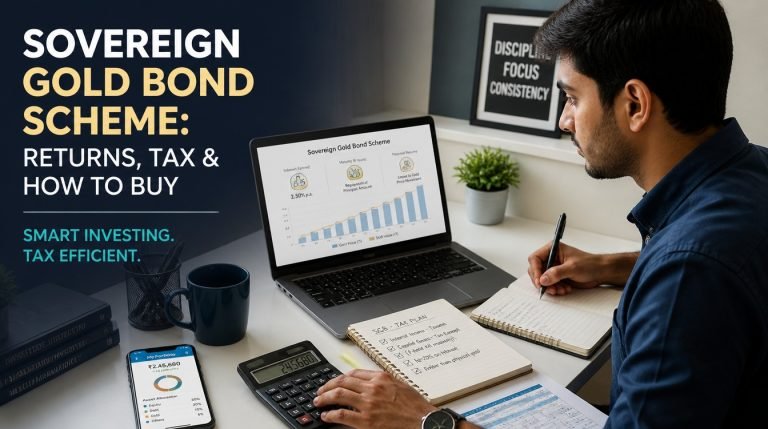
SGBs pay a fixed coupon of 2.5 percent per year for the initial subscription amount, credited semi-annually. The coupon is taxable as per your slab. The standout feature is that for individuals, capital gains at maturity are exempt. If you sell before maturity, different rules apply, including indexation benefits in some cases. By default, there is no tax deducted at the source of the coupon. The primary reason long-horizon buyers prefer SGBs as an investment is the combination of regular income and a tax advantage at maturity.
Limits and KYC
The minimum is one gram. The maximum is four kilograms per individual per financial year. You need standard KYC, including PAN. These limitations and the need for proper identification keep the program aligned with regulations while allowing widespread retail participation.
Who can buy
Residents are eligible to subscribe. If you buy as a resident and later change status, you can continue to hold the bonds, but proceeds have restrictions on repatriation. That detail matters if you expect life changes that involve moving abroad.
How to buy
You can subscribe through scheduled banks, designated postal offices, and recognized online portals during open tranches. If you apply digitally, you typically receive a small per-gram discount as an incentive for online applications. You can also buy on exchanges in the secondary market in demat form if units are available, though liquidity varies across series. Holding in RBI books or converting to demat are both possible. Choose the route you find simpler.
What recent outcomes look like
Older series that reached early redemption windows have seen strong absolute gains due to price appreciation, separate from the coupon stream. While this does not guarantee future outcomes, it demonstrates the benefits of patient holding in line with the program’s maturity feature. The main takeaway is that SGBs reward a long horizon and would not suit someone who needs to exit randomly or frequently.
Best for
Investors with a clear long-term plan who value tax efficiency at maturity and do not need day-to-day liquidity. If you can hold to the full term, SGBs are a strong flagship for your gold investment.
Taxes and costs—head to head
Physical gold
You pay GST on the gold value at purchase. If you bill jewelry-making charges separately, they will attract their own GST. The buy-sell spread lowers your take-home pay when you sell. Capital gains tax applies based on your holding period. From a pure investment standpoint, the upfront and hidden costs make the above option the least efficient of the three choices, though it is the only one that delivers adornment value.
Gold ETFs
You do not pay GST when you buy fund units. Your main costs are brokerage, the fund’s expense ratio, and small trading spreads. Capital gains tax applies when you sell units, and the realized outcome reflects the tracking quality over your holding period. For an investor who wants smooth execution, this route is typically more efficient than jewelry and often closer to coins or bars once you factor in storage and conversion hassles.
SGBs
You receive a fixed coupon of 2.5 percent per taxable year. For individuals, capital gains at maturity are exempt. Exits have different windows and rules prior to maturity. There are no making charges or storage costs. The main cost is time. You commit to a program that favors holding patients. For many long-term investors in higher tax brackets, that is an investment they are pleased to make.
Comparison table: costs, taxes, and liquidity at a glance
| Vehicle | Entry cost profile | Ongoing costs | Exit taxes on gains | Liquidity and lock-in |
|---|---|---|---|---|
| Physical gold | GST on purchase and spreads built into pricing | Storage and insurance if you use them | Capital gains rules apply by holding period | Liquidity depends on local buyers and spreads; there is no program lock-in. |
| Gold ETF | Brokerage and bid-ask spread at trade | Expense ratio within the fund | Capital gains rules apply on sale of units | Daily exchange liquidity with demat |
| Sovereign Gold Bond | No making charges; apply during tranches or buy in secondary | None on storage; receives 2.5 percent coupon taxed per slab | For individuals, gains are exempt at maturity; pre-exits have different rules | Eight-year maturity with early exit windows from year five; secondary sale depends on series liquidity |
Caption: This table shows how each vehicle balances entry costs, ongoing drag, exit taxes, and liquidity so you can match the structure to your investment goal.
Performance context (keep it balanced)
During times of stress and currency weakness, gold can perform well, but it may stagnate or decline when risk assets increase. That is expected. The point of owning some gold is not to win every period but to smooth the total journey of your savings. Investors who stuck with Sovereign Gold Bonds to their early redemption windows saw strong absolute returns driven by price appreciation, on top of the fixed coupon. ETF investors enjoyed liquidity and the ability to rebalance quickly when allocations drifted. Physical holders were comforted by something real, though spreads and making charges dampened effective returns. These examples underline a simple idea. Pick one role for gold in your portfolio and let it do that job, rather than chasing every short-term move.
Exactly how to buy—step by step
SGB primary subscription
Watch for open issue windows announced in advance. Use your bank’s net banking or an eligible online portal to apply. Keep PAN and KYC ready. Digital applications typically receive a small per-gram discount. Choose the quantity in grams, confirm the payment method, and select whether to hold an RBI book entry or a demat. After allotment, keep the acknowledgement safe. Mark the semi-annual coupon dates and the early redemption windows starting in the fifth year so you can plan ahead without guesswork.
SGB secondary purchase
If you missed a tranche or want a specific series, you can buy SGBs on exchanges through your demat. Check the quoted price against reference gold prices, and be aware of accrued interest and the time left to maturity. Liquidity varies by series. If you plan to hold to maturity, you may be comfortable with a less liquid series as long as pricing is sensible.
Gold ETF
Open a demat and trading account if you do not have one. Shortlist funds and look at expense ratios, historical tracking quality, and typical trading spreads. When you place an order, consider using limit orders for clean execution. Make periodic purchases to ensure regular allocation. Place measured sales to return the weight of your portfolio to the desired level for rebalancing. Keep a simple record of purchase dates, quantities, and reasons so your investment stays intentional.
Physical gold
Prefer BIS hallmarked products with clear purity markings. Ask for an itemized bill that shows the gold value, making charges if any, and applicable taxes. Compare spreads and make charges across sellers. If you buy jewelry for occasional use, keep designs classic rather than ornate so that resale deductions are less painful if you ever need to convert cash back. Store safely and review insurance if the holding is significant.
Strategy—build, manage, and rebalance your gold allocation
Set target weight
Decide on a sensible portfolio weight for gold that reflects your risk tolerance and goals. Many investors are comfortable with a modest slice. The key is to pick a number you can stick with through cycles. Write it down and treat it as a rule. That simple discipline protects you from herd moves and keeps the investment role of gold clear.
Choose vehicle mix
Blend vehicles to fit your style. One clean approach is to put your core allocation into SGBs for the tax benefit at maturity and use a gold ETF for tactical adjustments and rebalancing. If you want some physical exposure for tradition and gifting, keep it limited and price-sensitive. The idea is to let each vehicle do what it does best so the total portfolio works better than any single choice.
Rebalance rule
Rebalancing is a quiet superpower. Pick a simple rule. You can rebalance once a year on a fixed date or use thresholds. When gold rises far above your target weight, trim via the ETF. When it falls well below, add via the ETF. Leave SGBs untouched unless you have a clear reason to use an early exit window. This process keeps taxes and friction low while keeping your investment aligned with the plan.
Exit discipline
For SGBs, decide early whether you aim for full maturity or an early redemption window. Please set a reminder a few weeks before a window opens to allow for a calm evaluation. For ETFs, exit with intent, not emotion. Use limit orders when liquidity is thin and avoid rushing in low-volume moments. For physical gold, please ensure your documentation is prepared and consider reaching out to multiple buyers to obtain fair quotes if you ever need to sell. Keeping your discipline protects your investment from avoidable leaks.
Risks and pitfalls to avoid
Physical
Avoid buying without proper hallmarking or clear invoices. Be careful with designs that carry high making charges if your goal is investment. Store safely and keep purchase records. Understand spreads before you commit.
ETF
Watch for funds with thin trading and wide bid-ask spreads. While expense ratios matter, chasing the lowest headline number without checking tracking quality can backfire. Keep position sizes sensible relative to daily volumes so that you can exit without pressure.
SGB
This is a program for patient holders. If you are likely to need cash unpredictably, the lock-in and fixed exit windows can frustrate you. Remember that the coupon is taxable and plan accordingly. If you buy in the secondary market, check the time left to maturity and make sure the price reflects the remaining life of the bond.
FAQs
Which is better:SGB or Gold ETF for long-term Investment
If you can hold for the full term, Sovereign Gold Bonds offer the power of tax-exempt capital gains at maturity for individuals plus a fixed coupon. That combination is difficult to beat for a long horizon. If you want day-to-day flexibility, frequent rebalancing, or to build positions in small steps, a gold ETF shines. Many investors combine both. They put a core slice into SGBs and use an ETF for fine-tuning.
Is the SGB interest taxable
Yes. The 2.5 percent coupon is taxable as per your slab. There is no deduction at source by default, so plan for your advance tax or at least earmark part of the coupon for the eventual tax outgo. Treat the coupon as a small bonus rather than the reason to invest.
Can NRIs invest in SGBs
New subscriptions are for residents. If you buy as a resident and later become a non-resident, you can continue to hold the bonds. Proceeds are not repatriable. If you expect a change in status, decide with that detail in mind so your investment plan stays clean.
How is the SGB redemption price calculated
The program links redemption to a simple average of published 999 purity gold prices over a short window before redemption. This ties the payout to an objective reference rather than a dealer quote. It also means your maturity value reflects the broad market for fine gold at that time.
What is tracking error in a Gold ETF
A tracking error is a small difference between the return of your ETF and the return of the reference price of gold. It can arise due to expenses, cash holdings, and operational mechanics. Lower is better. When you compare funds, look for a steady pattern of staying close to the benchmark over time rather than isolated short-term wins.
What GST applies to Physical gold
Your invoice includes GST on the gold value. If you bill jewelry-making charges separately, each component bears its own GST. Keep itemized bills. That clarity helps with future purchases or exchanges and keeps your records complete.
Do I need a demat for SGBs
No. You can hold SGBs in the RBI book entry form. If you prefer, you can also hold them in a demat account by requesting that option. Either way, keep your acknowledgements and contact details updated so that coupon credits and redemption proceeds reach you smoothly.
Can I pledge SGBs for a loan
Yes, lenders may accept SGBs as collateral at loan-to-value ratios similar to gold loans. Policies vary across institutions. If you plan to use the bonds this way, check in advance so your investment can serve both as growth and as an emergency backstop.