

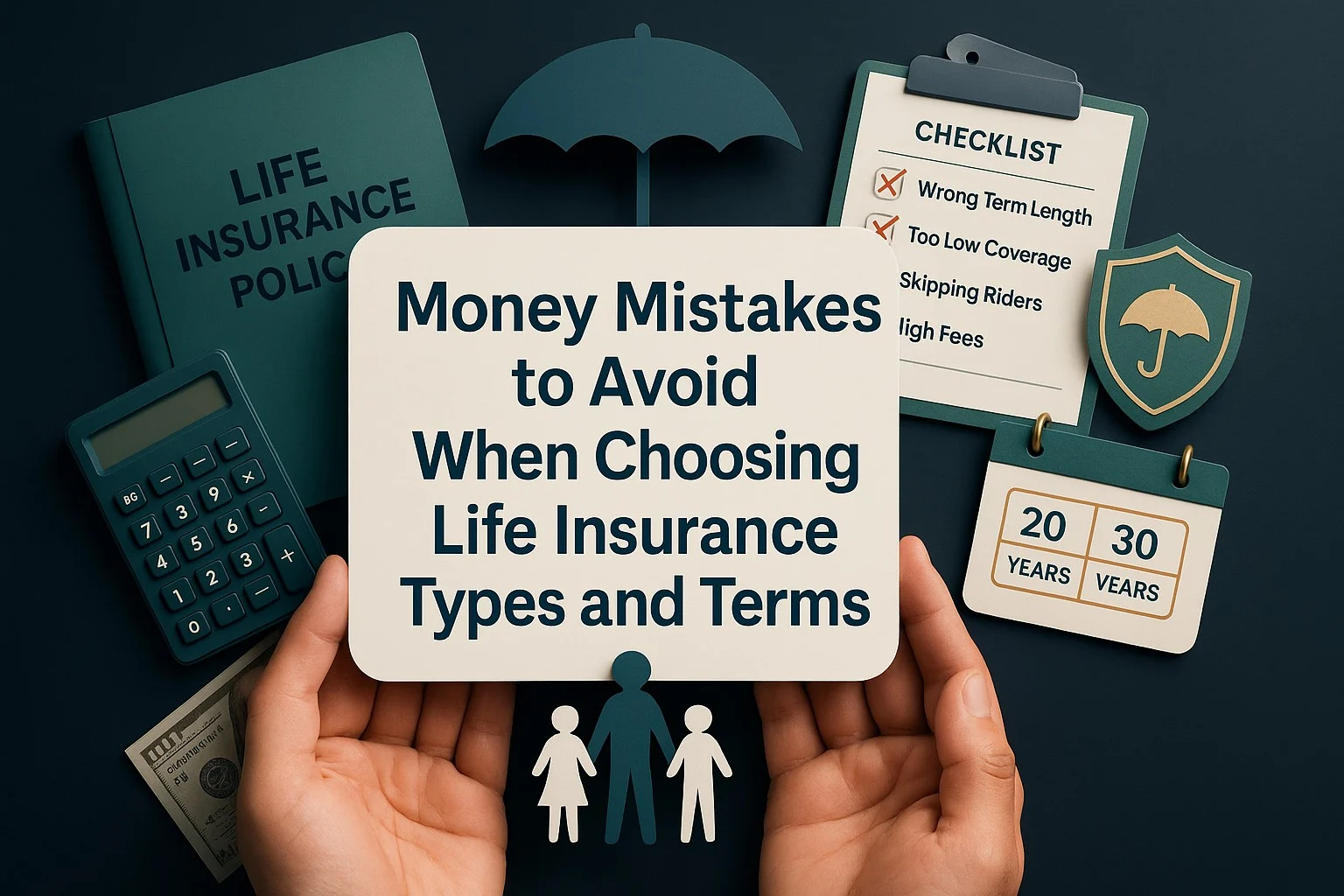
Life insurance mistakes are easy to make and costly to undo. Life insurance comes in two main flavours: term policies that last for a set number of years and permanent policies that can last a lifetime while building cash value. The question of which one fits you, how much coverage to buy, and how long the protection should last determines whether your family thrives or struggles after a loss. The simple truth is that most people repeat the same errors, from under-insuring to choosing an ill-matched policy type. In this guide, you will see every major mistake spelt out, along with step-by-step corrections. By the end of this guide, you will gain the ability to quickly identify financial mistakes, confidently run the numbers, and take actions that result in real savings.
What’s at Stake? Why Getting Type and Term Right Matters
Picking the wrong policy can drain your budget for decades or leave loved ones without the financial protection you meant to supply. A term life policy is often the most affordable way to handle debts that will vanish over time, like a 30‑year mortgage or a child’s future tuition. Permanent life insurance is costlier but may suit estate‑planning goals, lifelong dependents, or a need for cash‑value accumulation. When the coverage type fails to match the timeline of your obligations, you have set yourself up for one of the biggest money mistakes to avoid.
Consider a healthy 35‑year‑old nonsmoker. A 500,000-dollar, 20-year-term policy might cost about 25 dollars a month, while a whole-life policy for the same death benefit can easily top 400 dollars a month. Over two decades, that difference adds up to more than $90,000. If the family’s need is truly limited to the next 20 years, overpaying is a money mistake to avoid because those funds could be invested elsewhere.
Concerns extend beyond premiums. Underinsurance exposes survivors to uncovered debts and everyday expenses. Overinsurance locks you into premiums that crowd out retirement contributions. And if the term is too short, you face higher age‑bracket prices the next time you apply. Every mismatch between type, term, and needs adds to the financial mistakes you need to avoid on your journey to financial peace.
10 Life Insurance Mistakes to Avoid When Picking a Policy
The table below offers a quick snapshot of every key money mistake to avoid and the immediate strategy that fixes it.
| # | Mistake | Strategy Step |
|---|---|---|
| 1 | Buying too little coverage | Calculate needs at 10–12× income; include debts and future costs |
| 2 | Choosing the wrong type | Align term length or permanent status with financial timeline |
| 3 | Underestimating term length | Match policy end date to final obligation, such as mortgage payoff |
| 4 | Relying only on employer coverage | Treat group life as a supplement; own an individual policy |
| 5 | Delaying the purchase | Apply while young and healthy for lower lifetime premiums |
| 6 | Focusing solely on premium | Compare price, riders, guarantees, and company strength |
| 7 | Skipping the medical exam when healthy | Full underwriting often yields the lowest long‑term rate |
| 8 | Ignoring living‑benefit or waiver riders | Evaluate critical riders before rejecting them |
| 9 | Listing the wrong beneficiary or never updating | Review designations after every major life change |
| 10 | Forgetting regular policy reviews | Check policy every 3–5 years or after big milestones |
Caption: The table shows each common trap and its direct solution so you can act without guesswork.
#1 Buying too little coverage
Many families run a quick quote, see a large death benefit figure, and assume it is enough. This is the classic money mistake to avoid. To determine a realistic number, start with annual income replacement. Multiply earnings by ten to twelve, and add the full mortgage balance, any personal loans, projected college tuition, and final expenses. If the combined figure is not met by the policy, loved ones may resort to depleting savings or selling assets to meet their financial obligations.
Smart Fix: List all future obligations using a needs-based calculator or a simple spreadsheet. Build in an inflation rate of two to three percent. Choose the next death‑benefit tier that fully covers the sum.
#2 Choosing the wrong type (term vs whole)
Another money mistake to avoid is selecting a permanent policy when only temporary coverage is needed or choosing term insurance when lifelong coverage is essential. Permanent life insurance offers lifelong protection and a cash‑value account that grows tax‑deferred. Term life is pure insurance with no savings component and a clear time limit.
Smart Fix: Map the timeline of your financial obligations. If your last dependent will graduate college in 18 years and the mortgage will be paid off in 20, a 20‑year term is often the precise fit. If you have a lifelong dependant or estate‑tax concerns, layer a smaller permanent policy on top of a term plan rather than overbuying whole life from day one.
#3 Underestimating term length
A twenty-year term might seem generous until you realise the mortgage will last 25 years, or your youngest child will still be in high school when the policy ends. A gap in coverage creates a new money mistake to avoid because replacing an expired policy later costs more due to age and potential health changes.
Smart Fix: Identify the farthest future date when anyone relies on your income. Choose a policy term that stretches at least two years beyond that date. The small premium increase today is cheaper than requalifying later.
#4 Relying only on employer coverage
Group life insurance at work is a valuable perk, but the benefit is rarely enough and disappears when you leave the job. Treating it as full coverage is a money mistake to avoid.
Smart Fix: Treat employer coverage as a no‑cost supplement. Purchase an individual policy that you fully control and keep it portable across careers. If the budget allows, combine both to reach the needed death benefit.
#5 Delaying the purchase
Every birthday raises premiums. Waiting until a later life stage is a hidden money mistake to avoid because age‑based increases stack forever. A mild health condition can also mean higher rates or denial.
Smart Fix: Apply as soon as there is anyone depending on your income. Locking in a low rate for a 30‑year term during your thirties can save tens of thousands compared with waiting until your forties.
#6 Focusing solely on premium
Price matters, but viewing premium alone is a money mistake to avoid. Company financial strength, customer service, conversion rights, and rider availability can outweigh a small price gap.
Smart Fix: Gather quotes from at least three A‑rated insurers. Compare the premium alongside features like guaranteed level premiums, accelerated benefit riders, and the ability to convert terms to permanent coverage without new underwriting.
#7 Skipping the medical exam when healthy
No‑exam policies are convenient, but they impose higher premiums to offset risk. Choosing no-exam policies while you are healthy is a financial mistake to avoid because it causes you to miss out on preferred rates.
Smart Fix: If you are in excellent health, volunteer for a full medical. The thirty minutes spent on bloodwork can qualify you for the best rate class and save you thousands over the life of the policy.
#8 Ignoring living‑benefit or waiver riders
Riders add flexibility, but many buyers decline them to shave a few dollars and create another money mistake to avoid. An accelerated benefit rider can advance part of the death benefit if you face a terminal illness. A waiver for premium riders keeps coverage intact if you become disabled.
Smart Fix: Price the rider before refusing it. Often the cost is minimal compared with the downside of losing coverage or tapping savings during a crisis.
#9 Listing the wrong beneficiary or never updating
Naming minors outright, forgetting to list a contingent beneficiary, or failing to update designations after divorce can derail the entire plan. Avoiding this paperwork error can prevent significant financial mistakes.
Smart Fix: Review beneficiaries after any major life change: marriage, birth, divorce, or death in the family. Use a trust if minors are involved so the proceeds are managed responsibly.
#10 Forgetting regular policy reviews
Life, income, and goals evolve. The final financial mistake to avoid is allowing a policy to languish.
Smart Fix: Place a reminder on your calendar every three to five years, or sooner if you buy a home, welcome a child, or start a business. Adjust coverage, riders, or term length as needed rather than waiting until the policy no longer fits.
Quick Start Framework: Choosing the Right Type & Term
-
Please map your timeline by listing each obligation along with its end date.
-
Choose the policy type: select term insurance for time-bound needs and permanent insurance for lifelong protection.
-
Layer Coverage – Combine a term with a smaller permanent policy if goals differ.
-
Shop & Compare – Collect quotes from three A‑rated insurers and check conversion options.
-
Check the fine print—study exclusions, contestability periods, and premium guarantees.
Following these five steps in sequence removes guesswork and highlights each money mistake to avoid before it can cost you. Completing the exercise takes less than an hour and locks in years of accurate coverage.
FAQ: People Also Ask
What is the biggest money mistake when buying life insurance?
The biggest money mistake to avoid is underestimating how much coverage your family needs and assuming employer group life is enough.
How long should my term life policy last?
Choose a term that runs until the last major obligation, such as the final mortgage payment or the youngest child’s college graduation, plus a cushion of at least two extra years.
Is term or whole life better for young families?
For most young families, term life insurance offers the highest death benefit at the lowest premium, thereby freeing up funds for savings and investment.
How much coverage do I need?
A quick rule of thumb is ten to twelve times annual income, but refine with a needs‑based calculator that adds debts, tuition, and final expenses.
Does life insurance get more expensive if I wait?
Yes. Premiums rise with every birthday, and new health issues can add surcharges or lead to a decline. Acting early is one of the core money mistakes to avoid.