Introduction
Investing in the wrong place can result in significant losses over time, as inflation steadily reduces your purchasing power. The two most popular parking spots for Indian savers’ savings accounts and fixed deposits (FDs) look deceptively similar at first glance: both are bank products, both are insured by the Deposit Insurance and Credit Guarantee Corporation (DICGC) up to ₹5 lakh, and both promise guaranteed returns. Yet the way they grow or fail to grow your hard-earned cash is radically different.
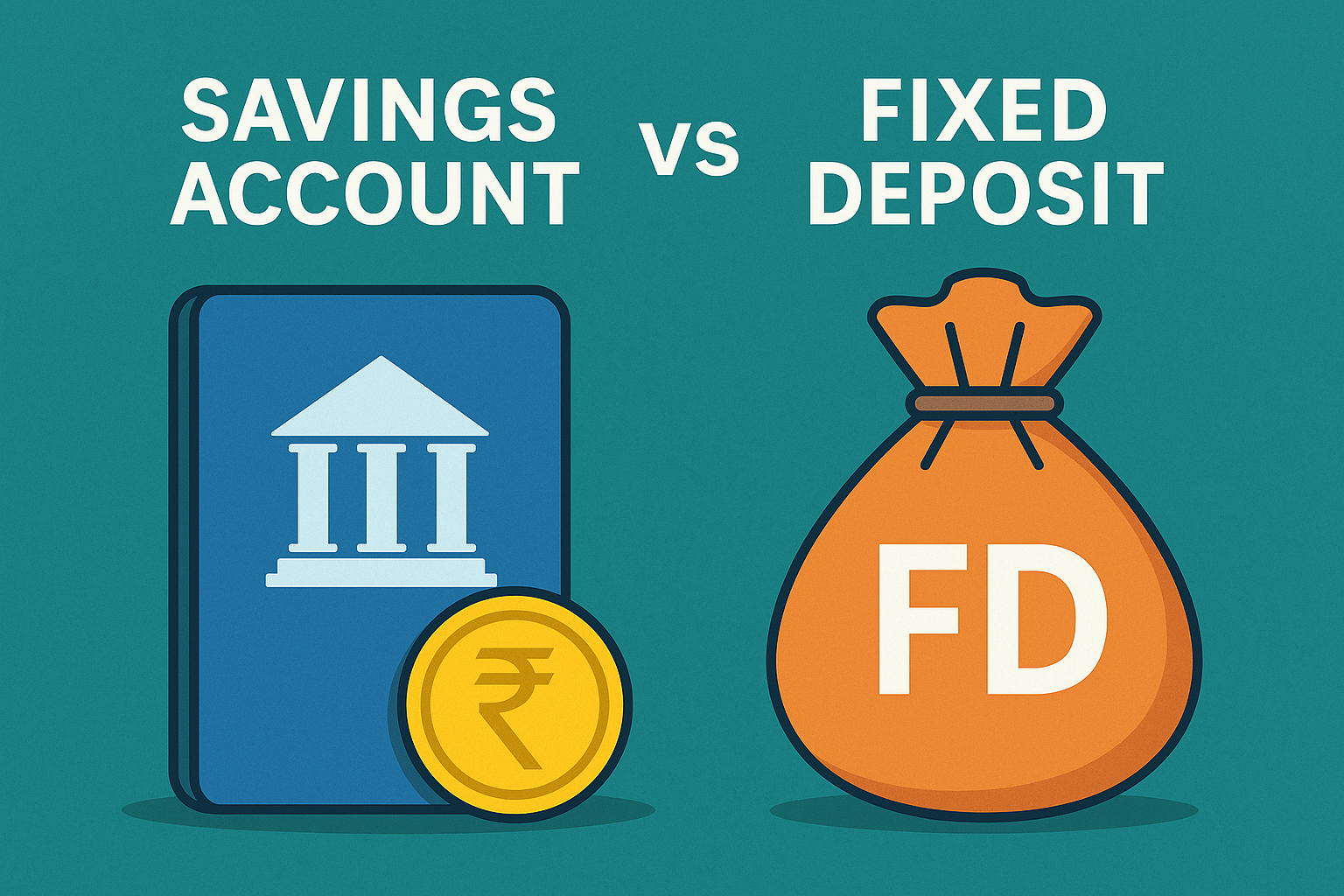
A savings account is a highly liquid bank account for day-to-day transactions, typically offering 2.5–4 percent interest per annum (p.a.). In contrast, a fixed deposit is a lump-sum deposit locked for a preset tenure (7 days to 10 years) that earns a higher, fixed rate of 5–7.5 percent p.a. (or more for senior citizens). By the end of this 3,000-word guide, you’ll know exactly where to stash emergency funds, short-term savings, and long-term goals, plus a hybrid strategy many fee-only financial planners recommend. Let’s dive in.
Key Differences at a Glance
| Parameter | Savings Account | Fixed Deposit |
|---|---|---|
| Interest Rates | 2.5–4% p.a. | 5–7.5% p.a. (senior citizens may earn more) |
| Liquidity | Instant access | Locked until maturity (premature exit penalty applies) |
| Safety | DICGC-insured up to ₹5 L | DICGC-insured up to ₹5 L |
| Minimum Deposit | ₹500–₹5,000 | ₹1,000–₹25,000 |
| Tax on Interest | Tax-exempt up to ₹10,000 (Sec 80TTA) | Fully taxable; 10 % TDS if yearly interest > ₹40,000 |
| Best For | Emergency fund, daily cash flow | Defined goals (down payment, vacation, tuition) |
A closer look at each parameter explains why and when one product makes more sense than the other.
Interest Rates (2.5–4% vs. 5–7.5%)
Savings accounts generally offer modest interest rates, ranging from 2.5 to 4 percent per annum. Although these rates fluctuate slightly from bank to bank, some private banks may provide marginally higher yields. The primary purpose of a savings account is liquidity, not high returns. By contrast, fixed deposits lock your money for a specific duration, and banks typically offer 5 to 7.5 percent p.a. on such deposits. Senior citizens often enjoy an extra 0.25 to 0.50 percent over standard FD rates, making FDs particularly attractive for retirees seeking predictable interest income. Over long tenures (e.g., three to five years), even a 1 percent difference can lead to substantial compounding; for a principal of ₹5 lakh, this extra percentage could result in an additional ₹5,000–₹7,500 in interest each year.
Liquidity (Instant Access vs. Locked-in Tenure)
A savings account excels in liquidity: you can withdraw funds via ATM, cheque, or online transfer at any time without penalty. This instant access makes a savings account ideal for holding an emergency corpus (three to six months’ worth of expenses), daily cash flows, or any funds you might need on short notice. Conversely, a fixed deposit locks in your capital until maturity. While some banks permit premature withdrawal, they levy a penalty, often 1 to 2 percent of the interest earned, thus significantly reducing effective returns. For example, breaking a one-year FD after six months usually means forfeiting a portion of the promised rate and paying penalties. Therefore, FDs are best suited for funds you can set aside for a fixed period, like saving for a down payment, a vacation six months away, or your child’s tuition next academic year.
Safety (DICGC-Insured up to ₹5 Lakh)
Both savings accounts and fixed deposits carry the same level of safety because the DICGC insures each bank customer’s deposit (across all branches of that bank) for up to ₹5 lakh. Whether you hold ₹2 lakh in your savings account or ₹4 lakh in an FD, you’re guaranteed full protection. If you have more than ₹5 lakh to park, you can split deposits across different banks (each insured separately) to fully leverage DICGC coverage. Importantly, both products are risk-free in terms of capital preservation. However, inflation risk remains: if inflation runs at 6 percent while your savings account pays only 3 percent, your real purchasing power erodes over time. FDs mitigate this risk to an extent by offering higher rates, but if inflation outpaces FD returns, especially on shorter tenors, your real returns could still be negative.
Minimum Deposit (₹500–₹5,000 vs. ₹1,000–₹25,000)
Opening balances for savings accounts typically range from ₹500 to ₹5,000, depending on the bank and type of account (basic savings vs. regular). Many public-sector banks allow zero-balance accounts for certain demographics (e.g., students), while premium or “privilege” savings accounts may require higher minimums in exchange for added benefits (waived fees, free lockers). In contrast, fixed deposits demand a larger lump sum: most banks set minimum FD amounts between ₹1,000 and ₹25,000. Senior citizen FDs sometimes permit lower minimums, but generally speaking, you need a buffer of at least ₹10,000 to ₹25,000 to open a bank FD at competitive rates. If you have only ₹5,000 to spare, a savings account remains your only recourse unless you explore specialised community or local credit union-style FDs.
Tax on Interest (Exempt up to ₹10,000 vs. Fully Taxable)
Interest earned on savings accounts is tax-exempt up to ₹10,000 in a financial year under Section 80TTA. For example, if you earn ₹12,000 in savings interest, only ₹2,000 becomes taxable as per your income tax slab. However, fixed deposit interest is fully taxable: banks deduct a 10 percent TDS (Tax Deducted at Source) on all FD interest exceeding ₹40,000 per year (₹50,000 for senior citizens). If your FD interest in a year is ₹60,000, the bank will automatically withhold ₹6,000 as TDS. You must still include the gross interest in your taxable income; if your slab rate is 20 percent, you owe ₹12,000 in tax but can adjust the ₹6,000 TDS already paid when filing returns. The higher FD rates thus become partially offset by taxes, so even if you lock in 7 percent on an FD, your post-tax yield at a 20 percent slab falls to around 5.6 cents. In contrast, savings account interest up to ₹10,000 per year effectively remains tax-free (if your total interest doesn’t exceed that threshold).
Best For (Emergency Fund vs. Defined Goals)
A savings account is best suited for an emergency fund or any situation that requires immediate access to cash, such as medical emergencies, unplanned repairs, or covering short-term expenses. Because you can withdraw anytime without losing principal or interest, a savings account functions as your financial safety net. Conversely, a fixed deposit aligns well with specific objectives, such as funding a child’s tuition for the upcoming semester, preparing for a wedding six months away, or building a down payment for a home purchase two years in the future. By matching FD tenors with specific milestones, you lock in higher rates while ensuring funds mature exactly when needed.
Hybrid Strategy (Leveraging Both Products)
Many fee-only financial planners recommend a hybrid approach: Maintain at least three to six months of expenses in a high-interest savings account for liquidity, then ladder multiple FDs for varying tenors—six months, one year, and two years—to capture higher rates while staggering maturity dates. For instance, if you have ₹10 lakh in surplus cash:
-
Maintain ₹2 lakh in a savings account to cover immediate emergencies and daily cash needs.
-
Split ₹8 lakh into four FDs of ₹2 lakh each: one maturing at six months, another at one year, then at 18 months, and finally at two years.
As each FD matures, you can either reinvest at prevailing rates or redirect funds to a new goal (e.g., higher-return debt funds or equity SIPs). This strategy minimises reinvestment risk (locking in rates across different interest-rate cycles) and provides periodic liquidity every six months without paying premature-withdrawal penalties.
Real-World Example (Emergency Fund vs. Down Payment)
Imagine you’re planning to buy a car in 12 months, and you’re also building an emergency corpus. You need ₹3 lakh for the down payment and want a cushion of ₹1 lakh readily available. You might:
-
Keep ₹1 lakh in a savings account (earning 3 percent) for immediate access.
-
Place ₹3 lakh in a one-year FD at 6.5 percent p.a.
At the end of 12 months, the emergency fund remains fully liquid, while your FD grows to approximately ₹3.19 lakh (pre-tax). After TDS at 10 percent on interest (about ₹19,500), you still receive around ₹3.17 lakh net, just enough for the down payment. Had you kept all ₹4 lakh in a savings account at 3 percent, you’d earn just ₹12,000 in interest but forgo the extra ₹45,000 from an FD.
How to Choose Based on Your Timeline and Tax Bracket
-
Undergraduate/Young Professionals (Low Tax Bracket): If you’re in the 5 to 10 percent tax bracket and need money within 12 months, a short-term FD (6 to 12 months) can beat savings account yields, even after TDS. A 6.5 percent FD taxed at 10 percent nets around 5.85 percent, compared to a savings account at 3 percent tax-exempt up to ₹10,000. For ₹2 lakh, the FD interest (~₹13,000) minus TDS (₹1,300) yields ~₹11,700, beating the ₹6,000 from savings.
-
Mid-Career (20 Percent+ Tax Bracket): If you’re in the 20 percent slab and need money in 2–3 years, consider ultra-short-term debt funds or recurring deposits instead of FDs. However, if you insist on FDs, ladder them at one-year and two-year lengths so you can periodically reinvest. Remember, a 7 percent FD taxed at 20 percent effectively yields only 5.6 percent, barely above the 3 percent savings rate.
-
Retirees/Senior Citizens: The additional 0.25 to 0.50 percent on FD rates can push yields to 7.25–7.75 cents. Since senior citizens enjoy a higher tax exemption on savings interest (Sec 80TTB: up to ₹50,000), parking ₹5 lakh in a savings account can earn 3 cents (₹15,000) tax-free, while a ₹5 lakh FD at 7.5 percent yields ₹37,500, with no TDS if interest ≤ ₹50,000.
Tax Filing Tips (Avoiding TDS Surprises)
-
Form 15G/15H Declarations: If your total income is below the taxable threshold, submit Form 15G (for non-seniors) or 15H (for seniors) to the bank so they don’t deduct TDS on FD interest. This benefit keeps your cash flow intact, though you still must report interest income when filing returns.
-
Aggregate Interest Across Banks: Because DICGC insurance caps coverage at ₹5 lakh per bank, many investors split deposits across multiple banks. However, interest above ₹40,000 per bank invokes 10 percent TDS. Keep track of cumulative interest from all sources. If annual interest stays under ₹40,000, you avoid TDS; even if the bank automatically deducts some, you can claim a refund during tax filing.
Why Inflation Matters (Erosion vs. Growth)
If inflation in India runs at 6 percent and your savings account pays 3 percent, your real return is –3 percent (3 – 6). Conversely, a 7 percent FD yields a 1 percent real return (7–6). Over five years, continuously rolling short-term FDs might not outpace inflation if rates slip. Thus, some planners recommend diversifying: park three months’ expenses in a high-yield savings account, allocate 30 percent of surplus to short-term FDs, and consider equity or balanced mutual funds for the remaining to chase inflation-beating returns.
Calculating Effective Yields (Post-Tax and Post-Inflation)
-
Savings Account (3 percent; tax-exempt ₹10,000): On ₹2 lakh, interest = ₹6,000; fully tax-exempt if under ₹10,000. We calculate the real return as 3 – 6 = -3 percent.
-
The one-year FD, which has a 6.5 percent interest rate and is taxable, generates ₹13,000 in interest on ₹2 lakh; after a 10 percent TDS of ₹1,300, the net interest amounts to ₹11,700, resulting in an effective rate of 5.85 percent and a real return of -0.15 percent when subtracting 6.
-
Two-Year FD (7 percent; taxable): For an investment of ₹2 lakh, the yearly interest amounts to ₹14,000, resulting in a total of ₹28,000; the yearly TDS is ₹1,400, leading to a net income of ₹12,600 per year; the average effective rate is approximately 6.3 percent, and the real return is calculated as 6.3 – 6 = 0.3 percent.
These illustrations show that shorter-term FDs barely keep pace with inflation after taxes, whereas longer-term FDs (with slightly higher rates) can edge ahead. Nevertheless, locking in money for two years removes flexibility.
How to Open & Manage Each Account
-
Savings Account: Visit any bank branch or use the bank’s online portal/app. You typically need a copy of your Aadhaar, PAN, proof of address (electricity bill, rent agreement), and a passport-size photo. Once activated, link your Aadhaar and PAN to the account for seamless e-KYC and avoid disruptions (e.g., KYC non-compliance). Monitor your average monthly balance (AMB) to avoid penalties; many banks waive fees if the AMB stays above ₹10,000.
-
Fixed Deposit: Log in to your net banking or visit the branch with your passbook/debit card. Please select the tenor (e.g., 1 year, 2 years), input the deposit amount, and confirm. Your savings account transfers funds to the FD sweep-in/out facility. For premature withdrawals, check the bank’s prevailing penalty rates, typically 1 percent of interest. Many banks allow you to set auto-renewal instructions: for example, renew the FD at maturity for the same tenor at current rates or credit principal and interest back to your savings account.
Hybrid Allocation Example for a Young Couple
Assume a working couple has ₹6 lakh in savings and wants to balance liquidity with returns:
-
₹2 lakh in a high-interest savings account (3.5 percent): emergency cushion, joint monthly bills, and liquidity for unpredictable expenses.
-
₹2 lakh in a one-year FD at 6.75 percent: Funds earmarked for a wedding anniversary trip next year. Expected gross interest = ₹13,500; net after TDS = ₹12,150.
-
₹2 lakh in a two-year FD at 7 percent: down payment savings for a car purchase two years later. The expected gross interest is approximately 14,000 per year, while the net interest is approximately 12,600 per year.
When the one-year FD matures, they can either reinvest at prevailing rates or redirect to short-term equity mutual funds if market valuations look attractive. Meanwhile, the two-year FD continues compounding at 7 percent, safeguarding capital against inflation.
Key Takeaways (Without Introducing New Sections)
-
A savings account is best for funds you may need instantly—emergency corpus, bill payments, or unplanned medical expenses. Interest rates (2.5–4 percent) remain modest, but up to ₹10,000 per year is tax-free under Sec 80TTA.
-
A fixed deposit offers higher, predictable returns (5–7.5 percent) in exchange for locking away capital for a set tenure. FD interest is fully taxable, with 10 percent TDS on interest exceeding ₹40,000 annually. Senior citizens earn an extra 0.25–0.50 percent, and they enjoy a higher savings interest exemption (Sec 80TTB).
-
DICGC insurance covers both products equally; each bank account (savings or FD) is insured up to ₹5 lakh. To protect balances beyond ₹5 lakh, split deposits across different banks.
-
Liquidity: A savings account provides unrestricted withdrawals. FDs impose penalties for premature withdrawals, so match FD tenors with your goal timelines to avoid locking funds you may need.
-
Tax Efficiency: If your total savings interest remains under ₹10,000 per year, keep funds in a savings account. If you’re in a lower tax bracket and have no near-term need, short-term FDs can still beat savings rates after taxes. High-income earners should ladder FDs over longer tenors or explore alternative debt instruments.
-
Hybrid Strategy: Many planners endorse maintaining three to six months of living expenses in a high-yield savings account while allocating surplus to a series of staggered-maturity FDs. This approach ensures periodic liquidity (every six months or so) while capturing higher FD rates.
Breaking Down Savings Accounts
Savings accounts form the backbone of everyday banking for millions of Indians, offering an accessible and secure place to park cash. Unlike investment products with lock-in periods, a savings account prioritises instant liquidity, daily interest accrual, and no tenure commitments, making it ideal for short-notice expenses or building an emergency corpus. By understanding how savings accounts work, their advantages, and potential drawbacks, you can make more informed decisions about where to keep your money.
How Savings Accounts Work
A savings account is structured around three core principles: always-on liquidity, daily interest calculation, and no tenure commitments. Each aspect ensures your funds remain flexible while earning some return.
Always-on Liquidity
• With a savings account, you can access funds on demand via multiple channels:
– ATM Withdrawals: Use your debit card at any participating ATM to withdraw cash instantly.
– UPI Transactions: Unified Payments Interface (UPI) lets you transfer money to anybody, anywhere, within seconds—ideal for splitting bills or paying vendors.
– NEFT/RTGS/IMPS: National Electronic Funds Transfer (NEFT) and Real-Time Gross Settlement (RTGS) facilitate secure bank-to-bank transfers, while Immediate Payment Service (IMPS) ensures 24 × 7 fund movement.
– Cheques: Issue a cheque against your savings account balance for payments or deposits, with clearing typically taking one to three working days.
Interest Mechanics
Most Indian banks calculate interest on a daily basis, using the end-of-day balance to determine the interest accrual. That accrued interest is then credited to your account either quarterly or monthly, depending on the bank’s policy. Daily compounding means
• Each night, the bank computes interest on the previous day’s closing balance.
• As your balance fluctuates due to deposits or withdrawals, the next day’s interest swivels accordingly, ensuring accurate, real-time calculation.
• At the end of each quarter (or month), the bank aggregates the daily interest figures and credits the total to your account, boosting your balance and maximising gains.
No Tenure Commitments
A savings account imposes no fixed term or lock-in period. You can:
• Deposit funds whenever you like, whether it’s a salary credit or a one-time transfer.
• Withdraw money instantly, regardless of when you deposited it, without facing any early withdrawal penalties.
• You may close the account at your convenience by submitting a written request or utilising net banking.
This flexibility makes savings accounts perfect for managing short-notice or unpredictable expenses such as medical bills, sudden travel needs, or unplanned home repairs.
Table: Core Mechanics of Savings Accounts
| Feature | Explanation |
|---|---|
| Always-on Liquidity | Withdraw cash via ATM/UPI/NEFT/RTGS/cheque at any time without prior notice. |
| Interest Mechanics | We calculate interest daily on the end-of-day balance and credit it either quarterly or monthly. |
| No Tenure Commitments | Funds can be deposited or withdrawn, or the account closed, anytime—perfect for urgent needs. |
Pros of Savings Accounts
A savings account delivers several benefits, chiefly, zero withdrawal penalties, a regulated safety net, and suitability for various everyday use cases.
Zero Withdrawal Penalties
Unlike fixed deposits (FDs), savings accounts do not penalise you for taking out money. Suppose you need ₹10,000 from your account today; you can withdraw it immediately without any reduction in the interest you’ve already earned. This zero-penalty feature ensures you never lose a fraction of interest due to urgent withdrawals, making it far more flexible than locking funds in FDs.
Regulated Safety Net
The Deposit Insurance and Credit Guarantee Corporation (DICGC) insures each savings account up to ₹5 lakh per depositor per bank. Even if a bank were to collapse or temporarily freeze operations, you are guaranteed full reimbursement of your balance (up to ₹5 lakh). This regulatory safeguard provides peace of mind that your capital remains protected from unforeseen bank failures.
Ideal Use Cases
• Emergency Fund (3–6 Months of Living Costs)
A savings account functions as a ready safety cushion. Financial experts recommend maintaining at least three to six months’ worth of expenses here for sudden job loss, medical emergencies, or unanticipated major repairs. Because there is no lock-in, you can tap into these funds immediately as situations arise.
• Salary Credits and Bill Payments
Many salaried professionals prefer receiving their paycheques in a savings account. From there, they can set up auto-debits or standing instructions to pay utility bills, EMIs, rent, and other recurring obligations, ensuring on-time payments without manual intervention.
• Business Owners with Continuous Cash Rotation
Entrepreneurs and small-business owners often rely on savings accounts to manage day-to-day operational cash flows: paying suppliers, receiving client payments, or covering payroll. The immediate liquidity ensures transactions can proceed without waiting on clearing cycles.
Table: Pros of Savings Accounts
| Advantage | Explanation |
|---|---|
| Zero Withdrawal Penalties | Withdraw any amount at any time without losing interest or facing a penalty. |
| Regulated Safety Net | DICGC insurance covers up to ₹5 lakh per depositor, providing full protection against bank failure. |
| Ideal Use Cases | The emergency fund, which can cover 3–6 months of living expenses, can be used for salary credits and bill payments, as well as for maintaining continuous business cash flow. |
Cons of Savings Accounts
While savings accounts excel in flexibility and safety, they carry notable downsides, chief among them low real returns, minimum-balance charges, and potential psychological leakage.
Low Returns vs. Inflation
Most savings accounts offer interest rates between 2.5 and 4 percent p.a. If inflation runs at 6 percent, earning 4 percent translates to a real return of –2 percent (4 – 6 = –2). In essence, your purchasing power erodes over time even though your nominal balance grows slightly. Long-term savers often find that placing excess money in higher-yielding instruments (like fixed deposits, debt funds, or equity mutual funds) becomes necessary to outpace inflation.
Minimum-Balance Charges
Private-sector banks frequently impose quarterly penalties ranging from ₹150 to ₹600 if your average monthly balance (AMB) dips below the threshold. For example, if a bank mandates a ₹25,000 AMB and you maintain only ₹20,000 for two months, you might face charges of ₹150 each quarter, eroding your effective return. Public-sector banks often have lower or zero-balance requirements, but feature sets (e.g., free cheques, free ATM transactions) may be more limited.
Psychological Leakage
Easy access to funds can tempt overspending. Because there is no friction, no lock-in, and no penalty, some savers find themselves treating a savings account like a spending account, withdrawing money impulsively for non-essential purchases. This “psychological leakage” can defeat the very purpose of building a savings buffer. If you lack strong self-discipline or have separate sub-accounts designated for “true savings”, it becomes effortless to access funds that should have remained untouched.
Table: Cons of Savings Accounts
| Drawback | Explanation |
|---|---|
| Low Returns vs. Inflation | Earning 2.5–4% when inflation is at 6% results in a guaranteed loss in purchasing power (real return of –2%). |
| Minimum-Balance Charges | Private banks may charge ₹150–₹600 per quarter if your average monthly balance falls below the prescribed minimum. |
| Psychological Leakage | The ease of withdrawals can lead to impulsive spending, undermining efforts to build a genuine savings buffer. |
Decoding Fixed Deposits
Fixed Deposits (FDs) offer a straightforward way to grow your money without exposing it to market volatility. By choosing a specific tenure, locking in an agreed-upon interest rate, and selecting how you want to receive payouts, you can tailor FDs to match your financial goals, whether that’s wealth accumulation, steady income, or disciplined savings. Understanding each step in the FD process, along with its advantages and drawbacks, empowers you to decide when and how to deploy your surplus cash.
How FDs Work
When you open an FD, you essentially lend a lump sum to the bank for a fixed period, earning a higher interest rate than you would in a savings account. Below are the key steps and options:
Select a Tenure
Banks publish a rate card that lists applicable interest rates for different tenures. Generally, tenures between one and three years offer the most attractive rates. For example, a 1-year FD might pay 6.5% p.a., while a 2-year FD could pay 7% p.a., and a 3-year FD might offer 7.25% p.a. By aligning your FD’s maturity date with your financial milestone, such as a planned purchase, tuition payment, or travel, you ensure funds become available exactly when you need them.
Choose Payout Style
You can decide how you want to receive interest payments:
Cumulative FD: The bank’s policy determines the daily or quarterly compounding of interest, and it only pays out the principal at maturity. This option maximises growth because interest itself earns interest throughout the tenure. It’s ideal for long-term goals when you don’t need periodic cash flow.
Non-Cumulative FD: The bank pays out interest at regular intervals, such as monthly, quarterly, or as specified. If you’re a retiree or someone who needs a steady income stream, this option ensures you receive periodic payouts that can supplement your living expenses.
Auto-Renew or Auto-Credit
At maturity, banks give you two main choices:
Auto-Renew: The FD principal (plus interest, if cumulative) automatically rolls into a new FD at the prevailing rate for the same tenure. For instance, the bank might renew a two-year FD maturing on June 30 for another two years starting July 1 at the current interest rate. This option benefits those who want to maintain continuous earnings without manual intervention.
Auto-Credit to Savings Account: On maturity, the bank transfers the FD principal plus any earned interest into your linked savings account. Those seeking immediate liquidity upon maturity or wishing to reallocate funds to another investment or expense should consider this option.
Table: Key Mechanics of Fixed Deposits
| Feature | Description |
|---|---|
| Tenure Selection | Choose a specific term (commonly 1–3 years) based on the bank’s rate card; longer tenures often yield higher rates. |
| Payout Style | Cumulative: Compounds daily/quarterly and pays at maturity; Non-Cumulative: Pays interest monthly or quarterly. |
| Auto-Renew/Auto-Credit | Auto-Renew: Rolls into a new FD of the same tenure at current rates; Auto-Credit: Transfers the maturity amount to a savings account. |
Pros of Fixed Deposits
Fixed deposits come with several compelling benefits: predictable returns, enhanced rates for senior citizens, and liquidity solutions like loans or overdrafts against the FD. These features make FDs a popular choice for conservative investors.
Higher Returns with Zero Market Risk
Unlike equities or debt funds, FDs guarantee a fixed interest rate for the entire tenure. From the moment you lock in a 7% p.a. rate, you know exactly how much you will receive at maturity, no matter how markets behave. This makes FDs especially attractive during periods of stock market volatility or when bond yields slump.
Senior Citizen Premium
Banks typically offer an additional 0.25–0.50% p.a. for depositors aged 60 years or older. For example, if the standard 1-year FD rate is 6.5% p.a., a senior citizen might earn 6.75% or 7% p.a. This premium compensates for reduced risk tolerance among retirees and encourages them to park funds in a safe instrument while earning slightly higher returns than younger depositors.
Loan/Overdraft Facility
If you need cash before your FD matures, you can borrow up to 90% of the FD’s value without breaking the deposit. The interest rate on this loan is typically 1–2% higher than the contracted FD rate. For instance, if you have a 7% P.A. FD, the bank might charge you an 8% P.A. rate for the loan against it. This feature lets you access funds quickly, say, to cover an unexpected medical bill without incurring premature withdrawal penalties.
Goal Earmarking
Most banks allow you to label each FD with a specific purpose, such as “Car Down Payment June 2027” or “Child’s Tuition March 2026”. By tagging FDs with goal names, you create psychological discipline: you’re less likely to tap funds earmarked for a specific milestone. This feature helps you stay on track toward long-term objectives by keeping those funds effectively out of sight until maturity.
Table: Pros of Fixed Deposits
| Advantage | Explanation |
|---|---|
| Higher Returns, Zero Market Risk | We lock in the interest rate at the outset, eliminating any exposure to fluctuations in the stock or bond markets. |
| Senior Citizen Premium | The Senior Citizen Premium provides an additional 0.25–0.50% p.a. for depositors aged 60+, thereby boosting overall yields for retirees. |
| Loan/Overdraft Facility | Borrow up to 90% of the FD value at 1–2% above the FD rate; this provides liquidity without breaking the FD. |
| Goal Earmarking | Label each FD with a purpose (e.g., “Vacation 2025”), promoting disciplined savings for specific financial goals. |
Cons of Fixed Deposits
Despite their safety and predictability, fixed deposits carry certain downsides: premature withdrawal penalties, tax inefficiency, and vulnerability to inflation. Being aware of these factors helps you decide when an FD truly makes sense.
Premature Withdrawal Penalty
If you break an FD before it matures, banks typically deduct 0.5–1% from the agreed interest rate. For example, a 2-year FD ategory 7% p.a. might drop to 6% p.a. if withdrawn early. That means on a ₹5 lakh principal, instead of earning around ₹35,000 per year, you’d receive only ₹30,000 per year, resulting in roughly ₹2,500 less each quarter. Over long tenors, this interest haircut significantly reduces your effective returns, making FDs less liquid than they appear at first glance.
Tax Inefficiency
FD interest is fully taxable under your income slab. Banks automatically deduct 10% TDS if your total annual interest at a single bank exceeds ₹40,000 (₹50,000 for senior citizens). For instance, if your FD generates ₹50,000 in interest over a year, the bank will withhold ₹5,000 as TDS. You must still report the full ₹50,000 interest when filing your income tax return; if your tax slab is 20%, you owe ₹10,000, but you can adjust the ₹5,000 TDS already paid. The combination of TDS and slab-based taxation often shrinks the effective post-tax FD yield, especially for higher-income earners.
Inflation Threat
In an environment where inflation runs around 6 % and an FD pays 7 %, your pre-tax real return is only 1 % (7 – 6 = 1). After paying taxes, say, 20% interest, the effective return might drop to 0.8% or even go negative. Over multi-year tenures, this erosion of purchasing power can be substantial. If inflation accelerates, a fixed FD rate that once seemed attractive can quickly become subpar, leaving your money’s real value effectively frozen or diminished.
Table: Cons of Fixed Deposits
| Drawback | Explanation |
|---|---|
| Premature Withdrawal Penalty | Breaking an FD early typically reduces the agreed rate by 0.5–1%, cutting your effective returns and limiting liquidity. |
| Tax Inefficiency | The interest earned on fixed deposits (FDs) is fully taxable, and banks deduct 10% Tax Deducted at Source (TDS) if the annual interest exceeds ₹40,000 (or ₹50,000 for seniors), which reduces the net yields. |
| Inflation Threat | A 7% FD in a 6% inflation environment nets just ~1% real return pre-tax; post-tax yields can be zero or negative if inflation rises. |
When to Choose Which? (Data-Driven Strategies)
Choosing between a savings account and a fixed deposit (FD) hinges on your immediate cash needs, risk tolerance, and timeline. By aligning your selection with specific financial goals, you can optimise liquidity and returns.
Opt for Savings Accounts If…
• Building an emergency fund: Maintain 3–6 months’ worth of expenses (for example, ₹50,000–₹2 lakh) in a highly liquid account. This option ensures instant access if unexpected costs arise from medical emergencies, urgent home repairs, or sudden travel needs, without breaking an FD and incurring penalties.
• Handling frequent transactions: Freelancers, small-business owners, and gig workers often require daily cash flow. A savings account provides uninterrupted liquidity with no delays or interest haircuts, making it ideal for continuous inflow and outflow.
• Covering short-notice medical or family contingencies: Medical bills or urgent family obligations may demand funds immediately. Skipping FD penalties by keeping money in a savings account can save both time and extra costs.
Opt for Fixed Deposits If…
• Saving for short-term goals (1–3 years): Whether you’re planning a car purchase, a destination wedding, a home renovation, or next year’s school fees, locking funds into a 1–3 year FD often yields higher, guaranteed returns than a savings account. Align the FD maturity date with your anticipated expenses to maximise interest without sacrificing liquidity prematurely.
• You are risk-averse: Retirees or conservative investors uncomfortable with market fluctuations often prefer FDs. The guaranteed interest rate eliminates volatility, ensuring you know exactly how much you’ll receive at maturity.
• Seeking rate arbitrage: If forecasts hint at an imminent RBI rate cut, locking in today’s higher FD rate preserves your yield. For instance, if current FD rates hover at 7% and economists predict a 0.25% cut, an early lock-in will secure 7% rather than risk a lower rate later.
Pro Tip: FD Laddering
Split a ₹5 lakh corpus into five separate ₹1 lakh FDs, each maturing one year apart. This “ladder” approach provides annual liquidity each year; one FD matures while still benefiting from longer-term FD rates on the unreached portions. For example:
Year 1: ₹1 lakh FD maturing
Year 2: Next ₹1 lakh FD maturing
…and so on until Year 5
Laddering reduces reinvestment risk (locking in varied rates across different interest-rate cycles) and ensures you never have all your funds tied up simultaneously.
Hybrid Approach for Maximum Gains
Combining a savings account with an FD portfolio often provides both a liquidity buffer and higher overall yields. The example below illustrates the year-end returns on different allocations:
Portfolio Composition Annual Return
₹10 Lakh @ 4% in Savings ₹40,000
₹8 Lakh in FD @ 7% + ₹2 Lakh in Savings @ 4% ₹8 L × 7 % + ₹2 L × 4 % = ₹56,000 + ₹8,000 = ₹64,000 (Annual)
By allocating ₹8 lakh to a 7% FD and keeping ₹2 lakh in a 4% savings account, you earn ₹64,000 per year, compared with ₹40,000 if all ₹10 lakh sits in savings. This results in an extra ₹24,000 annually while retaining ₹2 lakh for instant access. Many financial advisers therefore recommend a 20:80 liquidity-to-return split for savers seeking stability and superior yield.
Tax and Inflation Impact
Taxes and inflation can materially erode both savings accounts and FD returns; understanding these impacts helps you choose the most efficient vehicle.
Tax Rules in Plain English
Savings Account: Interest up to ₹10,000 per financial year is exempt under Section 80TTA (for senior citizens, the exemption rises to ₹50,000 under Section 80TTB). If you earn ₹12,000 in interest, the first ₹10,000 remains tax-free; ₹2,000 is taxable at your slab rate.
Fixed Deposit: Every rupee of FD interest counts as taxable income; there is no equivalent ₹10,000 cushion. Moreover, banks automatically deduct 10% TDS if your aggregate FD interest from one bank exceeds ₹40,000 in a year (₹50,000 for those who are 60+). For example, ₹50,000 in annual FD interest results in ₹5,000 TDS. You must still declare the full ₹50,000 as income; if you fall in the 30% tax bracket, you owe ₹15,000; subtracting the ₹5,000 TDS leaves a ₹10,000 tax liability.
Tax-Saver FD Hack: Five-year tax-saver FDs qualify for a deduction under Section 80C up to ₹1.5 lakh per year. However, these FDs carry a strict five-year lock-in, so you cannot break them prematurely, even in emergencies.
Inflation’s Hidden Toll
Even guaranteed returns can lag inflation. Consider a 3-year FD paying 7% p.a. if you fall in the 30% tax bracket and average CPI inflation is 6%:
Post-tax return = 7 % × (1 – 0.30) = 4.9 %
Real return = 4.9 % – 6 % = –1.1 %
Although FDs preserve principal better than a savings account (which at 4% yields a –2% real return in a 6% inflation scenario), neither vehicle beats inflation for horizons beyond three years. To protect purchasing power over the long term, consider complementing FDs with equity mutual funds or index fund assets historically outpacing inflation over multi-decade periods.
Pro Tips to Optimize Returns
Depositing a lump sum into a fixed deposit (FD) or keeping funds in a savings account does not guarantee you’re capturing every rupee of potential interest. By implementing targeted strategies, negotiating bulk rates, leveraging senior citizen specials, using auto-sweep facilities, and exploring small finance banks, you can significantly boost your effective yield without taking on extra risk.
Negotiate for Bulk Rates
When you deposit more than ₹15 lakh in a single FD, banks often offer an incremental rate premium of 0.10–0.25% above their standard published rates. For example, if the base rate for a 2-year FD is 7% p.a., a bulk-deposit premium could raise it to 7.25% or even 7.50% p.a. This slight percentage bump translates into thousands of extra rupees of interest over a one- to three-year tenure. To unlock this benefit:
• Visit your branch with proof of existing balances or transfer intent.
• Ask the branch manager for the “bulk deposit rate card” or any ongoing promotions for deposits above ₹15 lakh.
• Negotiate transparently, especially if you’re a long-term customer with multiple accounts or FDs at the same bank.
Grab Senior-Citizen Specials
Public Sector Undertaking (PSU) banks such as State Bank of India (SBI), HDFC, and ICICI regularly run limited-time FD schemes titled “Senior Citizen Care” or similar, offering an additional 0.30–0.50% p.a. over the prevailing senior citizen rate. For instance, if the standard senior citizen FD rate is 7.25% p.a. for a 1-year tenure, a special could push it to 7.75% p.a. or even 8% p.a. These schemes typically run quarterly or during festive seasons. To capitalise:
• Monitor bank websites or newsletter emails for “Senior Citizen Care FD” announcements.
• Visit the nearest branch with your age-proof document (PAN or Aadhaar).
• Please verify the validity period of the special rate, as most are available for only a few weeks.
Use Auto-Sweep Facilities
Several private banks, such as IDFC FIRST and Kotak Mahindra, offer an auto-sweep feature that automatically converts idle savings account balances above a predetermined threshold into mini-FDs, often at significantly higher rates. Typical thresholds include ₹25,000 or ₹50,000. Here’s how auto-sweep magnifies returns:
• Threshold Triggers: If your savings balance exceeds, say, ₹25,000 at any time, the surplus automatically moves into a mini-FD (usually for a 7- or 14-day tenure) at a higher mini-FD rate, often 0.50–1% above the regular savings rate.
• Automatic Liquidity: When you need cash, the bank sweeps the required amount back from the mini-FD into your savings account, ensuring you never lose money.
• Compound Advantage: Even if your surplus remains idle for just a few days each month, mini-FD rates can compound over time, especially when thresholds are ₹50,000 or more.
| Bank | Threshold for Auto-Sweep | Mini-FD Rate Premium |
|---|---|---|
| IDFC FIRST | ₹25,000 | +0.50% above Savings Rate |
| Kotak Mahindra | ₹50,000 | +0.75% above Savings Rate |
Explore Small Finance Banks
Small Finance Banks (SFBs) often feature FD rates well above mainstream players, sometimes touching up to 8.5% p.a. for a 2-year tenure, all while remaining fully DICGC-insured up to ₹5 lakh per bank. Here are a few prominent SFBs and their approximate two-year FD rates:
| Small Finance Bank | 2-Year FD Rate (Approx.) | DICGC Insurance |
|---|---|---|
| AU Small Finance Bank | 8.25% p.a. | Up to ₹5 lakh per depositor |
| Equitas Small Finance Bank | 8.50% p.a. | Up to ₹5 lakh per depositor |
| Jana Small Finance Bank | 8.25% p.a. | Up to ₹5 lakh per depositor |
| Suryoday Small Finance Bank | 8.00% p.a. | Up to ₹5 lakh per depositor |
Stagger Your Maturities Around Life Events
Locking in multiple FDs of varying tenures, often called “laddering”, allows you to align maturities with key financial milestones. Suppose you plan to pay school fees in April 2026, fund a wedding in December 2027, and undertake a home renovation in June 2028. You could:
• Open a 2-year FD today, maturing April 2026.
• Open a 3-year FD maturing December 2027.
• Open a 4-year FD maturing June 2028.
By staggering maturities, you avoid squeezing one FD and paying a premature-withdrawal penalty if an expense arises. Instead, each FD matures precisely when the funds are required.
How to Open or Switch Accounts Quickly
Opening a Savings Account
Thanks to digital onboarding, opening a savings account now takes mere minutes if you have essential KYC documents ready. Follow these streamlined steps:
Digital KYC Submission
• Visit the bank’s website or download its mobile banking app.
• Upload clear scans of your PAN card and Aadhaar card.
• Fill in personal details: name, address, contact information, and nominee details.
Video Verification
• Schedule a brief video call with the bank officer.
• Show your face in real time alongside original PAN and Aadhaar documents.
This live authentication usually takes under five minutes.
Account Activation
Within 10 minutes of successful video KYC, you receive:
• You will receive your account number and customer ID either via SMS or email.
• If the bank offers virtual debit card credentials, you can obtain them instantly.
You can immediately transfer an initial deposit (if the bank requires one) using UPI, NEFT, or net banking.
Opening a Fixed Deposit
Whether you prefer online convenience or visiting the branch, opening an FD is equally swift:
| Method | Steps | Time Taken |
|---|---|---|
| Online | Log into net banking → Navigate to ‘Open Fixed Deposit’ → Choose amount and tenure → Confirm details and authenticate via OTP. | Under 5 minutes |
| Offline (Branch) | Visit a branch with a cheque or cash, plus PAN and Aadhaar. Please complete the FD application form and submit the necessary documents, and you will receive a digital FD certificate promptly. | 10–15 minutes (including form filling) |
Switching Tip
If you wish to move a matured FD from Bank A to Bank B, you don’t need to visit Bank B’s branch physically. Instead:
• Wait for Bank A’s FD to mature and get credited (principal + interest) into your savings account.
• Use RTGS/NEFT to instantly transfer the entire maturity amount to your account at Bank B.
• Log into Bank B’s net banking, select ‘Open Fixed Deposit’, and re-book the transferred amount under your desired tenure.
By following these digital-first processes—digital KYC for savings accounts, online FD applications, and RTGS-based FD switching—you can efficiently manage your liquidity and returns, ensuring you never miss out on valuable interest opportunities.
FAQ
Which is safer: an FD or a savings account?
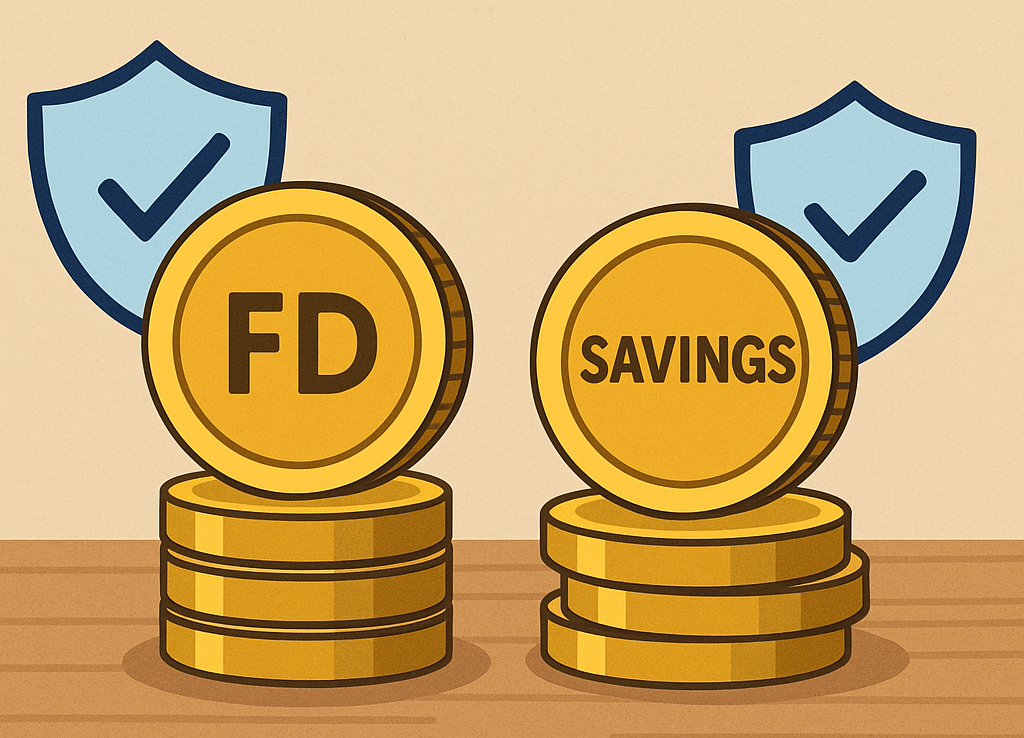
Both fixed deposits (FDs) and savings accounts offer an identical safety net: the Deposit Insurance and Credit Guarantee Corporation (DICGC) insures each depositor’s balance up to ₹5 lakh per bank. Whether you hold ₹3 lakh in a savings account or ₹4 lakh in a fixed deposit at the same bank, DICGC guarantees reimbursement up to ₹5 lakh if the bank fails. Beyond ₹5 lakh, perceptions of safety often hinge on bank size and backing; large public-sector banks are generally viewed as more stable due to implicit government support, while smaller private banks may carry marginally higher perceived risk despite DICGC coverage.
| Feature | Savings Account | Fixed Deposit |
|---|---|---|
| DICGC Insurance | Up to ₹5 lakh per depositor per bank | Up to ₹5 lakh per depositor per bank |
| Perceived Safety Beyond ₹5 lakh | Large banks preferred; government-backed institutions seen as safer | Large banks preferred; government-backed institutions seen as safer |
Can I lose money in an FD?
An FD guarantees the principal, meaning you cannot lose the face value you deposit. The only potential “losses” stem from two factors:
• Premature withdrawal penalty: If you break an FD before its maturity date, the bank typically reduces the contracted interest rate by 0.5–1 percentage points. For instance, a 2-year FD committed at 7% p.a. might drop to 6% p.a. if you withdraw early, meaning you forfeit part of the interest you would have earned.
• Inflation erosion: Even if you receive the full principal and contracted interest, high inflation can diminish the real value of your returns. For example, a 7% FD in a year when inflation averages 6% yields a nominal gain of 7%, but your real purchasing power increases by only 1%. Over multiple years, inflation can outpace the FD rate, effectively reducing your real wealth. In addition to the previous points, there is no risk to the principal amount itself; DICGC insurance covers up to ₹5 lakh, ensuring that the bank cannot default on the guaranteed payout for amounts within this insured limit.
Are FDs better than savings accounts for high interest?
Yes. On average, FDs offer interest rates that are 2–3 percentage points higher than savings accounts. For example, if a savings account yields around 4% p.a., a comparable-tenure FD often pays 6–7% p.a. This substantial spread means a ₹5 lakh FD at 7% earns ₹35,000 a year, whereas a savings account at 4% yields only ₹20,000. However, the trade-off is liquidity: whenever you withdraw from an FD before maturity, you incur a 0.5–1% haircut on the contracted interest rate. By contrast, savings accounts allow zero-penalty withdrawals at any time. In essence, FDs are preferable for locking away funds you do not expect to need immediately, while savings accounts serve better for balances requiring instant access.
How much FD interest is tax-free?
None. All FD interest is fully taxable according to your individual income tax slab. Banks deduct 10% TDS (Tax Deducted at Source) if the total interest earned in a year from one bank exceeds ₹40,000 (or ₹50,000 if you are a senior citizen). For example, if you earn ₹60,000 in FD interest from a single bank in a financial year, the bank automatically withholds ₹6,000 as TDS. You must still report the full ₹60,000 when filing your return. If your slab rate is 20%, you owe ₹12,000 in tax, and ₹6,000 TDS can be claimed as a credit. There is a special rule for 5-year tax-saver FDs: even though the interest you earn is fully taxable, the amount you put in can be deducted under Section 80C of the Income Tax Act up to ₹1.5 lakh each financial year, as long as you keep the FD for the entire five-year period.
What if I need money from an FD urgently?
If an urgent expense forces you to tap an FD prematurely, you have two primary options:
• Loan against FD: Many banks allow you to borrow against your FD up to 90% of its value at an interest rate typically 1–2 percentage points above the contracted FD rate. For instance, if your FD pays 7% p.a., the bank may charge you around 8–9% p.a. on the loan. This option lets you access cash immediately without breaking the FD or suffering an interest-rate penalty.
• Break the FD: You can surrender the FD before maturity, but the bank will reduce the interest rate by 0.5–1 percentage points relative to the original rate. If you hold a 3-year FD at 6.5% p.a. and withdraw after one year, the bank might recalculate the interest at 5.5% p.a. or 6% p.a. (depending on its policy), substantially reducing your earnings.
| Option | Pros | Cons |
|---|---|---|
| Loan against FD | Retains original interest rate; no penalty on FD principal; immediate liquidity | Interest charged at a premium (1–2% above FD rate); borrowing costs apply |
| Break the FD | No additional borrowing costs; straightforward closure | Interest rate reduced by 0.5–1%; overall earnings shrink significantly |
Should I use FDs for retirement savings?
FDs can form a secure “safety bucket” within a retirement portfolio, particularly for covering 3–5 years’ worth of living expenses. Their guaranteed returns and zero market risk ensure that a portion of your retirement corpus remains protected and liquid when needed. However, for horizons beyond five years, relying solely on FDs is inadequate to beat inflation and grow wealth. Given historical trends, equity or hybrid mutual funds outperform FDs over multi-year spans, delivering inflation-beating returns. So, use FDs for short- to medium-term, low-risk needs like emergency funds and immediate expenses, but invest a bigger portion of your retirement savings in equity-related instruments to maintain your buying power and grow your money over the long term.