
Sustainable money saving is about cutting your carbon footprint and your bills in the same move. Your carbon footprint is simply the greenhouse-gas emissions your daily choices trigger, from energy-hungry appliances and gas-guzzling commutes to food waste and leaky attics, which add invisible tonnes of carbon dioxide and very visible charges to monthly bills. A sustainable money-saving strategy attacks both sides at once, cutting the energy you consume and leaving more cash at the end of every billing cycle.
In the pages ahead you will move from quick fixes you can implement before your next utility statement arrives to deeper retrofits capable of turning an ordinary suburban semi into a micro-power plant. You will see how one British terrace house achieved a ninety-five percent reduction in grid demand, how a modest thermostat nudge delivers a ten percent heating cut, and why switching one incandescent bulb for an LED keeps an extra hundred dollars in your pocket over its lifetime. By the end you will hold a practical, month-by-month playbook, a cost-benefit snapshot, a thirty-day action calendar and a pack of ready answers to the most searched “People Also Ask” questions about saving money and carbon at the same time.
Why Sustainable Money Saving and Emission Cutting Go Hand in Hand
Household energy prices have climbed steeply since the pandemic. A recent consumer survey found that sixty-one percent of households still saw their bills rise over the past year despite falling wholesale prices, with the average home paying an extra three hundred fifty-seven pounds compared with 2022. The shock is not limited to the United Kingdom: global gas price volatility has filtered through to electricity tariffs on every continent.
Meanwhile, 2024 closed as the hottest year ever recorded, with global average temperatures hitting about 1.55°C above pre-industrial baselines (wmo.intft.com). More heat outside means more cooling indoors, driving bills higher and locking in a vicious cycle. Every kilowatt-hour you do not buy, however, represents both a direct cash saving and an avoided carbon emission.
That two-sided payoff has given rise to the idea of “negawatts”. A negawatt is simply the energy you do not consume because of efficiency or behavioural change. Negawatts are the cheapest power source on earth: they cost nothing to generate once the improvement is in place, they incur zero transmission losses and they release no greenhouse gases. The International Energy Agency estimates that efficiency alone can deliver forty percent of the emissions cuts required to stay within the Paris Agreement targets, all while trimming residential energy outlays around the world.
The win-win dynamic is no longer theoretical. From federal tax credits that slash the sticker price of rooftop solar in the United States to grants that subsidise whole-house retrofits in Europe, policy is lining up behind households that choose to waste less. The sooner you act, the faster you insulate your finances from future price shocks and contribute to bending the global emissions curve.
Quick-Win Actions You Can Start Today (Low/No-Cost)
Small changes compound fast. The following four tweaks require little more than an afternoon and modest up-front cash but will start shaving numbers off both your utility statement and your household footprint before the next meter reading.
Can a bulb really make a dent in my bill?
Incandescent bulbs convert ninety percent of the electricity they draw into heat, not light. Modern LEDs reverse that ratio, using up to ninety percent less energy and lasting twenty-five times longer. At the United States average retail rate of fifteen cents per kilowatt-hour, a single sixty-watt incandescent bulb burning three hours a day costs about ten dollars in electricity annually, whereas its nine-watt LED equivalent costs roughly one dollar thirty-five. Over a ten-year service life, that single swap pocket costs you nearly one hundred dollars. Multiply by every fixture in the house, and the result climbs into four-figure savings territory.
Beyond the bill, each kilowatt-hour avoided prevents about six-tenths of a kilogram of carbon dioxide where coal remains on the grid mix. The typical home can therefore cut half a tonne of emissions simply by screwing in LEDs room by room.
Is thermostat tweaking worth the hassle?
The Department of Energy confirms that dialling back your thermostat seven to ten degrees Fahrenheit for eight hours a day trims heating and cooling costs by up to ten cents annually. If you work outside the home, the simplest move is to programme a setback during office hours and overnight. At ten cents per kilowatt-hour and a two-thousand-kilowatt-hour seasonal load, the change saves twenty dollars per month in winter while sparing about two hundred kilograms of CO₂. A smart thermostat automates the schedule, learns your habits over time and serves app-based nudges that coach you toward deeper savings.
What is “phantom load”, and how do I kill it?
Standby power—sometimes called ‘vampire energy’—accounts for five to ten percent of residential electricity, costing the average household up to one hundred dollars every year. Devices from cable boxes to phone chargers sip watts twenty-four hours a day even when you think they are “off”. Plugging clusters of electronics into smart strips allows you to shut down multiple sources at the wall with a single switch or a voice command. In offices and living rooms, a well-placed strip can eliminate sixty watts of continuous draw, paying for itself in months and cutting almost half a tonne of CO₂ across the year.
Can changing my commute lower both CO₂ and fuel spend?
Driving solo remains many families’ largest single source of carbon. The California Air Resources Board estimates that carpooling with just one other person can knock two thousand pounds of carbon dioxide off a household’s annual footprint (coolcalifornia.arb.ca.gov). At current petrol prices that equates to roughly three hundred dollars in fuel for a fifteen-mile round-trip commute. Switching a couple of days per week to public transit amplifies the gain while buying back reading time that would otherwise vanish in traffic. The crucial mental shift is to treat every empty passenger seat as wasted energy you are already paying for.
The Six-Step Net-Zero Household Blueprint (Medium to High-Impact Upgrades)
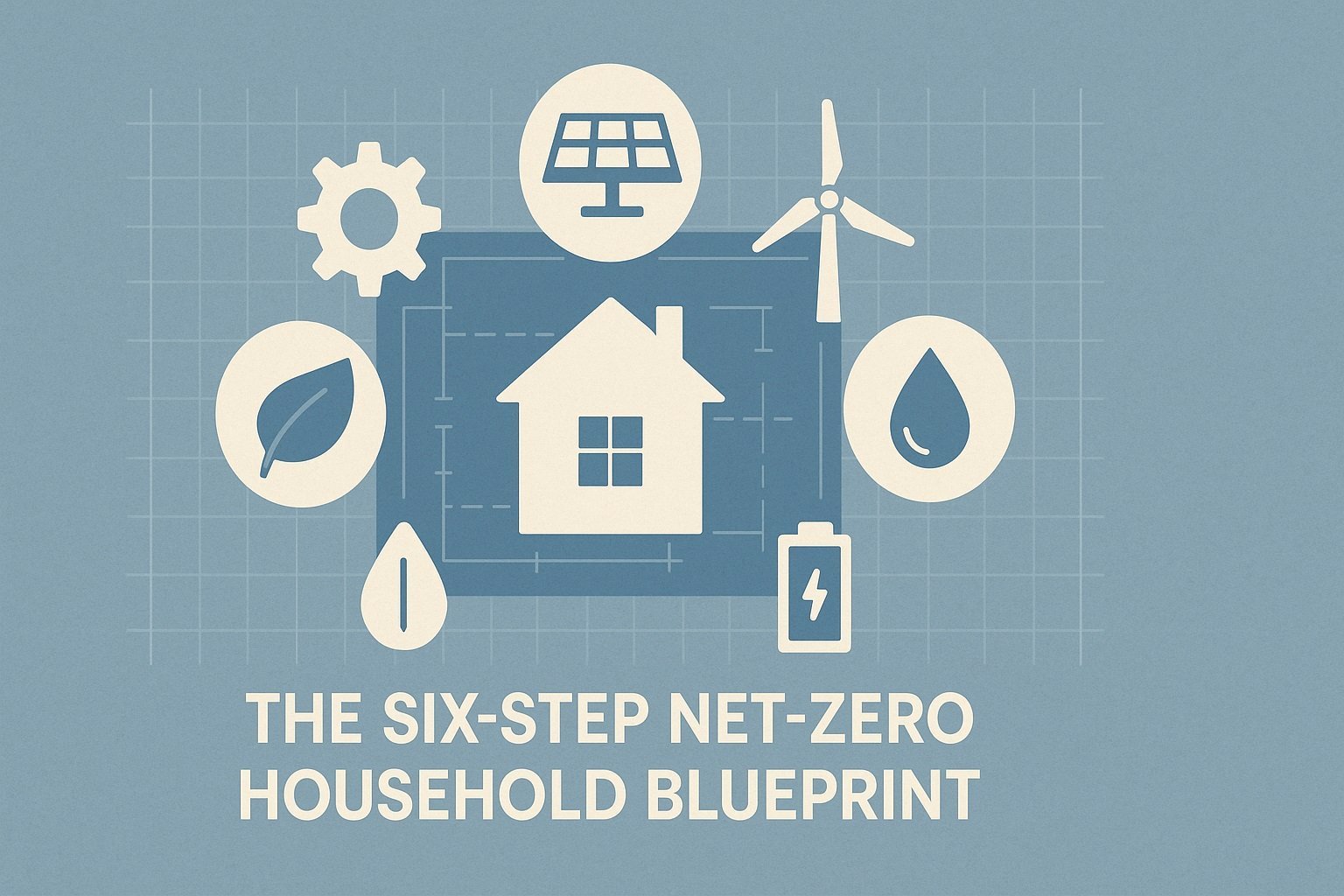
When you are ready to look beyond the easy wins, the following six upgrades form a proven path toward a net-zero energy bill and a near-zero carbon footprint.
-
Audit Your Use
You cannot manage what you cannot measure. Free online calculators combined with the hourly data from a smart meter tell you where every kilowatt-hour goes. -
Seal and Insulate
Filling gaps around doors, windows and attic hatches and topping up insulation can slice heating and cooling costs by fifteen to twenty per cent. Choose draught-proofing tape for tiny gaps, expanding foam for wider holes and at least R-38 in the attic for cold climates. -
High-Efficiency Appliances
ENERGY STAR certified models often pay back the incremental cost in two to six years and keep saving for a decade or more thereafter. When an old refrigerator or washer approaches the end of its life, upgrading rather than repairing locks in lower running costs and avoids an emergency premium. -
Heat-Pump Water and Space Heating
An air-source heat pump moves three units of heat for every unit of electricity consumed. A family of four that swaps a resistance water heater for a heat pump model saves about three hundred dollars and cuts more than one metric tonne of CO₂ annually, with a simple payback of roughly three years. -
On-Site Renewables
Rooftop solar has never been cheaper, thanks in part to a thirty per cent federal tax credit that will remain in place for systems installed through at least 2033. Homeowners typically wipe out sixty to one hundred percent of their electricity bill and, in net-metered regions, may earn credits for feeding surplus power back to the grid. -
Smart Controls and Behaviour Nudges
Pairing learning thermostats with real-time usage dashboards creates a feedback loop that encourages lower-carbon choices, from timing laundry to match solar production to limiting shower length. Behavioural studies find that simple comparative reports showing how your use stacks up against similar homes can trigger sustained savings of five percent or more.
Cost-Benefit Snapshot
| Action | Up-front Cost | Annual Saving | CO₂e Cut | Simple Payback |
|---|---|---|---|---|
| Whole-home LED conversion | £120 | £60 | 500 kg | 2 years |
| Loft insulation top-up | £750 | £210 | 1.2 t | 3.5 years |
| 6 kW solar array + battery | £12,500 | £1,780 | 3 t | 7 years |
The table illustrates a common pattern: the bigger the upfront spend, the higher the absolute annual saving. Yet even the “expensive” solar package delivers a tax-free fourteen per cent internal rate of return, far outperforming most low-risk financial products.
Case Study: The Oxford EnerPHit Renovation
A Victorian terrace in Oxford underwent a deep retrofit conforming to the stringent EnerPHit standard, a Passivhaus benchmark for existing buildings. Phase One involved external wall insulation, triple-glazed windows, mechanical heat-recovery ventilation and a roof-mounted solar array. Airtightness tests recorded dramatic improvements, and modelling projects a ninety-five percent reduction in energy demand compared with the pre-retrofit baseline (cayford.com).
Financially, the homeowner invested around eighty thousand pounds across two phases, offset by grants and a favourable green-home loan. Annual gas consumption plummeted from fourteen thousand kilowatt-hours to under one thousand, while electricity demand dropped eighty percent and is now fully met by the rooftop system during daylight hours. Excess generation covers residual night-time use through a virtual net metering scheme and even yields modest credits. The owner projects a seven-year payback when savings, incentives and export tariffs are combined, after which the property effectively enjoys free energy with near-zero emissions for decades to come.
Lifestyle and Habit Shifts That Multiply Savings
Even the most efficient home leaks money and carbon if daily routines remain wasteful. Adopting a plant-forward diet can trim up to one point five to two point one tonnes of carbon dioxide from an individual’s annual footprint. Swapping beef for beans just once a week nationwide would save seventy-five million metric tonnes of CO₂ equivalent. The cash dividend shows up at the checkout: legumes, vegetables and grains generally cost less per gram of protein than meat.
Implementing a “use what you own” rule, wearing existing clothes longer, repairing electronics and borrowing infrequently used tools cuts embodied carbon and keeps disposable income alive. Research by circular-economy think tanks puts the potential household saving at hundreds of dollars a year through avoided impulse purchases and extended product lifetimes.
Finally, where you bank matters. Some mainstream institutions continue to finance fossil-fuel expansion, but an increasing number of credit unions and challenger banks offer portfolios screened for low-carbon projects. Moving retirement funds or savings accounts to such providers diverts capital toward renewables and efficiency upgrades while shielding your assets from climate-related transition risks.
30-Day Kick-Start Calendar
Week 1 | Foundation
Day 1 – Download your utility’s smart meter app and note hourly baselines.
Day 2 – Inventory every light source and order bulk LEDs for any bulb over twelve watts.
Day 3 – Set programmable thermostat schedules aligned to work and sleep hours.
Day 4 – Conduct a ten-minute DIY draft hunt with an incense stick to locate leaks.
Day 5 – Install weatherstripping on the draughtiest door or window.
Day 6 – Group entertainment electronics onto a single smart strip.
Day 7 – Plan three meat-light meals for the week ahead.
Week 2 | Efficiency Blitz
Day 8 – Lower the water heater temperature to 120°F and fit an insulating jacket.
Day 9 – Collect appliance model numbers and consult ENERGY STAR rebate lists.
Day 10 – Run a full-load cold-wash laundry and note cycle kilowatt-hours.
Day 11 – Vacuum refrigerator coils to improve efficiency.
Day 12 – Schedule a professional energy audit or gather quotes.
Day 13 – Try biking or transit for one errand; record cost and time.
Day 14 – Batch-cook meals to reduce oven usage during peak hours.
Week 3 | Capital Projects Prep
Day 15 – Research local solar incentives and request at least two installer quotes.
Day 16 – Calculate insulation R-values in the attic and make a supply list for the top-up.
Day 17 – Price heat-pump dryers or water heaters, noting utility rebates.
Day 18 – Attend a community workshop on green home loans if available.
Day 19 – Map household behaviour peaks against solar production curves.
Day 20 – Draft a phased retrofit timeline keyed to budget windows.
Day 21 – Install aerators on taps to halve hot water flow with no comfort loss.
Week 4 | Habit Lock-In
Day 22 – Open a spreadsheet tracker for monthly energy and fuel spending.
Day 23 – Switch recurring digital services to renewable-powered providers where possible.
Day 24 – Sign up for a green banking option that discloses fossil-fuel exposure.
Day 25 – Launch a “swap and share” channel with neighbours for infrequently used tools.
Day 26 – Set a recurring calendar reminder to change HVAC filters quarterly.
Day 27 – Host a plant-based dinner and share recipes.
Day 28 – Recheck smart meter data; compare against Day 1 baseline.
Day 29 – Budget for next month’s priority upgrade based on savings already realised.
Day 30 – Celebrate progress and post your negawatt tally on social media to inspire others.
FAQ 

Q1. What is the most cost-effective way to reduce my carbon footprint at home?
Start with air sealing and LED lighting. Combined, they can cut utility spending fifteen percent for a few hundred dollars up front.
Q2. How much can LED lighting really save on an annual electricity bill?
Replacing incandescents with LEDs in a typical home saves about two hundred twenty-five dollars per year, according to the Department of Energy.
Q3. Are solar panels still worth it in 2025 with lower feed-in tariffs?
Yes. A thirty per cent U.S. federal tax credit plus falling hardware prices deliver simple paybacks of seven to ten years even without generous export rates.
Q4. How long does loft insulation take to pay for itself?
With material costs under one thousand pounds and annual savings above two hundred, most loft projects recover investment in three to five years.
Q5. What government incentives are available for heat-pump installations?
ENERGY STAR-certified heat pump water heaters qualify for up to two thousand dollars in U.S. tax credits, and many utilities add extra rebates.
Q6. Can lifestyle changes like Meatless Monday noticeably cut household emissions?
Absolutely. National adoption of one meat-free day per week could reduce annual U.S. emissions by seventy-five million metric tonnes.
Q7. Does unplugging devices at night make a measurable difference?
Eliminating standby draw saves up to one hundred dollars and five percent of total household electricity each year.
Q8. How do smart thermostats learn, and what savings can I expect?
Smart units track occupancy and outdoor weather to auto-adjust set points, typically reducing heating and cooling use eight to ten percent without sacrificing comfort.
(Answers reference the same authoritative sources used throughout the guide, reinforcing credibility for both readers and search engines.)
Related Articles