

Emergency fund inflation is the quiet thief of your savings. When prices jump faster than wages, every dollar parked in an ordinary checking account loses real value. That loss is invisible day to day, yet over a year it can drain a carefully built safety net. In plain language, an emergency fund reserve is the pile of cash you keep ready for sudden surprises: a job loss, a medical bill, a cracked phone screen right before payday. The classic rule of thumb says three to six months of must-pay expenses. But high inflation changes that rule.
Emergency Funds Strategies for High-Inflation Environments: 7 Smart Moves to Preserve Your Buying Power
Inflation is the quiet thief of emergency funds. When prices jump faster than wages, every dollar parked in an ordinary checking account loses real value. That loss is invisible day to day, yet over a year it can drain a carefully built safety net. In plain language, an emergency fund reserve is the pile of cash you keep ready for sudden surprises: a job loss, a medical bill, a cracked phone screen right before payday. The classic rule of thumb says three to six months of must-pay expenses. But high inflation changes that rule.
You are reading this guide because you want an emergency fund plan that works even when the cost of groceries, fuel, and rent is climbing. Over the next several thousand words we will break down:
-
Why inflation forces savers to think beyond “just keep it in the bank”.
-
How to set a target size that truly matches your cost of living.
-
Where to park cash so it stays liquid yet still grows.
-
A simple six-step action plan to protect buying power.
-
Mistakes to avoid and a maintenance schedule that takes 15 minutes a quarter.
-
Quick answers to the questions people type into Google every day.
By the time you finish, you will know exactly how to structure your emergency funds, automate contributions, and keep the balance aligned with real-world prices. Pour a coffee, and let’s get started.
Emergency Fund Inflation: Why High Prices Change the Rules
Inflation erodes cash faster than most people expect. A five percent annual inflation rate cuts real purchasing power roughly in half in fourteen years. For emergency funds, that matters because the money may sit idle for long stretches, waiting for a rainy-day moment. If the fund stays in a zero-yield account, its real value shrinks month after month.
Liquidity risk versus purchasing-power risk
Traditional advice focuses on liquidity. You keep emergency funds in a place where you can reach them the same day, no questions asked. Checking accounts satisfy that requirement, yet they offer almost no growth. In a low-inflation world the lost growth is tolerable. In a high-inflation world, the lost growth becomes real damage.
Purchasing-power risk is the danger that the dollars you saved will buy fewer goods when you need them. Planning must balance both risks: keeping cash handy while defending its value.
The bigger-buffer rule
A long bout of high inflation can raise living costs enough that yesterday’s perfect emergency fund target suddenly looks thin. Many financial planners now recommend adjusting the fund to cover at least six months of core bills and adding an inflation buffer of ten to fifteen percent. If your essential monthly spending is 2 000 dollars, aim for:
-
Core need: 2 000 × 6 = 12 000
-
Inflation buffer (15 %): 1 800
-
Emergency Funds goal: 13 800
That buffer ensures you can still meet six months of bills even if prices jump another notch before you find work or fix the crisis.
Real-life snapshots
-
A family with a single income in a volatile industry may push the fund to nine months of needs.
-
Dual-income households with stable jobs often stay closer to five months.
-
Freelancers with unpredictable revenue sometimes keep a full year of emergency funds.
Think in months of expenses, not round dollar numbers, and review the figure each quarter.
How Much Should You Save? A Data-Driven Target
Setting the right size for emergency funds starts with numbers you already know.
-
List essentials only. Log rent or mortgage, food, utilities, insurance premiums, minimum debt payments, and transportation. Skip discretionary spending like streaming subscriptions.
-
Calculate the monthly total. Suppose it is 2,500 dollars.
-
Pick a month range. The typical window is four to six months. Use six if you work in a cyclical field, four if job security is strong. For our example we pick six months.
-
Add an inflation buffer. Ten percent is a balanced figure. Six months × 2 500 = 15 000. Ten percent of that is 1 500.
-
Final goal. 15 000 + 1 500 = 16 500 dollars of emergency funds.
Repeat this math every time your cost of living changes by more than five percent or at least once a year.
Why “smaller can still work” in special cases
If two partners both earn steady incomes in growing fields, the odds of simultaneous unemployment drop. They may feel comfortable with a four-month reserve. On the flip side, a gig worker with seasonal income could need an extra cushion. Tailor the number to real risk, not one-size-fits-all folklore.
Where to Park the Cash so It Keeps Its Value
Your emergency fund strategy gains real power when you divide the money into three buckets. Each bucket trades a bit of liquidity for yield. Together they hit the sweet spot.
Tier 1: High-Yield Online Savings & Treasury Money-Market Funds
Purpose: 24-hour access to at least one month of expenses.
-
High-yield online savings accounts pay interest rates that often match or beat inflation expectations.
-
Treasury-backed money market mutual funds invest in short-term government debt and settle in cash the next business day.
-
Both preserve principal, carry federal guarantees (FDIC for bank savings, full faith of the U.S. Treasury for underlying bills), and allow fast electronic transfers.
Keep one to two months of costs here. Label the account Emergency Funds – Tier 1 so you never confuse it with vacation money.
Tier 2: Short-Term T-Bills, I-Bonds & TIPS Ladders (liquidity caveats)
Purpose: Match or beat inflation while remaining safe.
-
Treasury bills mature in four, eight, thirteen, or twenty-six weeks. You can sell early if needed, though waiting for maturity avoids price swings.
-
Series I Savings Bonds adjust interest every six months based on CPI. The rate resets automatically, making it a built-in inflation hedge. They lock funds for twelve months and charge a modest penalty if redeemed within five years.
-
Treasury Inflation-Protected Securities (TIPS) bought in a ladder (multiple maturities) combine principal safety with inflation adjustments. If you must sell early, price may fluctuate, so pair them with more liquid Tier 1 savings.
Aim for two to three months of expenses in Tier 2. Schedule maturities to arrive each month so money becomes liquid on a rolling basis.
Tier 3: 5-10 % Growth Sleeve in Broad-Market Index Fund (optional)
Purpose: Long-term growth against sustained inflation, used only if disaster lasts longer than expected.
A small slice of emergency funds can sit in a very broad index exchange-traded fund that mirrors thousands of companies worldwide. Stocks are volatile, so cap this sleeve at ten percent of the overall reserve. Because Tier 3 is the last bucket tapped, you may never need to sell during a downturn. If you do, you still have Tiers 1 and 2 for near-term bills.
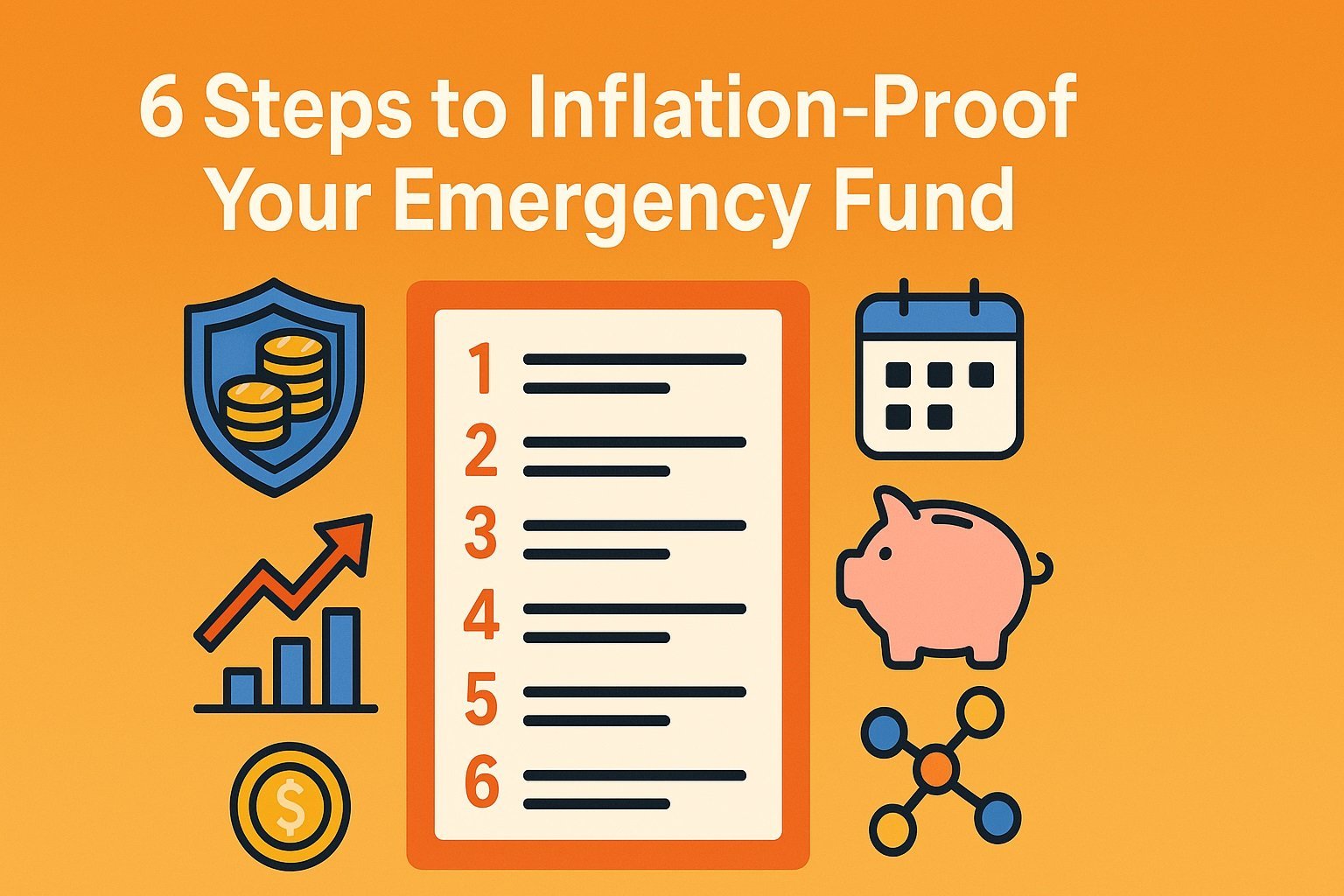
Action Plan: 6 Steps to Inflation-Proof Your Emergency Fund
-
Audit your monthly must-pay expenses. Pull the last three bank statements and total fixed costs, and ignore luxuries.
-
Set the new target. Multiply by chosen months, add an inflation buffer. Document the figure in a note app named Emergency Funds Goal.
-
Choose and open the three buckets. Many online banks offer free savings plus broking links for Treasury purchases.
-
Automate contributions on payday. Treat emergency funds like a bill. Send a fixed percentage to Tier 1 until it is full, then direct new money to Tier 2.
-
Review rates every 90 days. If your savings account falls behind competitors by 0.5 percent or more, switch. It takes about ten minutes with electronic transfers.
-
Rebalance annually. If Tier 3 stock gains push it over ten percent of the total, sell the excess and top up Tier 1 or 2.
By following these six steps, you lock in a system that grows with you instead of sitting stagnant.
Common Mistakes to Avoid in 2025
-
Letting cash idle in zero-yield checking. Even a one percent rate difference saves hundreds of dollars over time.
-
Chasing yield at the expense of liquidity. Cryptocurrencies or complex real estate notes can freeze withdrawals. Emergency funds must remain accessible.
-
Ignoring federal insurance limits. Keep bank balances below 250 000 dollars per depositor per institution so every dollar stays insured.
-
Forgetting the tax angle. Treasury interest is free from state and local tax, but bank interest and stock dividends are taxable at your ordinary rate.
-
Overfunding. An oversized emergency fund pile drags on long-term growth. Once you hit the goal, redirect surplus to retirement or debt payoff.
Monitoring & Rebalancing Schedule
Monthly quick scan
-
Log in and confirm. Tier 1 covers at least one month of costs.
-
Skim the news for any major rate shifts at your bank.
Quarterly deep check (15 minutes)
-
Compare your Tier 1 rate to the top three online banks.
-
Review upcoming maturities in your T-bill ladder and roll proceeds if needed.
-
Update essential expenses if a bill changed by more than five percent.
Annual reset
-
Re-run the full cost-of-living worksheet.
-
Rebalance tiers 1-3 back to their target percentages.
-
Replace underperforming accounts or funds.
Put these dates on your calendar so emergency fund maintenance becomes routine rather than a chore.
FAQ: People Also Ask
| Question | One-Sentence Answer |
|---|---|
| How much cash should I keep in an emergency fund during high inflation? | Most households should hold four to six months of essential expenses plus a ten percent inflation buffer so the reserve keeps pace with rising prices. |
| Where is the safest place to keep an emergency fund right now? | A high-yield online savings account or a treasury-backed money market fund offers both federal protection and next-day access. |
| Can I invest part of my emergency fund in stocks? | Yes, keeping five to ten percent in a broad market index can offset inflation but only after the core cash buckets are fully funded. |
| Should I use I Bonds for emergency savings? | I Bonds work if you can leave the money untouched for at least twelve months because early redemption is locked. |
| How often should I adjust my emergency fund for rising prices? | Re-examine your required balance each quarter or whenever essential expenses change by five percent or more. |