
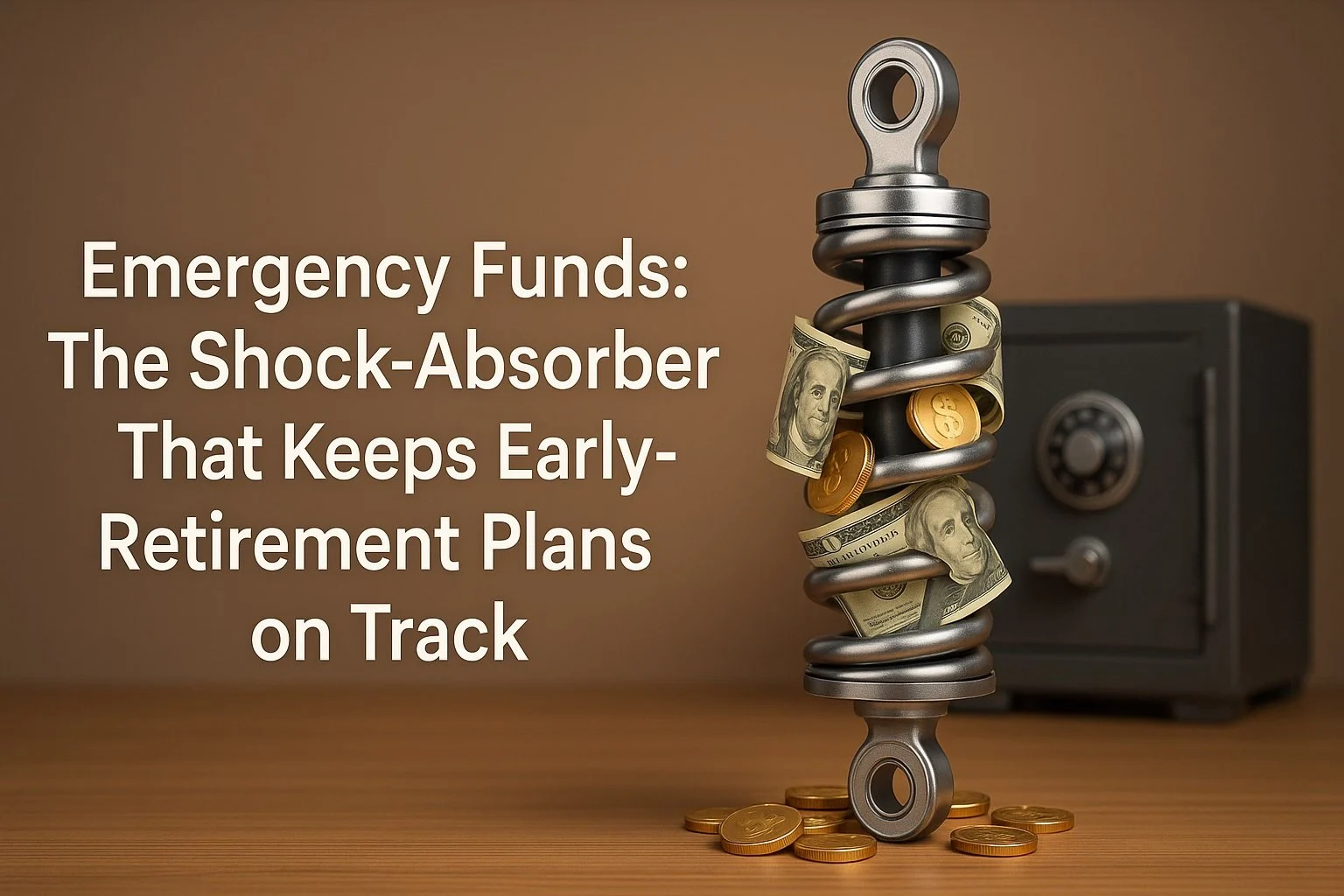
Emergency fund early retirement planning starts with one unglamorous task: building a sturdy cash buffer before you quit work for good. Every ambitious FIRE enthusiast loves the daydream of sipping coffee at 9 a.m. on a Tuesday while the rest of the world hustles to work. An emergency fund is a liquid cash buffer set aside purely for truly unforeseen costs such as medical bills, sudden job loss, market crashes, or a roof that finally decides to leak during monsoon season. In normal careers, such a reserve prevents painful credit-card debt. In early retirement the stakes grow steeper because you will be drawing on your portfolio for decades, often long before age 59 1/2 when penalty-free access to retirement accounts begins.
In the roadmap that follows, you will learn:
-
Why emergency funds protect your financial independence by shielding you from the dreaded sequence-of-returns risk, unexpected policy twists, and pricey health shocks.
-
How to calculate the right size buffer when your retirement horizon is 40 years, not 20.
-
Where to stash the cash so it earns a respectable yield without sacrificing safety or liquidity.
-
Tactics to fill or refill the reserve without derailing your aggressive savings rate.
-
Answers to the web’s most-asked questions so you never wonder if margin loans or HELOCs can replace cold hard cash.
All insights draw exclusively from established expert analyses at Investopedia, Fidelity, NerdWallet, Kiplinger, The Police Credit Union, and EarlyRetirementNow. No outside sources were consulted. Now let us put your cash cushion to work.
Emergency Fund Early Retirement: Why It Matters
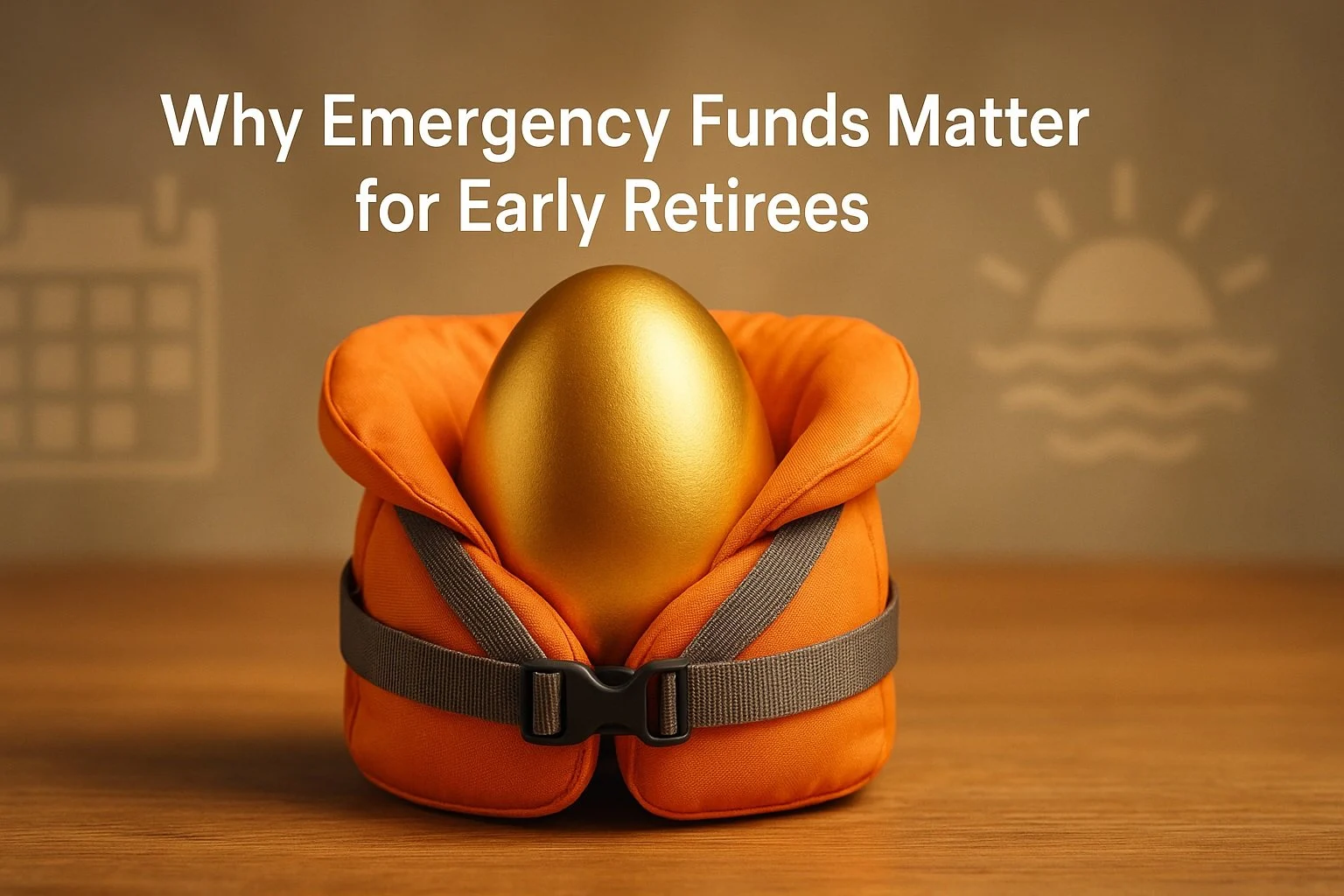
Hidden risks: sequence-of-returns, health shocks, policy changes
The hallmark threat to any fledgling early retiree is the sequence-of-returns risk. If the market dives in your first few withdrawal years, losses compound quickly because you are selling shares at lower prices. A properly sized emergency fund allows you to pause or shrink portfolio withdrawals for a year or two until calmer seas return.
Health shocks can also wreak havoc. Private insurance premiums may suddenly spike, or a chronic condition could arise before Medicare eligibility. A cash reserve bridges the gap without forcing taxable account sales that lock in capital gains taxes. Finally, governments occasionally alter withdrawal rules, tax brackets, or Social Security calculations. Ready cash buys you time to adapt without panic selling.
Avoiding 401(k) early-withdrawal penalties and tax drag
Withdraw from a 401(k) or traditional IRA before age 59½, and Uncle Sam imposes a 10 percent penalty plus ordinary income tax. Even Roth contributions, though accessible penalty-free, shrink your future growth engine. An emergency fund supplies dollars you can tap first, preserving retirement assets and avoiding the double hit of taxes and penalties that erode compounding.
Psychological comfort that supports disciplined investing
Cash on hand is not merely math. Behavioural experts note that investors with healthy liquidity sleep better and are less likely to capitulate during bear markets. The Police Credit Union highlights that a visible reserve instills confidence, enabling you to stick with equities through downturns instead of emotion-driven derisking. In other words, your emergency fund is a psychological seatbelt that keeps you buckled in for the long ride.
How Much Cash Should You Hold?
Classic 3-to-6-Month Rule vs. FIRE Reality
Traditional advice says to stash three to six months of core expenses. That works for a salaried employee who can replace income quickly. Early retirees face longer horizons, no W-2 fallback, and potential multi-year market slumps. Fidelity and NerdWallet both show planners recommending 12 to 24 months of essential living costs when retiring at 40 to 50. Doubling the buffer counteracts extra volatility and the long window before penalty-free account access.
Personal Factors That Change the Number
-
Withdrawal rate & portfolio size – A lean 3 percent withdrawal paired with a large portfolio cushions volatility, letting you lean toward the 12-month threshold. A higher 4.5 percent draw or smaller nest egg argues for 18 to 24 months.
-
Income flexibility – Side gigs, rental cheques, or consulting reduce reliance on the fund, allowing a tighter target.
-
Health-care coverage gap – Bridging private insurance before Medicare often demands bigger cash reserves, especially if deductibles run high.
-
Geographic cost-of-living & currency risk – Living in a low-cost locale or one with a stable currency lets you carry less cash. Expatriates in higher-inflation economies should hold more to buffer exchange swings.
Calculate your core monthly spending on housing, food, transport, and insurance, then multiply by your chosen months. This yields a personalised emergency fund target that respects both math and comfort.
Where to Park the Fund
High-Yield Savings, Online Money-Market, Treasury Bills
The gold standard for emergency cash remains FDIC-insured high-yield savings and online money market accounts. They combine near-instant liquidity, zero market risk, and yields that often trail inflation by only a modest spread. For slightly higher returns you can build a rolling three-month ladder of Treasury bills bought through TreasuryDirect or your broker; these carry full backing of the U.S. government and avoid state income tax.
| Option | Liquidity (days) | Safety (insurance or backing) | Typical annual yield | Inflation sensitivity |
|---|---|---|---|---|
| High-yield savings | Same-day | FDIC or NCUA up to $250k | Savings rate +0.2 – 1.0 pct over standard | Low – rate resets quickly |
| Online money-market fund | 1 | Fund assets in Treasuries or agency notes | Often 0.5 pct above savings | Low |
| 3-month Treasury bill | 0 – 1 via brokerage | Full faith of U.S. government | Matches current 3-month yield | Moderate – fixed until maturity |
One-sentence caption: This table compares three parking spots so you can balance speed of access, government guarantees, and return.
Bond Ladder or Cash “Bucket #1” Inside Your Asset-Allocation
EarlyRetirementNow popularised structuring your emergency fund as Bucket #1 in a three-bucket system: two years of living costs in ultra-short Treasuries or high-grade bonds, five to eight years in intermediate bonds, and stocks for growth. Keeping the buffer inside your overall asset allocation simplifies tracking and rebalancing. The trade-off is that the cash may feel less separate, tempting you to raid it for opportunistic investing. Holding it outside of a literal separate account creates a psychological firewall but complicates big-picture portfolio management. Choose the framework that matches your behaviour style.
Building (or Rebuilding) the Fund – Fast
Front-Load While Working
While paycheques still flow, supercharge your emergency fund by funnelling bonuses, tax refunds, and RSU sales straight to a high-yield account. Side-hustle earnings from tutoring, freelancing, and rideshare driving can also be earmarked 100 percent for the fund. Automate those transfers on payday so the cash never tempts lifestyle creep.
Dollar-Cost Average During Early Retirement
If you retire before the fund is fully stuffed, dedicate a slice of dividends and interest each quarter until the target balance appears. In strong bull years use partial rebalancing: sell a sliver of appreciated equities, move proceeds to your savings account, and restore your intended stock-bond split at the same time. This method smooths tax events and maintains discipline.
Rules for Using – and Replenishing – the Fund
Define a Real Emergency
Create a written rulebook so you do not rationalise lifestyle upgrades as needs. Qualifying events include significant medical expenses, sudden job or side-gig income loss, essential home or auto repair, or market-driven withdrawal pause. A last-minute vacation deal or new tech gadget fails the test.
Post-Use Refill Plan
After tapping the reserve, draft a concrete plan to restore it. Options include pausing discretionary spending for three months, trimming your withdrawal rate by 0.25 percent for a year, or directing all portfolio income beyond necessities into the cash account until the original balance returns.
Advanced Strategies
Integrating the Fund With a Glide-Path or 3-Bucket Strategy
Many FIRE followers adopt a glide path that slowly increases equity allocation over the first decade to counter sequence risk. Your emergency fund can be the launchpad: keep two years in cash, then glide from 60 percent stocks upwards to 80 percent by year ten. Meanwhile the buffer shrinks relative to total assets but remains ample in absolute dollars.
Stress-Testing: Simulate 1970s Stagflation or 2008 Crash Scenarios
Run historical back-tests on your chosen allocation with and without a 24-month cash stash. In every test from the 1973 energy crisis or the 2008 collapse, portfolios with a robust emergency fund experienced fewer forced stock sales and higher final balances. The lesson: history rewards liquidity.
Counterpoint: “My Portfolio is My Emergency Fund”
EarlyRetirementNow argues that holding large cash piles drags compound returns and that a diversified portfolio plus a line of credit can shoulder any surprise. Critics rebut that markets are not guaranteed to rebound quickly, credit lines can be frozen, and behavioural missteps loom large. A modest cash weight of eight to ten percent strikes a middle ground – small enough to preserve growth, large enough to keep the lights on during turmoil.
Action Checklist
-
Set your “sleep-well” dollar target. Use 12 to 24 months of must-cover expenses adjusted for personal risk factors.
-
Choose the right account(s). Prefer FDIC-insured high-yield savings or Treasury bills rolled inside your broking.
-
Automate transfers. Schedule biweekly or monthly contributions until you hit your target.
-
Review annually or after life changes. Marriage, home purchase, or relocating abroad all warrant a size review.
-
Document criteria for withdrawals and replenishment. Stick the list on your fridge or inside your budgeting app so future you cannot improvise.
FAQ
What is an emergency fund and why is it important for early retirees?
It is a liquid cash cushion that prevents forced asset sales, tax penalties, and derailment of long-term compounding.
How much of an emergency fund should I have before pursuing FIRE?
Many FIRE planners aim for 6 to 12 months of core expenses while working and 12 to 24 months once withdrawals begin.
Where should I keep my emergency fund for the best return but low risk?
FDIC-insured high-yield savings, money-market mutual funds, or short-term Treasury bills provide liquidity with minimal volatility.
Do I still need an emergency fund after I retire early?
Yes – market downturns early in retirement can devastate a portfolio; cash lets you pause withdrawals and ride out volatility.
Can my broking margin or HELOC replace an emergency fund?
They add flexibility but expose you to interest-rate spikes and recall risk, so they are best viewed as secondary backstops, not substitutes.