An emergency fund is not your “extra money.” It’s your financial fire extinguisher, the thing you grab when life catches fire. That’s why the goal of investing in your emergency fund for liquidity isn’t to “beat the market.” It’s to earn a reasonable return while staying instantly usable when the unexpected hits.
In my experience, people run into trouble when they treat an emergency fund like a mini-portfolio. They lock cash into accounts with withdrawal friction, chase rates across too many banks, or, worst of all, put it in assets that can drop the week they need it.
Here’s the thesis: You can “invest” an emergency fund safely by optimizing for liquidity first, then yield, using a tiered structure. You’ll keep a small amount for same-day needs, a bigger chunk in high-liquidity cash vehicles, and only the “rarely needed” portion in options that pay more but still protect access.
Quick Takeaway: The best emergency fund “investment” is a system, not a single account.
Quick Answer: Can You Invest an Emergency Fund and Still Keep Liquidity?

Yes, but only if you define “invest” the right way.
For emergency cash, “investing” means placing money into high-safety, high-liquidity cash equivalents (like FDIC/NCUA-insured accounts, government money market funds, or short T-bills held to maturity). It does not mean stocks, crypto, long-term bonds, or anything that can drop 10–30% when you need it most.
Featured snippet-style answer (direct):
If you want to invest your emergency fund for liquidity, use a tiered approach: keep 1–2 weeks of expenses in checking for instant access, 1–3 months in a high-yield savings account or money market, and the remaining portion in short-term Treasury bills or a no-penalty CD so it stays safe, accessible, and earning interest.
Why this approach works: Emergencies are unpredictable, but your cash access needs are not. Some emergencies require money today (car tow). Others require money in 2–5 days (medical bill). Rarely, you’ll need a larger amount over weeks (job loss).
Pro Tip: If you’re optimizing yield, do it mainly on the Tier 2 + Tier 3 portion, never on the “need it today” cash.
How to Invest Your Emergency Fund for Liquidity Using a 3-Tier System
Most people ask, “Where should I put my emergency fund?” The better question is, how fast might I need each part of it?
Tier 1: Instant Access (0–48 hours)
This is cash you can use immediately via debit card, ATM, or same-day transfer.
Target amount: typically 1–2 weeks of essential expenses (rent/mortgage, groceries, utilities, gas).
Example: If essentials are $3,000/month, Tier 1 might be $750–$1,500.
Tier 2: Fast Access (2–7 days)
This is the workhorse tier. It should be easy to transfer and stable.
Target amount: typically 1–3 months of essential expenses.
This is where HYSA or money market options shine.
Tier 3: Backup Access (7–30+ days)
This is for bigger, less frequent events: job loss, major home repair, and emergency travel.
Target amount: often 3–6 months (or more if income is variable).
This tier can be placed into slightly higher-yield cash tools as long as it stays safe and reasonably accessible.
A simple analogy: Consider Tier 1 as the cash in your pocket, Tier 2 as the cash in your wallet, and Tier 3 as the cash in a safe at home; it is still yours and accessible, but not instantly.
Expert Insight: Industry experts agree that a tiered emergency fund reduces the temptation to chase yield with the “urgent cash” portion while still improving overall returns.
The Non-Negotiables: Liquidity, Safety, and Friction (The Rules That Keep You Out of Trouble)
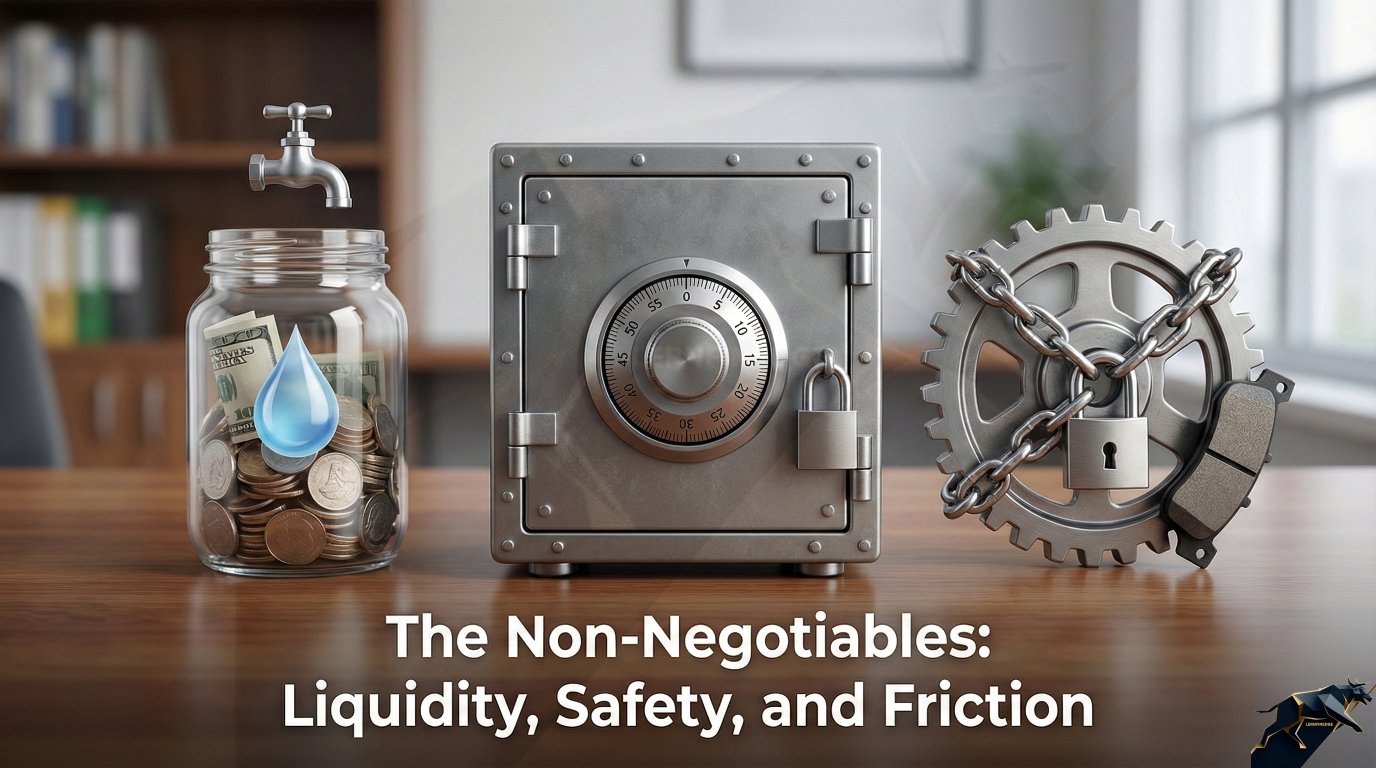
Establish these rules before selecting accounts. They prevent the classic “I had money, but I couldn’t access it” disaster.
Rule 1: Liquidity beats yield.
If an option pays slightly more but adds delays, penalties, or market risk, it’s usually not worth it.
Ask, “If I need $2,000 on a Friday night, what happens?”
Rule 2: Safety must be explicit, not assumed.
In the context of emergency funds, the term “safe” refers to:
- FDIC insurance (banks) or NCUA insurance (credit unions) typically up to $250,000 per depositor, per institution, per ownership category [Source]
- Alternatively, U.S. Treasury securities held to maturity are backed by the U.S. Treasury.
Rule 3: Reduce friction (transfer time is a hidden risk).
Research shows people abandon financial systems that are too complicated to maintain consistently [Source]. If your emergency fund is spread across five places with different logins and transfer rules, you’ve created a “money maze.”
Rule 4: Know your access lanes.
You want at least two ways to reach Tier 1 and Tier 2 cash:
- Debit/ATM
- ACH transfer to checking
- Checks
- (Sometimes) wire for large urgent needs
Quick Takeaway: If you can’t explain how you’ll get the money in 1 day, 3 days, and 7 days, you don’t have a liquidity plan.
Best Places to “Invest” Emergency Cash in the U.S. (Ranked by Liquidity)
Here are the most common vehicles and how they fit into the tier system.
High-Yield Savings Accounts (HYSA)
For most households, HYSA is the Tier 2 foundation.
Pros: FDIC/NCUA insured, straightforward transfers, simple.
Cons: Transfer times vary; rates change; some banks have limits or holds.
Money Market Deposit Accounts (MMDA)
These are bank deposit accounts (often FDIC-insured) that may pay competitive rates.
Pros: Often FDIC insured, sometimes check-writing.
Cons: Terms and limits vary by institution.
Money Market Mutual Funds (MMF) at a brokerage
This can be excellent for Tier 2 or Tier 3 if you choose carefully.
Pros: Often higher yields; fast internal brokerage settlement; good for disciplined savers.
Cons: Not FDIC insured; different fund types (government vs prime); check how quickly you can withdraw to your bank.
Cash Management Accounts
Brokerage “cash” accounts may sweep funds into banks or money market funds.
Pros include convenience, the availability of debit cards, and occasionally competitive yields.
Cons: “Sweep” details matter; insurance coverage depends on structure.
Checking (yes, really)
Checking is the Tier 1 tool, not the growth tool.
Pros: Instant spending access.
Cons: Usually low yield.
Pro Tip: Your emergency fund is allowed to be “boring.” Boring is what saves you at 2 a.m. when your furnace dies.
Comparison Table: Emergency Fund Options by Liquidity, Safety, and Best Use
Use this table to match tools to tiers without overthinking.
Option 1: Checking accounts offer the best liquidity, speed, safety profile, and yield potential, but be cautious of potential overdraft fees. A same-day bank deposit, which is often FDIC insured, has a low risk of overspending and typically takes 1 to 3 business days for transfers, while a Money Market Deposit Account (MMDA) also takes 1 to 3 business days and is often FDIC insured but may have transfer holds or limits. Medium rules vary. The Government Money Market Fund typically offers same- or next-day access for transfers within a brokerage, but it is not FDIC insured as it invests in government securities; therefore, it is important to understand the withdrawal process. Treasury Bills (held to maturity) have specific maturity dates. U.S. Treasury-backed Medium–High If sold early, the price can vary. The terms for a traditional CD3 have a low yield unless a penalty is paid; it is FDIC/NCUA insured and has a medium early withdrawal penalty. Traditional CD3 has a low yield unless a penalty is paid; it is FDIC/NCUA insured and has a medium early withdrawal penalty. Market risk is medium, meaning it can decrease when interest rates rise.
Quick Takeaway: For most people, the “sweet spot” is Tier 2 in HYSA and Tier 3 in T-bills/no-penalty CD, with Tier 1 in checking.
Treasury Bills: A Simple T-Bill Ladder for Tier 3 Liquidity (Step-by-Step)
If you want more yield without taking stock-like risk, short Treasuries can be useful if you structure them for access.
Why T-bills fit emergency funds (occasionally)
T-bills are short-term U.S. T-bills are short-term U.S. Treasuries that range from weeks to months. When held to maturity, the return is predictable. That makes them a potential Tier 3 tool.
The catch: liquidity depends on your ladder design.
If you buy one T-bill that matures in 6 months, you’ve created a 6-month lock (unless you sell early, which may create a gain/loss).
A practical ladder (example)
Let’s say your Tier 3 is $12,000. You could split it like this:
- $3,000 maturing in ~4 weeks
- $3,000 matures in ~8 weeks.
- $3,000 maturing in ~13 weeks
- $3,000 maturing in ~17 weeks
As each rung matures, you reinvest it unless you need cash.
Step-by-step setup
- Decide your Tier 3 amount (ex: 3–6 months of essentials).
- Split it into 4–8 equal pieces.
- Buy staggered maturities.
- Set reinvestment rules: auto-reinvest unless needed.
- Keep Tier 1 and Tier 2 untouched for immediate needs.
Expert Insight: In my experience, ladders work best when you keep them small, simple, and automated; complex ladders break when you’re stressed.
I Bonds and Emergency Funds: Where They Fit (and Where They Don’t)
My bonds are often misunderstood. They’re not a Tier 1 or Tier 2 tool.
The liquidity rules that matter
- I Bonds generally can’t be redeemed in the first 12 months [Source].
- If I Bonds are redeemed before 5 years, there is usually an interest penalty, which is typically equal to the last 3 months of interest earned.
This means that I Bonds are not suitable for money needed in the immediate future, such as “I might need this next week” situations.
Where can they fit?
If you already have a fully funded Tier 1 + Tier 2, I Bonds can sometimes be used as part of a deep резерв (backup reserve) for longer-term emergencies, especially if you’re protecting purchasing power.
A clean approach
- Build Tier 1 and Tier 2 first
- Use I Bonds only for “rare catastrophe” reserves
- Don’t count them in your “money I can access fast” number.
Quick Takeaway: I Bonds can support a long-term safety net, but they’re not a liquidity-first emergency fund tool.
In certain circumstances, CDs can improve your liquidity plan, but in others, they can be harmful.
CDs can either strengthen your liquidity plan or sabotage it.
No-Penalty CDs (often helpful)
A no-penalty CD can serve as either Tier 2 or Tier 3 because it allows withdrawals without penalty after a short initial period.
Ideal use case: You want a stable rate but want the option to exit if needed.
Watch out: Terms differ by institution; “no penalty” does not always mean “instant cash today.”
Traditional CDs (use carefully)
Traditional CDs may fit Tier 3 only if:
- You have enough Tier 1 + Tier 2 cash.
- You’re okay with early withdrawal penalties.
- You can choose shorter maturities or create a CD ladder.
A simple CD ladder (emergency-friendly version)
Instead of one big 12-month CD, split into:
- 3-month, 6-month, 9-month, and 12-month rungs
That way, cash becomes available regularly.
Pro Tip: If a CD’s early withdrawal penalty could cost more than a month of interest, it’s probably not helping your emergency liquidity plan.
How to Invest Your Emergency Fund for Liquidity Without Transfer Surprises (Logistics That Matter)
Liquidity fails in the details. This is where “great on paper” becomes “painful in real life.”
Transfer timing (ACH is not instant)
Many bank transfers take 1–3 business days. Weekends and holidays can stretch that.
Best practice: Test a transfer before you need it. Move $25 to see the timeline.
Holds, verification, and fraud triggers
Banks may hold transfers for new linked accounts or unusual activity. That’s normal security behavior.
Best practice: Link accounts early, verify identity, and avoid last-minute setup.
The FDIC/NCUA coverage structure
If you spread money across institutions, you can increase coverage and reduce single-point failure risk.
Best practice: Keep Tier 2 in one primary place for simplicity, but consider a backup lane.
Tax basics (keep it simple)
- HYSA/MMDA interest is typically reported on 1099-INT.
- Treasuries and brokerage products may have different tax reporting forms.
- Rates vary; keep records organized.
Research shows households often underestimate how “paperwork friction” can delay financial decisions under stress [Source].
Quick Takeaway: Liquidity isn’t only the product; it’s the process of getting cash into your checking account fast.
Advanced Optimization: Earn More Yield Without Breaking Liquidity
Once your tiers are solid, you can optimize effectively without making your emergency fund a secondary source of income.
Use a “home base” high-yield savings account (HYSA) along with one additional enhancer.
Pick one primary HYSA as Tier 2. Then add one Tier 3 tool:
- T-bill ladder or
- no-penalty CD or
- government money market fund
Exceeding that amount typically leads to unnecessary complexity without providing significant benefits.
Automate contributions.
Set an automatic transfer each payday. Even $25–$100 builds resilience.
Create a “rate change rule.”
Instead of chasing every rate bump, use a rule like
- “I only switch if the difference is meaningful and lasts 90+ days.”
Industry experts agree that consistency beats optimization when it comes to financial safety nets.
Protect against the “oops, I spent it” problem.
If your emergency cash sits next to your spending money, it’s easier to drain.
Fix: Keep Tier 2 in a separate institution or at least a separate account nickname (“Do Not Touch”).
Expert Insight: In my experience, the biggest yield improvement comes from moving money from zero-interest checking to a HYSA, not from chasing tiny differences across providers.
Common Mistakes That Destroy Liquidity (and What to Do Instead)
If you only read one section, read this.
Mistake 1: Invest the emergency fund in stocks.
Stocks can be down exactly when layoffs rise. That’s the correlation you don’t want.
Do instead: Keep emergency cash in cash equivalents; invest long-term money in long-term assets.
Mistake 2: Using long-duration bond funds for “safety”
Bond funds can lose value when interest rates rise. That’s not liquidity-friendly.
Do instead: Prefer short, predictable cash tools (HYSA, T-bills to maturity).
Mistake 3: Locking too much in CDs
Early withdrawal penalties can turn a “safe” product into an expensive one.
Instead, consider laddering CDs or using no-penalty versions.
Mistake 4: Over-fragmenting accounts
Five accounts can become five failure points.
Do instead: one primary Tier 2 account, one Tier 3 enhancer, and a tested transfer lane.
Quick Takeaway: Your emergency fund should be boringly reliable, not “optimized to the last basis point.”
Troubleshooting: What to Do When You Need Cash Fast (Real-World Playbook)
This is the “oh no” section because emergencies don’t schedule themselves.
Scenario A: You need money today.
- Use Tier 1 for checking cash
- If insufficient, use Tier 2 if it has debit/check access (some do).
- Consider same-day options like ATM or immediate card payments (depending on your setup).
Scenario B: You need money in 2–3 business days.
- Initiate ACH from HYSA/MMDA to checking
- If you have a brokerage MMF, sell/withdraw according to your brokerage’s process.
- Please document the steps now to avoid any uncertainty later.
Scenario C: Your transfer is delayed or held.
- Call the institution and ask for the exact hold reason.
- Use your backup lane (credit card float, then pay from Tier 2 once funds arrive).
- Keep a small “buffer” in checking to reduce this risk
Scenario: D: Big emergency (job loss)
- Shift into “minimum viable budget” mode immediately
- Use Tier 2 monthly, then Tier 3 ladder maturities as they come due
- Apply for assistance programs early if needed (delays are common).
Pro Tip: A credit card can act as a 30-day bridge only if you already have the cash to pay it off shortly after.
7-Day Action Plan: Build a Liquidity-First Emergency Fund System
You don’t need a finance degree. You need a plan you’ll follow.
Day 1–2: Define your number
- Calculate essential monthly expenses.
- Choose a target: 3–6 months (or more if income is unstable).
- Decide your tier split (example: 10% Tier 1, 40% Tier 2, 50% Tier 3).
Day 3–4: Set Tier 1 + Tier 2
- Keep Tier 1 in check
- Move Tier 2 to a HYSA/MMDA
- Link accounts and test a small transfer
Day 5–6: Add Tier 3 enhancer (optional)
Choose one:
- T-bill ladder or no-penalty CD or government money market fund
Keep it simple.
Day 7: Automate and document
- Set auto-transfers
- Write down “How to access cash” steps in one note
- Add an annual review reminder
Quick Takeaway: The best emergency fund is the one that’s easy to access and maintain, especially under stress.
Call to action: If you’re building your system from scratch, start with Tier 2 in a HYSA and only add Tier 3 tools after your transfers are tested and reliable. Your future self will thank you.
FAQ
Q1: Should I invest my emergency fund in the stock market?
A1: Generally no—stocks can drop when you need cash most. Use cash equivalents for liquidity and stability.
Q2: What’s the best account for an emergency fund in the U.S.?
A2: For most people, a high-yield savings account is ideal for the main portion because it’s insured and simple to access.
Q3: Are money market funds safe for emergency savings?
A3: They can be, especially government money market funds, but they’re not FDIC-insured, and access depends on brokerage withdrawal steps.
Q4: Can I use T-bills for my emergency fund?
A4: Yes, for a Tier 3 “backup” portion if you build a ladder and plan to hold to maturity for predictable access.
Q5: How much should my emergency fund be?
A5: Many households aim for 3–6 months of essential expenses, more if income is variable or job security is lower.