As 2026 approaches, now is the perfect time to take control of your personal finances, and the fastest way to do that is to build a smarter 2026 personal budget that sets you up for success. A good budget isn’t a punishment. It’s a roadmap that reduces stress, makes spending intentional, and keeps your goals moving even when life gets messy.
From what I’ve seen, the best budgets aren’t the ones that are the most strict; they’re the ones that are the most clear. They tell you what matters, protect you from surprises, and give you a simple routine to stay on track. Research indicates that people are more consistent when their plan is simple, automated, and reviewed regularly, not when it relies on willpower alone.
If you tried budgeting before and it “didn’t stick”, don’t blame yourself. Your system probably lacked flexibility, clear categories, or a review process. Let’s fix that step by step so that your personal budget for 2026 becomes a tool you can truly trust.
Quick Start: What a “Smarter 2026 Personal Budget” Really Means
A “smarter” budget is less about restriction and more about design. Think of it like building a GPS for your money: you choose the destination, the system maps the route, and when there’s traffic (unexpected expenses), it reroutes without panic.
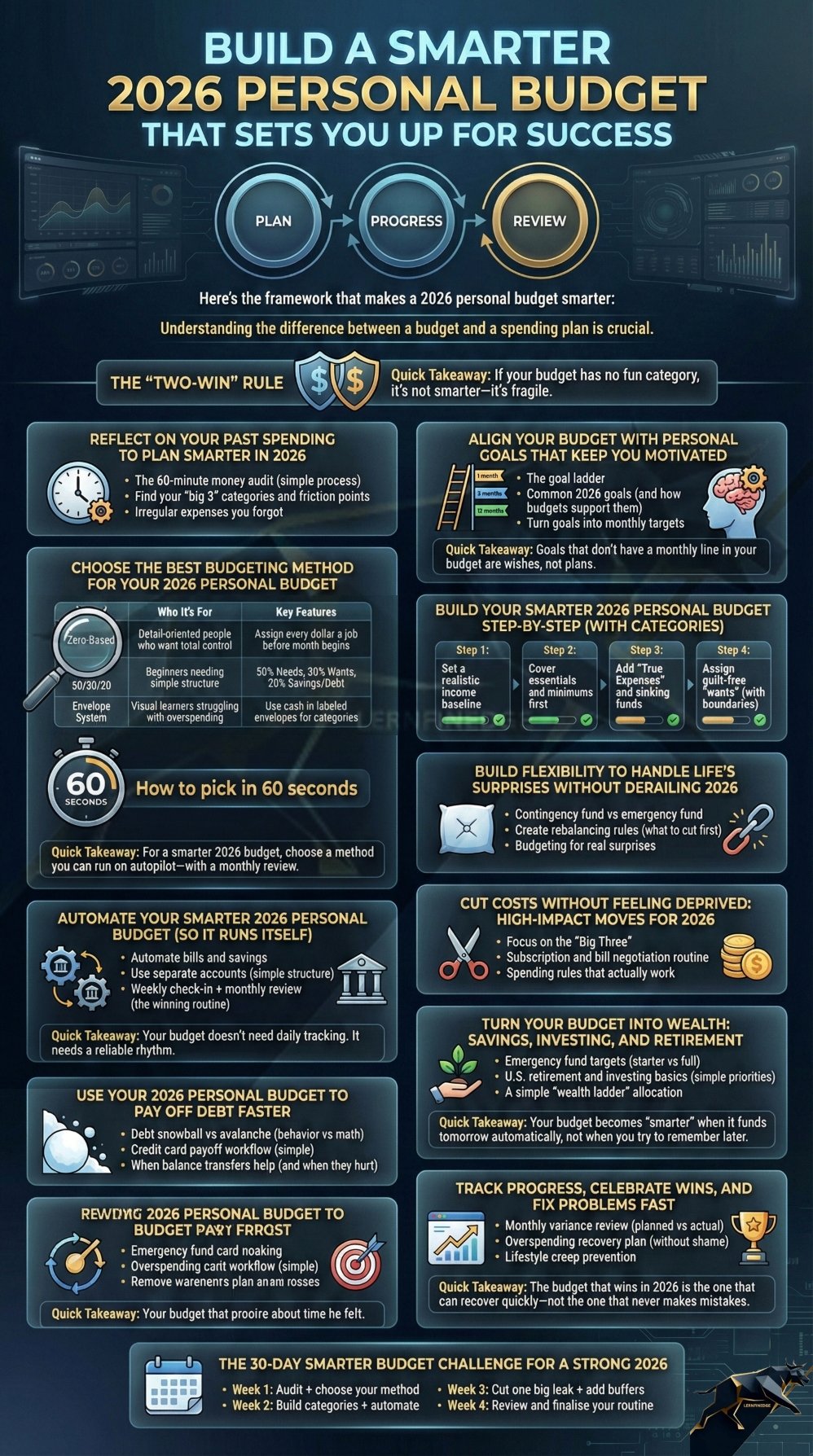
Here’s the framework that makes a 2026 personal budget smarter:
-
Plan: Decide where your money goes before you spend it on expenses. CT: Build buffers for surprises and “trexpenses.ses”. ESS: Aim money at goals (debt, savings, investing).
-
Review: Adjust with a simple routine, not endless tracking.
Industry experts agree that clarity beats complexity. A budget with 35 categories might look impressive, but it often fails because it’s exhausting to maintain.
Understanding the difference between a budget and a spending plan is crucial.
A budget is the numbers. A spending plan is a behaviour. Your 2026 budget should tell you, “This is what we do with money in this household.”
The “two-win” rule
A smarter budget must create two wins:
-
You can live your life this month (bills, payoffs, and fun).
-
You move forward (savings, debt payoff, investing).
Quick Takeaway: If your budget has no fun category, it’s not smarterit’s fragile.
Transition: Now that you know what “smarter” means, the next step is to base your 2026 plan on reality – your real spending patterns.
Reflect on Your Past Spending to Plan Smarter in 2026
Before building your new 2026 personal budget, look backwards for one hour. This single step prevents the #1 budgeting mistake: creating a fantasy plan that doesn’t match your life.
The 60-minute money audit (simple process)
Do this with the last 3 months (minimum) of:
-
Bank statements
-
Credit card statements
-
Any cash spending notes
Then sort every expense into broad buckets:
-
Housing (rent/mortgage, utilities)
-
Transportation (car payment, gas, insurance, transit)
-
Food (groceries, dining out)
-
Debt (credit cards, loans)
-
Health (insurance, meds)
-
Subscriptions (streaming, apps)
-
Shoppithree” categories and friction points.
Find your “big 3” categories and friction points
Most households have 2–3 categories that dominate (optimise them, and your 2026 budget will improve). If you optimise those, your 2026 budget improves dramatically.
Also identify “friction subscriptions”, e.g.,
-
Dining out occurs because meal planning is challenging. g is challenging. scriptions
-
dining out because meal planning is hard
-
Unexpected car repairs occur due to delayed maintenance.
Research shows a significant share of Americans can’t cover an unexpected $400 expense with cash. That’s not a character flaw; it’s a system issue that the 2026 personal budget can solve.
Irregular expenses you forgot
These are budget killers:
-
annual insurance premiums
-
holiday gifts
-
car registration
-
back-to-school spending
-
travel
-
medical deductibles
Pro Tip: Create a “True Expenses” list and divide each annual cost by 12. That monthly amount becomes a sinking fund line in your 2026 budget.
Internal link suggestion (LearnFineEdge): Emergency fund basics + Money mistakes to avoid.
Transition: Once you know where your money has been going, you can direct it towards future goals that genuinely motivate you.
Align Your Budget With Personal Goals That Keep You Motivated
A budget becomes powerful when it supports your priorities. Without goals, a 2026 personal budget feels like a spreadsheet. With goals, it becomes a plan you care about.
The goal ladder (1 month, 3 months, 12 months)
Use a simple ladder:
-
1 month: stop overdrafts, pay bills on time, build $500 buffer
-
3 months: starter emergency fund, reduce credit card balances
-
12 months: pay off a loan, save for a trip, invest consistently
This keeps momentum high because you’re always close to a win.
Common 2026 goals (and how budgets support them)
-
Emergency fund: protect against job changes or medical surprises
-
Debt payoff: reduce interest drag and stress
-
Home or car savings: avoid borrowing more than needed
-
Vacation fund: guilt-free spending because it’s planned
-
Retirement/investing: future-proofing your life
Turn goals into monthly targets
Example: If you want $2,400 saved by December 2026, you need $200/month.
Here’s the key: your goal amount must appear as a line item in your 2026 personal budget, not as a “hope”.
Quick Takeaway: Goals that don’t have a monthly line in your budget are wishes, not plans.
Internal link suggestion (LearnFineEdge): Smart spending habits + Emergency funds.
Transition: Now you’ll choose the budgeting method that matches your personality because the best budget is the one you’ll keep using.
Choose the Best Budgeting Method for Your 2026 Personal Budget
There isn’t one “best” method. There’s a best match for your life. Let’s compare the top systems for a 2026 personal budget.
Featured snippet: What’s the best budgeting method?
For most people, the best budgeting method is the one that is simple enough to follow, flexible for real life, and reviewed monthly. If you want easy, use 50/30/20. If you want control, use zero-based. If you struggle to save, use pay-yourself-first.
Comparison table: Budgeting methods (who they’re for)
| Method | Best For | Strength | Risk | What to Do in 2026 |
|---|---|---|---|---|
| 50/30/20 | Beginners | Simple, quick setup | Can be too loose | Use as a starting map |
| Zero-based | Detail-oriented | Total control | Can feel strict | Use fewer categories |
| Pay-yourself-first | People who don’t save | Automatic progress | Can ignore overspending | Pair with spending caps |
| Value-based | Overspenders | Cuts guilt, boosts meaning | Needs reflection | Use “top 3 values” rules |
| Hybrid (recommended) | Most people | Flexible and disciplined | Needs a routine | Use 50/30/20 + sinking funds |
How to pick in 60 seconds
Ask yourself:
-
Do I need simplicity or control?
-
Is my income stable or variable?
-
Do I overspend because of habits or because my plan is unrealistic?
Industry experts agree a hybrid often wins: simple structure + targeted controls.
Quick Takeaway: For a smarter 2026 budget, choose a method you can run on autopilotwith a monthly review.
Transition: Next, we’ll build your 2026 budget step-by-step with categories that cover real life (including irregular expenses).
Build Your Smarter 2026 Personal Budget Step-by-Step (With Categories)
This is where most people either win or quit. The goal is not perfection. The goal is a 2026 personal budget that feels doable on your worst week.
Step 1: Set a realistic income baseline
If your income is steady, use your monthly take-home pay.
If it varies, use the lowest typical month from the last 6–12 months. This creates safety.
Step 2: Cover essentials and minimums first
Start with:
-
housing
-
utilities
-
groceries
-
transportation
-
insurance
-
minimum debt payments
If essentials already consume most income, your first “budget goal” might be stabilising and reducing fixed costs.
Step 3: Add “True Expenses” and sinking funds
Sinking funds are your budget’s shock absorbers.
Examples:
-
car repairs
-
medical out-of-pocket
-
gifts/holidays
-
annual subscriptions
-
travel
If your car maintenance averages $900/year, set aside $75/month.
Research shows many financial emergencies are actually predictable; they’re just irregular.
Step 4: Assign guilt-free “wants” (with boundaries)
A smarter 2026 personal budget includes fun because humans aren’t robots.
Use guardrails:
-
a weekly dining-out cap
-
a “shopping” envelope
-
a 24-hour rule for non-essentials
Pro Tip: Fewer categories = more consistency. Start with 10–14 categories, then refine.
Internal link suggestion (LearnFineEdge): Money basics + Smart spending habits.
Transition: Great Your budget is built. Now we make it resilient, so unexpected expenses don’t knock you off track in 2026.
Build Flexibility to Handle Life’s Surprises Without Derailing 2026
Life is unpredictable. Your 2026 personal budget should be adaptable by design.
Contingency fund vs emergency fund
These are different, and mixing them causes confusion.
-
Contingency fund: small monthly buffer for minor surprises (car tire, copay, last-minute travel).
-
Emergency fund: larger safety net for major disruptions (job loss, major medical issue).
A contingency fund keeps small problems from becoming debt.
Create rebalancing rules (what to cut first)
When an unexpected expense hits, don’t “wing it”. Follow rules:
-
Pause non-essential shopping
-
Reduce dining out/entertainment temporarily
-
Use contingency fund
-
Shift from low-priority sinking funds
-
If needed, use emergency fund (then rebuild)
This prevents panic and protects your goals.
Budgeting for real surprises
Examples:
-
Medical bills: plan for deductibles and copays as “true expenses”.
-
Home repairs: create a home maintenance sinking fund if you own.
-
Travel emergencies: keep a small “family buffer”.
Pro Tip: Add a line called “2026 Life Happens” (even $50–$150/month). It’s the simplest flexibility upgrade.
Transition: With flexibility built in, the next step is making your budget easier to follow; automation turns “good intentions” into consistent progress.
Automate Your Smarter 2026 Personal Budget (So It Runs Itself)
A budget succeeds when it’s easy. Automation reduces decision fatigue and helps your 2026 budget work even when you’re busy.
Automate bills and savings
Set:
-
autopay for minimum payments and core bills
-
automatic transfers to savings/investing right after payday
Research shows automation improves saving consistency because it removes the need to “choose” every month.
Use separate accounts (simple structure)
Many people do better with 2–3 accounts:
-
Bill’s account: rent/mortgage + utilities + fixed costs
-
Spending account: groceries, gas, fun
-
Goals account: emergency fund, sinking funds, big goals
This makes it harder to “accidentally” spend bill money.
Internal link suggestion (LearnFineEdge): Neobanks vs traditional banks (account features, automation tools).
Weekly check-in + monthly review (the winning routine)
-
Weekly (10 minutes): check balances, upcoming bills, and category status.
-
Monthly (30–45 minutes): compare planned vs actual, adjust next month.
Quick Takeaway: Your budget doesn’t need daily tracking. It needs a reliable rhythm.
Transition: Automation locks in consistency. Next, we’ll cut costs strategicallywithout making your life miserable.
Cut Costs Without Feeling Deprived: High-Impact Moves for 2026
The goal isn’t “spend nothing”. The goal is to “spend on what matters.” A smarter 2026 personal budget reduces waste, not joy.
Focus on the “Big Three”
Most budgets change fastest by optimising:
-
Housing
-
Transportation
-
Food
Even a 5–10% reduction here can free up hundreds monthly.
Research shows housing often represents the largest share of household spending. That means small improvements matter.
Subscription and bill negotiation routine
Once per quarter:
-
cancel unused subscriptions
-
request better rates for internet/cable
-
shop insurance quotes at renewal
-
renegotiate phone plans
Make it a recurring budget task, not a one-time burst.
Spending rules that actually work
Try one rule at a time:
-
24-hour rule: wait a day before buying non-essentials
-
One-in, one-out: for shopping categories
-
Cash cap: weekly spending limit for impulse-prone areas
Pro Tip: If you hate tracking, track only your top 2 leak categories (often dining out + shopping). That’s usually enough.
Internal link suggestion (LearnFineEdge): Smart spending habits + Money mistakes to avoid.
Transition: Cutting costs frees cash. Now let’s direct that cash towards debt because interest is the silent budget killer.
Use Your 2026 Personal Budget to Pay Off Debt Faster
Debt payoff is where budgeting becomes emotional. You’re not just moving money; you’re buying back breathing room.
Debt snowball vs avalanche (behavior vs math)
-
Snowball: pay the smallest balance first to build momentum.
-
Avalanche: pay the highest interest first to save the most on interest.
In my experience, the “best” method is the one you’ll stick with for 12 months.
Internal link suggestion (LearnFineEdge): Debt snowball vs avalanche.
Credit card payoff workflow (simple)
-
List balances, APRs, minimums
-
Set a fixed monthly “extra payment” amount
-
Choose snowball or avalanche
-
Automate minimums and schedule extra payment
-
Track wins monthly
Research shows reducing high-interest debt can improve cash flow quickly.
When balance transfers help (and when they hurt)
They can help if:
-
you have a payoff plan
-
the fee and timeline makes sense
-
you stop adding new debt
They hurt if they become “time bought but no behaviour changed.”
Internal link suggestion (LearnFineEdge): Balance transfer credit cards: when they help and when they hurt.
Transition: As debt shrinks, your 2026 personal budget gains power. Next, we’ll turn that power into wealth-building.
Turn Your Budget Into Wealth: Savings, Investing, and Retirement
A smarter 2026 personal budget isn’t only defensive. It’s a growth plan.
Emergency fund targets (starter vs full)
Start with:
-
Starter fund: $500–$1,000
Then aim for: -
3–6 months of essential expenses (common guideline)
U.S. retirement and investing basics (simple priorities)
Many people use a ladder:
-
Starter emergency fund
-
Employer 401(k) match (if available)
-
High-interest debt payoff
-
Full emergency fund
-
Roth IRA / IRA (if eligible)
-
Taxable investing (for additional goals)
Research shows long-term investing benefits from consistency more than perfection.
A simple “wealth ladder” allocation
If you’re stable, consider a split like:
-
10–20% goals/savings/investing (start lower if needed)
-
structured debt payoff if you’re carrying balances
-
the rest for essentials and lifestyle
Quick Takeaway: Your budget becomes “smarter” when it funds tomorrow automatically, not when you try to remember later.
Internal link suggestion (LearnFineEdge): Emergency fund guide + Money basics: saving vs investing.
Transition: Now we make your budget self-correcting with tracking, reviews, and a no-shame troubleshooting plan.
Track Progress, Celebrate Wins, and Fix Problems Fast
Tracking isn’t about perfection. It’s about awareness. Your 2026 personal budget only needs enough tracking to steer the ship.
Monthly variance review (planned vs actual)
Once per month, compare:
-
planned spending vs actual spending
-
income vs expected
-
progress towards savings/debt goals
Then decide on one change for next month.
Overspending recovery plan (without shame)
If you overspend:
-
Identify the trigger (time, place, emotion)
-
Reduce the category next month slightly (not drastically)
-
Add a rule (cash cap, 24-hour rule, meal plan)
-
Rebalance using your rules (cut wants first)
Pro Tip: Don’t “punish” next month. Over-correcting often causes rebound spending. Adjust calmly.
Lifestyle creep prevention
When income rises, it’s easy for spending to rise too.
Use a rule:
-
“50% of any raise goes to goals” (debt, savings, investing)
Quick Takeaway: The budget that wins in 2026 is the one that can recover quicklynot the one that never makes mistakes.
Transition: Finally, let’s lock everything into a 30-day challenge so your smarter budget becomes your default.
The 30-Day Smarter Budget Challenge for a Strong 2026
If you want a budget that sticks, treat the first month like training. You’re building a repeatable system for your 2026 personal budget.
Week 1: Audit + choose your method
-
complete the 60-minute spending audit
-
pick your budgeting method (or hybrid)
-
list true expenses and annual costs
Week 2: Build categories + automate
-
set your baseline income
-
create your categories and sinking funds
-
automate bills and savings transfers
Week 3: Cut one big leak + add buffers
-
cancel or reduce 1–3 subscriptions
-
optimize one “Big Three” category
-
start contingency fund (“Life Happens” line)
Week 4: Review and finalise your routine
-
do your first monthly variance review
-
adjust categories based on reality
-
schedule your monthly budget meeting for all of 2026
Pro Tip: Celebrate wins weekly. Paying off $200 of debt or saving your first $100 buffer is proof the system works.
CTA (LearnFineEdge): Download the 2026 Budget Template and the Monthly Budget Review Checklist (see content upgrades below).
FAQ
Q1: How do I start a 2026 personal budget if I’m a beginner?
A1: Track the last 2–3 months of spending, set a realistic income baseline, cover essentials first, add savings goals, and automate transfers.
Q2: What budgeting method is best for a smarter budget in 2026?
A2: Most people do best with a hybrid: 50/30/20 for structure plus sinking funds and a monthly review for control.
Q3: How do I handle unexpected expenses without ruining my budget?
A3: Use a contingency fund line item, rebalancing rules (cut wants first), and an emergency fund for true disruptions.
Q4: How often should I review my budget?
A4: Do a quick weekly check-in (10 minutes) and a monthly review (30–45 minutes) to compare planned vs actual spending.
Q5: How can I budget with irregular income in 2026?
A5: Base your budget on your lowest typical month, prioritise essentials, and keep a larger buffer so variable months don’t create debt.