

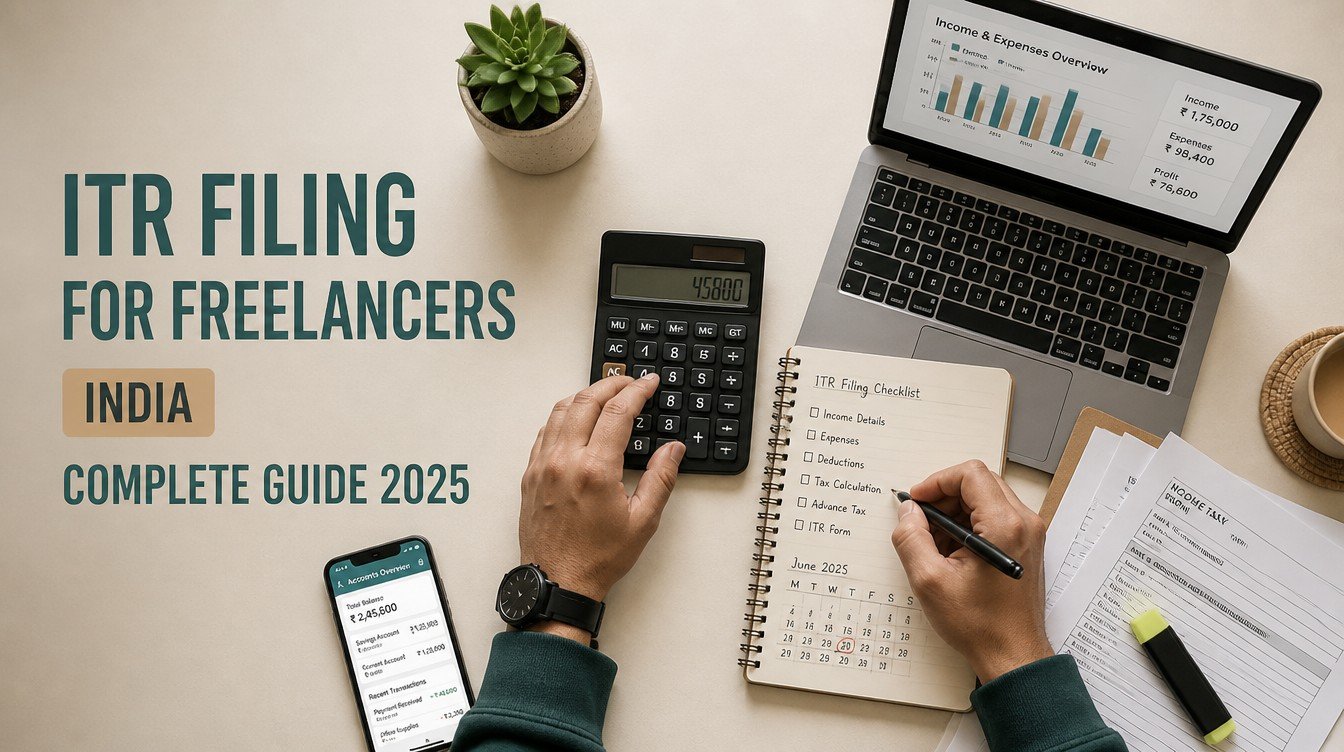
ITR Filing Freelancers India: What You Need to Know in 2025
Understanding itr filing freelancers india is essential for anyone who earns income from freelance projects, consulting, content creation, design work, or any other self-employed activity. Freelancers in India are treated as individuals with professional income, which means different ITR forms, different tax rules, and different deduction opportunities compared to salaried employees. This guide covers ITR form selection, advance tax, presumptive taxation, allowable deductions, and GST obligations for Indian freelancers.
Which ITR Form Do Freelancers Use?
Freelancers with professional income generally use one of two forms:
- ITR-3: For freelancers and professionals maintaining detailed books of accounts. Required if gross professional receipts exceed Rs 50 lakh or if you choose to maintain regular books. Requires a Balance Sheet and Profit and Loss account.
- ITR-4 (Sugam): For freelancers and professionals using the presumptive taxation scheme under Section 44ADA. Gross receipts must be below Rs 75 lakh (Rs 75 lakh for AY 2025-26, reduced from Rs 50 lakh threshold for some earlier years – verify current limit). The key benefit: no need to maintain detailed books or get accounts audited.
Section 44ADA is the most popular route for freelancers in India. Under this scheme, 50% of gross professional receipts is deemed to be profit (taxable income). You do not need to prove actual expenses. If your actual expenses are below 50% of receipts, Section 44ADA actually helps you by allowing you to declare a higher expense deduction without documentation.
Section 44ADA Presumptive Taxation: How It Works
Under Section 44ADA (applicable to notified professions – IT professionals, doctors, lawyers, architects, engineers, chartered accountants, interior decorators, and “other professions” under Section 44AA):
| Item | Under Section 44ADA |
|---|---|
| Taxable income | Minimum 50% of gross receipts |
| Books of accounts | Not required |
| Tax audit | Not required |
| Gross receipts limit | Rs 75 lakh per financial year |
| Advance tax | Entire advance tax due by March 15 (single installment, unlike regular 4 installments) |
Example: A freelance software developer earns Rs 30 lakh in professional fees. Under Section 44ADA, taxable income is 50% x Rs 30 lakh = Rs 15 lakh. Tax is calculated on Rs 15 lakh. The developer does not need to document or prove expenses – the 50% deduction is automatic. Under the new tax regime, the Rs 15 lakh taxable income would have lower tax liability for most slab combinations compared to the old regime without deductions.

TDS on Freelance Payments: What to Expect
If your clients are companies or firms (not individuals), they are required to deduct TDS on payments to you:
- Section 194J: TDS at 10% on professional or technical fees paid by Indian companies. If the payer classifies your work as “technical services” (as opposed to “professional services”), the TDS rate is 2%.
- Threshold: TDS applies when total payments to you in a year exceed Rs 30,000. Below this, no TDS is required.
- Foreign clients: If your client is a foreign company, no Indian TDS applies on the direct payment to you. However, you may need to report the income under FEMA guidelines if it exceeds certain thresholds.
All TDS deducted appears in your Form 26AS. When filing your ITR, claim credit for all TDS deducted. If your actual tax liability (after 44ADA deduction) is lower than TDS already deducted, you are entitled to a refund – file your ITR to claim it.
Advance Tax for Freelancers
If your total tax liability for the year exceeds Rs 10,000, you must pay advance tax. For freelancers under Section 44ADA, a special rule applies: the entire advance tax can be paid as a single installment by March 15 of the financial year (instead of the regular four installments in June, September, December, March).
Advance tax is calculated on your estimated annual income. For Section 44ADA freelancers: estimate total receipts for the year, take 50% as taxable income, apply tax rates, subtract TDS already deducted, and pay the balance as advance tax by March 15. If you miss advance tax, interest under Section 234B (1% per month from April 1 until payment) and Section 234C (1% per month for each delayed installment) applies. Freelancers who also trade cryptocurrencies must add flat 30% tax on crypto gains separately when calculating advance tax liability.

GST for Freelancers in India
GST registration is mandatory for freelancers if:
- Annual turnover exceeds Rs 20 lakh (Rs 10 lakh for certain Northeastern states). This threshold applies for services; for goods-only businesses it is Rs 40 lakh.
- You provide services outside India (export of services) – regardless of turnover, as exports are zero-rated and GST registration allows claiming Input Tax Credit refunds.
- You provide services to foreign clients and receive foreign currency payments – this is treated as export of services. Getting GST-registered and filing GST returns is beneficial as you can claim zero-rated export treatment.
GST rate for most professional services is 18%. If registered, you charge GST on your invoices to domestic clients (who can claim it back as ITC if they are registered businesses) and file monthly or quarterly GSTR-1 and GSTR-3B returns. GST filing is separate from income tax filing. For freelancers with foreign clients, the practical benefit of GST registration is not the GST itself (which is zero-rated on exports) but the formal documentation it provides for currency repatriation.
Common Deductions Available to Freelancers Under Old Regime
If you choose the old tax regime with actual books (ITR-3), deductible business expenses include:
- Home office rent (proportional to workspace area).
- Internet, electricity, and phone bills (proportional to business use).
- Computer, equipment, and software costs (depreciation basis).
- Professional subscriptions and tools.
- Business travel expenses with documentation.
- Continuing education and professional development costs.
Under Section 44ADA, none of these individual deductions apply – you simply declare 50% of receipts as expenses regardless of actual spending. The old regime with full books is only beneficial if actual documented expenses exceed 50% of receipts (a situation that typically requires very high fixed costs like office rental or significant equipment depreciation).
Frequently Asked Questions
Do freelancers need to pay both income tax and GST?
Yes, these are two separate obligations. Income tax is on your net profit (50% of receipts under Section 44ADA). GST is on your gross service value (if turnover exceeds the registration threshold). They are computed and filed independently. Not registering for GST when required creates separate penalties and interest under the GST Act, independent of income tax compliance.
Can a freelancer use the new tax regime?
Yes. Freelancers can choose either the new or old tax regime. However, unlike salaried individuals who can switch every year, freelancers with business income (including professional income under 44ADA) can switch from new to old regime only once in their lifetime. This is an important constraint – once you switch to old regime as a freelancer, you cannot switch back to new regime (except in one specific exception year). Choose your regime carefully, ideally with a tax advisor’s input, considering your projected long-term income and likely deductions.
What if my freelance income varies widely year to year?
Variable income is common in freelancing. For income tax, you pay tax based on actual earnings each year – no averaging or smoothing. For advance tax, estimate conservatively and make the March 15 payment based on your actual year-to-date income rather than a projection. If you overestimate and overpay advance tax, you get a refund when you file your ITR. Underpaying advance tax is costlier (interest applies), so it is better to pay slightly more advance tax and receive a refund than to underpay and owe interest.
Is a CA required for ITR filing for freelancers?
For freelancers using ITR-4 with Section 44ADA (most common case), a CA is not required. The ITR-4 form is relatively simple once you understand the 44ADA scheme. You can file online using the income tax portal. However, if your gross receipts exceed the 44ADA threshold, if you have complex capital gains, if you made errors in previous years that need correction, or if you received IT notices, professional help from a CA is worthwhile. The cost of a CA for straightforward ITR-4 filing ranges from Rs 1,000-5,000.
How do I report income from multiple clients in ITR?
You do not report income client-by-client in the ITR. You report the total gross professional receipts for the year. Under Section 44ADA, enter total gross professional receipts in the prescribed box; the form computes 50% as taxable income automatically. Keep a record of all client invoices and payments received privately (bank statements, payment receipts) as documentation in case of scrutiny – but you do not need to list individual clients in the filed return.
Related Articles
- New Tax Regime vs Old Tax Regime 2026
- Crypto Tax India: Section 115BBH Guide
- NPS Vatsalya Scheme: Complete Guide