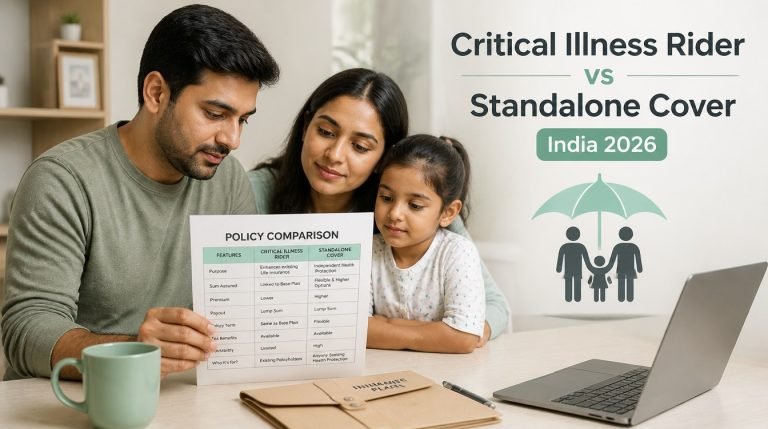

Renewal premium just landed and the number is ugly. Or claims keep getting nibbled at because the old policy has a Rs 1 lakh room rent sub-limit. Or the network hospital that matters in your city has quietly dropped off the cashless list. Health insurance portability India 2026 is the formal route that lets you change your insurer at renewal without throwing away the waiting periods, the cumulative bonus, and the pre-existing disease cover you have already served time for. The Insurance Regulatory and Development Authority of India rules it under the Health Insurance Regulations, and any indemnity health policy issued by any general or standalone health insurer can be ported.
This guide is written from the point of view of a salaried family of three or four whose first floater is two or three renewals old, and who suspects the next insurer might be both cheaper and better. Short answer: porting is almost always worth doing if your policy is more than two years old, but the form must reach the new insurer in the 45 to 60 day window before renewal, not after.
What portability actually preserves in 2026
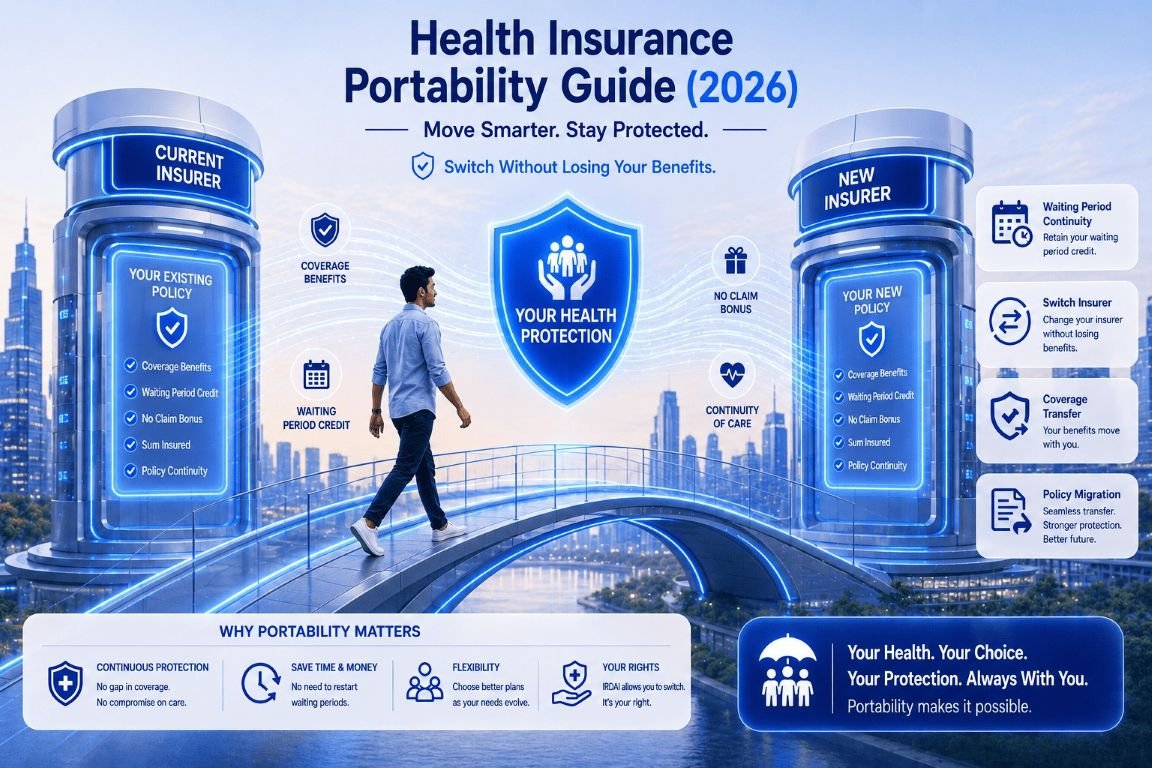
The IRDAI portability framework lets the new insurer credit the time you have already served on the old policy. Three things carry over by right. First, the pre-existing disease waiting period. If the old policy had a four-year PED waiting period and you have already completed three years, the new insurer cannot start the clock from zero. They credit the three years and apply only the remaining one year.
Second, the initial waiting period, usually 30 days for any non-accidental claim. If you have crossed it on the old policy, the new policy starts covering you from day one. Third, the specific disease waiting period, typically two years for things like cataract, hernia, and joint replacement. The time you have already served gets credited.
Fourth, the cumulative bonus or no-claim bonus you have built up. If your old Rs 5 lakh floater has grown to Rs 7 lakh through three claim-free years, the new insurer must offer you a sum insured that includes that Rs 2 lakh bonus, either as a higher base or as an explicit bonus rider. None of this is the insurer’s discretion; it is the regulator’s rule.
What porting does NOT preserve
This is the part most families miss. Porting preserves your time served, not the old policy’s terms. If the new insurer’s product has a Rs 5,000 daily room rent cap, a 10 percent co-pay above age 60, a Rs 50,000 cataract sub-limit, or a two-year exclusion on bariatric surgery, those rules apply to you from the first day of the new policy. The old, more generous terms do not travel with you. Read the new policy wording line by line for sub-limits, co-pays, modern treatment caps, and disease-specific exclusions before signing.
The 45 to 60 day window: not a day later
Portability requests must reach the new insurer at least 45 days before the renewal date of the old policy, and not more than 60 days before. If you apply on day 44 or day 30, the new insurer is within its rights to refuse the port. If you apply on day 70, they will tell you to come back. The window exists so the new insurer has time to underwrite you and so the old insurer can be informed in writing.
Calendar the renewal date the day you receive the renewal notice. Most insurers send the renewal intimation about 60 days before expiry. That intimation is your trigger to start porting if you intend to. Treat the 45-day mark as your hard internal deadline. Use the gap between weeks four and eight before renewal to compare two or three new insurers, lock the choice, and submit the portability form.
The portability form: what to fill carefully
The portability form, prescribed by IRDAI, is two documents in practice. The new insurer’s proposal form (the standard health insurance proposal) and the portability form (Form-P), which lists the existing policy details and authorises the new insurer to pull your claim and underwriting history from the current insurer through the IIB (Insurance Information Bureau) portability system.
The fields that matter: existing policy number, policy start date, total continuous years of coverage including all prior renewals, claims made in the last four years (with amounts), and any declared pre-existing diseases with onset year. Lying or under-disclosing here is the single most common reason a portability claim gets rejected six months later. Disclose everything; the new insurer is pulling the same data from IIB anyway. If the higher new premium will pinch the household cash flow, our 50-30-20 budget framework is a clean way to find the extra room without cutting protection.
Step-by-step portability in 2026
The clean sequence, executed inside the 45 to 60 day window:
One. Pull your existing policy schedule, list every endorsement, and note total continuous years of coverage. The years number is what unlocks waiting period credit, so be exact.
Two. Identify the sum insured and bonus you currently hold. A Rs 5 lakh floater that has built up Rs 2 lakh of bonus is effectively Rs 7 lakh of cover. The new policy must protect that.
Three. Shortlist two or three new insurers. Look at network hospital count in your city (not the all-India number), the room rent rule (prefer ‘no sub-limit’), co-pay structure (zero co-pay till 60 is the gold standard), and the published claim settlement ratio over the last three years.
Four. Get the new insurer’s quote in writing for the same sum insured plus bonus, with the family composition unchanged. Cross-check the premium against your current renewal. If the new premium is more than 15 percent cheaper for an equivalent or better product, porting is usually worth it.
Five. Submit the proposal form and Form-P together, with the existing policy schedule, last two renewal receipts, and ID-address proof. The new insurer has 15 days to seek your existing data from the old insurer, then 30 days to underwrite and revert with acceptance, conditional acceptance (with a loading), or refusal.
Six. If accepted, pay the new premium before the old policy expires. The new policy starts the day after the old one expires, with zero break in coverage. A single-day gap is fatal: it resets the waiting periods.
The IRDAI rule is that the new insurer cannot refuse a portability request without disclosing the reason in writing. If they sit on your application beyond the 15-day data fetch window, the policy is deemed accepted on the existing terms. Save the timestamps of every email exchange. Pair the portability decision with the larger insurance picture in our term insurance versus investment walkthrough, which sets the right base premium budget for the household.
Worked example: Rs 5 lakh family floater to Rs 10 lakh, no loss
Take a real case. Anand, 38, his wife Meera, 35, and their daughter, 8, live in Bengaluru. They have a Rs 5 lakh family floater from Insurer A, bought in 2020. Across six renewals, they have crossed both the 30-day initial waiting period and the two-year specific disease waiting period. The four-year PED waiting period was completed in April 2024, so PEDs are now fully covered. Cumulative bonus has grown to Rs 1.5 lakh, taking effective cover to Rs 6.5 lakh. The 2026 renewal premium quote from Insurer A: Rs 32,400.
Anand also wants more cover. A Rs 6.5 lakh sum insured no longer covers a single major hospitalisation at Manipal or Apollo in his city, where ICU and surgery combinations can easily cross Rs 8 lakh.
He shortlists Insurer B and Insurer C in early March 2026, well inside the 60-day window. Insurer B quotes Rs 28,800 for a Rs 10 lakh sum insured family floater, no sub-limits, zero co-pay till age 60, with the Rs 1.5 lakh bonus credited as a fresh cover top-up. They confirm in writing that all four PEDs declared on the old policy will be covered from day one of the new policy.
Anand submits the portability form on March 20. Insurer B fetches the existing data through the IIB portal by April 1. Underwriting accepts on April 12 with no loading. Premium of Rs 28,800 paid on April 25. Old policy expires May 1, new Rs 10 lakh policy starts May 2, zero break.
Outcome: cover doubled from Rs 6.5 lakh to Rs 11.5 lakh (10 lakh sum insured plus 1.5 lakh bonus), premium dropped from Rs 32,400 to Rs 28,800, and every waiting period credit travelled across. The trade-off Anand accepted: the new policy has a Rs 2 lakh annual cap on AYUSH treatment, which the old policy did not. He decided that was a fair price for the upgrade. Pair the new policy schedule with the household’s 80C plan; if the floater premium for parents above 60 is also part of the picture, our 80C deductions guide sets up the deduction split cleanly.
Common mistakes to avoid in 2026
Mistake one: porting too late. Filing the portability form 30 or 40 days before renewal gives the new insurer the right to refuse on timing alone. Mark the calendar the day you get the renewal notice.
Mistake two: shrinking sum insured to chase a cheaper premium. If you port from a Rs 6.5 lakh effective cover to a Rs 5 lakh fresh policy, you have just thrown away Rs 1.5 lakh of bonus. The new policy must match or beat your existing total cover including bonus, otherwise it is not a port, it is a downgrade.
Mistake three: ignoring sub-limits and co-pays. The new policy can be cheaper because it carries hidden caps. Read the room rent rule (any cap of 1 percent of sum insured or below is a problem), the co-pay table (anything above 10 percent at any age is a red flag), and the modern treatment list. The headline premium means nothing if a claim gets nibbled.
Mistake four: not coordinating with the household budget. A higher sum insured is the right move only after the emergency fund is in place and the term insurance is sized correctly. Run the household coverage stack against our term insurance versus ULIP versus endowment math before deciding the new floater size.
Mistake five: letting the old policy lapse before the new one starts. A one-day gap resets every waiting period and undoes the entire point of porting. The new policy must start on the day after the old one ends. Pay the new premium at least three days before the old expiry to avoid the gap.
When porting is NOT worth it
If your old policy is less than 24 months old, the time served credit is small. Wait one or two more renewals before porting. If you have an active high-value claim under review on the old policy, do not port; settle the claim first. If your declared PEDs would attract loading or rejection from every new insurer, the old policy at the renewal premium is the safer hold. Porting is a strategic tool, not a reflex. Keep your overall cash buffer separate from this decision; the household emergency fund is what pays the hospital deposit on day one of an admission, before any insurer approves cashless.
FAQs
Can I port my health insurance to a new insurer if I have made claims on the old one?
Yes. Claim history does not block portability under IRDAI rules. You must disclose every claim of the last four years on the portability form, with amount and cause. The new insurer fetches the same data independently from the Insurance Information Bureau, so under-disclosure is pointless and a future claim rejection risk. A heavy claim history may invite a premium loading or a specific exclusion, but an outright refusal can only be made with written reasons. The right to port survives claims; the cost might just go up.
Does the cumulative bonus carry over when I switch insurers?
Yes, by IRDAI rule. If your Rs 5 lakh floater has built up a Rs 2 lakh cumulative bonus through claim-free renewals, the new insurer must offer you cover that includes that Rs 2 lakh, either by enhancing the base sum insured or by issuing a matched bonus rider. The mechanism varies by insurer but the protection is non-negotiable. Ensure the policy schedule of the new contract explicitly states the bonus amount transferred. Without that line on the schedule, the bonus is effectively lost at the next renewal.
What is the deadline for filing a portability request?
The portability application must reach the new insurer at least 45 days before the renewal date of the old policy, and not more than 60 days before. Filing on day 44 or day 30 lets the new insurer refuse on timing alone. Filing on day 70 means you have to wait. The clean approach is to start comparing insurers the day the old insurer’s renewal intimation arrives, usually around 60 days before expiry, and submit the portability form between day 55 and day 50, with five days of buffer before the hard 45-day cut-off.
Will the new insurer apply fresh waiting periods on my pre-existing diseases?
Only for the time you have not yet served. If the new policy carries a four-year pre-existing disease waiting period and you have already completed three years on the old policy, the new insurer must credit three years and apply only the remaining one year. If you have already completed the full PED waiting period on the old policy, the new insurer starts covering pre-existing diseases from day one. Specific waiting periods like two years for cataract or hernia work the same way: time served on the old policy gets credited.
Can the new insurer refuse my portability request?
Yes, but only with written reasons and within the 15-day data fetch window plus 30-day underwriting window. The most common refusal reasons are non-disclosure of past claims, undeclared pre-existing diseases that surface in the IIB data pull, or a risk profile that falls outside the new insurer’s underwriting policy. If the new insurer does not respond within the combined 45-day window, the policy is deemed accepted on the existing terms. Save all email timestamps and the date-stamped portability form; the proof matters if there is a later dispute.