

The critical illness rider standalone comparison matters more than the usual term-insurance pitch suggests: “add the CI rider, it’s only a few thousand rupees extra”. The pitch is technically true but rarely complete. A critical-illness rider on a term plan and a standalone critical-illness policy from a health insurer are different products with different covered conditions, payout structures, claim experiences, and long-run renewal economics.
This guide compares the critical illness rider india 2026 attached to term plans with standalone CI covers from large Indian health insurers. It walks through how the lumpsum payout actually works, lists the typical condition catalogues, and gives a cost-per-Rs.25,00,000 (25 lakh) cover benchmark so buyers can run the same numbers across products. By the end, the right choice for your household should be clear from your existing insurance stack, age, and family medical history.
The short answer for most buyers in their thirties with a clean medical history is “both, layered”. The longer answer, which is what most of this article is about, is when to lean on the rider, when to invest in standalone, and when neither is worth the premium.

What A Critical Illness Cover Actually Pays
A critical-illness cover, whether bought as a term-insurance rider or as a standalone health-insurance product, pays a one-time lumpsum on the first diagnosis of any covered condition meeting the policy’s medical-definition criteria. The payout is independent of actual treatment costs; the family receives the sum assured even if treatment is fully covered by a separate health-insurance policy.
The “first diagnosis” trigger
Most CI policies require formal medical diagnosis confirmed by appropriate specialist documentation. A few policies require both diagnosis and survival for a specified period after diagnosis, commonly 14 to 30 days, before paying out. Read the survival-period clause; in cancers and cardiac events, this clause sometimes interacts with treatment timelines.
Why the payout is “free use”
The CI payout is not earmarked for hospital bills. Families typically use a slice for treatment co-payment, a larger slice for income replacement during recovery, and the remainder for lifestyle adjustments (mortgage relief, household help, modified work arrangements). This combination of uses is the structural argument for CI cover, because conventional health insurance pays only for medical expenses and conventional term insurance pays only on death.
The income-replacement angle
The hidden cost of a critical illness for an earning adult is not the hospital bill (which a strong health policy can substantially cover) but the 12 to 24 months of impaired earning capacity during treatment and recovery. A standard income-protection product is not available in India in retail form, and CI cover is the closest functional substitute.
Critical Illness Rider On A Term Plan
The critical-illness rider attached to a term-insurance policy is administratively simple: a single insurer, a single policy, a single premium debit. The rider’s covered conditions, payout structure, and renewal terms are governed by the term policy’s framework.
How the rider’s sum assured works
Most term-plus-CI-rider structures cap the rider’s sum assured at a fraction of the base term sum assured, typically 50 percent. A Rs.1,00,00,000 (1 crore) term policy might allow up to Rs.50,00,000 (50 lakh) of CI rider cover, often capped further by absolute rupee thresholds. On smaller term sums assured, the rider’s cap can be the binding constraint.
Acceleration versus stand-alone payout
CI riders come in two structural forms. The acceleration variant pays the CI sum assured by reducing the base death benefit (Rs.50,00,000 CI claim reduces the death benefit from Rs.1,00,00,000 to Rs.50,00,000). The additional-benefit variant pays the CI claim without affecting the death benefit; the base remains intact. The additional-benefit variant is structurally more valuable but carries a higher rider premium.
Renewal terms
The CI rider’s premium is locked at the term policy’s issuance and stays flat for the entire term, similar to the base term premium. This is one of the biggest advantages of the rider format: a 30-year-old who buys a 30-year term with CI rider carries the age-30 CI rate to age 60.
What the rider typically does not include
Most CI riders cover a curated list of 8 to 20 conditions, narrower than standalone CI policies. Mental-health conditions, autoimmune conditions, and some early-stage cancer definitions may be excluded or carry stricter clauses. The rider is generally a “core conditions only” product.
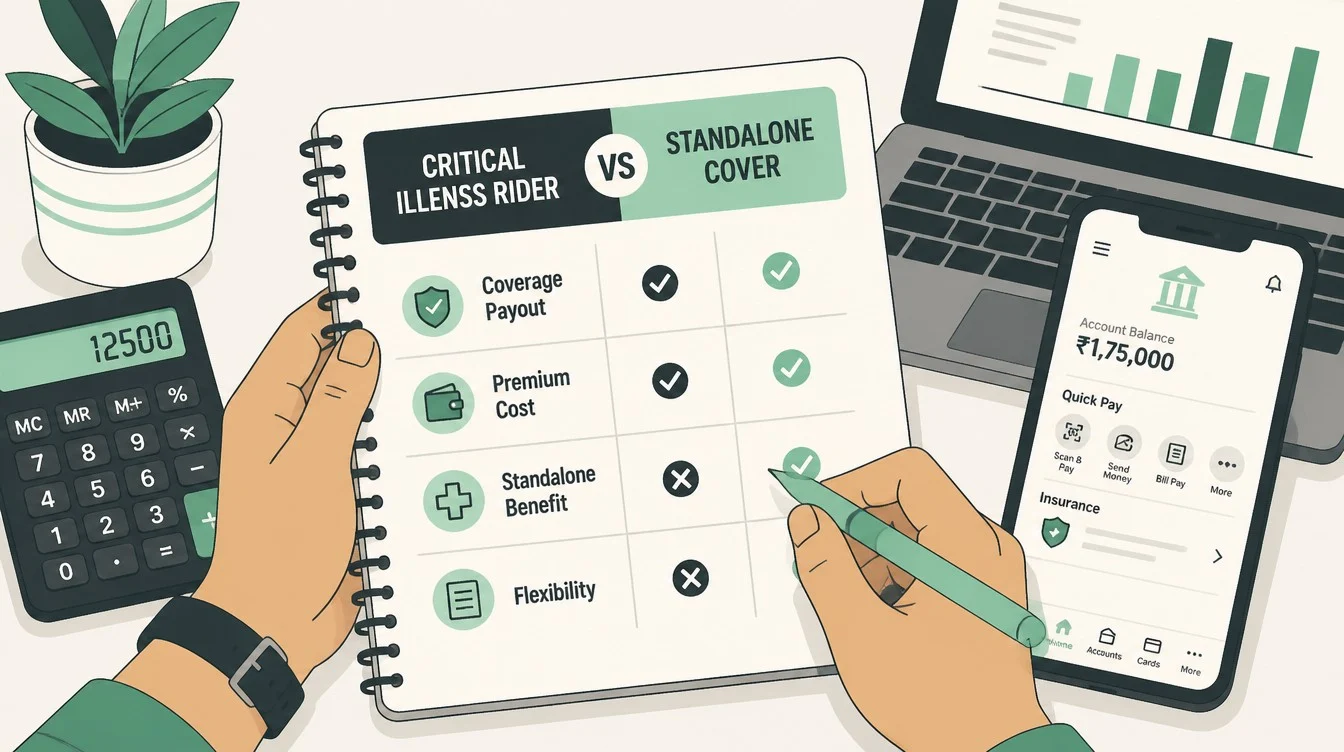
Critical Illness Rider Standalone Cover Compared
A standalone CI policy is purchased separately, typically from a health insurer, with its own application form, medicals, and renewal cycle. The product is more flexible and usually covers a wider list of conditions, but the renewal architecture is fundamentally different.
Wider condition catalogue
Standalone CI policies in 2026 commonly cover 25 to 64 listed conditions. The expanded list includes early-stage cancers, autoimmune conditions such as systemic lupus and multiple sclerosis, organ transplants (both donor and recipient), and stage-specific definitions that pay a partial benefit on early diagnosis. The broader catalogue typically commands a 15 to 30 percent premium delta versus a base CI rider.
Multi-pay versus single-pay
Single-pay standalone CI policies pay one claim and terminate. Multi-pay variants allow up to three or four claims across unrelated condition categories, with each claim leaving the cover intact for the remaining categories. Multi-pay is structurally more valuable for buyers with adverse family history or multiple risk categories, at a premium delta of 20 to 35 percent.
Annual renewal versus locked term
Standalone CI policies are typically annual renewable with insurer-discretionary premium revisions at each renewal. This is the biggest structural disadvantage versus the rider format: a 30-year-old buying a standalone CI policy in 2026 has no guarantee that the renewal premium at age 50 will be reasonable. Insurers do publish base rate cards by age band, but actual renewal pricing reflects the insurer’s portfolio experience.
Lifetime renewability and entry-age caps
Many standalone CI products have lifetime renewability if continuously renewed from entry. Skipping a renewal usually terminates the policy and requires fresh medical underwriting at the older age, which can be loaded heavily. This makes continuous renewal more important than premium-shopping at each cycle.
Cost Benchmark Per Rs.25 Lakh Cover
The cleanest way to compare the two structures is on a normalised cost-per-cover basis. The table below summarises approximate cost ranges for a Rs.25,00,000 (25 lakh) CI cover for a non-smoker male, no adverse medical history, in three age bands. Numbers are illustrative ranges and meant for comparison, not as quotes.
| Age Band | CI Rider On Term Plan (per year) | Standalone CI Single-Pay (per year) | Standalone CI Multi-Pay (per year) |
|---|---|---|---|
| 30 to 35 | ~Rs.2,500 to Rs.4,000 | ~Rs.3,500 to Rs.5,500 | ~Rs.5,000 to Rs.7,500 |
| 40 to 45 | ~Rs.5,000 to Rs.8,500 | ~Rs.7,500 to Rs.11,000 | ~Rs.10,000 to Rs.15,000 |
| 50 to 55 | ~Rs.12,000 to Rs.18,000 | ~Rs.18,000 to Rs.28,000 | ~Rs.25,000 to Rs.40,000 |
Why the rider often wins on early-age cost
The rider format is typically cheaper than standalone single-pay at the same cover, partly because of the leaner condition catalogue and partly because the insurer cross-subsidises across the base term book. For young, healthy buyers, the cost gap of Rs.1,000 to Rs.2,000 per year for the rider versus standalone is the cleanest entry point.
Why standalone often wins on long-run value
Standalone CI policies cover more conditions, more early-stage diagnoses, and offer multi-pay variants. For buyers who can absorb the premium delta and want broader protection, standalone is structurally a more comprehensive product. The condition-list breadth matters more for buyers with adverse family history.
The “both, layered” architecture
For a household running a Rs.1,00,00,000 (1 crore) term policy with a Rs.25,00,000 (25 lakh) CI rider plus a Rs.25,00,000 standalone multi-pay CI policy, the combined cover is Rs.50,00,000 in CI lumpsum across a broad condition catalogue with multi-pay capability. The combined premium for a healthy 35-year-old typically lands in the Rs.10,000 to Rs.15,000 per year range, which is meaningful but defensible for the protection delivered.
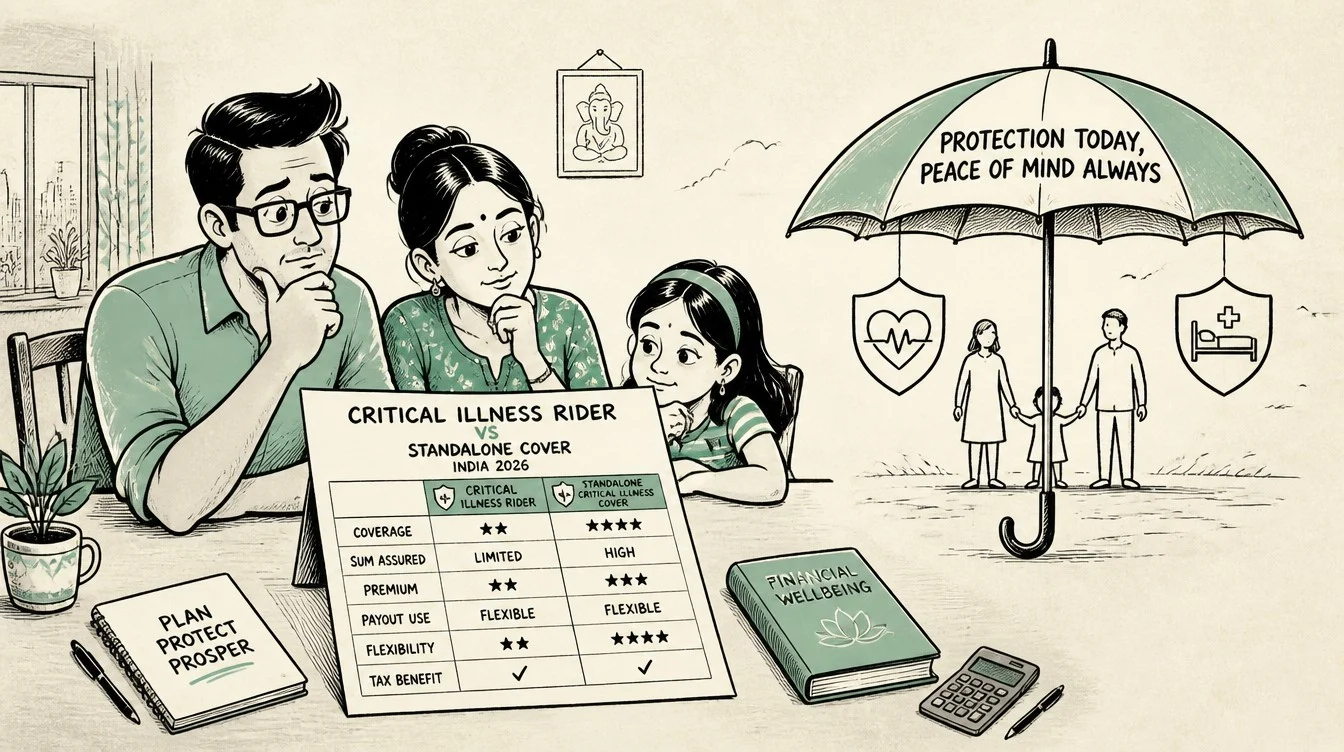
Covered Conditions: What Each Format Typically Includes
The covered-conditions list is the single biggest difference between the rider and standalone formats. Buyers should always read the actual policy wording for the exact medical definitions, but the broad pattern is consistent across the market.
Core conditions covered by almost every CI product
- Major cancers (excluding early-stage and skin cancers other than malignant melanoma in some products)
- First heart attack of specified severity
- Coronary artery bypass graft surgery
- Stroke resulting in permanent symptoms
- Kidney failure requiring regular dialysis
- Major organ or bone marrow transplant
- Multiple sclerosis with persistent symptoms
- Permanent paralysis of limbs
Conditions more commonly in standalone catalogues
- Early-stage cancers (carcinoma in situ, ductal carcinoma) at partial-payout levels
- Benign brain tumour
- Parkinson’s disease and motor neurone disease
- Systemic lupus erythematosus with renal involvement
- Aplastic anaemia
- End-stage liver disease and lung disease
- Coma of specified duration
- Aortic surgery and heart valve replacement
Why the definition wording matters
“Heart attack of specified severity” typically requires specific elevation of cardiac biomarkers, characteristic ECG changes, and chest pain. A milder cardiac event may not meet the policy’s diagnostic criteria even if a hospital admission and treatment occurred. The definition wording is where most contested claims live; an actuary-approved definition is non-negotiable.
Survival period
The survival period is the time the policyholder must survive after diagnosis before the claim becomes payable. 14 to 30 days is typical. For aggressive cancers diagnosed at advanced stage and cardiac events with mortality within the survival window, this clause can deny what families perceive as a valid claim. Prefer policies with a 14-day survival period over 30-day where the choice exists.
How To Decide Between Rider And Standalone
The decision compresses into a few diagnostic questions. Each question pushes the answer toward one format or both layered together.
- Do you already have a sufficient base term cover? If no, prioritise the term cover; CI is secondary.
- Is your family medical history clean across cancer, cardiac, and stroke categories? If yes, a CI rider on the term plan is a low-cost entry point. If no, lean toward standalone multi-pay with broader condition catalogue.
- Can you absorb a Rs.2,000 to Rs.5,000 annual premium delta for broader cover? If yes, standalone multi-pay is structurally stronger. If no, the rider format is a defensible compromise.
- Are you self-employed or in a profession where 12 to 18 months of impaired earning capacity would be financially severe? If yes, the CI cover should be sized higher (Rs.50,00,000-plus) and split across formats for layered protection.
- Will you commit to continuous renewal of a standalone policy through age 65 to 70? If no, the rider format avoids the renewal-discontinuity risk because the rider premium is locked at issuance.
The “I already have health insurance” question
A common buyer pushback is “I already have a Rs.10,00,000 (10 lakh) health policy; do I really need CI?” Health insurance pays for medical expenses; it does not replace lost income or fund lifestyle adjustments during 12 to 24 months of recovery. The two products solve different problems and stack rather than substitute.
The “I am 28, why bother” view
Young buyers are statistically less likely to face a critical illness, which makes the premium look like high friction for low probability. The right framing for a 28-year-old is that buying CI cover now locks in a low premium for the policy term (for the rider) or an early base for renewal underwriting (for standalone), and the protection is most valuable in the 35 to 55 age band where critical-illness incidence rises sharply.
The “wait until I am older” mistake
Postponing CI cover until a perceived “later” age is among the costliest delays in retail insurance. Underwriting at age 45 is dramatically stricter than at age 30, and any intervening diagnosis (even one that resolves) can result in loading or exclusion. Buy CI cover while underwriting is clean; the option to upgrade later is constrained by health history.

Common Mistakes With Critical Illness Cover
The recurring buyer mistakes in this category are predictable and each is correctable in a single planning session.
- Buying CI cover before securing adequate term and health insurance. The right priority order is term cover, base health cover, then CI cover.
- Ignoring the survival-period clause. A 30-day survival period can make a Rs.25,00,000 (25 lakh) policy unusable for aggressive cancers; prefer 14-day where the choice exists.
- Sizing CI cover at one or two times annual income. CI cover at three to five times annual income is closer to the income-replacement need during recovery.
- Choosing standalone for the broader catalogue without committing to continuous renewal. Lapse in renewal terminates lifetime renewability advantages.
- Assuming the CI claim coordinates with the health-insurance claim. The two are independent; both can be filed and paid simultaneously without offset.
- Stopping CI cover after a non-CI hospitalisation. A non-CI claim on a separate health policy does not affect the CI cover; continue renewing both.
The “tax planning” framing
CI rider premium under a term plan qualifies for Section 80C deduction under the old tax regime, alongside the base term premium. Standalone CI policy premium may qualify for Section 80D, which has a separate annual cap (Rs.25,000 for self-and-family or Rs.50,000 if a senior parent is covered). Confirm the deduction category with the insurer’s premium-receipt classification; the tax treatment varies by product wording.
The “second opinion” interaction
Many standalone CI policies include a complimentary second-medical-opinion benefit from international specialists. This is genuinely useful at the moment of diagnosis, when treatment-pathway decisions have outsized long-term consequences. The feature is worth checking even before premium comparison.
Frequently Asked Questions
Can I claim both critical illness and health insurance for the same illness?
Yes. The CI payout is a lumpsum on diagnosis and is independent of any health-insurance claim for the same condition’s hospitalisation expenses. Both claims can be filed and paid simultaneously without offset, because they cover different financial risks.
How is a critical illness rider different from a standalone CI policy?
A rider is attached to a term-insurance policy, shares the term policy’s framework, has premium locked at issuance, and typically covers a narrower list of 8 to 20 conditions. A standalone CI policy is purchased separately from a health insurer, covers a broader 25 to 64 condition catalogue, is annually renewable with insurer-discretionary premium revision, and offers multi-pay variants. The two stack well as layered protection.
What is the survival period in critical illness cover?
The survival period is the number of days the policyholder must survive after the formal diagnosis of a covered condition before the claim becomes payable. 14 to 30 days is typical. For aggressive cancers and cardiac events with mortality within the window, a shorter survival period is more buyer-friendly.
How much critical illness cover should I buy?
A cover equal to three to five times annual income is a reasonable starting point for an earning adult, sized to fund roughly 12 to 24 months of impaired earning capacity plus treatment co-payments. Adjust upward for self-employed earners and households with significant fixed obligations.
Does the critical illness rider reduce my term insurance death benefit?
It depends on whether the rider is an acceleration variant or an additional-benefit variant. Acceleration variants pay the CI sum assured by reducing the base death benefit by the same amount. Additional-benefit variants pay the CI claim without affecting the death benefit. Confirm which variant your policy uses, because the difference is material.
Related guides on cover sizing, claim documentation, and Section 80D structuring are forthcoming on LearnFineEdge and will be linked here once published.