

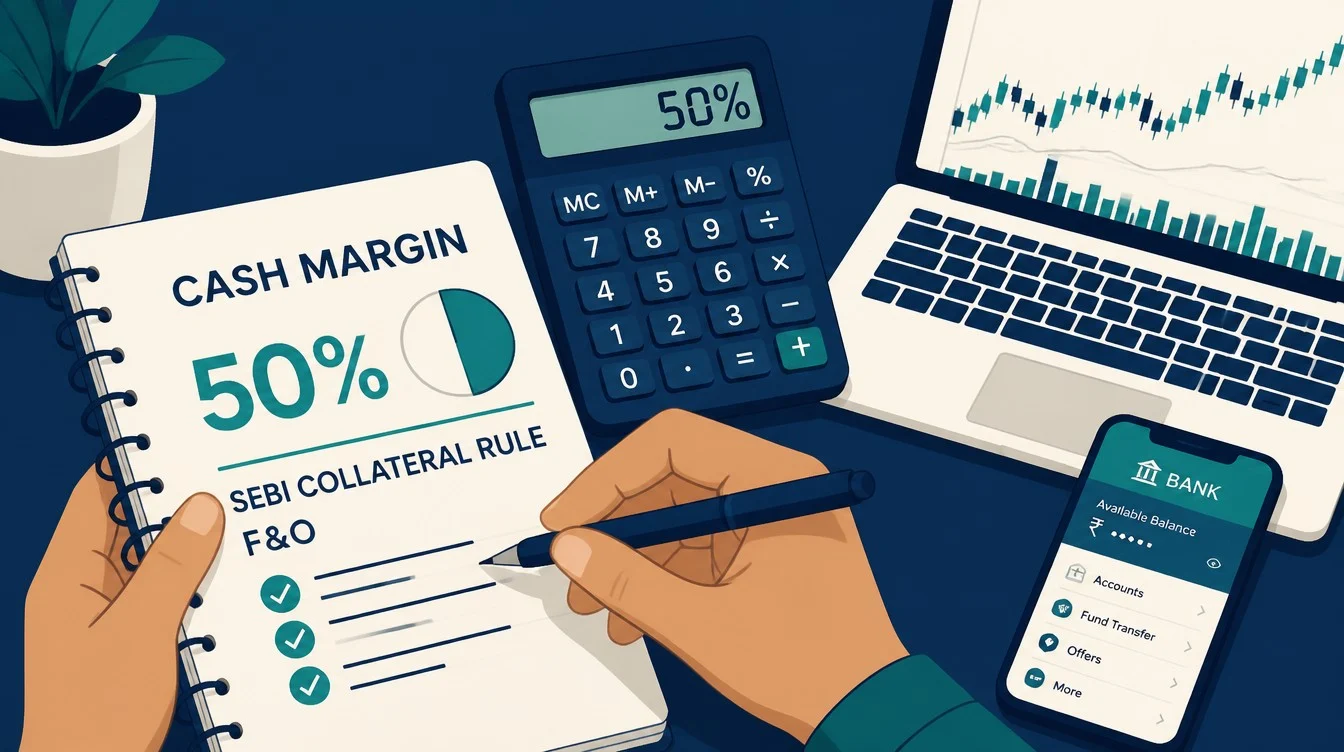
The SEBI cash margin 50 percent India 2026 framework rewrites how Indian retail and proprietary traders fund their F&O positions. Effective April 1, 2026, every F&O position must be backed by collateral that is at least 50% cash or cash-equivalent, with the remaining 50% allowed as pledged shares and eligible non-cash securities.
The old model, where a retail trader could pledge a portfolio of equity holdings and run a sizeable F&O book on minimal liquid cash, is gone. So is the trick of leaning entirely on pledged shares for short option margin. The 50/50 split is the new floor.
This guide explains the math of the rule, what counts as cash and what does not, how bank guarantees and pledges work under the framework, and what happens when the cash side falls short. The standard caveat applies: F&O carries leveraged risk and is unsuitable for most retail investors; the cash margin rule is one of several mechanisms that force the segment to be capital-honest.

The Rule In One Sentence
From April 1, 2026, SEBI requires that for every F&O position requiring margin, at least 50% of the total margin must be in cash or cash-equivalent, and at most 50% can be funded through pledged equity or eligible non-cash securities.
The Numbers
If a Nifty short straddle requires Rs.3,00,000 (3 lakh) of SPAN plus exposure margin, the trader must have at least Rs.1,50,000 in cash or cash-equivalents and can fund the remaining Rs.1,50,000 through pledged equity. If the cash balance is below Rs.1,50,000, the broker either applies a penalty or squares off positions.
Why The 50/50 Split
SEBI’s view is that pledged equity is a fluctuating asset whose value depends on market levels at the moment a margin call is triggered. In a sharp market drop, the same pledge that was worth Rs.5 lakh on Friday can be worth Rs.4 lakh on Monday morning, exactly when margin shortfalls bite. Cash and cash-equivalents do not have this co-movement risk.
The Broader Frame
The cash margin rule is part of a coordinated tightening that also includes RBI’s parallel rules on broker bank funding and stricter haircuts on equity collateral at the bank level. The combined effect raises the genuine working capital required to run an F&O book.
What Counts As Cash Or Cash-Equivalent
The “cash” side of the 50/50 split is broader than literal bank balance. SEBI’s framework counts several liquid, low-correlation instruments as cash-equivalent.
Free Cash In The Trading Account
The simplest cash form is uninvested rupee balance in the trading or demat account. Free cash counts at face value with no haircut. For most retail accounts, this is the bulk of the cash leg.
Liquid And Overnight Mutual Funds
Units of liquid mutual funds and overnight funds, pledged through the standard CDSL or NSDL pledge process, count as cash-equivalent. The pledge typically applies a small haircut (1% to 5%), but the residual value sits on the cash side of the ledger. For traders who want to keep capital working at a small yield, liquid funds are a common cash-equivalent vehicle.
Central Government Securities
Central government securities (G-Secs) pledged to the clearing corporation count as cash-equivalent at the post-haircut value. For larger accounts, G-Sec pledges are an efficient cash side because they pay a coupon.
Bank Fixed Deposits Pledged To The Clearing Corporation
A bank fixed deposit issued in favour of the clearing corporation, or assigned through the bank’s lien mechanism, counts on the cash side. The FD continues to earn interest while serving as margin, which makes it one of the most capital-efficient cash legs.
What Is Not Cash
Equity shares, equity mutual fund units, ETFs, and most bond mutual funds (other than overnight or liquid funds) are not on the cash side. They sit on the non-cash side and can fund only the remaining 50% of margin.
Bank Guarantees Under The New Framework
Bank guarantees (BGs) have long been a margin instrument for larger trading accounts and proprietary desks. Under the 2026 framework, the rules on BGs were tightened sharply.
The Core Requirement
A bank guarantee issued to a clearing corporation must be backed by collateral of at least 50% of the guaranteed amount. Of that backing, at least 25% must be in cash. The remaining backing can be in equity or other eligible securities.
Proprietary Trading Guarantees
For proprietary trading, the rule is stricter. The bank guarantee must be fully secured, and at least 50% of the collateral must be in cash. This brings the rules for proprietary participants in line with retail in terms of cash discipline.
Practical Effect On Retail
Most retail traders do not use bank guarantees directly. The relevance of the BG rule is indirect: it caps how aggressively brokers can extend collateral to their own house accounts, which in turn affects how much margin financing the broker can offer end-clients.
The Shortfall And Penalty Mechanics
The 50/50 split is not a one-time check. It is monitored continuously through the trading day and at end-of-day reporting to the clearing corporation.
End-Of-Day Margin File
At the end of each trading day, the broker submits a margin file to the clearing corporation that breaks down each client’s margin into cash and non-cash components. If the cash component is below 50% of the total margin requirement, the broker must either top up from house funds (and pass on the cost) or apply a penalty to the client.
Intraday Triggers
Intraday monitoring is also live. If a sharp market move drops the value of pledged equity such that the cash side falls below the 50% floor, the broker can issue an intraday call. If the call is not met, partial or full square-off is the typical response.
What The Penalty Looks Like
Penalty mechanics vary across brokers, but the common structure is a daily charge on the shortfall amount, plus mandatory disclosure to the client. Repeated breaches can result in trading restrictions or, in extreme cases, account-level suspension of F&O privileges.
The Rule Side By Side
The table below summarises the practical change for a retail trader running an F&O book.
| Margin component | Before April 1, 2026 | From April 1, 2026 |
|---|---|---|
| Acceptable cash side | Bank balance, liquid funds | Cash, liquid and overnight funds, FDs, G-Secs |
| Equity pledge contribution | Could fund up to 100% in some structures | Up to 50% only |
| Minimum cash floor | None at retail level | 50% of total margin |
| Bank guarantee backing | Light-touch collateral | Minimum 50% collateral, of which 25% cash |
| Proprietary BG backing | Partial collateralisation common | Full collateral, 50% in cash |
| Intraday monitoring | End-of-day reconciliation | Continuous monitoring, intraday calls possible |
How To Structure Margin Under The New Rule
For a retail trader who wants to remain active in F&O while staying compliant, the practical question is how to structure the working capital across cash and pledge.
Step 1: Decide The F&O Working Capital
Add up the typical margin requirement of the strategies the trader actually runs. For a one-lot Nifty short-strangle plus a small directional book, this might be Rs.3,00,000 to Rs.4,00,000 of margin. The “F&O working capital” is at least 1.5 times this number, to provide buffer.
Step 2: Split The Working Capital
Of the F&O working capital, allocate at least 50% to cash or cash-equivalent vehicles: a sweep-in FD, a liquid mutual fund pledge, or simple bank balance in the trading account. The remaining 50% can sit in pledged equity or eligible securities.
Step 3: Choose The Right Cash Vehicle
For yield-conscious traders, a liquid mutual fund pledge or a bank FD lien typically earns a small return while serving as the cash side. For simplicity-focused traders, free balance in the trading account works but earns nothing. The choice is a small optimisation; what matters is meeting the 50% floor.
Step 4: Monitor The Ratio
Most brokers expose a real-time view of the cash-to-total-margin ratio in their risk dashboard. The ratio should never drift below 50%. A sharp market move that depresses equity pledge value can pull the ratio down even when the trader has not added or reduced a position.

Worked Example: A Rs.10 Lakh F&O Account
Consider Vikram, a 38-year-old salaried IT professional with Rs.10,00,000 (10 lakh) of dedicated F&O working capital. He runs a mix of long options on Nifty weeklies and short-strangle positions on Sensex.
The Margin Requirement
Across his typical book, Vikram’s SPAN plus exposure margin runs Rs.3,00,000 to Rs.4,00,000 at any given time. The 50% cash floor on Rs.4,00,000 is Rs.2,00,000.
His Pre-2026 Structure
Pre-2026, Vikram pledged Rs.8,00,000 of equity holdings (post haircut, that gave him Rs.6,00,000 of margin value), kept Rs.50,000 cash, and ran his F&O book mostly on the pledge. The cash share of his margin was 12%, well below the new 50% floor.
His Post-2026 Structure
Vikram restructured by pledging Rs.4,00,000 of equity (giving Rs.3,00,000 of margin value at typical haircut), pledging Rs.3,00,000 of a liquid mutual fund (giving Rs.2,90,000 of cash-equivalent margin), and keeping Rs.50,000 cash balance. His total margin capacity is roughly Rs.6,40,000, with cash and cash-equivalent contributing Rs.3,40,000 (53% of the total). He is comfortably above the floor.
What He Gave Up
The visible cost was a slightly lower portfolio equity exposure (Rs.4,00,000 less in pledged equity), partially offset by the liquid fund pledge earning a modest yield. The genuine cost was the discipline of moving away from a near-fully-pledged structure to a more balanced one.
How The Rule Interacts With Other 2026 Changes
The cash margin rule does not stand alone. It interacts with the lot-size change, the suitability test, and the algo framework.
Lot Size And Cash Floor
The Rs.15 lakh notional lot size raises the absolute margin per lot. Combined with the 50% cash floor, a single Nifty short option lot can need Rs.60,000 to Rs.90,000 of pure cash backing. Below Rs.5 lakh working capital, even a one-lot short-side strategy is uncomfortably tight.
Suitability Test And Cash Floor
A conditional-pass account that is restricted to long options is partly insulated from the cash margin rule because options buyers pay premium upfront and do not face the cash-collateral split for the directional bet. The rule mostly bites on short-option and futures sellers, who are typically the more sophisticated retail tier.
Algo Framework And Cash Floor
An algo cannot bypass the cash floor. Any short-leg strategy generated by an algo on a thin-cash account triggers the same broker-side calls. Algos need to be designed to read the live cash-to-total-margin ratio and pause or reduce positions when the ratio narrows.

Common Mistakes Under The New Margin Rule
Across early FY 2026-27 broker advisories and support tickets, three patterns of failure recur.
Mistake 1: Pledging Almost Everything
Some traders pledged the maximum eligible securities (equity, ETFs) and let the cash side drift to a token amount. The first margin call exposes the under-funding. The fix is to actively rebalance the pledge: reduce equity pledge, add a liquid fund pledge or sweep-in FD on the cash side.
Mistake 2: Counting ETFs As Cash
Equity ETFs, including Nifty 50 and Sensex ETFs, do not count on the cash side. They are non-cash collateral and contribute to the 50% non-cash bucket. Mistaking them for cash-equivalent is a common conceptual error that produces unexpected shortfalls.
Mistake 3: Reacting Late To Intraday Calls
The cash-to-margin ratio moves with the market. A sharp 2-3% drop in pledged equity value can push the ratio below 50% intraday. Waiting for end-of-day reconciliation to act often means receiving a square-off rather than fixing the gap voluntarily. The right response is to monitor the broker’s dashboard during volatile sessions and top up the cash side proactively.
The Outlook For Margin Capital In FY 2026-27
The cash margin rule is one of the structural pieces of the 2026 framework that has the cleanest macro effect on retail behaviour. Several patterns are already visible.
Liquid Fund Pledges On The Rise
Liquid mutual fund AUM at retail-friendly fund houses has grown noticeably in FY 2025-26, partly because traders are using these instruments as the cash side of their F&O margin. AMFI data through the period showed steady inflows into the liquid and overnight categories.
Smaller Effective F&O Books
The cash floor effectively raises the working capital required to support a given F&O book. Many retail accounts have reduced concurrent position counts to live inside their cash-side capacity. Average notional exposure per active retail account has compressed, in line with what SEBI intended.
The Broader Discipline Effect
The most underrated outcome of the rule is the discipline it imposes on retail traders to compute genuine working capital before scaling up. A trader who, in 2024, would have stretched a Rs.3 lakh portfolio across multiple short option lots can no longer do so. The math of the rule does the gatekeeping that some traders would not have done on their own.
Frequently Asked Questions
What is the SEBI cash margin 50 percent India 2026 rule?
Effective April 1, 2026, SEBI requires that at least 50% of the total margin for every F&O position be in cash or cash-equivalent instruments, with the remaining 50% allowed as pledged shares or eligible non-cash collateral. The rule applies at both end-of-day and intraday levels, and breaching the floor triggers either a penalty or a partial square-off.
What counts as cash-equivalent under the rule?
Cash-equivalents include free cash balance in the trading account, liquid and overnight mutual fund units pledged to the clearing corporation, bank fixed deposits issued in favour of the clearing corporation, and central government securities pledged at the post-haircut value. Equity shares, equity ETFs, and standard equity mutual funds are not on the cash side.
What happens if my cash side falls below 50%?
The broker is required to either top up from house funds (and pass on the cost), apply a daily penalty on the shortfall, or square off positions to restore compliance. Repeated breaches can lead to broader trading restrictions or temporary F&O suspension on the account.
Are bank guarantees still usable for margin?
Yes, but with tighter rules. A bank guarantee issued to a clearing corporation must be backed by collateral of at least 50% of the guaranteed amount, of which at least 25% must be in cash. For proprietary trading guarantees, the BG must be fully secured with at least 50% cash backing. Most retail traders do not use BGs directly.
Does the rule apply only to short option positions?
The rule applies to any F&O position that requires margin (futures, short options, short-leg multi-leg strategies). Long option positions are funded by upfront premium payment and are not subject to the 50/50 split, because they do not require margin in the same sense. The rule mostly bites on sellers and futures traders.
Related LearnFineEdge guides on the broader 2026 SEBI framework, the F&O suitability test, the MWPL retail cap, and risk management for retail F&O are forthcoming.