
Few financial events feel more violating than a rejected insurance claim. The premium was paid on time, the policy was in force, the event happened, and the response from the insurer is a letter citing a clause the buyer never read. The IRDAI’s published annual data shows health-insurance claim rejection rates have edged up in recent years, and life-insurance early-claim repudiations remain a meaningful share of contested claims.
This guide breaks down the ten most common reasons for insurance claim rejection india across life, health, and motor lines, walks through the escalation playbook that policyholders can actually use, and provides a documentation checklist that materially improves the odds of a contested claim being overturned. The escalation route from insurer’s internal grievance cell to the Insurance Ombudsman to consumer court is real, well-trodden, and surprisingly buyer-friendly when followed correctly.
A rejected claim is not the end. It is the start of a process that, with the right documents and the right sequence, frequently ends in full or partial payment. The article shows how to run that process without losing your composure or your case.

Insurance Claim Rejection India: The Underlying Mechanics
Insurance contracts in India operate on the principle of “utmost good faith” (uberrimae fidei), which means both the policyholder and the insurer are expected to disclose all material facts. When a claim is rejected, the underlying logic is almost always that the insurer believes either a material fact was not disclosed at the proposal stage, the event falls outside the policy’s coverage scope, or the documentation submitted does not establish entitlement.
The contestability period in life insurance
Section 45 of the Insurance Act, 1938 (as amended) limits the insurer’s ability to repudiate a life-insurance claim on grounds of misstatement or non-disclosure to the first three years from policy commencement. After three years, the insurer cannot reopen the policy on grounds of fraud or misstatement except in extremely narrow circumstances. The three-year mark is therefore a critical line in life-insurance claim defensibility.
The “material fact” definition
A material fact is any information that would have influenced the insurer’s underwriting decision: pre-existing diseases, occupation hazards, smoking status, family medical history of major hereditary illnesses, previous insurance applications declined or loaded, and prior hospitalisations. The test is not whether the fact actually caused the claim event but whether it would have affected underwriting at proposal time.
The “coverage scope” question
Even with full disclosure, a claim can be rejected if the event falls outside the policy’s coverage. Health-insurance policies typically exclude certain treatments (cosmetic surgery, dental except as accident-related, fertility treatments in some products), and motor policies exclude consequential losses (engine damage from continuing to drive after water ingress, for example). Reading the exclusions section is as important as reading the inclusions.
Reason 1: Non-Disclosure At Proposal Stage
The single most common reason for claim rejection across both life and health insurance is non-disclosure of material facts at the time of application. The non-disclosure may be deliberate or genuinely accidental; from the insurer’s perspective, the result is the same.
Typical patterns
Common non-disclosures include diagnosed diabetes treated by lifestyle modification rather than medication, hypertension diagnosed once but not pursued, an old admission for chest pain ruled “non-cardiac” but on hospital record, family history of major hereditary illness, and occasional or “social” tobacco use. Each of these would normally result in a loaded premium or a specific exclusion rather than outright denial of cover, but non-disclosure converts what would have been a manageable underwriting note into a claim-rejection trigger.
How to avoid this trap
Disclose everything in the proposal form, even if the agent assures you “this small thing won’t matter”. Most insurers’ loaded premium for honest disclosure is meaningfully smaller than the family-level financial damage of a rejected claim. If a condition exists, it is better to be insured with the condition and a loading than to be apparently insured with the condition hidden, only to discover at claim time that the cover was never genuinely in force.
The “policy past contestability” defence
If the policy has crossed the three-year contestability mark for life insurance, the insurer’s ability to repudiate on non-disclosure grounds is significantly constrained. For health insurance, there is no equivalent statutory protection, but most insurers’ practice is to scrutinise non-disclosure cases harder in the first two years.

Reason 2: Claims Within Waiting Period
Health-insurance policies in India typically have several waiting periods that operate in parallel. The initial waiting period (30 days from policy commencement, with accident-related claims usually exempt), the specific-disease waiting period (commonly 24 months for cataract, hernia, gallstones, varicose veins, and similar listed conditions), and the pre-existing-disease waiting period.
The IRDAI 2026 PED cap
IRDAI’s 2026 framework caps the pre-existing-disease waiting period at three years across the industry, replacing the previous four-year practice for most insurers. Claims for pre-existing conditions made within the three-year window are typically rejected as falling within the waiting period.
Practical implications
A buyer who is hospitalised for a kidney-stone procedure four months into a new policy will almost certainly face a claim rejection because kidney stones typically fall within the 24-month specific-disease waiting period. The claim is not “wrongly rejected”; it is rejected on policy-wording grounds. Buyers should plan elective procedures around waiting periods where possible and use ported policies (which preserve waiting-period credit) when switching insurers.
How portability protects waiting-period credit
IRDAI portability rules allow waiting-period credit to be carried from the old policy to the new policy, so a buyer who held the old policy for three years and ports does not restart the waiting clock with the new insurer. Lapsing and re-buying, by contrast, restarts every waiting period.
Reason 3: Treatment Outside Network Hospital Without Authorisation
Health insurance offers cashless treatment at network hospitals. Treatment at a non-network hospital requires reimbursement, which has stricter documentation requirements and longer processing timelines. Many claims are rejected because of procedural failures at non-network hospitals.
The intimation requirement
Most policies require claim intimation within 24 to 48 hours of hospitalisation, even for planned procedures. Failure to intimate within the policy’s specified window is sometimes cited as a rejection ground. The intimation can usually be made via the insurer’s app, call centre, or email, and it should be done immediately on admission regardless of whether the hospital is in network.
Documentation discipline
Reimbursement claims need a much fuller documentation file than cashless claims: original hospital bills with itemised charges, discharge summary with diagnosis and treatment timeline, original prescription history, original pharmacy bills, original diagnostic-test reports and bills, original investigation reports, and a copy of the policyholder’s photo ID and policy schedule. Missing any of these can stall or derail the claim.
The “reasonable and customary” deduction
Even when reimbursement claims are approved, insurers sometimes deduct amounts that exceed “reasonable and customary” charges for the locality. This is contestable: produce comparable charge lists from peer hospitals in the same metro to support the disputed line items.
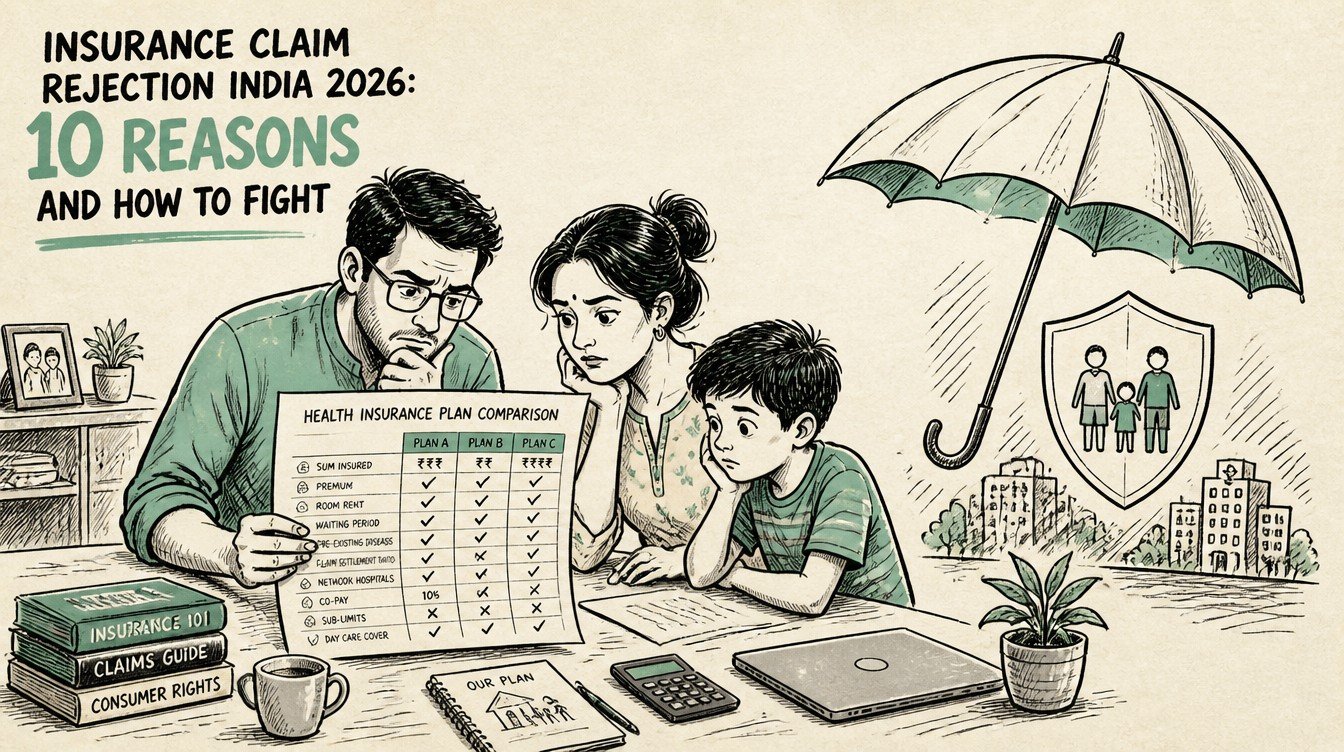
Reason 4: Misuse Of Sub-Limits And Room-Rent Capping
Sub-limits and room-rent capping clauses are among the most aggressive deduction mechanisms in modern health insurance. They are technically not “rejections” but materially reduce the claim payout.
How room-rent proportional deduction works
If a policy caps room rent at 1 percent of the sum insured (Rs.5,000 per day on a Rs.5,00,000 policy) but the insured chose a Rs.8,000 per day room, the insurer can apply the proportional ratio to all associated charges, including doctor’s fees and ICU costs. The effective deduction can be 30 to 40 percent of the entire bill.
How to avoid this
Prefer policies without a hard room-rent cap, or with a cap large enough to cover a standard private room at the hospital category you actually use. The premium delta for a no-cap product is usually small relative to the protection it preserves at claim time.
Disease-wise sub-limits
Procedure-specific sub-limits (Rs.40,000 cap on cataract surgery, Rs.1,50,000 cap on knee replacement, and similar) operate similarly. Modern indemnity policies with no procedure-wise capping are usually preferable, even at a premium delta, for buyers who value predictable cover at claim time.
Reason 5: Lapsed Policy Or Premium-Default Grace-Period Issues
A policy that has lapsed due to non-payment of premium is not in force, and any claim during the lapsed period is rejected. The grace-period rules under IRDAI 2026 framework specify the days within which a lapsed policy can be revived without losing continuity benefits.
Grace periods in 2026
Annual premium policies typically carry a 30-day grace period; monthly modal policies carry a 15-day grace period. A claim arising during the grace period before the lapsed premium is paid is sometimes contested, and the typical resolution is that the insurer accepts the claim provided the lapsed premium is paid promptly.
Revival after lapse
A lapsed policy can typically be revived within a defined revival window (commonly two years for life policies), subject to payment of arrears and possibly fresh medical underwriting. A claim during the revival window before revival is completed is rejected because the policy is not in force.
How to prevent lapse
Set up auto-debit for premium payment and check the bank balance schedule against premium-due dates. Calendar reminders 15 days and 5 days before the due date catch most failed auto-debits before they convert into lapse.
Reason 6: Misstatement Of Age
Life-insurance and some health-insurance products are age-rated, and a misstatement of age at proposal stage can convert into a claim-rejection trigger or a benefit-adjustment trigger.
The “correct age, wrong premium” scenario
If the insurer later establishes the correct age was higher than stated, the policy is typically adjusted: the death benefit is reduced in proportion to the premium that would have been paid for the correct age, rather than the claim being rejected outright. This is a meaningful protection compared to outright denial.
The “correct age, ineligible at issuance” scenario
If the correct age would have made the applicant ineligible at issuance (above the product’s maximum entry age), the claim can be rejected because the policy should not have been issued. The case is often defensible if there is evidence the insurer’s underwriting team had access to age documents at issuance.
Documentation
Aadhaar, PAN, passport, and birth certificate are the standard age proofs. Filing the most reliable document at proposal stage reduces the risk of later disputes. School-leaving certificates and ration cards are sometimes accepted but are weaker evidence in a dispute.
Reason 7: Suicide Within The First Year Of Life Insurance
Most life-insurance policies in India have a suicide exclusion or partial benefit during the first 12 months of the policy. After the first 12 months, suicide is typically a covered cause of death.
The standard wording
The IRDAI-aligned wording in most current life-insurance policies is that if the policyholder dies by suicide within 12 months from policy commencement, the insurer pays back the premiums received, less applicable charges. After the 12-month mark, suicide is covered as a normal cause of death.
Revived policy treatment
For revived policies, the 12-month suicide-exclusion window may restart from the date of revival, depending on the policy wording. The exact treatment varies by insurer; nominees should consult the policy schedule and the revival documentation.
Why this clause exists
The suicide-exclusion clause is a standard market practice across most jurisdictions to discourage anti-selection. Policyholders should know it exists, but it is rarely a contested ground because the wording is unambiguous and the mark is clear.
Reason 8: Insurance Fraud Indicators At Claim Stage
Insurers maintain industry-wide databases of claim-fraud indicators and run pattern-recognition reviews on suspicious claims. Genuine policyholders sometimes get caught in the net of pattern detection.
Common fraud-indicator triggers
Claim soon after policy issuance, claims at hospitals previously flagged for fraudulent billing, unusually high billing relative to the diagnosis category, multiple policies covering the same risk taken in a short window, and discrepancies between the diagnosis on the hospital admission record and the discharge summary all trigger closer review.
How to navigate enhanced scrutiny
For high-value claims or claims early in the policy term, expect enhanced scrutiny and prepare for it. Maintain a comprehensive documentation file from the day of hospitalisation. Co-operate with the insurer’s investigators and provide additional documents promptly. If the insurer requests an independent medical review, agree to it; refusal often becomes a rejection ground.
Genuine claims wrongly flagged
Genuine claims wrongly flagged as suspicious are usually resolved through the insurer’s internal review process or, failing that, through the IRDAI grievance route. Maintain copies of all communication, including timestamps on email exchanges and call logs from the insurer’s support line.
Reason 9: Procedural Failures – Late Intimation, Incomplete Forms
Many claims are rejected on purely procedural grounds rather than on substantive coverage grounds. These are often the easiest to overturn through escalation, but they are also the easiest to avoid.
Late intimation
Most policies require intimation within 24 to 48 hours of hospitalisation or accident. Late intimation is sometimes cited as a rejection ground; the standard counter is that late intimation by itself does not cause the loss and should not be a sole basis for rejection. The Insurance Ombudsman has consistently ruled in favour of policyholders on late-intimation-only rejections.
Incomplete claim forms
Claim forms returned for “incomplete information” should be completed and resubmitted promptly. Insurers’ standard claim-acknowledgment timelines run from the date of the complete file, not from the date of the first incomplete submission, so resubmission resets the clock.
Missing documents
The single most common procedural failure is missing supporting documents: pharmacy bills, diagnostic reports, original prescription. Maintain a comprehensive folder from admission day, including duplicate copies of all bills before discharge. Hospitals do not always retain billing detail after discharge; the policyholder’s own copies are the primary record.
Reason 10: Exclusions Specific To The Policy
Every policy has its own exclusions list. The standard exclusions across health policies include cosmetic surgery, dental treatment unrelated to accident, fertility treatments in some products, and self-inflicted injuries. Motor policies exclude consequential damage from continuing to drive after an event.
The “I didn’t know it was excluded” defence
Policyholders sometimes argue they did not know an exclusion applied. The standard counter is that the policy document was provided at issuance with a free-look period during which it could have been returned. The Insurance Ombudsman has occasionally ruled in favour of policyholders where the exclusion was buried in fine print and not adequately disclosed, but the success rate of this argument is modest.
The “industry-standard inclusion” defence
Some exclusions in older policy wordings have been overruled by IRDAI as industry-standard inclusions. For instance, mental-health treatment was historically excluded but is now mandatorily included under IRDAI 2018 guidance. Older policies that still exclude mental health may face contestability on this ground.
Reading exclusions before buying
The single most useful 30 minutes a buyer can spend on a health policy is reading the exclusions section before signing. Modern indemnity products with shorter exclusion lists are usually worth the premium delta over older products with longer exclusion lists.
The Escalation Playbook
If a claim is rejected, the policyholder has a clear escalation path with defined timelines at each stage. Following the path in sequence usually delivers the strongest outcome.
Step 1: Insurer’s grievance redressal cell
Every insurer maintains an internal grievance redressal cell. The first escalation is a written representation to this cell, including the policy schedule, the claim file, the rejection letter, and the policyholder’s response. The insurer is required to respond within 14 days, and most do.
Step 2: IRDAI’s IGMS portal
If the insurer’s response is unsatisfactory or absent after 14 days, the next step is the IRDAI Integrated Grievance Management System (IGMS). The complaint can be filed online and is routed back to the insurer’s senior management with regulatory oversight. Many complaints are resolved at this stage because insurers face regulatory consequences for unresolved grievances.
Step 3: Insurance Ombudsman
The Insurance Ombudsman handles disputes up to Rs.50,00,000 (50 lakh) in value and operates as an alternative to consumer court. Filing with the ombudsman is free, no advocate is required, and the process is faster than civil litigation. Decisions are binding on the insurer; the policyholder can accept or reject the award. The ombudsman’s office covers the policyholder’s location of residence, not the insurer’s office location.
Step 4: Consumer court
For claims above Rs.50,00,000 or for ombudsman decisions the policyholder finds unsatisfactory, the consumer court (District / State / National Consumer Commission depending on value) is the next forum. Legal representation is helpful but not mandatory. Timelines are longer than ombudsman, often 18 to 36 months, but awards can include penal interest and litigation costs.
Step 5: Civil court (rare)
For exceptional cases involving fraud, criminal misrepresentation by the insurer, or large complex disputes, civil court is available. This is rarely the first or even second forum chosen by retail policyholders.
Documentation Checklist For Contesting A Rejection
The strength of a contested claim almost always comes down to the documentation file. The checklist below covers the documents that materially improve outcomes at each stage of escalation.
- Policy schedule (the certificate showing sum insured, premium, term, policyholder details)
- Original proposal form copy (insurer-provided on request) showing what was disclosed at application
- Premium payment receipts for the relevant policy years
- Claim intimation acknowledgement (email, app screenshot, call-centre ticket)
- Hospital admission record with diagnosis and admission date
- Discharge summary with diagnosis, treatment timeline, and discharge date
- Itemised hospital bills (final and all interim bills)
- Original prescription history for the admission and follow-up
- Original pharmacy bills matched to prescriptions
- Diagnostic and investigation reports with associated bills
- Original specialist consult notes (cardiologist, oncologist, neurologist as applicable)
- The insurer’s rejection letter with the cited clause and rationale
- The policyholder’s written response rebutting each rejection ground point by point
- Photocopy of policyholder photo ID and address proof
- Bank-account details for claim disbursement if the rejection is reversed
The “expert opinion” supplement
For medical claim rejections that turn on diagnosis disputes, an independent specialist’s written second opinion (not from the treating hospital) can materially strengthen the policyholder’s case. The cost of a Rs.2,000 to Rs.5,000 specialist consult is small relative to the value of the disputed claim.
Timelines to remember
The insurer’s response window is 14 days from a complete representation. The ombudsman’s process typically takes 90 to 180 days. Consumer court is 18 to 36 months at the lower forums and longer at higher forums. Plan the timeline assuming the longer estimate; out-of-pocket bridging finance during the dispute is often the family’s biggest cost.
Frequently Asked Questions
What is the most common reason for insurance claim rejection in India?
Non-disclosure of material facts at the proposal stage is the single most common reason across both life and health insurance. Common non-disclosures include diagnosed hypertension or diabetes treated by lifestyle, previous admissions, family history of major hereditary illness, and tobacco use. Disclose everything at proposal time; the loaded premium for honest disclosure is almost always smaller than the family-level financial damage of a rejected claim.
Can a life insurance claim be rejected after three years of policy?
Section 45 of the Insurance Act, 1938 (as amended) significantly constrains the insurer’s ability to repudiate a life-insurance claim on grounds of misstatement or non-disclosure after three years from policy commencement. Outright denial after the three-year mark is rare and requires extremely narrow grounds.
How do I escalate a rejected health insurance claim?
Start with the insurer’s internal grievance cell. If unresolved within 14 days, file via the IRDAI IGMS portal. If still unresolved, file with the Insurance Ombudsman for claims up to Rs.50,00,000 (50 lakh). For higher-value claims or ombudsman decisions you find unsatisfactory, consumer court is the next forum. Maintain a complete documentation file at every stage.
Is the Insurance Ombudsman’s decision binding?
The ombudsman’s award is binding on the insurer. The policyholder may accept the award (and the insurer must comply) or reject it and pursue consumer court or other legal forums. The ombudsman process is free, no advocate is required, and decisions typically take 90 to 180 days, which is faster than consumer-court routes.
Can I claim partial payment if part of my hospital bill is disputed?
Yes. Insurers can and do settle the undisputed portion while contesting specific line items. The policyholder accepts the partial settlement in good faith without waiving the right to contest the deducted portion through the escalation process. The acceptance letter should explicitly note that the policyholder is contesting the deducted amount, not accepting it.
Related guides on policy-document reading, IRDAI portability rules, and IRDAI Ombudsman process detail are forthcoming on LearnFineEdge and will be linked here once published.