

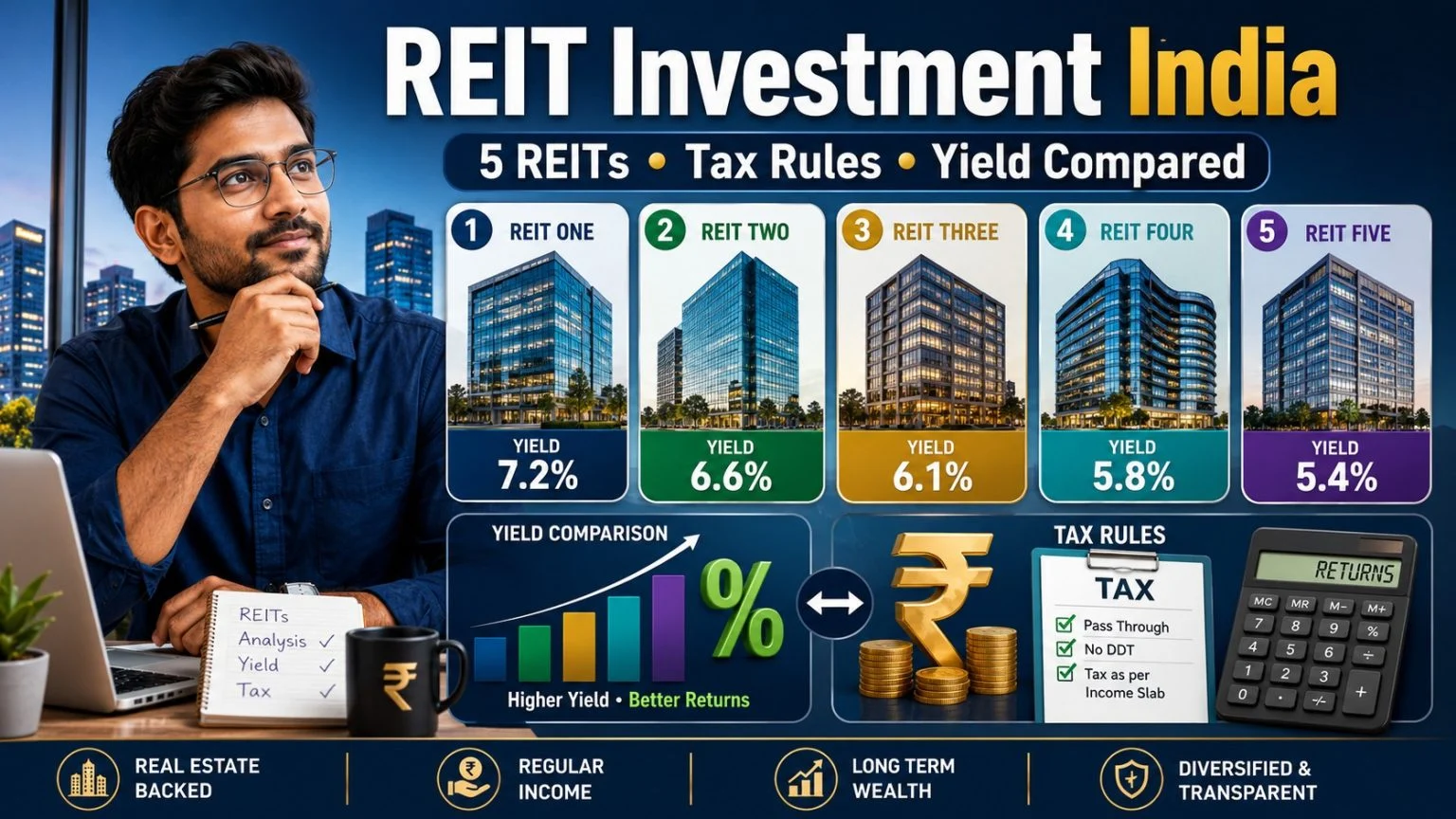
REIT investment India has opened commercial real estate to everyday investors: for a few hundred rupees you can own a slice of income-producing office and retail assets and earn rental income without buying a whole property. This guide covers how REITs work, the five listed REITs, how distributions are taxed, and how they compare with rental property.
REITs and InvITs in India: How to Earn Real Estate Rental Income with Rs 500
REIT investment in India has moved from a niche listed product in 2019 to a meaningful asset class in 2026, with Embassy Office Parks, Mindspace Business Parks, Brookfield India Real Estate, and Nexus Select Trust now well-tracked on the exchanges and a fifth (Knowledge Realty Trust) in active circulation. The minimum lot size has dropped to a single unit; monthly or quarterly distributions land in the bank account, and the asset class has quietly become an option for investors who want rental-style income without buying a flat.
This guide explains exactly how REITs and InvITs work in India; the tax treatment that splits rental, dividend, and capital-gain components differently; the five investable REITs available to retail today; and a head-to-head comparison against direct rental property. The point is to let an investor with Rs 500 or Rs 5 lakh decide whether REITs belong in their portfolio at all and at what allocation.
What a REIT Actually Is
A Real Estate Investment Trust is a SEBI-regulated trust that owns a portfolio of income-generating real estate, leases the assets to tenants on long-term contracts, and is required by law to distribute at least 90 percent of its net distributable cash flow to unitholders. The investor buys units of the REIT on a stock exchange exactly like buying a share, holds them in the same demat account, and receives distributions periodically.
InvITs (Infrastructure Investment Trusts) follow the same structure but invest in infrastructure assets such as roads, transmission lines, telecom towers, or gas pipelines instead of real estate. Both are governed by SEBI’s REIT and InvIT regulations, both distribute on the same 90-per-cent-of-NDCF rule, and both trade in the same market microstructure. The differences sit in the underlying assets and the cash flow profile.
Why the structure matters
The pass-through structure is what gives REITs their character as a yield instrument. Unlike a normal company that can choose to retain earnings, a REIT is legally obliged to send most of the cash out to investors. This creates a stable, bond-like distribution profile with equity-like upside if the underlying rents grow, and it is the closest listed proxy to actually owning rental real estate in a tax-efficient wrapper.
The Five REITs Available in India Today
Embassy Office Parks REIT was the first to list in India in 2019, with a portfolio dominated by Grade-A office space across Bangalore, Mumbai, Pune, and Noida. The asset base is approximately 45 million square feet with occupancy in the high 80s and a tenant mix dominated by global technology firms. Distribution yields have historically sat in the 6 to 7 percent range.
Mindspace Business Parks REIT, sponsored by K Raheja Corp, listed in 2020 with a portfolio concentrated in Mumbai, Pune, and Hyderabad. The asset profile is similar to Embassy in being office-led, with strong tenant concentration in the IT and financial services sectors. Distribution yields have been comparable to Embassy.
Brookfield India Real Estate Trust, sponsored by Brookfield Asset Management, was listed in 2021 with a portfolio across Mumbai, Gurugram, Noida, and Kolkata. The strategy emphasises larger asset tickets and tenant covenants from global financial services and consulting firms. Brookfield’s track record outside India in operating REIT structures has been a source of confidence for institutional investors.
Nexus Select Trust, which was listed in 2023, is the only retail-asset REIT in India. The portfolio are shopping malls across major cities, with tenants drawn from organised retail, food and beverage, and entertainment. The cash flow profile is meaningfully different from the office REITs because retail leases include a fixed-rent plus revenue-share component, which makes distributions more sensitive to consumer spending cycles.
Knowledge Realty Trust is the most recent listing, focused on educational and knowledge-economy real estate. It is the smallest of the five and still building a track record, which makes it appropriate primarily for investors who want a small satellite position alongside the more established names.
How REIT Distributions Are Taxed in India
The tax treatment of REIT distributions is the single most misunderstood aspect of the asset class. A REIT distribution arrives in three statutory components, each taxed differently in the investor’s hands. The breakdown is published by the REIT each quarter alongside the distribution announcement, and the investor’s annual information statement reflects the same split.
The interest component represents the share of distribution that flows from interest received by the REIT on inter-corporate deposits or loans to its special-purpose vehicles. This is taxed at the investor’s slab rate in the year of receipt. For a 30 percent bracket investor, this component effectively yields 70 percent of its gross value after tax.
The dividend component is the share that flows from dividends declared by the SPVs to the REIT. This is taxed in the investor’s hands only if the SPVs have opted for the concessional corporate tax regime under Section 115BAA. If the SPVs are on the regular corporate tax regime, the dividend reaches the investor tax-free. Most current REITs have at least some SPVs on the concessional regime, so a portion of the dividend is taxable.
The rental component (also called the amortisation of debt component) represents the share that is treated as repayment of capital or as a return of the investor’s principal. This component is not taxable as income at receipt, but it reduces the cost of acquisition of the units for the purpose of capital gains computation when the units are eventually sold.
Why this matters for after-tax yield
A REIT advertising a 7 percent distribution yield does not deliver 7 percent post-tax to every investor. A 30 percent bracket investor, where 40 percent of the distribution is the taxable interest component, 30 percent is the taxable dividend, and 30 percent is the rental return-of-capital component, would see a post-tax yield closer to 5.5 to 5.8 percent. The exact number depends on the SPV-level tax regime mix, which the investor can confirm from the REIT’s quarterly disclosures.
Capital Gains Taxation on REIT Units
REIT units are listed securities and are eligible for the listed-securities capital gains regime. Short-term capital gains, on units held for less than 36 months, are taxed at 20 percent. Long-term capital gains, on units held for 36 months or more, are taxed at 12.5 percent on gains exceeding Rs 1.25 lakh per financial year, in line with the unified LTCG framework that applies to listed securities since the 2024 reform.
The cost of acquisition for capital gains purposes is reduced by the cumulative rental return-of-capital component received during the holding period. An investor who held a REIT unit for 10 years and received Rs 50 of distribution per unit as rental return-of-capital during that period must subtract Rs 50 from their original cost when computing capital gains on sale. This is the trap that catches retail investors who treat REIT distributions as pure income.
REITs vs Buying Rental Property: The Honest Comparison
The marketing pitch for REITs is that they replicate the rental property experience without the capital intensity, the tenant management, or the illiquidity. This is broadly true, but the comparison deserves a careful look at yield, liquidity, leverage, and after-tax returns.
On yield, a Bangalore 2BHK rental property typically nets 2.5 to 3.5 percent gross rental yield before maintenance, property tax, and vacancy. A REIT distributes 6 to 7 percent. The REIT yield is higher because the underlying assets are commercial grade-A space with long-term tenant covenants, whereas the residential rental yield in Indian cities is structurally low.
On liquidity, a REIT can be exited in a single trading session for less than 0.5 percent transaction cost. A rental property typically takes three to twelve months to sell, with stamp duty, registration, broking, and capital gains friction that can easily cross 7 percent of the sale price.
On leverage, a rental property buyer can borrow up to 80 percent of the property value at a home loan rate of 8 to 9 percent, with the interest deductible against the rental income under Section 24(b). REIT units cannot be margin-bought in the same way, so the leveraged-IRR profile of rental property remains genuinely different from a REIT for an investor who is comfortable with the debt.
On after-tax returns, the math depends on the investor’s tax bracket and on whether the rental property is in a high-appreciation micro-market. Research shows that for a 30 percent bracket investor in a normal urban market, the after-tax IRR of a REIT and an unleveraged rental property are within 1 to 1.5 percent of each other, with the REIT winning on tax-of-capital-recovery efficiency and the rental property winning on long-term capital appreciation if the location is right.
What REITs do not replicate
The one thing a REIT does not replicate is the long-tailed capital appreciation of a well-located plot or flat in a tier-1 metro. Indian residential real estate has historically delivered nominal capital appreciation of 6 to 10 percent annually, which combined with the rental yield produces a total return that is competitive with the REIT yield. The REIT trades the appreciation potential for liquidity and tax-of-distribution efficiency, which is a real trade-off worth understanding.
REIT Investment India: How to Buy Your First REIT
The buying process is identical to buying any listed equity. A retail investor with an existing demat and trading account can search the REIT name on their broker terminal, place a buy order at the desired price, and receive the units in the demat account on T plus 1 settlement. There is no separate KYC or paperwork specific to REITs.
The minimum lot size has dropped to one unit after SEBI’s 2024 amendment, which means a REIT trading at Rs 350 per unit can be bought with Rs 350 plus broking. This is the single most significant retail-friendly change to the asset class and has materially expanded the eligible investor base from high-net-worth individuals to ordinary salaried savers.
Brokerage and demat costs
Brokerage on REIT trades is the standard cash-market brokerage charged by the broker, typically zero on delivery trades at discount brokers and 0.1 to 0.5 percent at full-service brokers. STT applies to any listed security. A demat account’s annual maintenance covers REIT units alongside other holdings at no incremental cost.
Building a REIT Portfolio
For a retail investor with Rs 5 lakh of allocation to real-estate-flavoured assets, a reasonable approach is to split across three of the five listed REITs to diversify both the sponsor and the asset mix. A typical structure would be roughly 40 percent in an established office REIT such as Embassy or Mindspace, 30 percent in a second office REIT to diversify the sponsor risk, and 30 percent in the retail-focused Nexus Select Trust to capture a different cash flow profile.
The InvIT side of the market offers a parallel exposure to infrastructure cash flows. Power Grid InvIT, IndiGrid, and IRB InvIT are the better-known names. Yields on InvITs have historically been slightly higher than on REITs, reflecting the longer-duration and counterparty-concentrated nature of infrastructure cash flows. A modest 10 to 15 percent of the REIT-and-InvIT bucket in InvITs gives the portfolio a useful yield kicker.
Pairing REITs with the regime decision
The taxation of REIT distributions is regime-neutral in the sense that both the new and old income tax regimes apply the same treatment to the interest, dividend, and rental components. The capital gains side is also regime-neutral. This means a REIT investor does not need to revisit their tax regime decision just because they have added a REIT, which is one of the cleaner administrative features of the asset class.
Common Mistakes REIT Investors Make
The first mistake is treating the headline distribution yield as the post-tax yield. The three-component split means the after-tax number can be 1 to 1.5 percentage points lower than the headline, depending on the bracket and the SPV mix. A 7 percent headline yield is closer to 5.5 percent post-tax for a 30 percent bracket investor.
The second mistake is ignoring the rental return-of-capital effect on the cost of acquisition. Investors who hold REITs for years and then sell are often surprised by a larger capital gain than they expected because their effective cost basis has been reduced by the cumulative return-of-capital component. The annual REIT distribution disclosure breaks out this component clearly; the investor needs to actually read it.
The third mistake is concentrating on a single REIT. The five REITs in India have different sponsors, different asset profiles, and different tenant concentration risks. Holding only the Embassy is a bet on Bangalore office tenants and on Embassy’s sponsor execution. Splitting across at least three reduces idiosyncratic exposure for very little additional cost.
Step-by-step entry plan for a new REIT investor
- Open a demat and trading account if you do not have one.
- Decide the overall REIT-plus-InvIT allocation as a percentage of net worth, typically 5 to 15 percent for a balanced investor.
- Pick three REITs across at least two sponsors and at least one retail-asset REIT for diversification.
- Stagger the entry over three to six months to average the price.
- Read the quarterly distribution disclosure to understand the three-component split.
- Track the effective cost basis after each rental return-of-capital component to avoid surprise capital gains at exit.
Comparison Table: REIT vs InvIT vs Direct Rental Property
| Parameter | REIT | InvIT | Direct Rental Property |
|---|---|---|---|
| Minimum investment | Rs 350-400 (one unit) | Rs 100-200 (one unit) | Rs 50 lakh and above |
| Asset class | Commercial/retail real estate | Infrastructure (roads, power, etc.) | Residential real estate |
| Typical gross yield | 6-7% | 7-9% | 2.5-3.5% |
| Liquidity | T+1 sale on exchange | T+1 sale on exchange | 3-12 months to sell |
| Leverage available | Limited (no home loan) | Limited | Up to 80% home loan |
| Distribution frequency | Quarterly | Quarterly | Monthly rent |
| Capital appreciation | Modest, market-linked | Modest | High if location is right |
| Tenant management | None (REIT handles) | None | Investor’s responsibility |
| Exit costs | Brokerage and STT | Brokerage and STT | Stamp duty, brokerage, capital gains |
Advanced Strategy: REITs in a FIRE Portfolio
For investors building a corpus targeting financial independence early in life, REITs offer a useful middle ground between pure-equity volatility and pure-debt yield. A REIT-heavy allocation in the decade leading up to FIRE provides a rising cash distribution stream that can partially fund living expenses without selling units, while the underlying real estate cash flows continue to compound.
A 40-year-old aiming for FIRE at 50 might run an 80-percent equity allocation today, taper toward 60 percent equity and 20 percent REIT-plus-InvIT and 20 percent debt by age 50, and live primarily on REIT distributions plus a small SWP from the equity sleeve through their fifties and sixties. The REIT yield of 6 to 7 percent compares favourably to a debt fund yield of 6.5 to 7.5 percent on a post-tax basis for an investor in the 30 percent bracket, and the asset class adds a different driver of returns than pure equity-debt.
Pairing this with the SEBI F&O rules
Investors who used to chase income through aggressive options strategies on indices have a structurally different alternative in REITs now that the SEBI F&O new rules have raised the cost of the weekly options income trade. A REIT distribution stream is not a substitute for derivatives income in terms of magnitude, but it is far more durable and far less stressful.
Frequently Asked Questions
Can I hold REITs in a tax-saving wrapper like ELSS?
No. REIT units are not eligible as an investment under Section 80C, and they cannot be bought inside an ELSS structure. A REIT must be held in a regular demat account, and the distributions and capital gains are taxed in the investor’s hands as described above.
Is there a SIP option for REITs?
There is no formal SIP product on REITs, but investors can simulate a SIP by placing periodic buy orders for one or more units each month. Some brokings now offer recurring-buy automation that effectively delivers a SIP-like cadence into REITs at no incremental cost beyond standard broking.
Do REIT distributions count as rental income for the home loan exemption?
No. REIT distributions are taxed under their statutory three-component breakdown as described, not as “income from house property”. The Section 24(b) home loan interest deduction cannot be claimed against REIT distributions because there is no underlying house property in the investor’s name.
What happens to my REIT units if the sponsor exits?
The sponsor’s stake is regulated to ensure minimum holding for a defined period under SEBI’s REIT regulations. If the sponsor exits in compliance with the regulations, the units continue to trade and the underlying assets continue to be managed by the REIT manager, which is a separate entity from the sponsor. Sponsor-exit risk is real but not as acute as in a typical promoter-led company.
Can NRIs invest in REITs?
Yes, NRIs can invest in REITs through a non-resident demat account, with funds routed from an NRE or NRO account. The taxation of distributions and capital gains follows the standard NRI framework, with TDS applicable at source on the distribution components. Double taxation avoidance agreements may further reduce the effective tax depending on the country of residence.
Related Articles
- SEBI F&O New Rules 2026: Retail Trader Guide
- New Tax Regime vs Old Tax Regime FY 2026-27
- NPS Vatsalya Scheme: Complete Guide for Parents 2026