
By Financial Content Strategist Understanding credit score is the first step to taking control of your money, because this single number shapes the loans, credit cards, and interest rates you are offered.
For many Americans, their credit score – the three-digit number attached to their financial identity – feels less like a metric and more like a mystery. You pay a bill, and it goes up a few points. You pay off a loan, and confusingly, it drops. It can feel arbitrary, frustrating, and crucial all at the same time.
But here is the reality: your credit score is not magic; it is maths.
Specifically, it is an algorithm designed to answer a single question for lenders: if they lend you money, how likely are you to pay it back?
In the United States, 90% of top lenders use the FICO score to make this determination. Whether your goal is to purchase your first home, lease a car, or secure a premium rewards credit card, understanding the intricacies of finance is the first step towards financial mastery.
In this guide, we are stripping away the jargon to reveal the five specific factors that determine your financial reputation and exactly how you can influence them, legally, to your advantage.
The Adult Report Card: Why This Number Rules Your Wallet
Before we dissect the factors, we need to establish the stakes. A credit score is essentially a risk assessment tool. It generally ranges from 300 to 850. The higher the score, the lower the risk you pose to a bank.
Why does this matter? Risk carries a high cost.
Did you know? According to recent financial data, the difference between a good score around 700 and an excellent score of 760 or higher can save a borrower over $40,000 in interest payments over the life of a 30-year mortgage. Source: FICO and MyFICO calculator insights.
Your score can influence:
-
The interest rates you pay on loans and credit cards
-
Your insurance premiums
-
Your ability to rent an apartment
-
In some states, even your eligibility for certain jobs
Understanding Credit Score: The FICO Pie Chart Breakdown
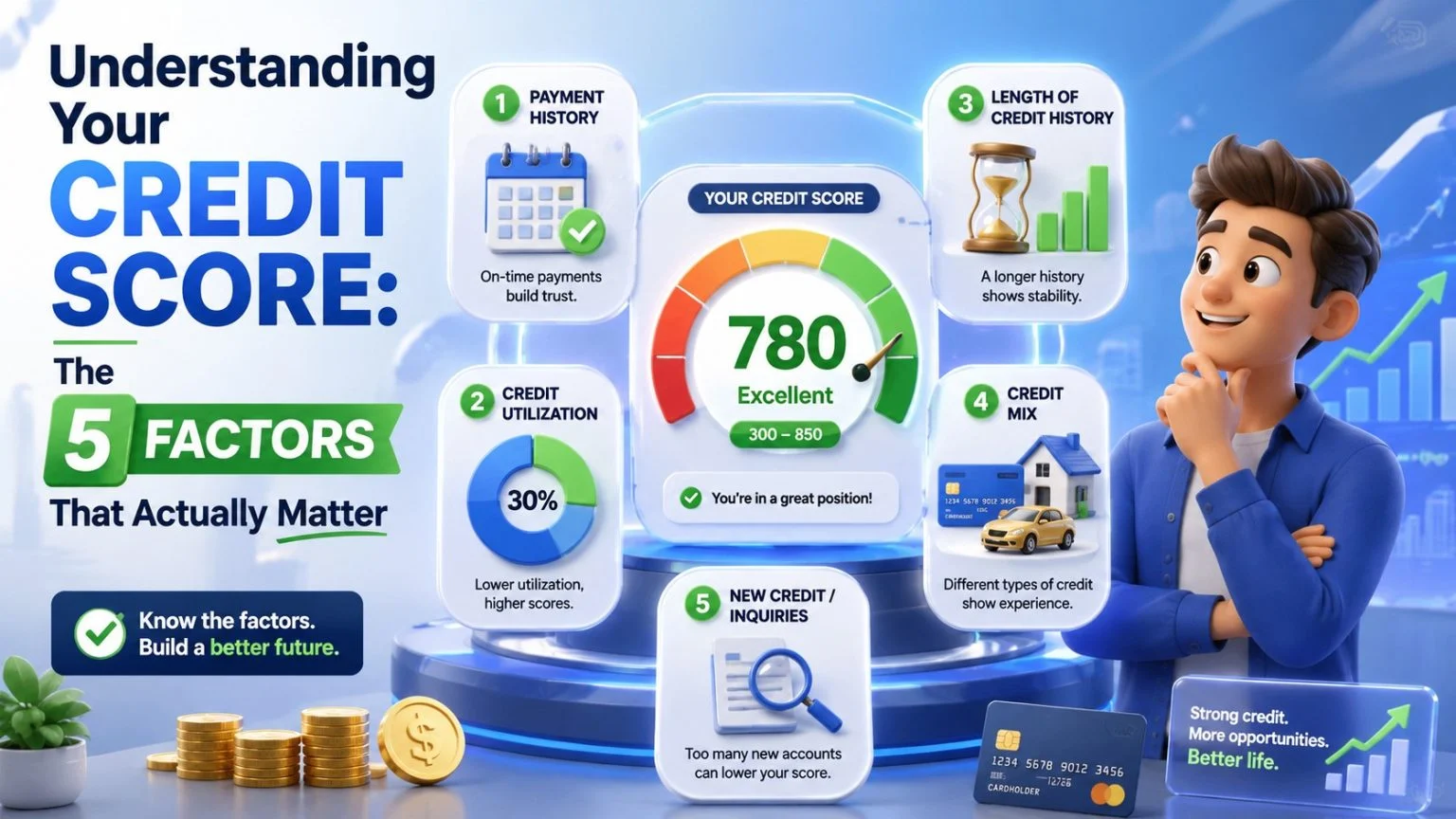
While there are complex algorithms at play, the FICO model is transparent about how it weighs your behaviour. It breaks down into five distinct categories:
-
Payment History: 35%
-
Amounts Owed (Utilization): 30%
-
Length of Credit History: 15%
-
Credit Mix: 10%
-
New Credit: 10%
Quick takeaway: The first two factors, payment history and utilisation, make up 65% of your total score. If you focus consistently on these two areas, you are winning more than half the battle.
Factor 1: Payment History (35%) The Foundation of Trust
This is the heavyweight champion of your credit report. Since the lender’s primary concern is getting a refund, your track record of paying on time is the strongest predictor of future behaviour.
How Missed Payments Hurt You
A single missed payment can severely damage a high credit score. If you have a pristine score around 800 and miss a payment by more than 30 days, industry data suggests your score could drop by over 100 points.
However, not all late payments are treated equally. The algorithm looks at:
-
Recency: A late payment last month hurts more than one from four years ago.
-
Frequency: One slip-up is awful; however, a pattern of missing bills is much worse.
-
Severity: How late was it? Is it 30 days, 60 days, 90 days, or has it been charged off?
The Recency Effect
The good news is that credit scores are resilient. The impact of a late payment fades over time. While a delinquency can stay on your report for seven years, its influence on your score diminishes significantly after the first two years, provided you have been perfect since then.
Pro Strategy: The Goodwill Letter
If you have a generally excellent history but missed one payment due to an emergency (such as a medical issue, natural disaster, or technical glitch), you can try a goodwill adjustment letter.
Expert insight: Write to your creditor explaining the situation. Remind them of your long history of loyalty and on-time payments, and ask them to remove the late mark as an act of goodwill. It does not always work, but when it does, your score can recover quickly.
Factor 2: Amounts Owed and Utilization (30%) The Balancing Act
This factor is often the most confusing for consumers. It does not just look at how much you owe in total dollars; it looks at how much you owe relative to your credit limits. This measure is called your credit utilisation ratio.
Understanding the 30% Rule and the 10% Ideal
The standard advice is to keep your utilisation below 30%.
Example: If you have a credit card with a $10,000 limit, you should avoid having a balance higher than $3,000 reported to the credit bureaux.
However, “acceptable” is not the same as “optimal”.
Research shows that consumers with the highest credit scores, typically 800 or above, often utilise less than 7% of their available credit. Source: Experian data and industry analysis.
The Difference Between Balance and Utilization
Many people believe that paying off their credit card in full every month means their utilisation is 0%. This is often not what the credit bureaux see.
Credit card issuers usually report your balance on your statement closing date, not your payment due date. If your statement closes with a $2,000 balance on a $10,000 limit, the bureaux see 20% utilisation, even if you pay that $2,000 off the very next day.
Hack: The Azul Strategy (Mid-Cycle Payments)
To maximise this factor:
-
Please determine the statement closing date for each of your cards.
-
Pay off most or all of your balance two to three days before that date.
-
Let the statement close with a tiny balance, such as $10, or even $0.
This ensures the report sent to the bureaux shows very low utilisation, which can give your score a noticeable boost.
Factor 3: Length of Credit History (15%) The Patience Factor
Lenders like to see a long track record. This factor considers:
-
The age of your oldest account.
-
The age of your newest account
-
The average age of accounts (AOA)
Why You Should Not Close Old Cards
This is a classic mistake. You pay off an old starter credit card with a low limit and think, “I do not need this anymore; I will close it to be tidy.”
Do not do it.
When you close an old card:
-
You reduce your total available credit, which can increase your utilisation ratio.
-
You eventually shorten your average account age when that card stops contributing to your history.
Pro tip: If an old card has an annual fee, ask the issuer to downgrade it to a no-fee version so you can keep the account open and preserve the history without paying for it.
Piggybacking: Being an Authorized User
If you are young or new to credit, you can benefit from someone else’s history. If a parent or partner adds you as an authorised user on a long-standing, well-managed credit card, their positive payment history and account age can help your score. If the primary user maintains good habits, adding another person is one of the fastest ways to establish a credit score from the beginning.
Factor 4: Credit Mix (10%) Proving Versatility
Lenders want to see that you can handle different types of debt responsibly.
Revolving vs. Instalment Credit
There are two main buckets:
-
Revolving credit: Accounts with variable payments and no set end date, such as credit cards and home equity lines of credit.
-
Installment credit: Accounts with fixed payments and a set end date, such as auto loans, mortgages, and student loans.
Having both types on your report shows you are a versatile and responsible borrower.
Do You Need a Loan to Build Credit?
No. You should never pay interest just to build credit.
While having a mix of credit types can be beneficial, it only accounts for 10% of your overall credit score. You can achieve an excellent score of 760 or higher with only credit cards, as long as your payment history and utilisation are strong. Do not take out a personal loan you do not need simply to satisfy this small portion of the scoring model.
Factor 5: New Credit (10%) The Hungry Factor
Opening too many accounts in a short period suggests you are in financial distress or “hungry” for credit. This is where inquiries come in.
Hard Pulls vs. Soft Pulls
-
Soft pull: Happens when you check your score or when an employer checks your background. This type of enquiry does not affect your score.
-
Hard pull: Happens when a lender checks your credit to approve a loan or credit card. Such enquiries can temporarily reduce your score by roughly five to ten points.
The Rate Shopping Window
The scoring models are smart enough to know when you are shopping around for the best deal.
If you are looking for a mortgage or an auto loan, FICO often treats multiple enquiries for the same type of loan as a single enquiry as long as they occur within a specific window, typically between 14 and 45 days depending on the version.
Key takeaway: If you are shopping for a car or home loan, do all your applications within about two weeks. Avoid spreading them out over several months.
FICO vs. VantageScore: Does the Difference Matter?
You might check your score on a free app and see 750, then apply for a loan, and the bank tells you that your score is 720. Why is there such a disparity?
-
FICO: Used by the majority of lenders for actual lending decisions.
-
VantageScore: Often used by free credit monitoring sites and some rental screening services.
While the algorithms differ slightly – for example, some newer VantageScore versions may treat paid collection accounts differently – the core behaviours that matter are the same:
-
Pay on time
-
Keep balances low
-
Avoid unnecessary new credit
Do not obsess over small differences between the two scores. Focus instead on the financial behaviours that improve both.
Common credit score myths can negatively impact your rating.
Let us debunk a few myths that might be holding you back from reaching an 800-level score.
Myth: Checking My Own Score Hurts It
Fact: False. Checking your score is a soft pull. It has no impact on your credit and is an important part of managing your financial health.
Myth: Carrying a Balance Helps My Score
Fact: False. You do not need to pay interest to show credit usage. Paying in full and on time is best for your wallet and just as good for your score.
Myth: My Income Affects My Score
Fact: False. Your salary is not listed on your credit report. A high-income earner can have a low score, and a student earning a modest income can have an excellent score. It is about discipline and behaviour, not wealth.
Conclusion: Taking Control of Your Financial Identity
Improving your credit score is a marathon, not a sprint. There is no legitimate “repair” service that can remove accurate, negative information from your report.
However, by focusing your energy where it matters most – payment history and utilisation – you can see meaningful improvements in as little as six to twelve months.
Your next step: Log into your bank app or a free credit monitoring service right now. Check your credit utilisation ratio. If it is over 30%, make a plan to pay it down. That is the single fastest lever you can pull to improve your credit score and overall financial standing today.
FAQ Schema
Q1: What is the most important factor in a credit score?
A1: Payment history is the most important factor, accounting for about 35% of your FICO score.
Q2: Does checking my credit score hurt it?
A2: No. Checking your score is considered a soft enquiry and has zero impact on your credit rating.
Q3: What is a favourable credit utilisation ratio?
A3: While under 30% is the standard recommendation, keeping utilisation below 10% generally offers the best score improvement.
Q4: How long do late payments stay on my credit report?
A4: Late payments can remain on your credit report for up to seven years, though their impact fades over time if you maintain positive behaviour.
Q5: Is FICO or VantageScore more important?
A5: FICO is used by most major lenders, making it the more critical score for securing loans and mortgages, but the habits that improve both scores are very similar.