
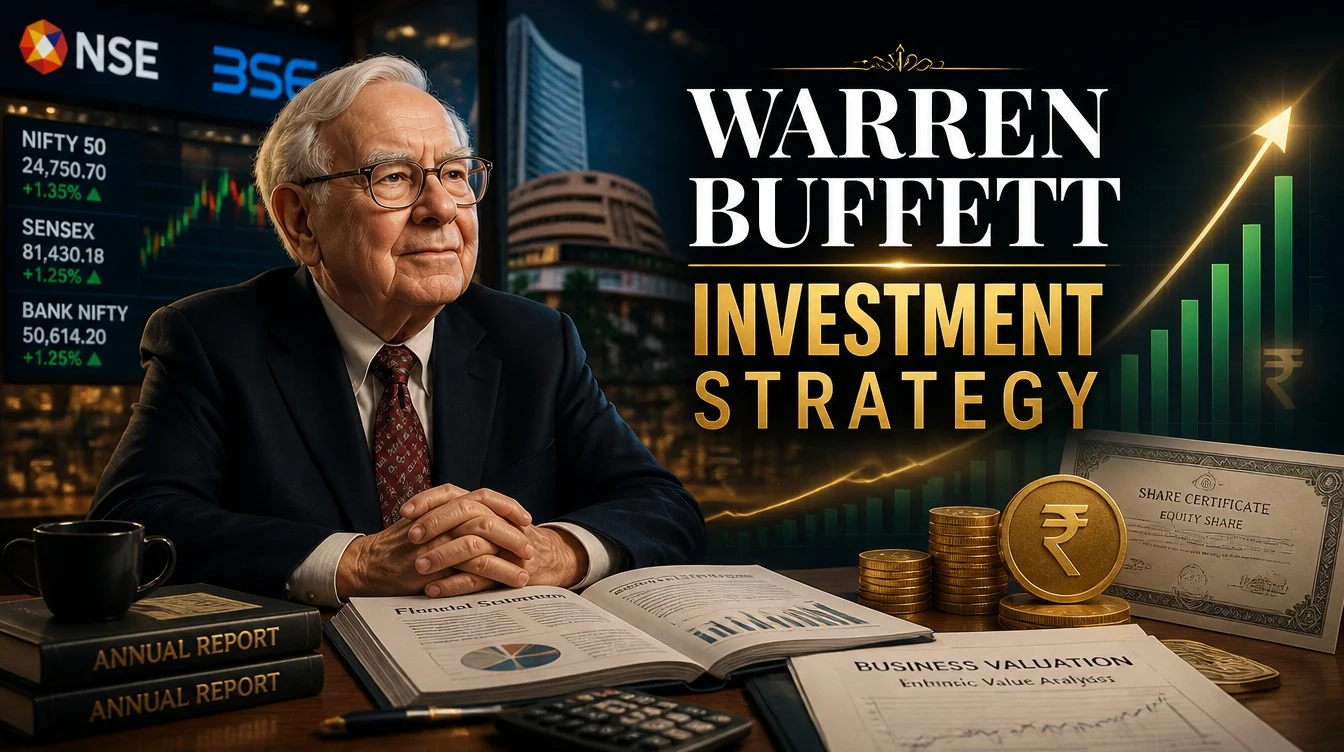
Warren Buffett Investment Strategy: The Complete Value Investing Guide for Indian Investors
Warren Buffett’s investment strategy has compounded Berkshire Hathaway’s book value at roughly 20% per year over six decades, turning a struggling textile mill into the world’s most studied investment vehicle. For Indian investors navigating the NSE and BSE, the Warren Buffett investment strategy is not a relic of American markets; it is a repeatable framework built on logic that transcends geography, currency, and market cycles.
This guide covers every pillar of Buffett’s approach: how he selects businesses, how he values them, why he holds forever, and where Indian retail investors most frequently go wrong when they try to copy him. By the end, you will have a working checklist you can apply to any Indian stock today.
Who Is Warren Buffett? A Brief Biography Worth Knowing
Warren Edward Buffett was born in Omaha, Nebraska, in 1930. He bought his first stock at age 11 – three shares of Cities Service Preferred at $38 each. By 13 he was filing a tax return for a paper route. By 30 he had wound up his investment partnerships with a 29.5% annualised return and taken control of Berkshire Hathaway.
The biography matters because Buffett formed his habits before the internet, before algorithmic trading, and before 24-hour financial news. He built his method in conditions of information scarcity, which is why it relies on durable business logic rather than data speed advantages.
The Mentors Who Shaped His Thinking
Buffett studied under Benjamin Graham at Columbia Business School. Graham’s The Intelligent Investor gave Buffett the concept of intrinsic value and the margin of safety. His later partnership with Charlie Munger shifted his focus from ‘buying cheap’ to ‘buying great. ‘That evolution is the most important intellectual thread in Buffett’s career – and the one most Indian investors miss when they treat value investing as pure price hunting.
Berkshire Hathaway: The Vehicle
Berkshire Hathaway owns 60+ operating businesses outright and holds large equity stakes in companies like Apple, Coca-Cola, and American Express. In India, investors often treat Berkshire as a fund. It is not. It is a holding company whose insurance float funds long-duration equity positions. Understanding this structure explains why Buffett can “hold forever” – he has permanent capital from insurance premiums subsidising patient ownership.
Why His Record Matters in India
The Nifty 50 TRI has delivered roughly 12-14% annually over 20-year rolling periods. Buffett averaged ~20% for 40 years. The gap compounds to a factor of 30 over a career. That arithmetic is why Indian investors want to apply his method – not to American stocks, but to the same compounding discipline applied to Indian businesses.
The 4 Filters Buffett Uses to Select Stocks
Buffett has described his stock selection in many different ways across 60 years of annual letters, but the logic consistently resolves to four filters. Pass all four and you have a candidate. If you fail any one, you will move on. This is value investing for Indian investors distilled to its most actionable form.
Filter 1: Business He Can Understand
Buffett calls this area the ‘circle of competence’. He buys businesses whose economics he can model 10 years out with reasonable confidence. FMCG, banks, insurance, and consumer durables – these sectors pass. Semiconductor fabs and early-stage biotech do not, because the business model complexity exceeds what he can reliably predict.
For Indian investors, the practical translation is ‘Do not buy a business you cannot explain in two sentences. ‘ ‘ If you can’t explain how the company makes money, keeps customers, and what would cause them to leave, you’re outside your circle.
Filter 2: Durable Competitive Advantage (the Moat)
Buffett popularised the term “moat” – the economic equivalent of a castle’s protective waterway. A moat is anything that stops competitors from taking your customers and your margins. The moat must be durable: it must still be there in 10 years without management doing extraordinary things to maintain it.
Indian examples of genuine moats: HDFC Bank’s distribution network and credit culture built over 30 years. Asian Paints’ dealer relationships and colour-matching technology are key components of its business strategy. Pidilite’s Fevicol brand equity is so strong that the product name became the category name. These are moats. A company that is “the biggest in its city” or “has a better product this year” is not a moat – it is a temporary position.
Filter 3: Honest and Capable Management
Buffett looks for managers who treat shareholders as partners, not as a source of capital that they manage for personal gain. He reads proxy statements more carefully than income statements. He looks at how management allocates free cash flow – do they buy back stock when it is cheap, invest in the business when returns justify it, or avoid acquisitions that serve executive ego more than shareholder value?
In India, promoter-driven businesses require extra scrutiny here. The three fastest signals of whether management is aligned or extracting are pledge levels, related-party transactions, and the frequency of equity dilution.
Filter 4: Sensible Price
The first three filters define quality. The fourth determines whether the investment makes mathematical sense. Buffett does not use complex DCF models in practice – he uses a mental shortcut: at this price, can I expect to earn at least 15% annually over 10 years from the business’s earnings growth and dividend yield alone, without requiring a re-rating?
If the answer is yes, he buys. If the price requires the stock market to permanently value the business at 40x earnings to justify the return, he waits. This is why he missed the dot-com bubble and why he bought Apple in 2016 at roughly 10x earnings, not at the 30x multiple the market assigned to it later.
Understanding Economic Moats: Indian Examples
The moat concept is the single most valuable idea Buffett contributed to investment thinking. Understanding it deeply—not just knowing the word—is what separates investors who apply value investing correctly from those who misapply it.
Types of Moats Buffett Recognises
There are five types of moats worth studying:
- Intangible assets: Brands, patents, and regulatory licences. Nestlé India’s Maggi brand survived a product recall because the brand equity was worth more than the short-term revenue hit.
- Switching costs: The cost a customer bears to move to a competitor. Tally ERP has switching costs because migrating 10 years of accounting data is expensive in time and risk.
- Network effects: The product becomes more valuable as more people use it. BSE and NSE benefit from this effect – liquidity attracts traders, which creates more liquidity.
- Cost advantages: The ability to produce at a structurally lower cost than competitors. Coal India has a cost advantage by virtue of owning the largest captive coal reserves in the world.
- Efficient scale: A market where one or two players earn reasonable returns but the market is not big enough to attract a third. Many regional private sector banks in India operate in this zone.
Moat Durability: The Indian Test
In India, regulatory changes, the rise of D2C brands, and UPI-driven fintech disruption have weakened moats that looked permanent in 2010. Investors applying Buffett’s framework must ask, ‘Which of the five moat types is this, and is it getting stronger or narrower over the next five years?’
A brand that required 30 years to build is more durable than a distribution advantage that a well-funded competitor can replicate in three. The fundamentals of building wealth through investing consistently circle back to this idea: buy businesses that compound, not businesses that merely grow.
How to Spot a False Moat
A false moat is a position that looks like a structural advantage but is actually a cyclical or regulatory one. Indian telecom in 2010 looked like a moat business. It was not; spectrum auctions, regulatory battles, and Jio’s entry proved it. The test is simple: if the moat depends on a government decision remaining constant or a competitor remaining irrational, it is a false moat.
Intrinsic Value and Margin of Safety: The Mathematical Core
Buffett defines intrinsic value as the discounted present value of all cash that can be taken out of a business between now and its terminal date. This sounds technical, but Buffett uses it as a qualitative anchor, not a precise formula. His margin of safety – the gap between intrinsic value and the price he pays – is his protection against being wrong about both the quality of the business and the valuation math.
How to Approximate Intrinsic Value as a Retail Investor
You do not need a Bloomberg terminal. A useful shortcut: take normalised earnings per share (use a 3-year average to smooth cycles), multiply by a growth rate you can defend for 10 years, and then ask what P/E the market will likely assign in year 10. The result gives you a rough terminal value. Discount that back to 10-12% (your required return). If today’s price is 30-40% below that number, you have a margin of safety.
The arithmetic is less important than the discipline of doing it. Most retail investors in India skip this step entirely and use “target price” notes from brokerage research as a substitute for independent valuation. That is the opposite of what Buffett teaches.
Margin of Safety in Indian Markets
Indian equity markets tend to be more volatile than US markets relative to underlying business performance. This means the margin of safety should be wider than Buffett’s typical requirement in US markets. A 30% margin of safety on a US blue chip translates to roughly 40-50% in a mid-cap Indian business with less liquid governance structures.
The comparison between SIP and lump-sum investing over 20 years illustrates this point: lump-sum investing only outperforms when you can identify an entry point with a genuine margin of safety. Otherwise, systematic investing through SIP is the rational default for most investors.
The Price-Value Distinction Buffett Makes Every Time
Buffett famously said: “Price is what you pay, value is what you get.” For Indian investors applying this principle, the practical discipline is, before buying any stock, to write down in one paragraph why the current price is lower than your estimate of intrinsic value. If you cannot write that paragraph, you are speculating, not investing.
Warren Buffett’s Holding Philosophy: Why He Almost Never Sells
Buffett’s favourite holding period is “forever”. This is not sentimentality. It is mathematics. Selling a great business to buy another great business incurs two frictional costs: capital gains tax and the transaction cost of being wrong about the replacement. Over a 20-30 year holding period, these costs compound into an enormous drag on returns.
When Buffett Does Sell
He sells under three conditions: the business fundamentals have permanently deteriorated, the price is so far above intrinsic value that the expected return over 10 years drops below the risk-free rate, or he needs cash to fund a better opportunity at a significantly wider margin of safety.
Indian investors frequently sell for a fourth reason Buffett rejects: the stock has doubled, and they want to “lock in profits”. This behaviour is emotionally satisfying and mathematically destructive. If the business quality has not changed and the price is still below intrinsic value, selling a double to feel safe means selling a great business at a 50% discount to its fair value.
The Compounding Argument for Permanent Ownership
Consider a business that grows its intrinsic value at 18% annually – not unusual for a quality mid-cap Indian compounder. If you buy at fair value and hold for 20 years, the stock appreciates ~27x. If you sell after a 2x and pay 10% capital gains tax, then redeploy in another “good” business that also compounds at 15%, your 20-year result is materially worse, even before accounting for being wrong about the replacement.
This is the mathematical case for Buffett’s holding discipline. It is not about patience as a virtue. It is about recognising that selling great businesses is almost always the wrong decision when measured over the right time horizon.
Applying This in India: The Compounder Checklist
Before selling a holding, ask: Has the moat weakened, or has the price just run ahead temporarily? Has management’s capital allocation quality declined, or am I reacting to one bad quarter? Is there genuinely a better business at a better price, or is this merely a temptation to trade activity for returns? If the honest answer to all three is “no”, the holding period should extend, not contract.
Buffett vs. Typical Indian Retail Investor: A Comparison
| Dimension | Buffett’s Approach | Typical Indian Retail Investor |
|---|---|---|
| Stock selection basis | Business quality + moat + management + price | Tip from broker / social media / TV channel |
| Valuation method | Intrinsic value estimate with margin of safety | Brokerage target price or P/E comparison |
| Holding period | 5-10 years minimum, often forever | Days to months; sell on 20-30% gain |
| Reaction to market fall | Buy more if the thesis is intact | Panic sell to avoid further loss |
| Portfolio concentration | 5-10 highest-conviction bets | 30+ stocks for “diversification” |
| Information source | Annual reports, 10 years of financials | Stock screeners, Twitter, F&O flow data |
| Primary risk framing | Permanent loss of capital | Underperforming Nifty this quarter |
Circle of Competence: Knowing What You Know in Indian Sectors
The circle of competence is not about being smart. It is about being honest about the boundaries of your knowledge. Buffett stayed away from technology stocks for decades not because he thought they were bad businesses, but because he could not reliably model their economics 10 years out. That honesty protected him from enormous losses in the dot-com crash, even as it meant missing the early gains.
How to Define Your Circle for Indian Markets
Start with your professional expertise. A doctor can model pharmaceutical distribution economics and hospital EBITDA margins better than a software engineer can. A textile manufacturer understands the working capital cycles of an apparel brand. A banker understands credit quality signals in an NBFC.
Extend your circle deliberately. If you work in FMCG and want to invest in IT services, spend six months reading annual reports, earnings calls, and client case studies before treating IT as within your circle. Do not pretend you are inside a circle just because you own stocks in that sector.
The 10-Year Test
Buffett’s practical test: can you write a one-page thesis on why this business will earn more money per share in 10 years than it does today, and what specifically would cause that thesis to fail? If the thesis takes more than a page to explain, the business is outside your area. If the failure conditions are vague, you have not thought it through.
Indian Sectors That Are Naturally Circle-Friendly for Retail
FMCG (Hindustan Unilever, Nestle, and Dabur), private sector banks (HDFC Bank, Kotak, and ICICI), insurance (LIC, HDFC Life, and SBI Life), and consumer staples (ITC’s cigarette business) have economics that most retail investors can model with 20 hours of annual report study. The businesses change slowly. The moats are observable. The management team has documented the quality over decades.
Investment psychology biases, like overconfidence and familiarity bias, often push investors to trade complex businesses they know superficially rather than simple businesses they could understand deeply. Buffett’s antidote is rigors self-assessment: not “Do I know this sector?” But can I model this specific business with confidence?
Common Mistakes Indian Investors Make When Applying Buffett’s Framework
People in India widely discuss and misapply Buffett’s ideas. The mistakes are predictable and repeated across market cycles. Understanding them specifically is the fastest way to improve your application of value investing.
Mistake 1: Confusing Cheapness with Value
A stock trading at 5x earnings is not automatically a value buy. If the earnings are declining, the moat is eroding, and management is of questionable quality, a 5x P/E is expensive. This is the “value trap” – a low-priced stock that keeps getting cheaper because the underlying business is genuinely deteriorating. Buffett learned this lesson from his early Graham-influenced “cigar butt” investing and eventually rejected it entirely.
Mistake 2: Using F&O for “Hedging” a Long-Term Portfolio
Many Indian investors who claim to be long-term value investors simultaneously run F&O positions to “hedge” their equity holdings. Buffett views derivatives with deep scepticism. The hedging argument almost always masks speculation. SEBI’s new F&O rules for 2026 reflect regulatory awareness of how much retail capital is destroyed through derivative positions that were sold as risk management tools.
Mistake 3: Over-Diversification as a Substitute for Knowledge
Holding 40 stocks reduces risk only if you can monitor them. Buffett runs a concentrated portfolio. His top 5 holdings typically represent 70-80% of Berkshire’s equity portfolio. Concentration requires conviction, which requires genuine understanding. If you have a genuine understanding, concentration is safer than a 40-stock portfolio where you know 10 well and hold 30 for “exposure”.
Mistake 4: Ignoring Management Quality Because the Business Looks Good
India has seen multiple cases where excellent businesses were destroyed by management that treated listed companies as personal capital pools – pledging promoter shares, related-party loans, and eventually committing fraud. Buffett will not buy a great business run by dishonest management. In India, this filter eliminates a larger percentage of the universe than it would in the US. That is not a reason to lower the filter – it is a reason to hold it higher.
Mistake 5: Selling in Bear Markets to “Protect Capital”
The Indian equity market has experienced multiple corrections of 30-50% since 2000. Each time, long-term holders who maintained or added to high-quality positions recovered and compounded their investments past their pre-correction level within 2-4 years. Investors who sold to “protect capital” locked in losses and then typically re-entered at higher prices after confidence returned.
This is the most expensive mistake in Indian investing. Building a retirement portfolio that survives bear markets requires precisely Buffett’s discipline: own great businesses, pay reasonable prices, and stay the course through volatility that is unrelated to the underlying business quality.
How to Apply Buffett’s Strategy to Indian Small-Cap and Mid-Cap Stocks
Buffett today manages hundreds of billions and cannot buy small companies. But the young Buffett built his early fortune in small, overlooked businesses. Indian small-cap and mid-cap markets have structural information inefficiencies that closely resemble the US market Buffett operated in during the 1960s and 1970s.
The Opportunity in Indian Mid-Cap Information Gaps
A company with a Rs 2,000-5,000 crore market cap in India receives limited institutional analyst coverage. Promoter communications are less polished. Quarterly results get fewer column inches. This area is where a retail investor with genuine sector knowledge and Buffett’s analytical framework has a structural edge over large institutions who cannot meaningfully size a position in a ₹3,000-crore company.
Adjusting the Framework for Smaller Businesses
Apply the four filters identically, but raise the management quality bar significantly. In smaller businesses, the promoter IS the business. Their work ethic, capital allocation track record, and communication integrity matter more than in large-cap companies where professional management runs institutions that outlive any individual.
Also raise the margin of safety. Smaller businesses have less liquidity, less diversified revenue, and more binary outcomes if a key product, client, or regulatory position changes. A 40% margin of safety is a reasonable minimum for small-cap applications of value investing.
Where to Find Indian Compounders Early
Look for businesses in sectors that are growing at 15-20% annually, where the market leader has a cost, brand, or distribution advantage. Alternative asset classes like REITs demonstrate how new categories create compounding opportunities before institutional interest fully prices them. The same principle applies to emerging Indian businesses in EV components, speciality chemicals, and healthcare delivery.
Advanced Strategies: What Most Investors Miss in Buffett’s Method
Reading Buffett superficially produces a checklist investor. Reading him deeply reveals several advanced ideas that most interpreters miss.
The Importance of Owner’s Earnings, Not Reported EPS
Buffett uses “owner’s earnings” – net income plus depreciation minus the capital expenditure required to maintain the business’s competitive position. For capital-intensive Indian businesses (telecom, cement, and airlines), the gap between reported EPS and owner’s earnings is enormous. A cement company reporting Rs 50 EPS that requires Rs 40 in maintenance capex is actually earning Rs 10 for shareholders, not Rs 50. Applying a 20x P/E to reported earnings in such cases destroys capital systematically.
Float as an Investment Concept for Indian Investors
Berkshire uses insurance float—premiums collected before claims are paid—as interest-free leverage for equity investments. Indian investors cannot replicate this strategy directly, but the concept applies to businesses that collect cash from customers before delivering products or services. Subscription businesses, prepaid utilities, and retailers with high inventory turns funded by extended supplier credit all have “float-like” characteristics. These businesses compound faster than their reported earnings growth suggests because they require less external capital.
Reading Annual Reports the Buffett Way
Buffett reads every word of annual reports, including the fine print. For Indian investors, the critical sections most skip are related-party transaction disclosures, contingent liabilities, management discussion and analysis (the narrative, not the numbers), and the auditor’s report. A clean auditor’s report with no qualifications or emphasis-of-matter paragraphs is a minimum requirement, not a virtue.
Buffett’s View on Gold and Alternative Investments
Buffett famously dislikes gold because it does not produce anything. Gold as an investment in India has a long cultural and portfolio-diversification rationale, but Buffett’s framework suggests that gold should occupy a small, tactical position – a store of value for extreme scenarios, not a compounding engine for long-term wealth creation.
Step-by-Step: How to Build a Buffett-Style Portfolio in India Today
Here is an actionable framework you can execute with the Indian market’s current structure:
- Define your circle of competence. Write down three sectors where your professional or personal experience gives you a genuine analytical advantage. Start only in those sectors.
- Build a watchlist of most businesses. Identify 10–15 businesses in your circle that have genuine, observable moats. Read 5 years of annual reports for each. Understand the economics deeply enough to explain it to someone who knows nothing about the sector.
- Estimate intrinsic value for each. Use normalised earnings, a defensible 10-year growth rate, and a terminal P/E that is consistent with the business quality. Require a 35-40% margin of safety before buying.
- Wait. Most of the time, the best businesses on your watchlist will not be available at a price that provides a margin of safety. Use market corrections, which happen on average every 3-4 years in India, to initiate or add to positions.
- Concentrate when you have conviction. Build positions of 8-15% in your 6-8 highest-conviction ideas. Avoid the comfort of 40-stock diversification that dilutes returns without reducing risk for a knowledgeable investor.
- Review annually, not quarterly. Check business fundamentals once per year. If the moat is intact and earnings are compounding as expected, the price change is noise. Do not let short-term price volatility interfere with a thesis that operates on a 10-year horizon.
- Sell only when the thesis breaks. If the moat has narrowed, management has proved dishonest, or the price is so far above intrinsic value that 10-year expected returns drop below 10%, sell and redeploy. Otherwise, hold and compound.
Frequently Asked Questions
Is Warren Buffett’s investment strategy applicable to Indian markets?
Yes. Buffett’s framework is based on business economics, not market structure. The principles of moat, management quality, intrinsic value, and margin of safety apply identically to NSE and BSE stocks. Indian markets may require a wider margin of safety and a higher bar for management quality, but the framework translates directly. The investors who have built the largest Indian equity fortunes – Ramdeo Agrawal, Nemish Shah, and Porinju Veliyath, each in their own style – all apply versions of Buffett’s core logic.
What is Warren Buffett’s minimum holding period?
Buffett’s stated minimum is “forever”, with the practical interpretation being at least 5 to10 years for any position. He sells when the thesis breaks – when the moat deteriorates, management quality declines, or price rises so far above intrinsic value that expected returns drop below the risk-free rate. For Indian investors, a 3-5 year minimum holding discipline already puts you ahead of most retail participants who hold for months.
How many stocks should a Buffett-style Indian portfolio hold?
Buffett typically holds 5-10 major equity positions, which represent 70-80% of the portfolio value. For Indian retail investors with limited research bandwidth, 8-12 positions is a practical range. The key is that every position must be genuinely understood, not just held for diversification. A 10-stock portfolio where you understand all 10 deeply is far safer than a 40-stock portfolio where you understand 8 and hold 32 for “exposure”.
Can value investing work in a bull market like India’s current one?
Yes, with patience. In extended bull markets, very few stocks trade at a genuine margin of safety. Buffett’s response to this environment is to hold cash, wait for corrections, and use market-wide pullbacks to initiate positions at prices that provide the required margin. Indian investors can replicate this strategy by maintaining a pre-built watchlist with target prices, so they act decisively when the market creates the entry point rather than scrambling to analyse during a correction.
What is the biggest mistake first-time value investors make in India?
This confuses a low P/E with a value opportunity. A stock at 6x earnings with a declining return on equity, a weakening moat, and a promoter with a history of related-party transactions is not cheap – it is a value trap. The first filter is always business quality and moat, not price. Price determines whether an attractive business is also an attractive investment. Skipping to price without completing the qualitative filters is the fastest route to permanent capital loss in value investing.
Related Articles
- Investing 101: Investment Basics to Build Wealth from Scratch
- Investment Psychology: 10 Biases That Cost You Money
- SIP vs Lumpsum: What Rs 10,000 Looks Like After 20 Years