
Ray Dalio Debt Cycle India: How the Framework Applies to the Economy
Ray Dalio spent decades studying economic history across multiple countries before publishing his debt cycle framework in the essay “How the Economic Machine Works.” The framework’s core insight is that economies do not move in random patterns; they move in predictable, mechanical cycles driven by the expansion and contraction of credit. Understanding the Ray Dalio debt cycle in India and applying this framework helps investors anticipate the macro conditions that will affect their equity and fixed-income portfolios over multi-year periods, rather than being surprised by credit crunches, inflation cycles, and currency stress, which the framework treats as foreseeable.
The Two Types of Debt Cycle
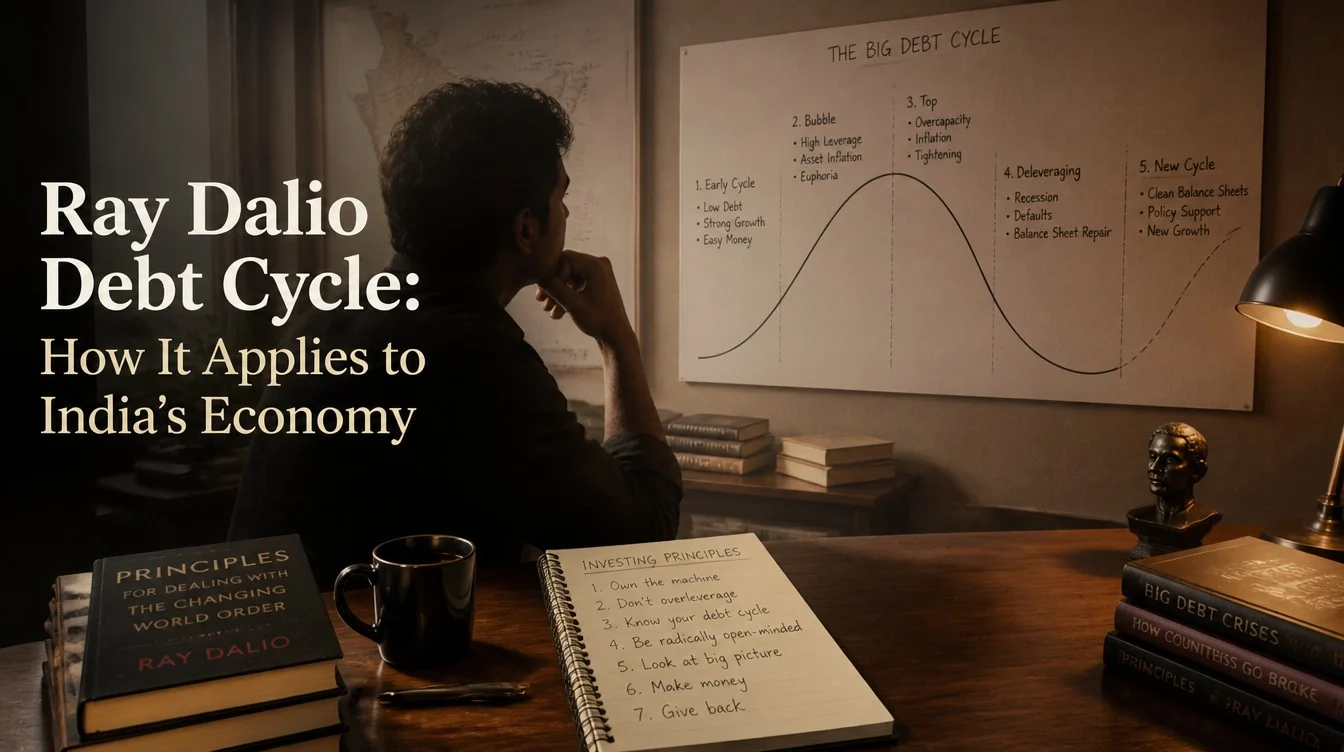
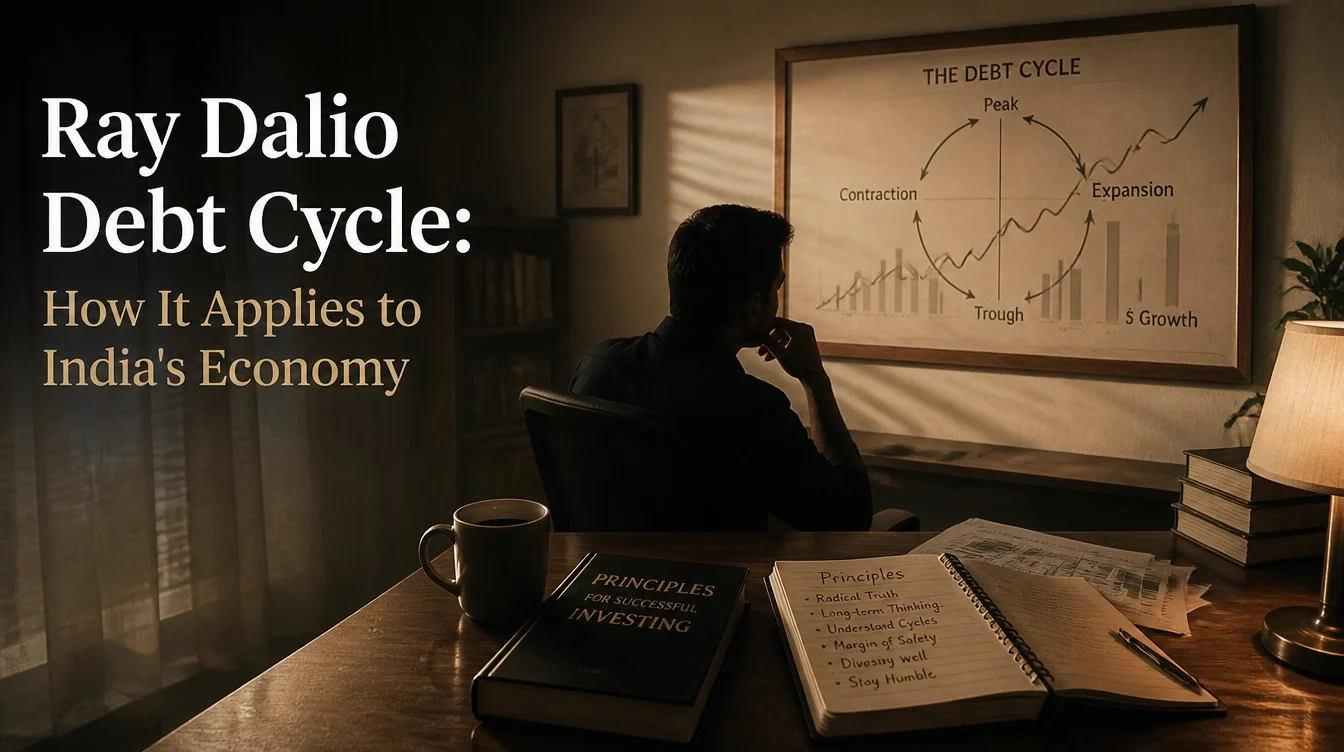
Dalio distinguishes between two distinct debt cycles that operate simultaneously in any economy. The first is the short-term debt cycle, which runs for 5-8 years and roughly corresponds to the business cycle that most economists track. The second is the long-term debt cycle, which runs 50-75 years and represents the full arc of a country’s debt-to-GDP expansion from low levels to unsustainably high levels and back.
The Short-Term Debt Cycle
The short-term debt cycle works as follows: central banks lower interest rates when growth is weak, which makes borrowing cheaper, which stimulates credit expansion and spending, which drives economic growth and eventually inflation. As inflation rises, central banks raise interest rates, which makes borrowing pricier, which contracts credit and spending, which slows growth and eventually lowers inflation. Then the cycle repeats.
India’s short-term debt cycles are observable in the RBI’s rate history. The cycle of rate cuts in 2015-2016 and again in 2019-2020 stimulated credit growth; the subsequent tightening cycles in 2018 and 2022-2023 constrained it. For equity investors, the key insight is that the beginning of an easing cycle, when the RBI starts cutting rates after a period of tightening, is historically one of the most favorable periods to be overweight equities and credit, while the end of an easing cycle (when inflation is rising and rate hikes are approaching) is a period to reduce duration and be more selective about credit quality.
The Long-Term Debt Cycle
Most investors understand the long-term debt cycle less well, and it is more consequential. It describes the gradual accumulation of debt relative to income across an entire economy over decades. In the early phases of the long-term cycle, debt levels are low, credit is expanding from a low base, interest rates can be lowered to stimulate each subsequent short-term cycle, and debt service costs are manageable relative to incomes. Growth is generally strong and consistent during this expansion phase.
In the late phase of the long-term cycle, debt levels are high relative to income, interest rates have been pushed toward zero in the previous short-term cycle and cannot be lowered much further to stimulate the next one, and debt service consumes a growing share of income for both households and governments. When a recession hits in the late phase of the long-term cycle – as happened in the US in 2008 and Japan in 1990 – the normal short-term cycle tools are insufficient because interest rates are already at or near zero. Dalio calls this phase a “deleveraging,” a period in which the debt burden must be reduced through some combination of debt write-offs, austerity, wealth redistribution, and money printing.
Where India Sits in the Debt Cycle
India’s positioning in the long-term debt cycle is fundamentally different from the US, Europe, or Japan. India’s household and corporate debt-to-GDP ratios remain well below the levels associated with late-cycle vulnerabilities. Government debt is elevated but manageable relative to nominal GDP growth rates. The banking system has spent 2015-2023 cleaning up a large non-performing loan problem (primarily in public sector banks) and has emerged with provisioned balance sheets and improving credit quality metrics.
This positioning is relevant for long-term investors. India is more likely to be in the early-to-mid expansion phase of its long-term debt cycle than in a late-cycle position. Credit penetration in households (mortgages, consumer finance, credit cards), corporate borrowing in underpenetrated manufacturing and infrastructure sectors, and government borrowing for productive infrastructure investment all have room to grow before reaching the debt saturation levels that create long-term cycle risk. Dalio’s all-weather portfolio construction is partly designed to protect against late-cycle deleveraging conditions, conditions that India is not yet facing but that other major economies are navigating.
The Mechanics of a Deleveraging: What It Looks Like and How to Survive It
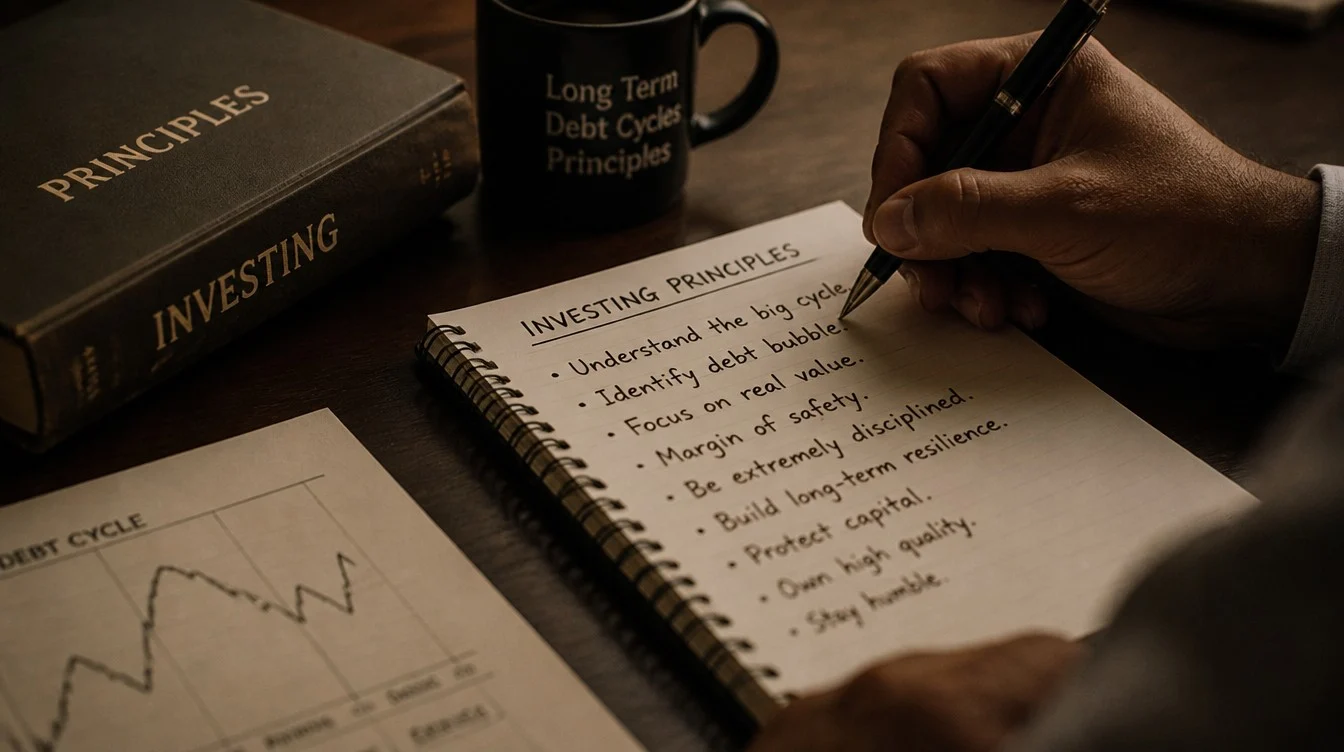
Dalio identifies four policy levers that governments and central banks use to manage a debt crisis, each with different economic effects:
Austerity: cutting government spending to reduce deficits and lower debt levels. Deflationary – it reduces spending, slows growth, and can cause deflation and depression if applied too aggressively.
Debt write-offs and restructuring: lenders accept losses, and borrowers get relief. Deflation reduces the money supply as lenders write off loans, but it directly addresses the debt burden.
Wealth redistribution: raising taxes on high earners and wealth holders to transfer resources to debt-burdened sectors. Political constraints limit the scale of this lever in most democracies.
Debt monetization: the central bank prints money to buy government bonds and other assets, injecting it into the system to offset the deflationary effects of deleveraging. Inflation is the primary tool used in the US and Europe post-2008 through quantitative easing programs.
Dalio argues that a “beautiful deleveraging,” one that reduces debt burdens without causing depression or inflation, requires all four levers to be used in appropriate proportions so that the deflationary effects of austerity and write-offs are offset by the inflationary effects of monetization, keeping overall growth and inflation near stable.
For Indian investors, the relevance is primarily in understanding how to position themselves across assets during deleveraging conditions. Gold, inflation-linked bonds, and equity in businesses with pricing power have historically outperformed nominal government bonds and cash during debt monetization phases. Real assets, including real estate, tend to perform well when central banks are printing money, as the expansion of the money supply flows partially into asset prices.
India’s NPA Cycle: A Dalio Framework Application
India’s banking sector NPA crisis of 2015-2019 was a textbook short-term debt cycle contraction. The credit expansion phase of 2004-2014, particularly in infrastructure and power sector lending by public sector banks, produced a large stock of impaired loans that became visible as projects failed to generate sufficient revenue to service their debt. The subsequent deleveraging through bank recapitalization, the Insolvency and Bankruptcy Code process for large defaulters, and aggressive provisioning represent the contraction phase of the short-term cycle.
The practical investment implication of the Dalio framework was foreseeable from this analysis: the transition from NPA cycle contraction to credit cycle expansion would be positive for Indian banking stocks as provisioning normalized, credit growth resumed, and return on equity recovered toward pre-crisis levels. Investors who recognized this transition in 2019-2020 captured significant returns from private sector bank stocks as the credit cycle turned. Macro-level cycle awareness, combined with stock-level analysis, is more powerful than either in isolation. The Dalio framework provides the macro timing, while individual stock analysis provides the selection within the macrotheme.
Currency and Debt Cycle Interactions: The Rupee Perspective
Dalio’s framework extends beyond domestic debt cycles to include the interaction between debt cycles and currency dynamics. His observation is that currency weakness tends to occur when a country’s debt cycle is in a contraction phase, foreign capital exits, the current account deficit widens as imports exceed exports, and the central bank either raises rates (deepening the domestic contraction) or allows currency depreciation to occur.
India experienced this dynamic acutely in 2013 during the “taper tantrum.” When the US Federal Reserve signaled it would reduce its bond purchases, foreign capital fled emerging markets, including India. As a result, the rupee fell approximately 20% against the dollar in a few months, and the RBI was forced to raise interest rates sharply despite domestic growth already slowing. The Dalio framework predicted this sequence: a late-phase US short-term debt cycle (low rates, easy money) flowing into emerging markets reverses when the cycle turns, and the emerging markets that had been recipients of that capital flow face the sharpest adjustments.
For Indian equity investors, this currency-debt cycle interaction creates specific positioning considerations. Businesses with significant rupee revenue and INR-denominated costs (domestic consumer businesses, banks, and healthcare providers serving domestic patients) remain relatively insulated from rupee depreciation. Rupee weakness benefits businesses with USD revenues (IT services exporters). Businesses with significant USD debt and INR revenue (some infrastructure companies and importers) face serious stress during rupee depreciation cycles. Mapping your portfolio against this framework before a cycle turn produces better outcomes than repositioning after the turn occurs.
Applying the Debt Cycle Framework to Indian Equity Positioning
Dalio’s framework translates into specific positioning guidelines for each phase of the debt cycle:
In the early expansion phase (low debt levels, credit growing from a low base, and accommodative monetary policy), overweight equities broadly, particularly in cyclical sectors that benefit from credit expansion (banks, NBFCs, consumer durables, real estate developers, and infrastructure).
In the mid-expansion phase (moderate debt levels, normalizing monetary policy, and inflation rising toward but not exceeding the target), remain overweight equities but rotate toward quality defensives (FMCG, healthcare, and technology services exporters) as the rate environment becomes less accommodating.
In the late expansion phase (debt levels elevated, monetary policy tightening, and inflation above target), reduce cyclical equity exposure; increase gold and short-duration fixed income; and be cautious about businesses with high leverage or variable-rate debt.
In the contraction/deleveraging phase (credit contracting, NPAs rising, and monetary policy easing aggressively), accumulate high-quality equities in businesses with strong balance sheets and pricing power; avoid businesses with debt covenants or refinancing risk; and increase gold exposure as a hedge against policy uncertainty. Long-term investment vehicles like NPS provide structure for maintaining equity exposure through cycle contractions without the psychological pressure of a pure equity portfolio in a declining market.

Frequently Asked Questions
What is Ray Dalio’s debt cycle theory?
Dalio’s debt cycle theory holds that economies move through predictable, mechanical cycles driven by credit expansion and contraction. The business cycle corresponds to the short-term debt cycle (5-8 years) and primarily manages it through interest rate policy. The long-term debt cycle (50-75 years) represents the full arc of debt accumulation from low to unsustainably high levels, ending in a deleveraging phase that requires a combination of austerity, debt write-offs, wealth redistribution, and money printing.
Is India in a zone of risk related to the debt cycle?
India’s household and corporate debt levels are relatively low compared to developed economies, suggesting India is in the early-to-mid expansion phase of the long-term debt cycle rather than facing late-cycle deleveraging risk. The main domestic debt risk is in state government finances (several states have high debt-to-GSDP ratios) and in the historical accumulation of public sector bank NPAs, which have been substantially addressed through the IBC process and bank recapitalization since 2016.
How does the debt cycle affect Indian stock markets?
The debt cycle affects equity markets by impacting credit availability, interest rates, and corporate earnings. During credit expansion phases, rate-sensitive sectors (banks, real estate, and consumer durables) and capital-intensive businesses benefit from cheap debt. During contraction phases, these sectors experience the most exposure. The strongest-performing sectors across full cycles tend to be those with pricing power and low capital intensity (FMCG, healthcare, and technology services) because they are least dependent on the credit cycle for earnings growth.
What did Dalio predict about India’s economy?
Dalio’s Bridgewater has consistently viewed India as one of the more structurally attractive major emerging markets based on its debt cycle positioning, demographic dividend, and improving institutional quality. The firm’s published research has highlighted India’s transition from a high-deficit, high-inflation economy in the 1990s and 2000s to a more macro-stable environment, with improving fiscal management, as evidence of a country in a favorable phase of its long-term development and debt cycle.
How should Indian investors use the debt cycle framework?
The most practical application is macro-positioning awareness. Knowing which phase of the short-term debt cycle India is in helps investors tilt their equity and fixed-income allocations toward the sectors and asset classes that benefit from that phase. The framework does not predict exact timing, but it provides a structural lens for understanding why certain sectors are outperforming or underperforming at a given moment and what conditions would need to change to reverse those patterns.
Related Articles
- Ray Dalio All Weather Portfolio: Build a Recession-Proof Portfolio for India
- Investing 101: The Basics Every Indian Investor Needs
- NPS Vatsalya: Complete Guide to Long-Term Retirement Investing