


Ray Dalio All Weather Portfolio India: Building a Recession-Proof Version
Ray Dalio built the world’s largest hedge fund by solving a single problem: how do you construct a portfolio that performs across every economic environment, not just the ones you predict correctly? His answer – the ray dalio all weather portfolio india framework – is built on the insight that most investors are unknowingly concentrated in one economic scenario. When that scenario plays out, they do well. When it does not, they suffer far more than they realise.
This guide explains the All Weather framework from first principles, translates it into an actionable Indian portfolio using instruments available on NSE and BSE, and shows why the approach is especially valuable for Indian investors navigating a high-growth, high-volatility emerging market environment.
Who Is Ray Dalio? The Architect of All Weather
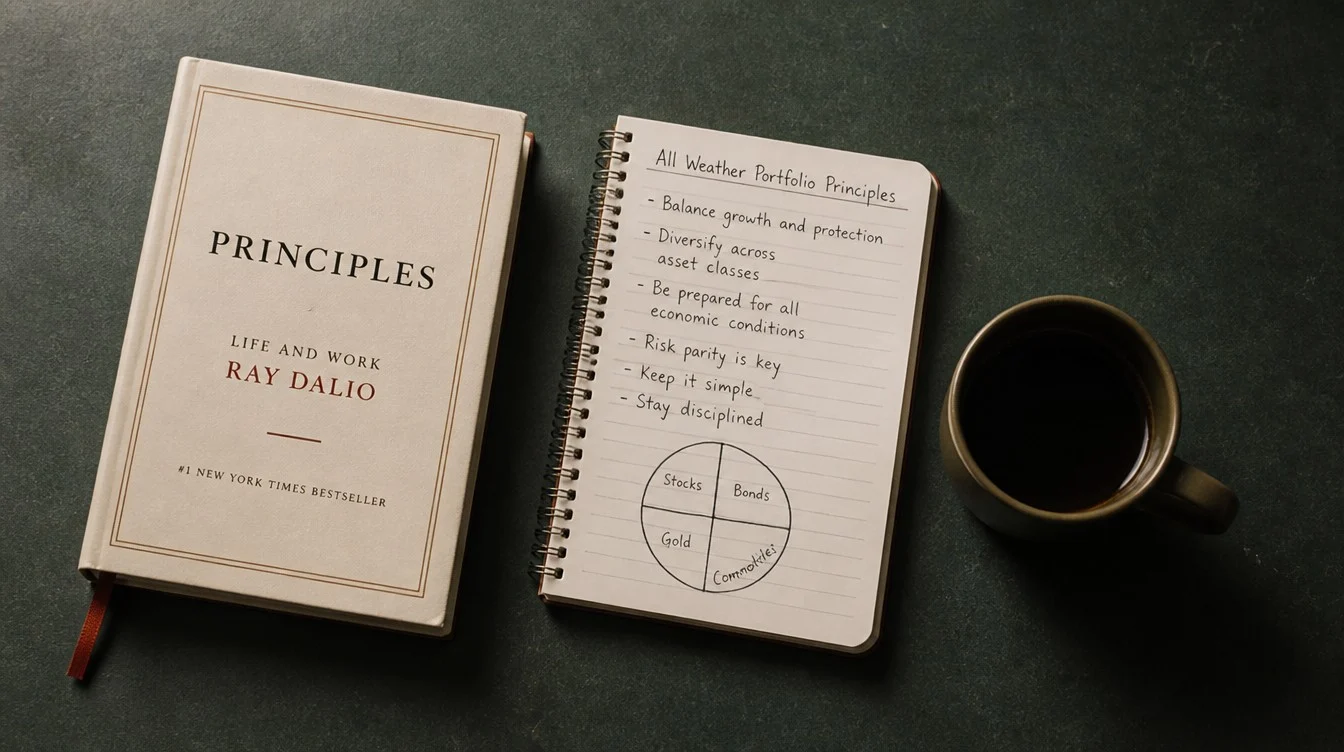
Ray Dalio founded Bridgewater Associates in 1975 from his apartment in New York. Today Bridgewater manages roughly $150 billion and is the most studied hedge fund operation in the world. Dalio’s personal fortune exceeds $15 billion. But more influential than his wealth is the intellectual framework he built and published freely in his book Principles and in a series of public research pieces including “Principles for Navigating Big Debt Crises” and “The Changing World Order.”
The 1982 Mistake That Built All Weather
In 1982 Dalio predicted a debt crisis and depression following Mexico’s debt default. He was partly right about the crisis but catastrophically wrong about the depression – the US economy entered a prolonged bull market instead. Bridgewater nearly went bankrupt. That humiliation forced Dalio to rebuild his entire investment philosophy around one question: instead of trying to predict the future, how do I build a portfolio that works across all futures?
The Economic Machine
Dalio’s most famous public contribution is his animated video “How the Economic Machine Works,” which has been viewed over 40 million times. The core insight: economies run in short-term debt cycles (5-8 years) and long-term debt cycles (75-100 years), with productivity growth as the underlying trend. Most economic volatility comes from the debt cycle, not from genuine changes in productivity. Understanding where India sits in both cycles is the starting point for applying the All Weather framework to Indian portfolios.
Why All Weather Was Created for Institutional Investors
The original All Weather portfolio was designed for Dalio’s family trust – a pool of capital that needed to outlast any single economic scenario, across decades, without requiring active management. The institutional version uses leverage and derivatives to equalise risk contributions across asset classes. The retail version – which is what Indian investors can build – achieves similar diversification without leverage, accepting slightly lower absolute returns in exchange for dramatically lower volatility.
The Four Economic Environments: The Foundation of All Weather
Every asset class performs differently depending on two variables: whether growth is rising or falling, and whether inflation is rising or falling. These two variables produce four possible economic environments. All Weather is built to hold assets that perform well in each of the four quadrants.
Quadrant 1: Rising Growth, Falling Inflation (the Goldilocks environment)
This is the environment most investors implicitly assume will last forever. Equities perform best here. Corporate earnings grow, interest rates stay manageable, and risk assets broadly appreciate. India experienced extended Goldilocks periods in 2003-2007 and 2014-2018. Investors who were 100% in equities during these periods did extremely well – and then were unprepared for what followed.
Quadrant 2: Rising Growth, Rising Inflation
Commodities and inflation-linked assets perform best here. Equities can still do well if earnings growth outpaces input cost inflation, but margins compress. Real assets – physical gold, commodity producers, real estate – outperform financial assets. India experienced this in the 2007-2008 commodity supercycle and again in 2021-2022 when post-COVID demand met supply chain disruption.
Quadrant 3: Falling Growth, Falling Inflation (deflation/recession)
Long-duration government bonds perform best here. As growth slows and inflation falls, central banks cut rates, which pushes bond prices up. Equities suffer as earnings fall. India saw this dynamic play out partially in 2019-2020 before the COVID shock accelerated it. Long-duration fixed income instruments like NPS provide exactly the Quadrant 3 protection that All Weather requires.
Quadrant 4: Falling Growth, Rising Inflation (stagflation)
The most painful environment for conventional portfolios. Equities fall because earnings decline. Bonds fall because inflation forces rates higher. Gold and inflation-linked assets perform best. India has not experienced severe stagflation since the 1970s, but the 2022 global stagflation scare – when RBI was forced to hike rates aggressively despite slowing growth – demonstrated that the risk is real and the conventional 60/40 portfolio offers no protection.

The All Weather Asset Allocation: Original and Indian Adaptation
The original All Weather portfolio for US investors uses five asset classes with specific allocations designed to provide roughly equal risk contribution from each quadrant:
| Asset Class | Original US Allocation | Economic Quadrant Protected | Indian Equivalent |
|---|---|---|---|
| Equities | 30% | Q1: Rising growth, falling inflation | Nifty 50 index fund / large-cap ETF |
| Long-term government bonds | 40% | Q3: Falling growth, falling inflation | Gilt funds / 10-30 year G-Sec ETFs |
| Medium-term government bonds | 15% | Q3 support / income stabiliser | Short-to-medium duration debt funds |
| Gold | 7.5% | Q2 and Q4: Inflation and stagflation | Sovereign Gold Bonds / Gold ETF |
| Commodities | 7.5% | Q2: Rising growth, rising inflation | Commodity mutual funds / agri/energy ETFs |
Why the Indian Adaptation Differs
The original allocation is heavily weighted to long bonds (55% combined) because in a developed market with a deep, liquid bond market and a credible central bank, long bonds are the most reliable recession hedge. In India, the bond market is less liquid, duration risk is higher relative to credit risk, and retail access to long-duration instruments is more limited. The Indian adaptation reduces bond weight slightly and increases the allocation to gold, which has historically been India’s most accessible and culturally embedded inflation hedge.
Suggested Indian All Weather Allocation
- Nifty 50 / large-cap index fund: 30%
- 10-30 year G-Sec gilt fund or ETF: 25%
- 3-7 year duration debt fund (AAA/sovereign): 20%
- Sovereign Gold Bonds or Gold ETF: 15%
- Commodity fund / international equity (inflation hedge): 10%
This allocation does not maximise returns in any single environment. It is designed to avoid large permanent drawdowns across all environments. The expected long-run return is lower than a 100% equity portfolio in a bull market and significantly higher than a 100% equity portfolio across a full economic cycle that includes a recession and a stagflation episode.
Ray Dalio’s Debt Cycle: Why It Matters for Indian Investors
Dalio’s second major framework – the debt cycle – is as important as All Weather for Indian investors. The short-term debt cycle (5-8 years) is driven by credit expansion and contraction. The long-term debt cycle (75-100 years) is driven by the accumulation of debt to levels that cannot be serviced without either default, inflation, or debt restructuring.
Where India Sits in the Debt Cycle (2026)
India’s household debt-to-GDP ratio is relatively low by global standards – roughly 40%, compared to 75% in the US and over 100% in South Korea. This means India has significant debt capacity remaining, which is a structural tailwind for credit growth, consumer spending, and corporate investment over the next decade. The risk is not a long-term debt cycle ceiling but a short-term cycle where RBI’s rate decisions, fiscal expansion, and global capital flows interact to create periodic credit tightening. Regulatory changes like SEBI’s F&O rules are partly a response to credit-financed retail speculation, which is a short-term debt cycle signal worth monitoring.
The Beautiful Deleveraging
Dalio coined the term “beautiful deleveraging” to describe the optimal way to reduce debt burdens: a balance of austerity, debt restructuring, wealth redistribution, and money printing, managed in proportions that keep the economy growing nominally even as debt ratios decline. He argues that policy makers who understand this balance can navigate debt crises with far less economic damage than those who apply only austerity or only money printing.
For Indian investors, the practical implication is: when India’s government manages fiscal consolidation alongside infrastructure investment and monetary easing, the portfolio environment is more favourable than when policy tilts to pure austerity or pure stimulus. Monitoring this balance is a macro framework that All Weather investors should track annually.

Building an All Weather Portfolio Using Indian Instruments
Here is a practical step-by-step guide to implementing the All Weather framework using instruments available to Indian retail investors in 2026.
Step 1: Choose the Equity Component (30%)
Use a Nifty 50 or Nifty 100 index fund from a low-cost AMC. The expense ratio should be under 0.10% for direct plans. Avoid actively managed large-cap funds in this sleeve – the All Weather framework requires predictable correlation to the equity quadrant, and active fund factor exposure introduces noise. If you want some international diversification, split this sleeve: 20% Nifty 50 index + 10% US S&P 500 or global equity fund. This provides exposure to different economic cycles and currency diversification.
Step 2: Build the Bond Component (45%)
Split into two sub-sleeves. Long duration (25%): use the Bharat Bond ETF series (AAA PSU bonds) with 10+ year maturity, or a long-duration gilt fund. This sleeve provides the deflation and recession hedge. Medium duration (20%): use a 3-5 year duration AAA debt fund or a short-duration government securities fund. This provides income stability and reduces the volatility of the long-duration sleeve.
Avoid credit risk funds in the All Weather framework. Corporate bond credit risk is correlated with equity risk – both decline in recessions. Including credit risk in the bond sleeve defeats the purpose of having a recession hedge.
Step 3: Gold (15%)
Sovereign Gold Bonds (SGBs) are the preferred instrument – they provide gold price exposure plus a 2.5% annual interest payment and are tax-efficient on maturity. If SGBs are not available (RBI pauses issuances periodically), use a Gold ETF. The comparison between digital gold, SGBs, and Gold ETFs matters here – SGBs are superior for long-term All Weather purposes because of the interest income and tax treatment. Physical gold creates storage and security costs that erode the portfolio efficiency the All Weather framework is designed to maximise.
Step 4: Commodities / Inflation Hedge (10%)
This is the most difficult sleeve to implement in India due to limited retail access to commodity futures and the relatively nascent state of commodity ETFs. Practical options: a multi-commodity fund (where available), an international energy ETF, or a commodity-linked equity basket (energy + metals sector funds). Some All Weather implementers in India substitute this sleeve with international equity or REIT exposure. REITs provide partial inflation protection through rental income escalation, making them a reasonable substitute for the commodities sleeve in an Indian context.
Step 5: Rebalancing Protocol
Rebalance annually back to target weights. Do not rebalance more frequently – the cost of rebalancing (transaction costs, exit loads, short-term capital gains tax) erodes the benefit of precise allocation maintenance. Annual rebalancing forces you to systematically buy what has underperformed and sell what has outperformed – the mechanical contrarian discipline that produces the All Weather’s risk-adjusted return advantage.
All Weather vs. 60/40 vs. 100% Equity: A Performance Comparison for India
Using historical Indian asset class returns as a rough guide (Nifty 50 TRI, 10-year G-Sec, Gold), the All Weather framework shows its advantage most clearly during stress periods:
- 2008 Global Financial Crisis: Nifty 50 fell ~52%. A 30/45/15/10 All Weather portfolio would have fallen roughly 18-22% – painful but not catastrophic, and recoverable without permanent capital impairment.
- 2020 COVID crash: Nifty 50 fell ~38% peak to trough. Gold surged. Government bonds rallied. All Weather drawdown would have been roughly 12-15%.
- 2022 inflation shock: Equities fell ~15% from peak. Bonds suffered as RBI hiked rates. Gold held. This was the worst environment for All Weather – but still superior to 100% equity.
The 100% equity portfolio outperforms in pure bull markets. The All Weather portfolio outperforms across a full cycle that includes at least one significant drawdown. For investors with a 20+ year horizon, the psychological benefit of not experiencing 50% drawdowns is itself a performance advantage – investors who avoid panic selling during crashes do better than those who suffer 50% drawdowns and exit at the bottom. The long-term maths of consistent investing demonstrates that avoiding large drawdowns is as important as maximising peak returns.
Dalio’s Principles Applied to Personal Finance
Beyond the All Weather framework, Dalio’s book Principles contains several ideas directly applicable to individual investors and personal finance decisions.
Radical Open-Mindedness
Dalio’s most important personal principle: approach every belief you hold as a hypothesis to be tested, not a truth to be defended. In investing, this means being genuinely willing to be wrong about any position – and having a pre-defined process for recognising when you are wrong and updating your portfolio accordingly. This is harder than it sounds. The investors who are most confident are often those who have not tested their beliefs against enough contrary evidence.
The Two-by-Two Decision Framework
Dalio uses a matrix to evaluate any major decision: consider the probability of each outcome and the magnitude of each outcome, then act on expected value rather than most-likely outcome. This is identical to Munger’s probability and expected value mental model, and it produces the same investment discipline: a small chance of catastrophic loss should be weighted more heavily than its probability alone suggests, because catastrophic losses destroy the compounding base that all future returns depend on.
Pain Plus Reflection Equals Progress
Dalio’s most quoted personal principle. Applied to investing: every loss, every mistake, and every underperformance period contains information that should be extracted and systematised. Investors who treat losses as bad luck miss the learning. Investors who treat losses as data – what did I get wrong? what assumption failed? how do I update my process? – compound their learning alongside their capital. The psychological biases that cost investors money can only be overcome through exactly this kind of systematic reflection after losses.
Common Mistakes When Implementing All Weather in India
The All Weather framework is conceptually simple but practically difficult. These are the most common implementation mistakes among Indian investors attempting it.
Mistake 1: Using Credit Risk Funds in the Bond Sleeve
Credit risk funds invest in lower-rated corporate bonds to generate higher yields. In a recession (Quadrant 3), exactly when you need the bond sleeve to appreciate, credit risk funds fall because default risk rises and spreads widen. They provide equity-like risk without equity-like long-run returns. The bond sleeve must be sovereign or AAA only. The entire point is to hold an asset that moves opposite to equities in a downturn.
Mistake 2: Treating Gold as a Speculation, Not an Allocation
Many Indian investors buy gold when it is rising (availability bias) and sell when it falls. In the All Weather framework, gold is a structural allocation that is rebalanced mechanically – bought when cheap relative to the target weight, sold when expensive relative to target. The discipline of rebalancing into underperforming gold during equity bull markets is precisely what produces the portfolio’s protection when gold’s environment arrives.
Mistake 3: Abandoning the Framework During Underperformance
All Weather will underperform a 100% equity portfolio in a sustained bull market. An investor who switches to 100% equity after watching the Nifty outperform their All Weather portfolio for three years defeats the entire purpose. The framework is designed for a full cycle. Abandoning it during the easy part and redeploying it after the crash (when equities have already fallen) is the classic sequence that produces the worst of both worlds.
Mistake 4: Ignoring Currency Risk in the International Sleeve
If you include international equity in the equity sleeve, the currency exposure adds another source of volatility. Dollar appreciation vs. the rupee adds to international equity returns in rupee terms during risk-off periods (when dollars typically strengthen), which is actually beneficial for All Weather purposes – it adds to diversification. But investors who hedge this currency exposure eliminate one of the unintentional diversification benefits the international sleeve provides.
Risk Parity: The Institutional Version of All Weather
The professional implementation of All Weather at Bridgewater uses a concept called risk parity. In a conventional 60/40 portfolio, 60% of the capital is in equities but roughly 90% of the portfolio risk comes from equities, because equities are far more volatile than bonds. Risk parity rebalances not to capital weights but to risk contributions – each asset class contributes roughly equal volatility to the portfolio.
Why Bridgewater Uses Leverage in Risk Parity
To make bonds contribute as much risk as equities (since bonds are much less volatile), you need to hold a lot more bonds relative to equities. When you equalise risk contributions at an unlevered level, you end up with very little equity and a lot of bonds, which produces a very low expected return. Bridgewater solves this by levering the entire portfolio – borrowing to amplify the returns of a risk-balanced allocation to achieve a higher absolute return.
Indian retail investors cannot use this institutional lever. But the underlying logic – that a conventional portfolio is dangerously overweight equity risk and underweight the stabilising contributions of bonds and gold – is directly actionable without leverage. The All Weather allocation (30% equities, 45% bonds, 15% gold, 10% commodities) is the unlevered retail approximation of Bridgewater’s risk parity approach.
Applying Risk Parity Thinking Without Leverage
Even without the maths, you can apply risk parity thinking qualitatively. Before finalising your allocation, ask: “If equities fall 40%, how much of my portfolio falls with them?” In a 100% equity portfolio, the answer is 100%. In a 70/30 equity/bond split, the answer is still roughly 85% (because equities drive most of the volatility). In the All Weather allocation, the answer is roughly 30-35% – still meaningful, but not catastrophic, and recoverable without abandoning the plan.
Volatility Targeting for Indian Retail Investors
A practical rule of thumb for All Weather implementation in India: target a portfolio where a 40% Nifty crash causes no more than a 15-18% total portfolio decline. Running this stress test against your current holdings – calculating the approximate impact of a severe equity drawdown on your full portfolio – tells you whether you are genuinely diversified or just nominally diversified. Many investors discover that their “balanced” portfolio is 80% correlated to equity in a crisis.
Dalio’s Changing World Order: What It Means for Indian Investors
In 2021 Dalio published “The Changing World Order,” a long-form analysis of how great power cycles unfold and what the current US-China rivalry implies for global asset allocation over the next 10-30 years. For Indian investors, the framework raises specific questions about where India fits in the emerging world order and what asset classes benefit from that positioning.
The Three Indicators Dalio Watches
Dalio tracks three leading indicators to assess a country’s long-run power trajectory: education quality and innovation output, competitiveness in global trade, and internal order and rule of law. By these indicators, India scores strongly on the first two over a 10-20 year horizon – a large, young, increasingly educated workforce producing engineers and entrepreneurs at scale. Internal order and rule of law is the variable that requires monitoring for Indian investors, as regulatory stability and institutional quality directly affect the risk premium that global capital assigns to Indian assets.
Reserve Currency Transition and Indian Rupee Internationalisation
Dalio’s analysis of reserve currency cycles suggests that no single currency maintains reserve status permanently. The dollar has held reserve currency status for roughly 80 years; historical precedent suggests the transition to a multipolar currency regime is a matter of decades, not centuries. India’s push for rupee internationalisation – settling trade in rupees, expanding bilateral currency agreements – is consistent with this macro transition. For Indian investors, the practical implication is that currency diversification (holding some international equity, some dollar-denominated assets) provides a hedge against both rupee depreciation and the global monetary system transitions that Dalio’s framework anticipates.
Gold in the Changing World Order
Dalio has become increasingly positive on gold in the context of the changing world order, arguing that gold is the one asset class that has no counterparty risk, is not a liability of any government, and has served as a store of value through every reserve currency transition in history. Gold’s role in Indian portfolios is therefore not merely cultural – it is structurally defensible from a global macro perspective. Dalio recommends a meaningful gold allocation (his own portfolio reportedly holds 5-10% in gold) as insurance against the tail risks in the monetary system that conventional financial models systematically underestimate.
How to Monitor Your All Weather Portfolio: Annual Review Checklist
The All Weather framework requires minimal monitoring. Once constructed and funded, the main task is the annual rebalancing review. Here is a practical checklist for Indian All Weather investors:
- Calculate current allocation weights. Total portfolio value, then each sleeve as a percentage. Compare to target (30/45/15/10).
- Identify sleeves more than 5 percentage points off target. A sleeve at 37% equity (vs. 30% target) is due for trimming. A gold sleeve at 9% (vs. 15% target) is due for adding.
- Check tax implications before rebalancing. Equity units held under 12 months attract 20% STCG. Debt funds held under 3 years attract slab-rate tax. Sequence rebalancing to minimise tax cost where possible.
- Review instrument quality. Confirm debt funds have not drifted toward credit risk. Confirm equity fund expense ratios are still competitive. Confirm SGB/Gold ETF positions are correctly recorded.
- Assess macro quadrant. Which of the four economic quadrants does current India appear to be in? This is not for market timing – it is context for understanding why certain sleeves underperformed and for maintaining conviction through the rebalancing discipline.
- Update the portfolio’s stress test. Re-run the “40% equity crash” scenario with current weights. Confirm the estimated portfolio impact is still within your acceptable range (target: under 18% total decline).
The entire review should take 1-2 hours per year. Any more time spent monitoring an All Weather portfolio is time being spent on anxiety management, not investment improvement. The framework is specifically designed to require no more active management than this annual review. Building a portfolio that can sustain financial independence requires exactly this kind of low-maintenance, all-conditions durability.
Frequently Asked Questions
What is Ray Dalio’s All Weather Portfolio?
The All Weather Portfolio is an asset allocation framework designed to perform across all four economic environments: rising growth, falling growth, rising inflation, and falling inflation. It holds equities (30%), long-term government bonds (40%), medium-term bonds (15%), gold (7.5%), and commodities (7.5%) in proportions that provide roughly equal risk contribution from each quadrant. The goal is to avoid large permanent drawdowns rather than to maximise returns in any single environment.
Can Indian investors build an All Weather Portfolio?
Yes. The five asset classes in the original framework all have Indian equivalents: Nifty 50 index funds for equities, Bharat Bond ETFs or gilt funds for long bonds, AAA debt funds for medium bonds, Sovereign Gold Bonds for gold, and commodity funds or REIT exposure for the inflation-linked sleeve. The allocation percentages need slight adjustment for India’s market structure – reducing long bond weight slightly and increasing gold weight, given India’s inflation history and gold’s cultural and financial role.
What return should I expect from an All Weather Portfolio in India?
A rough estimate based on historical Indian asset class returns: 10-12% annualised over a full economic cycle, with maximum drawdowns of 15-25% versus 40-55% for a 100% equity portfolio. The return is lower than pure equity in bull markets and higher in full-cycle terms because the elimination of catastrophic drawdowns preserves the compounding base. The correct comparison is not “All Weather vs. Nifty in a bull market” but “All Weather vs. Nifty across a full 15-20 year cycle including at least one major recession.”
How often should I rebalance an All Weather Portfolio?
Once per year is the recommended rebalancing frequency for Indian retail investors. More frequent rebalancing incurs exit loads on debt funds, short-term capital gains tax on equity, and transaction costs that erode the portfolio’s efficiency. Annual rebalancing is also tax-efficient: long-term capital gains tax on equity (10% above Rs 1.25 lakh) and indexation benefits on debt funds held for three or more years make the tax cost of rebalancing manageable at an annual frequency.
Is the All Weather Portfolio suitable for all investors?
The All Weather framework is most suitable for investors with a 10-20 year horizon who want to build wealth without exposing themselves to the risk of permanent capital impairment from a single catastrophic drawdown. It is less suitable for investors in the accumulation phase with a very high risk tolerance who can genuinely hold 100% equity through a 50% drawdown without panic selling. The honest question is not “can I tolerate 50% drawdowns theoretically?” but “will I actually stay invested through a 50% drawdown in practice?” For most investors, the honest answer is no, which makes All Weather a more realistic path to long-term compounding.
Related Articles
- SIP vs Lumpsum: What Rs 10,000 Looks Like After 20 Years
- REIT Investment India: Complete Guide
- Digital Gold vs Sovereign Gold Bond vs Gold ETF 2026