
Munger’s Inversion Principle: Think Backwards to Make Better Investment Decisions
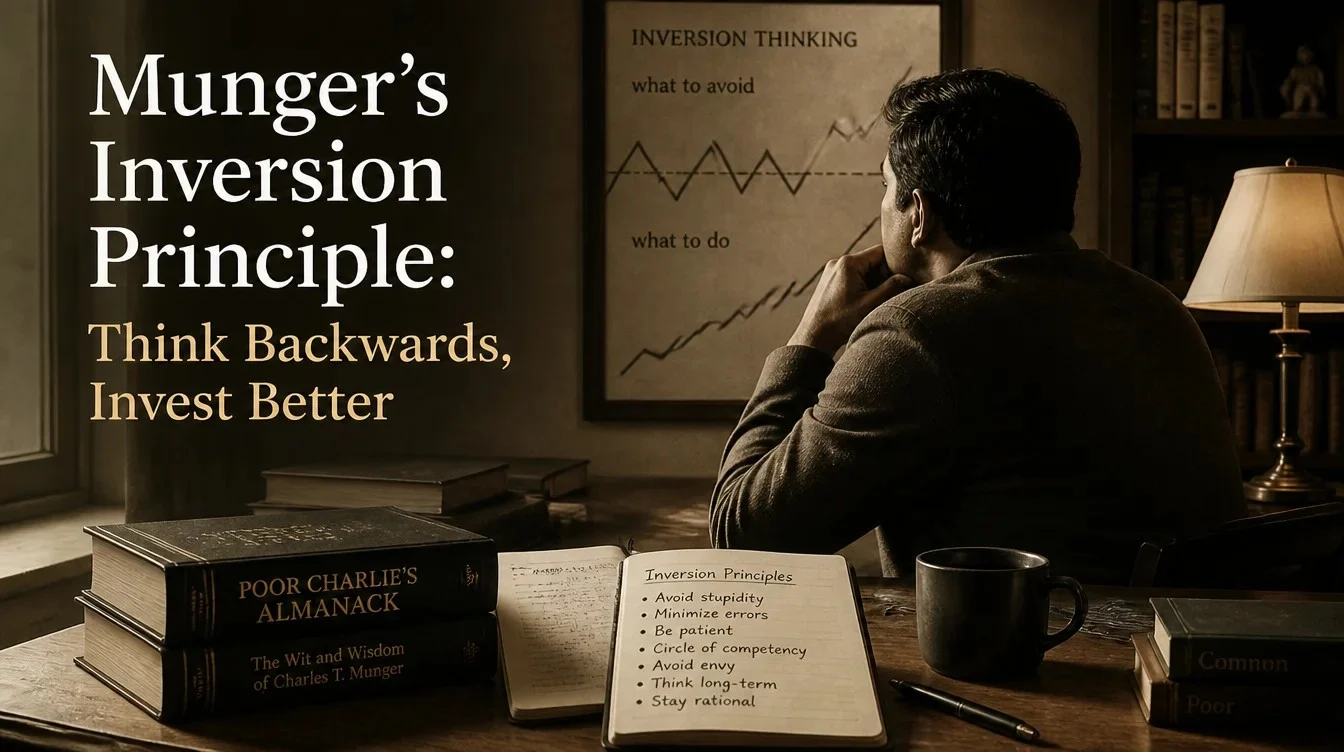
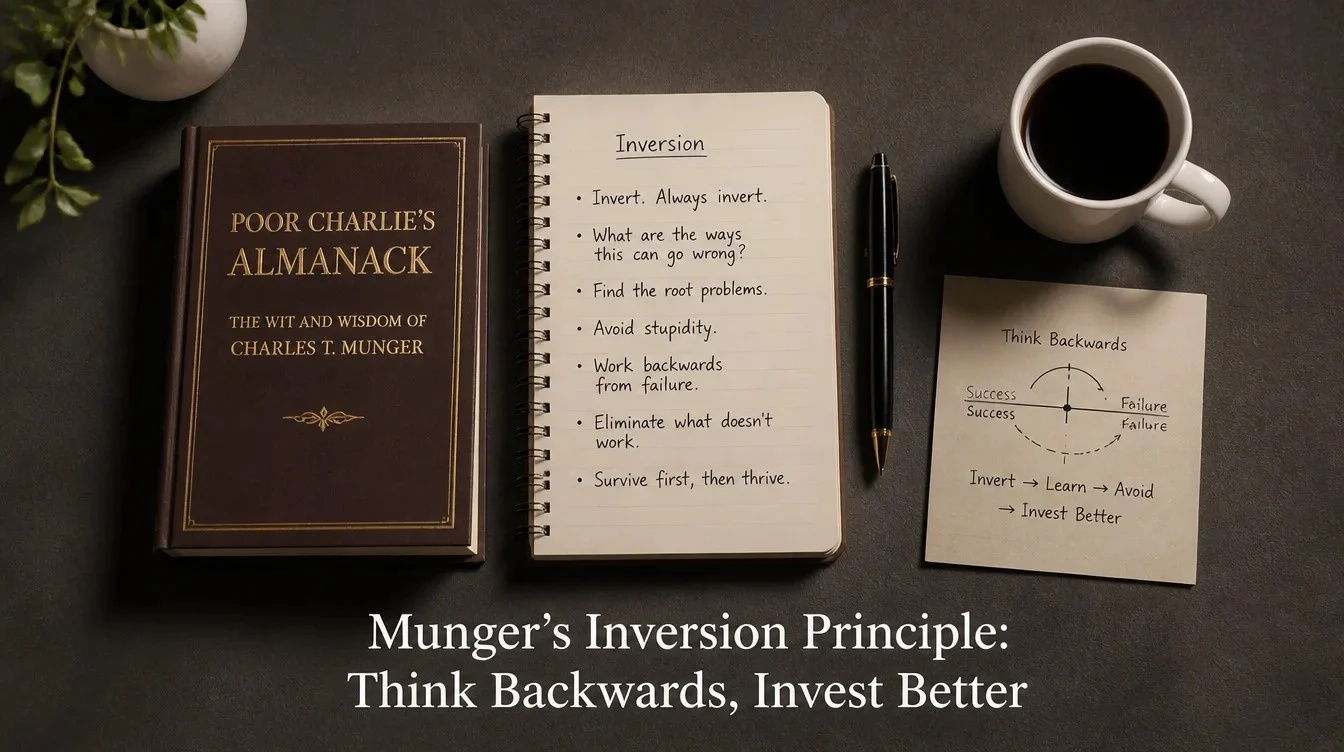
Charlie Munger borrowed one of his most powerful thinking tools from the 19th-century German mathematician Carl Jacobi, who famously advised: “Invert, always invert.” The investing application of the inversion principle that Munger developed from this idea is deceptively simple and profoundly useful: instead of asking, “How do I succeed at this investment?” ask, “What would guarantee I fail at this investment?” Then avoid those things systematically. The gap between these two questions is enormous, and most investors only ever ask the first one.
What Inversion Principle Investing Is and Why Munger Uses It
Inversion is the practice of thinking about problems from the opposite direction. Rather than identifying the path to a desired outcome, you identify the surest paths to the opposite outcome and then structure your decisions to avoid those paths. Munger applies this technique across business analysis, investment decisions, and personal behavior with remarkable consistency.
His reason for valuing inversion is rooted in cognitive psychology. Humans are naturally wired to think forward, to imagine positive scenarios, and to build plans toward them. This forward bias creates blind spots: we underweight the risks that are most likely to derail us precisely because we focus on optimistic projections. Thinking backwards forces those risks into the foreground.
In a famous commencement address, Munger illustrated inversion with a simple question: “All I want to know is where I’m going to die, so I’ll never go there.” The joke has a serious point. If you can map reliable failure routes, you can navigate around them even when the positive vision of success is unclear.
Inversion Applied to Investment Analysis
The most direct investment application of inversion is the bear case requirement. Before buying any position, Munger’s framework demands that you ask, ‘What are the most compelling reasons this investment will fail?’ Not the superficial risks – every analyst can identify one or two generic risks – but the deep, structural reasons why the thesis might be fundamentally wrong.
The Three Failure Questions
Munger’s investment inversion generates three specific questions for every potential position:
What would cause the competitive moat to erode? Every moat has conditions under which it becomes vulnerable. Brand moats erode when a competitor builds superior distribution or when a generational shift in consumer preferences makes the brand irrelevant to younger buyers. Cost moats erode when input cost dynamics shift, when new production technology reaches competitors, or when the regulatory framework that protected the cost advantage changes. Network effect moats erode when a competing network reaches critical mass in a segment the incumbent underserves.
For an Indian investor analysing a large FMCG business, the inversion question is, ‘What specific conditions would cause a challenger brand to meaningfully erode market share within five years?’ If you cannot answer this question with specificity, you cannot assess whether the current moat is durable or fragile. Munger’s full mental model toolkit consistently uses inversion as a pre-commitment device against overconfidence.
What management behavior would destroy this business? Capital misallocation, investing retained earnings into low-return acquisitions or capital expenditures, is the most common management failure mode. A business with 25% return on equity that compounds for a decade and then makes a large, expensive acquisition in an adjacent industry it does not understand will destroy more value in the following three years than it created in the preceding decade. Asking what management would have to do to destroy this business focuses attention on the capital allocation history, the acquisition track record, and the incentive structure that governs management decisions.
What macro or regulatory change would invalidate the investment thesis? Many apparently durable investment theses rest on regulatory frameworks, tax treatments, or policy environments that could change. Regulatory and policy inversion questions are material for businesses such as an NBFC with excellent credit quality based on priority sector lending classifications, a renewable energy company reliant on state government power purchase agreements, or a pharma company heavily exposed to US generic pricing. Identifying these specific vulnerabilities before investing, rather than after, is the difference between a thesis that can survive adversity and one that breaks on first contact with changed conditions.

Inversion in Portfolio Construction
Beyond individual stock analysis, inversion is a powerful portfolio construction tool. Instead of asking, “How do I build a portfolio that maximizes returns?” Munger’s approach asks, “What portfolio construction mistakes are most reliably associated with poor long-term outcomes?”
The inverted list of portfolio construction failures is specific and actionable:
- High turnover and transaction costs are significant challenges. Portfolios that trade frequently reliably underperform because transaction costs, taxes on short-term gains, and the bid-ask spread compound against the investor over time. The actionable inversion is to avoid high turnover, rather than simply aiming for low turnover.
- Leverage during corrections. Investors who use margin or pledge shares to amplify equity positions will be forced to sell at the worst possible time when corrections trigger margin calls. The path to failure is leverage; the inversion is no leverage in long-term equity positions.
- Panic selling at corrections. Multiple studies of Indian mutual fund redemption data show that retail investors reliably redeem at market lows and reinvest at market highs. The inverted question: What behavior guarantees that I capture the worst possible entry and exit prices? This means selling during 20%+ corrections and buying after 30%+ rallies. Avoiding that specific behavior pattern serves as protection. Behavioral biases in investing are easier to manage when framed as “What behavior will definitely hurt me?” rather than “What behavior is optimal?”
- Excessive diversification into businesses you do not understand. Munger is explicit that owning 40 stocks is not wisdom; it is simply a thinly spread form of ignorance. The inverted question: what portfolio construction ensures I can never benefit from my best ideas? Spreading capital so thinly that even a 10x winner in a single position moves the portfolio by only 2% is the reliable path to mediocrity.
Inversion as a Business Quality Filter
Munger uses inversion to filter for business quality before he starts any positive analysis. His inverted business quality questions are ‘What businesses are most reliably unprofitable?’ What characteristics correlate most consistently with poor long-term equity returns?
His answers are well-documented across his speeches and Berkshire’s shareholder letters. Businesses with these characteristics reliably produce poor long-term returns: commodity products with no pricing power, high capital intensity with low returns on invested capital, management teams with incentives misaligned from shareholder interests, industries with structural pricing pressure from powerful buyers or suppliers, and regulated utilities without the ability to earn above-regulated returns on new investment.
The inversion is not “I am looking for businesses with pricing power.” It is “I am eliminating all businesses where pricing power is structurally absent.” The framing matters because it shifts the analysis from identifying positive attributes (which is subject to confirmation bias) to eliminating negative attributes (which is a more reliable process). Even in asset classes outside equities, the question of what guarantees poor returns is more reliably answered than the question of what guarantees high returns, particularly in low-quality real estate with weak rental demand, thin operating margins, and structural vacancy.

Inversion in Risk Management
Perhaps the most powerful application of inversion for Indian retail investors is in personal risk management. Munger has applied inversion to his life decisions with striking consistency; he has described his goal not as “maximizing success” but as “avoiding the decisions that lead to catastrophic failure.”
The inverted risk management question for equity investors: what decisions reliably lead to permanent capital loss rather than temporary drawdowns? The answer is specific: investing in leveraged vehicles where losses can exceed principal (futures; options without hedging; and leveraged ETFs), investing in businesses with high fraud risk (small-cap companies with opaque promoter structures, no external auditor credibility, and circular related-party transactions), and concentrating capital in sectors where you have no genuine analytical edge and are relying entirely on market momentum.
Permanent capital loss, losing money you cannot recover, is categorically different from temporary drawdowns. A temporary drawdown in a quality business recovers as the business’s underlying earnings power reasserts itself in the share price. Permanent capital loss from fraud, leverage failure, or fundamental business failure is not recoverable. Inversion focuses attention on avoiding permanent loss rather than on maximizing returns. The asymmetry between these two goals is what Munger believes most investors get backwards.
Practical Exercises for Indian Investors
Applying inversion concretely requires practice. Three exercises produce immediate practical value:
The failure pre-mortem. Before making any investment, write a paragraph that begins, “It is five years from now, and this investment has lost 70% of its value. What happened?” Force yourself to identify the specific failure sequence, not a generic market risk but the specific chain of events by which this particular business, in this particular competitive context, could go from its current valuation to 70% lower. If you cannot write this paragraph with specificity, you misunderstand the risk profile of the investment.
The anti-portfolio audit. Apply inversion to your existing portfolio. For each holding, answer: if I were advising someone never to own this stock, what would I tell them? The compelling reasons to avoid a holding you already own are the very reasons you are most likely to ignore because of confirmation bias. The anti-portfolio audit surfaces the risks that emotional attachment to existing positions tends to suppress. Warren Buffett’s investment framework incorporates the same anti-portfolio audit logic in Berkshire’s annual shareholder letter discussion of past mistakes.
The sector failure map. For any sector you are considering entering, map out the three or four most reliable routes to investment failure in that sector. In Indian banking, the failure map includes aggressive loan book growth into unseasoned credit segments, promoter-linked loan exposure, inadequate provision coverage during credit cycles, and management teams that have not operated through a credit cycle. In Indian IT services, the failure map includes client concentration above 20% in a single account, margin compression from commodity pricing, attrition rates above 25%, and revenue exposure to US financial services during cyclical downturns. Having this map before entering a sector means you can screen out the highest-risk names immediately rather than discovering their vulnerabilities after the investment is made.
Frequently Asked Questions
What is Charlie Munger’s inversion principle?
The inversion principle is Munger’s adaptation of mathematician Carl Jacobi’s advice to always invert a problem. Instead of asking how to succeed at an investment, Munger asks what would guarantee failure and then systematically avoids those conditions. The practical investment application is the requirement to construct a compelling bear case before investing and to map the specific failure paths for each business in a portfolio.
How does inversion improve investment decisions?
Inversion counteracts the natural human tendency toward optimistic forward projection. By forcing explicit identification of failure modes before investing, it surfaces risks that confirmation bias and optimism bias would otherwise suppress. Research on decision quality consistently shows that people who explicitly consider failure scenarios before committing to decisions make fewer catastrophic errors than those who focus exclusively on positive outcomes.
Can inversion be applied to SIP investing?
Yes. Applied to SIP investing, inversion asks, ‘What investor behaviour reliably destroys the compounding benefit of systematic investing?’ The answers are: stopping SIPs during corrections (when units are cheapest), increasing SIP amounts only during bull markets, switching funds based on trailing returns, and investing in thematic or sectoral funds without a thesis for why the theme will persist over the SIP’s full time horizon. Avoiding these behaviors is more actionable than optimizing fund selection.
What other mental models does Munger use alongside inversion?
Munger’s full mental model toolkit includes inversion, second-order thinking (what happens after the immediate effect?), the margin of safety principle borrowed from Graham, the incentives-driven behavior model (show me the incentive, and I’ll show you the behavior), lollapalooza effects (when multiple cognitive biases combine to produce extreme outcomes), and the basic numeracy of compound interest and its power over long periods. These models work together: inversion identifies failure paths, second-order thinking traces their downstream consequences, and incentive analysis identifies which management behaviors are most likely.
Is Munger’s inversion different from risk management frameworks used by institutions?
Munger’s inversion is less formal but more psychologically honest than institutional risk management frameworks. Institutional VaR models and scenario analysis are mathematically sophisticated but are often calibrated to recent history, which means they systematically underestimate tail risks in novel conditions. Munger’s inversion is qualitative, forward-looking, and explicitly designed to surface the risks that quantitative models calibrated to past data are most likely to miss.
Related Articles
- Charlie Munger Mental Models: 25 Thinking Tools Every Indian Investor Needs
- Warren Buffett Investment Strategy: The Complete Value Investing Guide for India
- 10 Investment Biases That Cost Indian Investors Money