
The monthly salary slip is the single most important financial document for any salaried earner in India, and almost no one reads it line by line. Most employees glance at the net pay number and file the PDF away. The result is a quiet erosion of financial awareness: errors go undetected, tax-saving opportunities get missed, and conversations with the HR or payroll team become harder than they need to be. The salary slip india is a structured record of how cost-to-company turns into in-hand pay, and learning to read it is one of the highest-leverage personal-finance skills available to anyone with a job.
This guide walks line by line through a typical Indian payslip in FY 2025-26, with a worked sample, the impact of choosing the new tax regime under Section 115BAC, the most common errors to spot, and a short checklist for every month. The aim is not to make readers into accountants. The aim is to make every salary slip understandable in under two minutes.

What Is a Salary Slip and Why It Matters
A salary slip, also called a payslip, is a monthly statement issued by the employer that lists the earnings the employee has received and the deductions taken out of those earnings for that pay period. It is both a payroll record for the employer and a legal proof of income for the employee.
The Payment of Wages Act, 1936, and state-level shops and establishments acts require employers to provide payslips to employees in most contexts. The format varies, but the core structure is standardised: a top half listing earnings and a bottom half listing deductions, with the net pay computed at the bottom.
Why the salary slip is more than a pay confirmation
The payslip is the document banks ask for when sanctioning home loans, car loans, and credit cards. Embassies ask for it for visa applications. The Income Tax Department uses it indirectly through Form 16, which is built from the same data. Errors in the payslip propagate into loan applications, tax filings, and refund timelines.
Monthly versus annual view
A single payslip captures one month of payroll. Form 16, which the employer issues at the end of the financial year, captures the same data aggregated over twelve months along with the final TDS reconciliation. The two documents have to agree at year-end; if they do not, the salaried earner has the right to ask the payroll team to reconcile.
Digital vs paper payslips
Almost every employer in India now delivers payslips through an HR information system or email PDF. The legal status of a digital payslip is the same as paper. Downloading and archiving every monthly payslip in a single folder is a small habit with large payoffs at tax filing time.
The Earnings Section of an Indian Salary Slip
The earnings section sits at the top of every payslip and lists the components of gross monthly pay. Each component has a different tax treatment, a different role in retirement contributions, and a different sensitivity to the chosen tax regime.
Basic salary
Basic salary is the foundational component, typically 40 to 50 percent of cost-to-company under common payroll structures. Many other components, including Provident Fund, HRA limits, and gratuity, are calculated from the basic. A higher basic generally means higher EPF and higher gratuity, but also higher current tax exposure in the old regime if HRA is not claimed.
House Rent Allowance (HRA)
HRA is a separately listed allowance intended to help with rented accommodation. Under the old tax regime, HRA is partially exempt from income tax under Section 10(13A) of the Income-tax Act, 1961: the exemption is the least of actual HRA received, rent paid minus 10 percent of basic, and 50 percent of basic for metros (40 percent for non-metros). Under the new tax regime, HRA exemption is generally not available; the allowance still appears on the payslip but is fully taxable.
Leave Travel Allowance (LTA)
LTA is an allowance for domestic travel. Under the old regime, it is exempt up to a limit twice in a four-year block on production of actual travel bills, per Section 10(5) read with Rule 2B. Under the new regime, LTA exemption is generally not available. Many employers still pay LTA as a fixed amount each month or as a lump sum once a year.
Special allowance and conveyance
Special allowance is the residual bucket that balances the gross to the agreed CTC after fixed components are set. It is fully taxable under both regimes. Conveyance allowance, once partially exempt, is now generally taxable under both regimes; standard deduction covers a broad slice of these allowances in the new regime.
Other allowances and reimbursements
Many employers carry medical reimbursement, food coupons or meal cards, telephone reimbursement, and similar smaller heads. The tax treatment varies by component and regime; the safest reading is that under the new regime, most of these exemptions are no longer available, while under the old regime several still survive subject to documentation.
The Deductions Section of an Indian Salary Slip
The deductions section lists everything that reduces the gross pay before arriving at the net amount that lands in the bank. The four standard deductions are EPF, professional tax, TDS, and any voluntary or company-mandated items.
Employee Provident Fund (EPF)
EPF is mandatory for most salaried employees in companies with 20 or more employees, governed by the Employees’ Provident Fund and Miscellaneous Provisions Act, 1952. The employee contributes 12 percent of basic salary and the employer contributes a matching share, of which a portion goes to the Employees’ Pension Scheme and the rest to EPF. The employee’s contribution is deductible under Section 80C of the old regime; under the new regime, EPF still flows but the 80C deduction is generally not available.
Professional tax
Professional tax is levied by state governments and capped at Rs.2,500 per year across most states, deducted monthly. The amount and slabs vary by state. It is a small line item but appears on every payslip in states that levy it.
TDS (Tax Deducted at Source)
TDS is the monthly income-tax deduction the employer makes against the projected annual liability. It is computed by adding projected gross income for the financial year, subtracting the standard deduction and any eligible exemptions and deductions based on the chosen regime, applying the applicable slab rates, and dividing by twelve months. The TDS amount on a given payslip can change month to month as the projection updates, especially after investment proofs are submitted in January and February.
Voluntary deductions
Many employees opt for voluntary contributions: Voluntary Provident Fund (VPF) above the mandatory 12 percent, NPS Tier I through Section 80CCD(2) where the employer offers it, group health insurance top-ups, salary advance recoveries, and corporate gift-store deductions. These reduce in-hand pay further and need to be reconciled with the original elections in the employee self-service portal.
A Sample Indian Salary Slip Walked Through
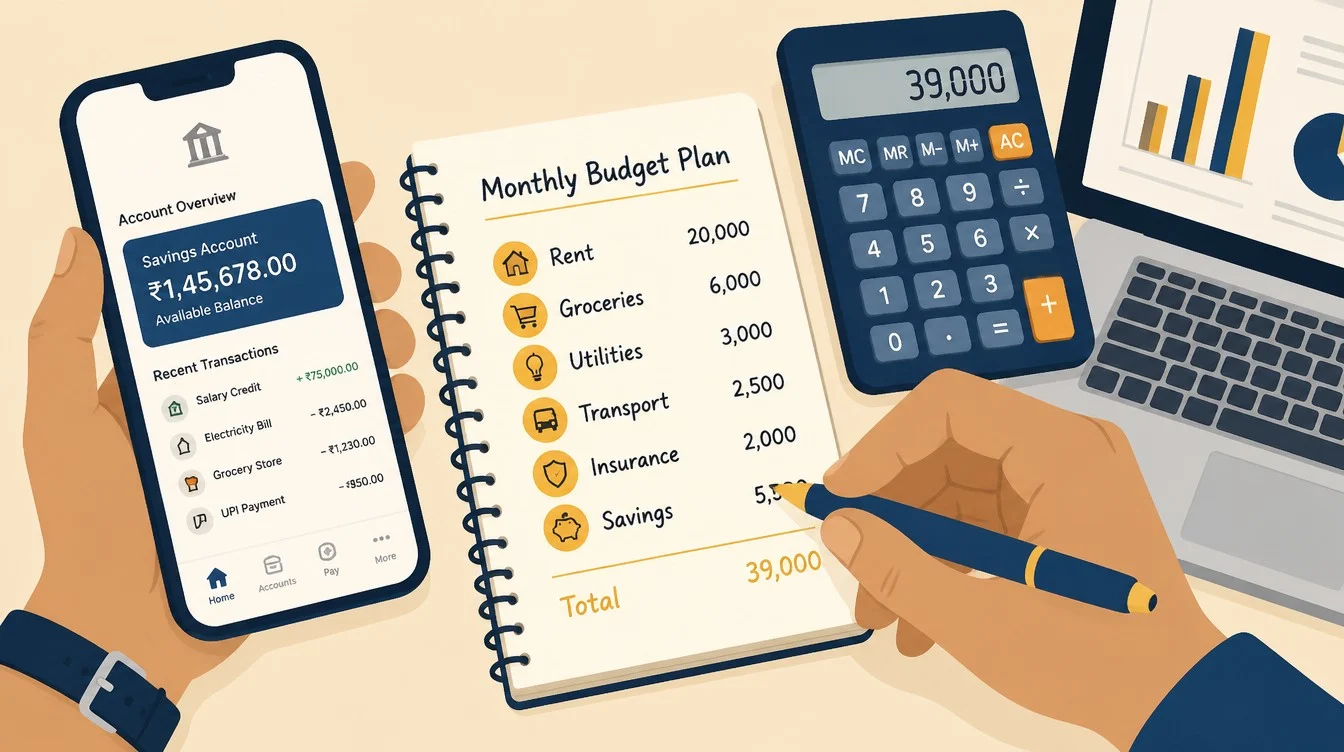
Numbers explain the structure faster than words. The illustrative payslip below uses a typical mid-career salaried profile in a tier-1 metro under the old tax regime with HRA claimed.
Annual CTC and monthly base
Assume a cost-to-company of Rs.18,00,000 per year (18 lakh). The employer breaks this into fixed monthly pay of about Rs.1,40,000 plus a one-time retention or variable component of Rs.1,20,000 that pays out annually. The monthly payslip math below is based on the Rs.1,40,000 fixed monthly base.
Sample monthly payslip
| Component | Amount (Rs.) | Notes |
|---|---|---|
| Basic salary | 56,000 | 40% of fixed monthly |
| HRA | 28,000 | 50% of basic for metro |
| LTA | 4,000 | Annualised over 12 months |
| Special allowance | 50,000 | Residual balancing item |
| Conveyance / other | 2,000 | Taxable under both regimes |
| Gross earnings | 1,40,000 | Sum of earnings |
| EPF (employee) | 6,720 | 12% of basic |
| Professional tax | 200 | Karnataka/Maharashtra rates |
| TDS (illustrative) | 16,500 | Old regime, with HRA + 80C |
| Total deductions | 23,420 | Sum of deductions |
| Net pay (in-hand) | 1,16,580 | Gross minus deductions |
The CTC vs in-hand gap explained
The annual CTC of Rs.18,00,000 averages out to Rs.1,50,000 a month. The in-hand pay in the sample is Rs.1,16,580. The gap of roughly Rs.33,000 a month is the combined effect of employer EPF (which is paid into the EPF account, not the bank), gratuity provision, group insurance, and TDS. The bank credit is the only number that should drive monthly budgeting; the CTC is useful for comparison across offers and benchmarking, not for cash flow.
What changes for the new tax regime
If the same employee chose the new tax regime under Section 115BAC, the HRA, LTA, and most allowance-level exemptions would generally not apply. The TDS line would be recomputed against the new slabs and the higher standard deduction. The net pay can be slightly higher or slightly lower depending on the actual eligible deductions under the old regime. The clean comparison is done annually using the Income Tax Department calculator.
How New Tax Regime Changes the Payslip
The new tax regime under Section 115BAC has been the default since FY 2023-24, and the slab structure has continued to evolve through recent Finance Acts. The choice between old and new regimes is communicated to the payroll team at the start of the financial year and can be changed during return filing in most cases. The choice has a direct, visible impact on the payslip.
Higher standard deduction in the new regime
The new regime carries a higher standard deduction for salaried taxpayers, currently set at Rs.75,000 for FY 2024-25 onwards per recent Finance Act updates, compared to Rs.50,000 under the old regime. This single change reduces taxable income for most salaried earners and is the primary reason many low-deduction taxpayers find the new regime favourable.
Loss of most exemptions and deductions
The new regime largely withdraws Section 80C (Rs.1.5 lakh investments), Section 80D (health insurance), Section 80CCD(1B) (NPS Tier I voluntary), HRA exemption, LTA exemption, and most other Chapter VIA deductions. NPS contributions through the employer under Section 80CCD(2) survive in the new regime within prescribed limits, which makes employer-routed NPS a meaningful planning lever.
When the old regime still wins
The old regime tends to be more attractive when the taxpayer has high rent paid for HRA, a home loan with both principal repayment under 80C and interest under Section 24, full 80C utilisation through EPF and ELSS, and substantial health insurance and term life premiums. The crossover point varies; the only reliable test is to run both regimes through a salary calculator on the Income Tax Department portal each February.
How the payslip line items shift between regimes
The earnings half of the payslip rarely changes between regimes. The change shows up in TDS. Under the old regime, TDS reflects the exemptions and deductions claimed; under the new regime, TDS is computed against gross income minus only the standard deduction and a few surviving deductions. The same employee can see TDS swing by several thousand rupees a month between the two regimes.
Common Errors to Spot on a Salary Slip
Payroll teams handle hundreds or thousands of payslips a month, and small errors slip through. Most are easy to catch in the first two minutes of a careful review.
Wrong PAN or UAN on the slip
The PAN drives TDS and the link to Form 26AS and the Annual Information Statement. The UAN (Universal Account Number) drives EPF. A wrong PAN can lead to TDS not getting credited to the right tax account, which surfaces only at return filing. A wrong or missing UAN can lead to EPF contributions sitting in suspense for months. Both numbers should match the employee’s actual identifiers.
EPF deducted on the wrong base
EPF is computed on basic plus dearness allowance under most schemes. Some employers cap EPF on Rs.15,000 of basic by default, even when the actual basic is much higher, which materially reduces the EPF accumulation. Employees who want EPF computed on the full basic may need to opt in explicitly, depending on the company’s scheme.
Professional tax in a state that does not levy it
A few states (Delhi, Haryana, Uttarakhand, Uttar Pradesh, J&K, Arunachal Pradesh, and a few others) do not levy professional tax. An employee based in such a state should not see a professional tax line. Errors usually trace back to old location data in the HR system.
TDS not reflecting submitted investment proofs
The clearest indicator of a TDS error is a high deduction in March even after all investment proofs were submitted on time. The fix is to check the regime election, the proof submission status in the HR portal, and the TDS projection that the system used. Form 16 at year-end consolidates the final number, but spotting the error earlier means a smaller refund wait.
Missing or wrong components
Occasionally an allowance disappears from a payslip because of a system roll-back, or a one-time reimbursement appears in the wrong column. The fix is a written ticket to the payroll team referencing the specific month and component. Verbal escalations rarely leave the audit trail required for correction.
What the Salary Slip Tells You About Your Effective Tax Rate
The TDS line on the payslip is the single best indicator of the household’s effective income-tax rate. A small monthly arithmetic check is worth running quarterly.
Computing the effective tax rate from the payslip
Multiply the monthly TDS by 12 to get the annualised tax. Divide that by the annualised gross income (monthly gross times 12 plus any one-time variable components). The result is the effective tax rate. For a mid-career salaried earner in the old regime with full 80C and HRA, this figure is often in the 12 to 18 percent range; under the new regime without major deductions, the same household might see 15 to 22 percent depending on the slab.
The marginal vs effective distinction
The slab rate (30 percent for higher brackets) is the marginal rate, the rate applied to the next rupee of income. The effective rate is the average across all rupees. Confusing the two is the most common misreading of one’s own salary slip. A 30 percent marginal rate often translates to an effective rate closer to 18 to 22 percent because the lower slabs and standard deduction reduce the average.
Using the rate to plan investment proofs
An employee in the 30 percent marginal slab who has yet to use the full Rs.1.5 lakh of Section 80C under the old regime stands to save Rs.45,000 of tax by completing the contribution before March. The payslip’s TDS line is the simplest annual reminder to verify whether the 80C envelope is filled.
The impact of one-time arrears and bonuses
A March payslip with a sudden TDS spike usually reflects a year-end bonus, arrears recomputation, or final regime reconciliation. The spike is not an error in itself; it reflects the year’s actual liability landing on the last payslip. The Form 16 number at year-end matches this final figure.
A Monthly Salary Slip Checklist
A two-minute review every payday catches most errors before they compound. The checklist below is intentionally short.
- Verify the employee name, employee code, PAN, UAN, and bank account on the slip header.
- Confirm the gross earnings figure equals the sum of the listed components.
- Check that EPF equals 12 percent of basic (or the agreed VPF percentage).
- Verify the professional tax line against the employer location.
- Note the TDS amount and confirm it is broadly stable month to month.
- Confirm the net pay matches the bank credit, allowing for differences in pay date and clearing.
- Save the PDF to a dated folder for the financial year.
Salary Slips and the Loan Approval Process
Banks and NBFCs anchor home loan, car loan, and personal loan underwriting to the salary slip. Understanding what the lender looks for makes the conversation smoother and the eligibility outcome more predictable.
What lenders read first
Lenders look at net in-hand pay, not gross or CTC. The fixed monthly net is the input to most foir (fixed-obligation-to-income ratio) calculations, which determine the maximum EMI the borrower can carry. Most lenders cap the foir between 40 and 55 percent of net in-hand for salaried borrowers.
The three-month payslip rule
Most lenders ask for the last three months of payslips plus the latest Form 16. Three months of consistent net pay is the standard proof of income. Variable pay shown in those three months may or may not be counted depending on the lender’s policy; some apply a haircut, others ignore variable pay entirely.
The bank statement cross-check
Lenders also pull the salary account bank statement and verify that the net pay number on the payslip matches the credit. A mismatch raises immediate underwriting questions. This is one reason it is worth checking that the bank credit and the payslip net pay align every month.
Salary Slips for the Self-Employed and Consultants
Freelancers, consultants, and proprietors do not get a salary slip in the strict sense, but the document equivalent matters when they apply for loans, visas, or rental agreements.
Why income proof gets harder without a payslip
Self-employed earners typically substitute payslips with bank statements, GST returns where applicable, professional tax returns, and the ITR-3 or ITR-4 form. Banks discount this income compared to salaried payslips because it is less predictable, and the loan eligibility math is correspondingly tighter.
Issuing a self-payslip
Consultants who run a single-member private limited company or a one-person company can structure themselves as employees of that entity and issue payslips on the company letterhead. The payslip and accompanying Form 16 then function exactly like a salaried earner’s documents for downstream financial use. The cost is the corporate compliance overhead.
Switching from salaried to freelance and back
Earners who move between salaried and freelance work in a single financial year end up with both a Form 16 and an ITR-3 / ITR-4 return at year-end. The salary slips from the employed months remain valuable evidence; saving them remains worthwhile even after the employment ends.
Using the Salary Slip to Drive a Better Budget
The payslip is also a budgeting tool, not just a payroll record. Reading it carefully each month nudges the household toward better cash-flow choices.
The savings rate visible on the payslip
The combined EPF deduction is an automatic savings line. For a typical earner contributing 12 percent of basic, EPF alone contributes meaningfully to the household’s savings rate. Adding VPF to the same payroll line is the simplest way to push the savings rate higher with zero ongoing effort because the deduction happens before the salary lands.
The 80C and tax-saving line of sight
Under the old regime, the 80C envelope of Rs.1.5 lakh per year is best filled through EPF, ELSS mutual funds, PPF, life insurance premiums, and home loan principal repayment. The payslip’s EPF line shows how much of the envelope is already used; the rest is what needs to be invested outside the payslip during the year. Equity-linked savings schemes carry market risk; the tax saving does not change that.
Using TDS as a planning anchor
If the monthly TDS feels unexpectedly high, it usually means the payroll system is projecting an annual liability that does not account for some deduction the employee plans to claim. Submitting an updated investment declaration earlier in the year smooths the TDS across months, increases monthly in-hand pay, and reduces the refund wait at year-end.
Refresh the payslip review at every salary change
Every time CTC changes (annual increment, role change, promotion, or job switch), the entire payslip structure usually changes too. The first payslip after a change deserves a careful five-minute review, not a glance. Errors caught in the first month are easier to fix than errors discovered at year-end.
FAQ
Why is my in-hand salary much lower than my CTC?
The CTC includes everything the employer spends on the employee: gross pay, employer EPF, gratuity provision, group insurance, and sometimes the variable bonus pool. Only a portion of that lands in the bank each month. After employer-side items, employee EPF, professional tax, and TDS, the typical in-hand for an Indian salaried earner is 70 to 80 percent of CTC in net terms, with the exact ratio depending on the salary structure and chosen tax regime.
Is the salary slip mandatory in India?
Most state shops and establishments acts and the Payment of Wages Act, 1936, require employers above certain size thresholds to issue payslips. Digital payslips have the same legal status as paper. If an employer does not provide one on request, the employee can escalate to the labour commissioner of the relevant state.
Can I switch between old and new tax regimes mid-year?
The regime declared at the start of the financial year is used by the employer for monthly TDS computation. At the time of return filing, salaried employees can usually still choose the more favourable regime, subject to the conditions of Section 115BAC and any restrictions on business income. The clean practice is to declare the right regime at the start, then run the final calculation against both regimes at return filing.
What should I do if my EPF is being deducted on the wrong base?
Submit a written ticket to the payroll team with the payslip in question, the calculated EPF that should apply (12 percent of basic plus DA), and the actual figure on the slip. If the employer has a capped EPF policy at Rs.15,000 of basic, the employee may need to opt in to full-basis EPF through a formal request, depending on company policy.
How long should I keep my salary slips?
A common practice is to retain monthly payslips for at least six full financial years to align with the Income Tax Department’s reassessment time limits. For employees who plan to apply for major loans or visas, keeping all payslips since employment began is the safer default. Digital archives are inexpensive, so the cost of over-saving is negligible.
Related guides on this topic are coming to learnfinedge.com soon.