
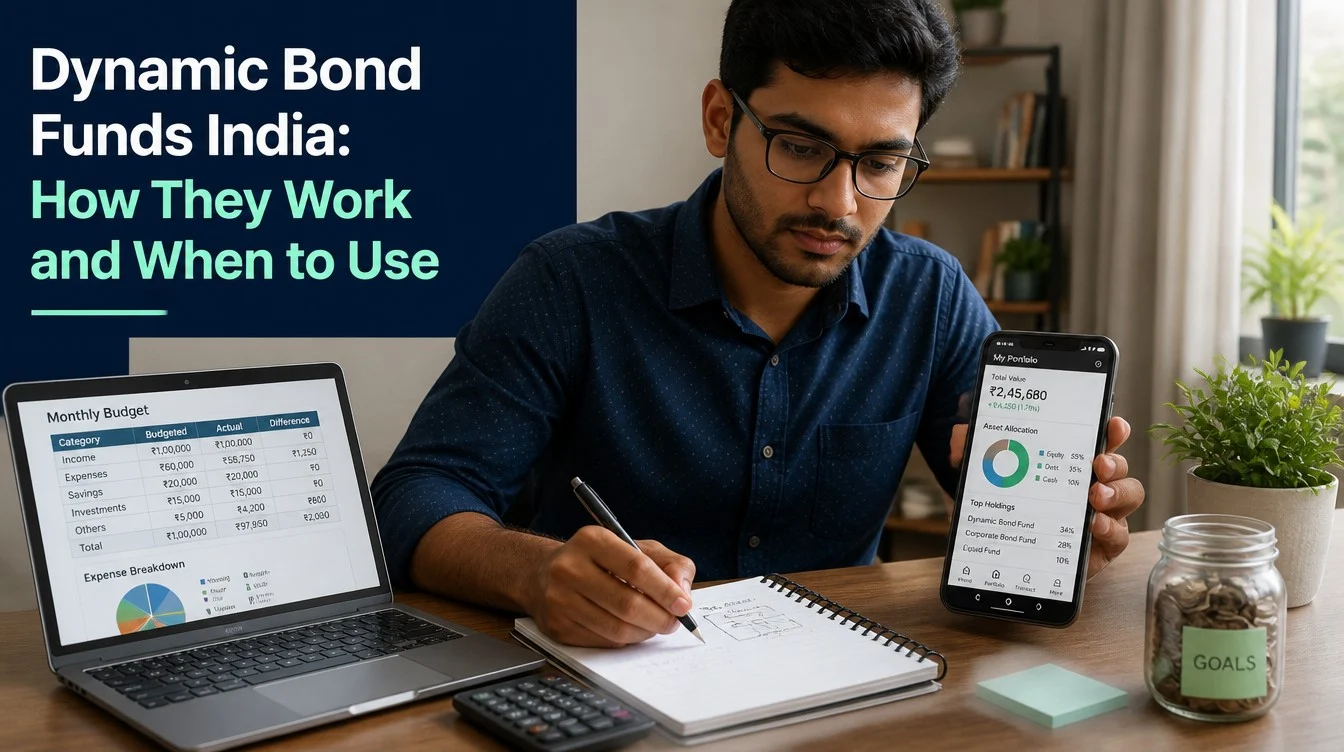
Dynamic Bond Funds India: How They Work and When to Use Them
Most debt funds operate with a fixed mandate – a liquid fund stays short, a gilt fund stays long. Dynamic bond funds india are the exception. A dynamic bond fund can hold bonds of any maturity, and the fund manager actively shifts duration up and down based on their view of where interest rates are headed. When rates are expected to fall, the manager extends duration to capture capital gains on long-term bonds. When rates are expected to rise, the manager shortens duration to protect the NAV. In theory, this is the optimal approach to debt investing. In practice, it requires consistent accuracy in predicting rate movements – which is harder than it sounds.
How Dynamic Bond Funds Work
A dynamic bond fund has no SEBI-mandated duration constraint. The fund manager can hold a portfolio with Macaulay duration of 0.5 years (equivalent to an ultra-short fund) or 10 years (equivalent to a gilt fund), and can switch between these extremes based on their interest rate outlook.
The manager uses macro analysis to form rate views: RBI policy stance, inflation trajectory, GDP growth, global bond yields (particularly US Treasury yields), and currency movements. When these signals collectively point to rate cuts, the manager buys long-duration bonds. When signals point to rate hikes, the manager reduces duration by selling long bonds or buying short-tenor instruments.
Duration as the Primary Tool
Duration management is the central skill in dynamic bond fund management. A portfolio duration of 8 years means the fund’s NAV rises approximately 8% for each 1% fall in yields and falls approximately 8% for each 1% rise. A portfolio duration of 1 year means NAV sensitivity is minimal. The dynamic fund manager’s edge – if any – is in knowing when to be 8 years and when to be 1 year.
The Manager Dependency Problem
Unlike a gilt fund or short duration fund, where category rules define the portfolio characteristics, a dynamic bond fund’s performance depends almost entirely on the manager’s rate-prediction ability. Two dynamic bond funds can have dramatically different returns in the same year because their managers made opposite duration calls. This manager dependency is higher in dynamic bond funds than in any other debt fund category.

Dynamic Bond Funds vs Gilt Funds: Key Differences
| Feature | Dynamic Bond Fund | Gilt Fund |
|---|---|---|
| Portfolio mandate | Any duration; manager discretion | Government securities only; usually long duration |
| Credit risk | Can hold corporate bonds (credit risk possible) | Zero credit risk (government securities only) |
| Duration range | 0.5 to 12+ years depending on manager view | Typically 7-15 years; relatively stable |
| Return driver | Manager’s duration calls + accrual | Interest rate direction + accrual |
| Consistency | Highly variable across market cycles | Consistent sensitivity to rate changes |
| Best use case | When you trust a specific manager’s macro call | When you have a personal view on rate direction |
Historical Performance: Do Dynamic Funds Deliver?
The evidence on whether dynamic bond fund managers consistently outperform their benchmarks is mixed. During the 2014-2016 rate-cutting cycle, managers who extended duration early delivered strong returns. During the 2022-2023 rate-hiking cycle, managers who shortened duration early protected capital effectively. The challenge is that not all managers get both calls right, and switching managers is impractical for most retail investors.
A consistent pattern in dynamic bond fund performance is wide dispersion within the category. In any given year, the top-performing and bottom-performing dynamic bond funds may differ by 5-8 percentage points in return – a much wider gap than in other debt categories where mandates constrain the range. This dispersion reflects the range of manager skill and duration positioning accuracy. The compounding impact of consistently outperforming by 1-2% is meaningful, but consistently underperforming by the same margin is equally damaging over time.
When Dynamic Bond Funds Make Sense
Dynamic bond funds are most appropriate in specific conditions rather than as a default debt fund choice.
When You Have Confidence in a Specific Manager
If you have tracked a fund manager’s public rate commentary and seen consistent accuracy over 2-3 rate cycles, there is a basis for conviction in that manager’s dynamic allocation decisions. This requires active research – reading quarterly portfolio commentaries, comparing stated rate views with subsequent duration positions, and checking whether stated views were implemented in the portfolio. Few retail investors do this work systematically.
As an Outsourced Rate View
Some investors prefer not to make their own interest rate calls but want exposure to long-duration bond returns in rate-cutting cycles. A dynamic bond fund with a history of extending duration during rate cuts offers this exposure without requiring the investor to personally time the duration shift. The trade-off is that manager execution may be slower or less accurate than direct exposure via a gilt fund. Long-term retirement vehicles like NPS also shift debt allocation duration based on fund manager discretion, making them structurally similar to dynamic allocation in the debt portion.
Risks in Dynamic Bond Funds
The risks in dynamic bond funds are distinct from those in fixed-duration debt funds.
Manager Duration Call Risk
The most significant risk is that the manager makes the wrong rate call. If a manager extends duration anticipating rate cuts and the RBI instead hikes rates, the fund suffers both the NAV fall from rising yields and the opportunity cost of not being positioned in short-duration instruments earning higher accrual. This double hit can produce negative returns in a year when fixed-rate instruments were earning 6-7%.
Credit Risk in Corporate Bond Holdings
Unlike pure gilt funds, dynamic bond funds can hold corporate bonds. If the manager’s duration extension also involves moving into lower-quality corporate bonds for higher yield, the fund carries both duration risk and credit risk simultaneously. Reading the portfolio factsheet to understand the credit quality mix is important. Recency bias often causes investors to evaluate dynamic funds only on recent returns without examining whether those returns came from appropriate risk-taking.
Inconsistency Across Rate Cycles
A dynamic bond fund that performed well in one rate cycle may perform poorly in the next if the manager’s duration framework does not adapt. Rate cycles differ in magnitude, speed, and drivers, so a macro framework that worked in 2015 may not work identically in 2025. Backtesting performance over at least two complete rate cycles (one cutting and one hiking) gives a more representative picture than performance over a single cycle.
How to Choose a Dynamic Bond Fund
Selecting a dynamic bond fund requires more due diligence than other debt categories because of the manager dependency.
- Identify the manager. Dynamic bond funds are managed by named fund managers, not teams. Find out who manages the fund you are evaluating and how long they have been managing it.
- Read the last 8 quarterly portfolio commentaries. Look for stated rate views and check whether the subsequent duration positioning matched the stated view. Consistency between stated view and portfolio action indicates a disciplined process.
- Check performance in both a hiking and cutting cycle. A fund that performed well only in the 2020 cutting cycle but poorly in the 2022-2023 hiking cycle has not demonstrated all-weather capability.
- Compare expense ratios in direct plan. Dynamic bond funds often charge slightly higher expense ratios than passive-mandate funds because of the active management. Confirm you are in direct plan and that the expense ratio is below 0.5% for the direct plan.
- Check AUM. Prefer funds with AUM above Rs 2,000-3,000 crore. Smaller AUM dynamic funds may have less liquidity in their corporate bond holdings.
The Alternative: Manage Duration Yourself
A simpler alternative to dynamic bond funds is to make your own duration calls and implement them by switching between a liquid or short duration fund (when you expect rate hikes) and a gilt or long duration fund (when you expect rate cuts). This approach gives you full control, avoids the manager dependency risk, and captures the same return potential. The trade-off is that it requires you to actively monitor the interest rate environment and make switches – which requires discipline and monitoring effort. Diversifying beyond fixed income into real asset classes reduces the overall importance of getting the interest rate call right at any given time.
Frequently Asked Questions
What is the minimum investment in dynamic bond funds India?
Most dynamic bond funds accept lumpsum investments starting from Rs 1,000 to Rs 5,000 and SIP investments from Rs 500 to Rs 1,000 per month through direct plans. The minimum is similar to other debt fund categories. More important than the minimum is sizing the investment appropriately relative to your total debt allocation, given the higher return volatility of dynamic funds compared to short-duration funds.
Are dynamic bond funds suitable for a 1-year horizon?
Dynamic bond funds can be volatile over 1-year periods because of their flexible duration. If the manager has a long-duration position (8-10 years) and rates rise, the fund can post negative returns in a 12-month period. For a strict 1-year horizon, short duration funds or banking and PSU debt funds are more appropriate. Dynamic bond funds need at least a 2-3 year horizon to allow the manager’s duration calls to play out through a rate cycle.
How are dynamic bond fund returns taxed in India?
Dynamic bond fund gains are treated as short-term capital gains for units purchased after April 1, 2023, and taxed at the investor’s slab rate regardless of holding period. This is the same treatment as all debt mutual funds after the Finance Act 2023 amendment. The indexation benefit and 20% LTCG rate that previously applied to debt funds held for over 3 years no longer applies to new purchases.
What is the average duration of a dynamic bond fund?
By definition, this varies with the manager’s current rate view and can range from under 1 year to over 10 years. A typical dynamic bond fund in a neutral rate environment might hold a portfolio with Macaulay duration of 4-6 years. During rate-cutting expectations, duration might extend to 7-9 years. During rate-hiking expectations, it might shorten to 1-2 years. Always check the current month’s factsheet for the actual duration figure rather than relying on category averages.
What is the difference between dynamic bond funds and balanced advantage funds?
Dynamic bond funds manage only the debt component and vary duration within fixed income. Balanced advantage funds (BAFs) dynamically allocate between equity and debt based on market valuations, and may also vary the duration of their debt component. BAFs carry equity exposure and are suitable for different goals. Dynamic bond funds are pure debt instruments and do not carry equity market risk. They serve different roles in a portfolio and should not be confused or substituted for each other.
Related Articles
- NPS Vatsalya Scheme: Complete Guide for Indian Investors
- SIP vs Lumpsum: 20-Year Backtest Results
- 10 Investment Biases That Cost Indian Investors Money