


80C Deductions India: Full List and Limits Under the Old Tax Regime
Section 80C is the most widely used tax deduction under the 80c deductions india old tax regime, allowing up to Rs 1.5 lakh reduction in taxable income per financial year. Understanding all qualifying investments and payments, their individual limits, lock-in periods, and combined effect on your tax liability helps you maximize savings under the old regime. This guide covers every 80C investment option with their specific rules.
Section 80C: The Rs 1.5 Lakh Limit and Who Can Claim It
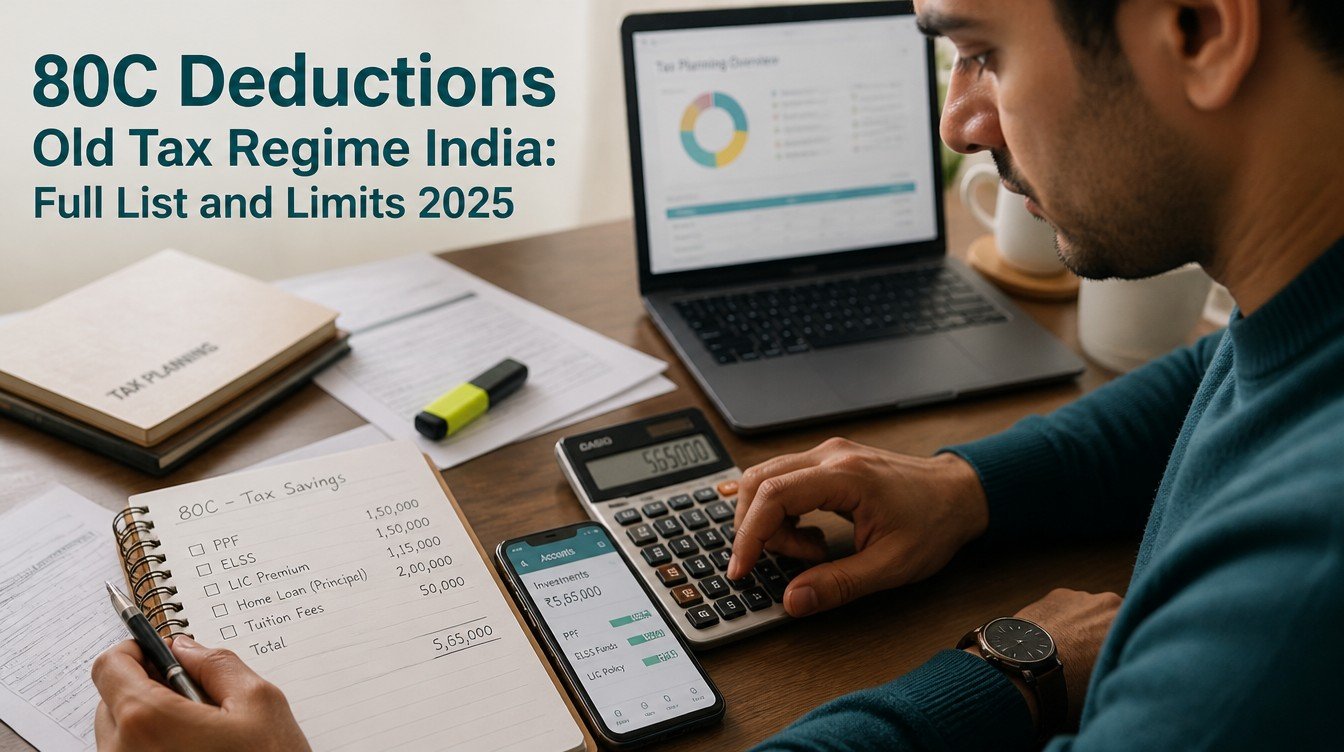
Section 80C allows individuals and HUFs to deduct up to Rs 1,50,000 per financial year from taxable income by making specified investments or payments. This deduction is available only under the old tax regime – it is not available if you choose the new tax regime. The limit is a combined ceiling – you cannot claim more than Rs 1.5 lakh even if you make qualifying investments worth Rs 3 lakh.
This Rs 1.5 lakh deduction saves:
- Rs 15,000 in tax for those in the 10% slab.
- Rs 30,000 in tax for those in the 20% slab.
- Rs 45,000 in tax for those in the 30% slab (plus cess).
Complete List of 80C Qualifying Investments and Payments
| Investment/Payment | Lock-in Period | Returns | Notes |
|---|---|---|---|
| PPF (Public Provident Fund) | 15 years | 7.1% (current, tax-free) | EEE: Exempt on investment, growth, and withdrawal |
| ELSS Mutual Funds | 3 years | Market-linked (12-14% historical) | Shortest lock-in among 80C; LTCG on gains above Rs 1.25 lakh |
| EPF (Employee Provident Fund) | Until retirement (withdrawable earlier) | 8.15% (FY 2024-25) | Auto-deducted from salary; employer also contributes |
| NSC (National Savings Certificate) | 5 years | 7.7% (current) | Interest taxable but qualifies as fresh 80C each year |
| Tax-saving FD | 5 years | 6.5-7.5% (varies by bank) | Interest taxable at slab rate |
| SCSS (Senior Citizens Savings Scheme) | 5 years | 8.2% (current) | Only for those above 60 years |
| Sukanya Samriddhi Yojana | Until girl turns 21 | 8.2% (current, tax-free) | Only for daughters below 10 years; EEE treatment |
| NPS (National Pension System) Tier 1 | Until 60 (partial withdrawals allowed) | Market-linked (9-11% historical) | 60% lump sum tax-free at withdrawal; 40% must buy annuity |
| Home loan principal repayment | No lock-in (but property must not be sold within 5 years) | N/A (debt repayment) | Only principal portion qualifies; stamp duty and registration also qualify |
| Life insurance premium | Policy term | Varies (traditional LIC: 5-6%) | Premium must not exceed 10% of sum assured (pre-2012: 20%) |
| Tuition fees | None | N/A | Full-time education for up to 2 children; only tuition, not other fees |
Best 80C Options: How to Choose
Ranking 80C investments based on efficiency:
- ELSS (best for wealth creation): Shortest 3-year lock-in, highest potential returns (equity market), and the gains above Rs 1.25 lakh LTCG exemption are taxed at only 12.5%. For investors who can tolerate equity volatility, ELSS typically delivers the highest long-term post-tax returns.
- PPF (best for safety): Government-backed, 7.1% tax-free returns, 15-year lock-in. EEE status makes it one of the best risk-free tax-saving options. Good for conservative investors or as a debt component of 80C allocation.
- EPF (automatic for salaried): Employee EPF contributions count toward 80C limit automatically. This often fills a significant portion of the Rs 1.5 lakh cap without additional action from employees with higher salaries.
- NPS (for additional tax saving beyond 80C): NPS Tier 1 qualifies under 80C, but also provides an additional Rs 50,000 deduction under Section 80CCD(1B) over and above the Rs 1.5 lakh 80C ceiling. This makes NPS the only investment that gives beyond Rs 1.5 lakh in tax deductions.
- Avoid LIC traditional plans as 80C investments: Traditional LIC endowment and money-back policies offer 5-6% returns – well below inflation and far below ELSS or PPF. The insurance component is typically inadequate compared to standalone term insurance. Better to invest in PPF/ELSS and buy separate term insurance.
Most efficient 80C strategy for a new investor: check EPF deduction (usually auto-fills Rs 50,000-80,000), invest remaining Rs 80,000-1,00,000 in ELSS via monthly SIP, and buy term insurance (not counted in 80C strategy but essential). SIP investing in ELSS over years builds significant wealth while maintaining tax efficiency.

Section 80CCC and 80CCD: Related Deductions
Beyond Section 80C, two related sections matter for retirement-focused taxpayers:
- Section 80CCC: Deduction for pension fund contributions (annuity plans of insurance companies). Up to Rs 1.5 lakh, combined with 80C in the Rs 1.5 lakh ceiling.
- Section 80CCD(1): NPS employee contribution. Also within the Rs 1.5 lakh ceiling with 80C. The maximum is 10% of salary for employees.
- Section 80CCD(1B): Additional Rs 50,000 NPS contribution over and above the Rs 1.5 lakh ceiling. This is the only deduction that goes beyond the Rs 1.5 lakh cap – meaning total tax deduction can be Rs 2 lakh (Rs 1.5 lakh 80C + Rs 50,000 NPS).
- Section 80CCD(2): Employer NPS contribution. Available under both new and old regimes. Up to 14% of salary for government employees, 10% for private sector, fully deductible from income.
Combining 80C (Rs 1.5 lakh) + 80CCD(1B) (Rs 50,000) + 80D (up to Rs 75,000 for senior parents) can reduce taxable income by Rs 2.75 lakh, saving Rs 82,500 in tax for 30% bracket taxpayers. This is the combination that makes the old regime most compelling for high earners. Understanding NPS in detail helps maximize the 80CCD(2) employer contribution benefit.

Frequently Asked Questions
Is the 80C limit Rs 1.5 lakh per person or per family?
Rs 1.5 lakh per individual taxpayer per financial year. Each earning family member has their own Rs 1.5 lakh limit. A couple can each claim up to Rs 1.5 lakh in 80C deductions, for a combined household saving of up to Rs 3 lakh from 80C. Children cannot file ITR or claim deductions – their education fees qualify as the parent’s 80C deduction (up to 2 children’s tuition).
Can I claim 80C if I invest in ELSS after March 31?
No. Investments for a financial year (April 1 to March 31) must be made within that financial year. ELSS investments made after March 31 count for the next financial year’s 80C deduction. Many taxpayers rush to invest in February-March. Setting up a monthly SIP in ELSS from April avoids this last-minute pressure and averages your entry price across the year.
Does home loan interest qualify under 80C?
No. Home loan interest qualifies under Section 24(b) as a separate deduction (up to Rs 2 lakh for self-occupied property). The home loan principal repayment qualifies under Section 80C. These are two separate deductions from different sections. For a home loan of Rs 40 lakh, a significant portion of early EMIs is interest – that portion qualifies under Section 24(b) only, not 80C. The principal component qualifies under 80C.
What happens to 80C investments if I switch to new tax regime?
Existing investments continue normally. Switching to the new regime means you forego the 80C deduction on future contributions, but existing PPF, ELSS SIPs, and other investments are unaffected. You can continue PPF contributions without claiming the deduction. You can continue ELSS SIPs. The investments themselves do not change – only your tax treatment changes.
Is 80C available for NRIs?
NRIs can claim 80C deductions on their Indian-sourced income using specific qualifying investments. NRIs can invest in ELSS, NPS Tier 1 (with NRE/NRO account), pay life insurance premiums, and make home loan principal repayments on Indian property. PPF is generally not available for fresh NRI investments (though existing accounts opened before becoming NRI can continue until maturity). NSC, SCSS, and Sukanya Samriddhi are generally not available for NRIs.
Related Articles
- New Tax Regime vs Old Tax Regime 2026
- NPS Vatsalya Scheme: Complete Guide
- SIP vs Lumpsum: 20-Year Backtest