

HRA Exemption New vs Old Tax Regime: Which Is Better for Salaried Employees?
The hra exemption new vs old tax regime comparison is critical for salaried employees who pay rent. House Rent Allowance (HRA) exemption is one of the most significant components of the old tax regime advantage – it can reduce taxable income by Rs 1-3 lakh per year depending on salary and rent. But HRA exemption is not available under the new tax regime. This guide explains how HRA exemption is calculated, when it makes the old regime decisively better, and what alternative exists under the new regime.
What Is HRA and How Is HRA Exemption Calculated?
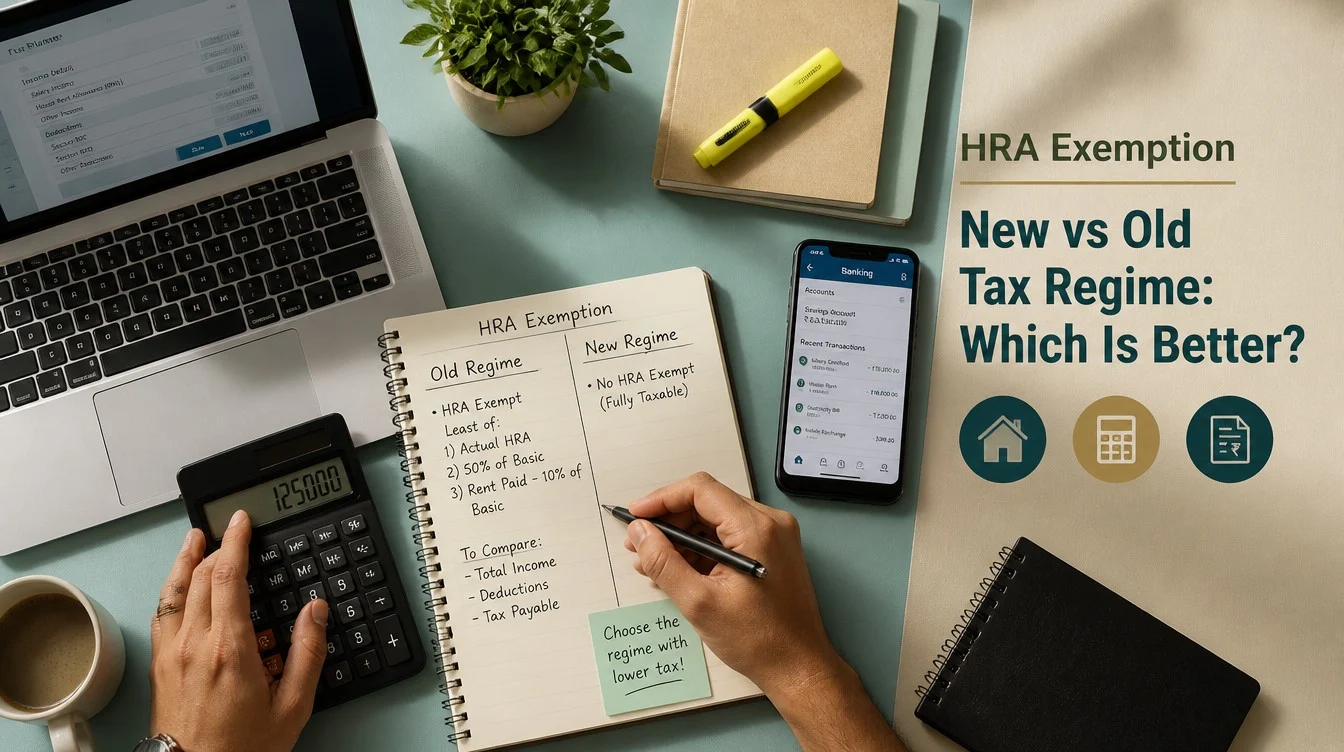
House Rent Allowance is a salary component that employers pay to help employees meet housing costs. The amount of HRA exempt from income tax is the minimum of three conditions:
- Actual HRA received from employer.
- 50% of (basic salary + DA) for metro cities (Delhi, Mumbai, Chennai, Kolkata), or 40% for non-metro cities.
- Actual rent paid minus 10% of (basic salary + DA).
The lowest of these three amounts is exempt from tax. The remaining HRA (if any) is taxable as part of salary.
Example calculation for a Mumbai employee:
- Basic salary: Rs 8,00,000 per year
- HRA from employer: Rs 4,00,000 per year
- Actual rent paid: Rs 3,60,000 per year (Rs 30,000/month)
Condition 1: Rs 4,00,000 (actual HRA). Condition 2: 50% of Rs 8,00,000 = Rs 4,00,000. Condition 3: Rs 3,60,000 minus 10% of Rs 8,00,000 = Rs 3,60,000 – Rs 80,000 = Rs 2,80,000. Minimum = Rs 2,80,000. HRA exemption = Rs 2,80,000. Taxable HRA = Rs 4,00,000 – Rs 2,80,000 = Rs 1,20,000.
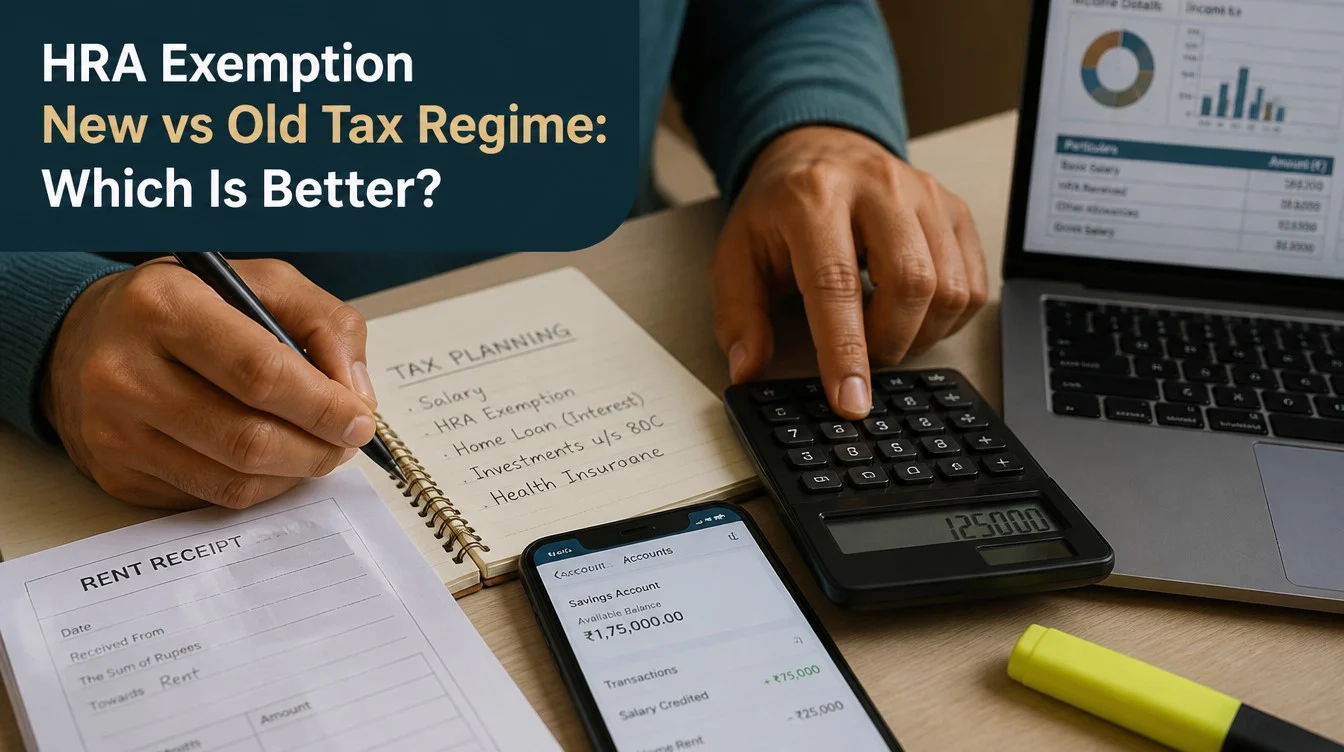
HRA Exemption Under Old Tax Regime vs New Tax Regime
| Feature | Old Tax Regime | New Tax Regime |
|---|---|---|
| HRA Exemption | Available (as calculated above) | Not available |
| Taxable HRA | Only excess over exempt amount | Full HRA is taxable |
| Documentation required | Rent receipts, landlord PAN (if rent > Rs 1 lakh/year) | None needed (no exemption to claim) |
| Benefit for metro-city renters | Significant (50% of basic available as exemption) | None |
For employees paying significant rent in metro cities, the HRA exemption can be substantial – Rs 2-4 lakh per year for mid-to-high income earners. This single deduction often swings the regime comparison decisively in favor of the old regime for urban renters. The full regime comparison shows that combining HRA with 80C and 80D deductions under the old regime creates a large advantage for taxpayers with all three.
When Does HRA Make Old Regime Better?
A quick decision rule: if your HRA exemption exceeds Rs 1.5-2 lakh annually, the old regime is likely better for you even without other deductions. Here is why:
At Rs 15 lakh income, the new regime saves approximately Rs 50,000 versus old regime without deductions (due to lower slabs). To overcome this Rs 50,000 new regime advantage, your HRA exemption in the old regime needs to be at least Rs 2 lakh (saving you Rs 60,000 at 30% bracket) to create a net saving. Add 80C (Rs 45,000 saving at 30%) and you are firmly in old regime territory.
For employees earning Rs 15-30 lakh in metro cities, paying Rs 25,000-40,000 rent per month, the HRA exemption alone is typically Rs 1.5-3 lakh per year. Combined with 80C, old regime wins clearly for this profile.

HRA Exemption Claim Process
To claim HRA exemption under the old tax regime:
- Submit rent receipts to employer: Provide monthly rent receipts to your company’s HR/payroll before February-March deadline. Receipts should show date, amount, landlord name, address, and landlord signature.
- Landlord PAN required if rent exceeds Rs 1 lakh per year: If annual rent payments exceed Rs 1 lakh (Rs 8,333/month), your employer will ask for the landlord’s PAN number. Without PAN, they cannot give you the full exemption at source.
- Self-claim in ITR if missed at employer: If you forgot to submit rent receipts to your employer, you can claim the HRA exemption directly in your ITR under the old tax regime. Keep receipts as proof in case of scrutiny.
- Rent agreement as supporting document: Keep your registered or unregistered rent agreement. In case of IT scrutiny, you may need to show the rental arrangement is genuine.
Note: You cannot claim HRA exemption if you own a house in the same city and are paying rent for another house. HRA is only for genuine renters. Claiming HRA for rent paid to immediate family members (parents, spouse) is allowed but creates risk of scrutiny if the arrangement is not genuine – payment must be actually made to the family member, and they must declare it as rental income in their own ITR. For the broader tax compliance picture, ensure all income sources including rent received by family members are properly declared.
What About Those Who Own a Home and Still Pay Rent?
Some employees own a house in another city but pay rent in their current work city. In this case, they can claim both HRA exemption (for rent paid in work city) and home loan interest deduction under Section 24(b) (for the owned property). This is a legal and common arrangement – you are genuinely renting in the work city because your owned property is in a different location. Document the situation clearly if asked.
Frequently Asked Questions
Can I claim HRA if I pay rent to my parents?
Yes, subject to conditions. Rent paid to parents is deductible as HRA exemption if: you actually transfer the money to them (bank transfer preferred over cash), your parents own the property (it should be in their name, not yours), and your parents declare this rental income in their own ITR. The arrangement must be genuine – not a paper transaction to create a tax benefit. If rent is above Rs 1 lakh annually, provide parents’ PAN to your employer. Many taxpayers use this arrangement legitimately, especially when living in a parental home and contributing to household expenses.
What if my employer does not give me HRA as a salary component?
If your salary structure does not include an HRA component (some companies pay consolidated salaries), you cannot claim the standard HRA exemption. However, under the old tax regime, you may be eligible to claim deduction under Section 80GG for rent paid. Section 80GG is the deduction for those who neither receive HRA nor own a house in the city of employment. The Section 80GG deduction limit is lower than typical HRA exemption amounts (Rs 5,000 per month maximum) and requires additional conditions.
Is the HRA exemption calculation different for joint rent payment?
If two salaried individuals are co-tenants paying rent jointly (common for working couples), each can claim HRA exemption on their proportional share of rent paid. Each person’s HRA exemption is calculated based on their individual salary and their individual rent payment. Keep documentation showing who paid what portion of the rent, and ensure the rent receipts reflect the split.
Does HRA exemption change if rent changes mid-year?
HRA exemption can be calculated separately for each period with different rent amounts. If your rent changed in October (say from Rs 20,000 to Rs 25,000 per month), calculate exemption for April-September at Rs 20,000/month and October-March at Rs 25,000/month. The annual exemption is the sum of both periods’ calculations. Your employer should recompute the exemption when you notify them of rent changes.
What documents do I need for HRA exemption?
Required documents: rent receipts (monthly, with stamp if amount exceeds Rs 5,000), rent agreement (registered preferred but not mandatory for claim), landlord’s PAN (if annual rent exceeds Rs 1 lakh), and proof of payment (bank transfer records preferred). If you lose rent receipts, self-signed receipts are generally acceptable but create documentation risk in scrutiny. For rent to parents, bank transfer records showing the transfer are essential.
Related Articles
- New Tax Regime vs Old Tax Regime 2026
- NPS Vatsalya Scheme: Complete Guide
- Crypto Tax India: Section 115BBH Guide