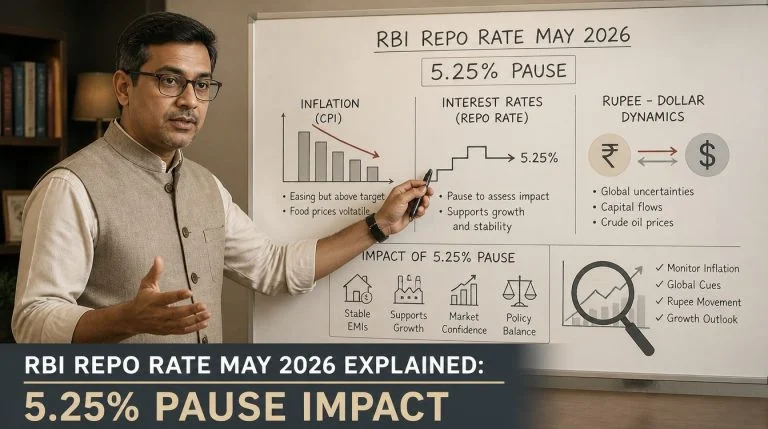

The Reserve Bank of India’s Monetary Policy Committee meets next from June 3 to June 5, 2026, and Indian borrowers are watching this rbi mpc june 2026 meeting more closely than usual. The MPC has already paused at 5.25% in April after a 125 basis point easing cycle, so the June print is a referendum on whether the cycle is truly finished or whether one more cut is still in the pipeline.
This preview lays out the three realistic scenarios for the June outcome, walks through what a typical home loan borrower, FD saver, and equity investor should do under each, and offers a sober reading of what the rate-cut probability looks like a fortnight out. The goal is to be ready, not to predict.
Borrowers tend to read MPC meetings emotionally. Either the cut comes and the relief is short-lived, or the cut does not come and frustration follows. The smarter posture is to set up your financial life so the outcome of any single MPC meeting changes the dials only slightly. A pause and a 25 basis point cut should both leave you fine.
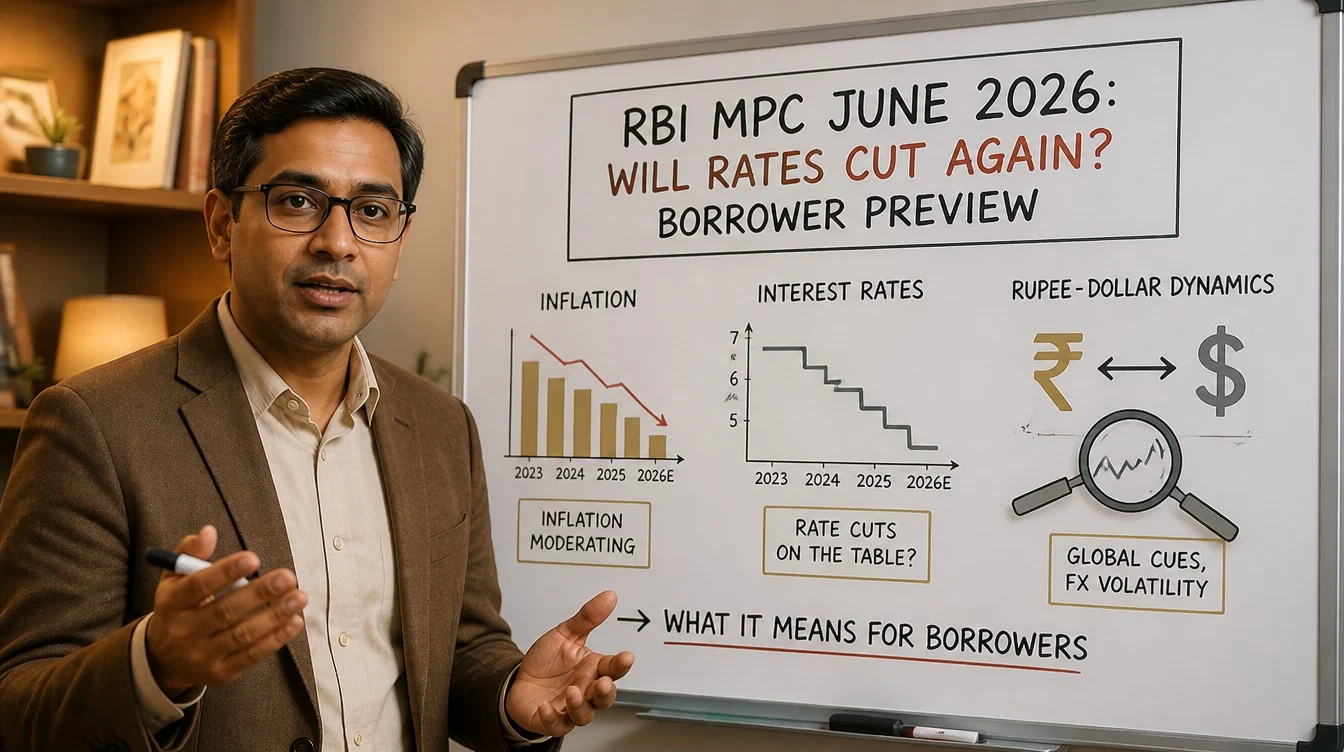
Where the RBI MPC June 2026 Meeting Starts From
The April 2026 MPC delivered a unanimous decision to hold the repo at 5.25%. SDF stayed at 5.00%, MSF and Bank Rate at 5.50%, and the stance was kept neutral. FY 2026-27 real GDP was projected at 6.9% and CPI at 4.6%.
That snapshot frames the June discussion. The committee will walk into the room with two months of additional CPI prints, fresh trade and current account data, a clearer monsoon picture, an updated read on the rupee, and the latest signals from the US Federal Reserve and global oil markets.
Why this MPC matters more than usual
This will be the first MPC after a deliberate pause. The committee will use this meeting to clarify whether the pause is a single-meeting pause within a still-active cycle, or whether the cycle has effectively ended for now. Either signal is consequential for bond yields, the rupee, and bank lending behaviour.
The base rate environment heading in
The 10-year G-Sec yield has been hovering broadly around the 7% area in early FY 2026-27. Bank one-year MCLRs sit in the high-8% range at large lenders, EBLR-linked home loans typically run in the 8% to 9% area depending on customer profile, and large bank FD rates for one to three year buckets cluster in the mid-6% range. The pause has stabilised this picture; a cut would move it.
Scenario 1: A 25 bps Cut to 5.00%
If the MPC delivers a 25 basis point cut in June, the repo would land at 5.00%, taking the cumulative easing cycle to 150 basis points. The stance would likely remain neutral, since the committee has been disciplined about not pre-committing.
What would trigger this scenario
A softer-than-expected CPI print in April and May, comfortable food inflation, a benign monsoon outlook, and a stable-to-stronger rupee would all support a cut. If the US Federal Reserve has eased meaningfully by then and global oil has cooled, the MPC gets more room.
Immediate impact for borrowers
EBLR-linked home loans would reset within roughly 90 days. For a Rs.50,00,000 (50 lakh) loan with about 18 years left, a 25 basis point cut translates to a meaningful EMI reduction (typically in the range of Rs.700 to Rs.900 per month, depending on the exact tenure and spread). The default reset is tenure shortening; borrowers who want the cash relief should request the EMI cut explicitly.
Immediate impact for savers
Bank FD rates would face fresh downward pressure within weeks. A saver with cash to deploy should not wait. Lock medium-tenor FDs (12 to 24 months) before banks revise their slab cards. Senior citizens should review the 5-year tax-saving FD against PMVVY-equivalents and SCSS.
Immediate impact for investors
Equity markets would likely react positively in the short term, particularly rate-sensitive sectors. Bond funds with longer duration would see a price tick higher as yields move lower. Investors with a fixed asset allocation should rebalance rather than chase the move.
Scenario 2: Hold at 5.25%
This is the scenario many analysts are leaning toward as the base case. The MPC holds at 5.25%, keeps the neutral stance, and emphasises data dependence and ongoing transmission of prior cuts.
What would trigger this scenario
A CPI print that confirms the projected Q3 lift toward 5%-plus, oil at uncomfortable levels, sticky food inflation, a sliding rupee, or fresh global risk-off could each on their own be enough to keep the MPC on the sidelines. So could continued strong GDP momentum that takes the urgency off the easing pedal.
Borrower playbook under a hold
No new EMI relief comes from a hold. Borrowers should focus on getting the full benefit of the cuts already delivered. Pull the latest provisional interest certificate, confirm the rate, confirm whether it is EBLR or MCLR, and consider switching if you are still on the older benchmark.
Saver playbook under a hold
FDs broadly hold their current shape. There is no immediate rush to lock long tenors. Maintain the ladder. Top up PPF early in the financial year. Refresh small savings allocation if SCSS or NSC rates were notified favourably in the most recent quarterly review.
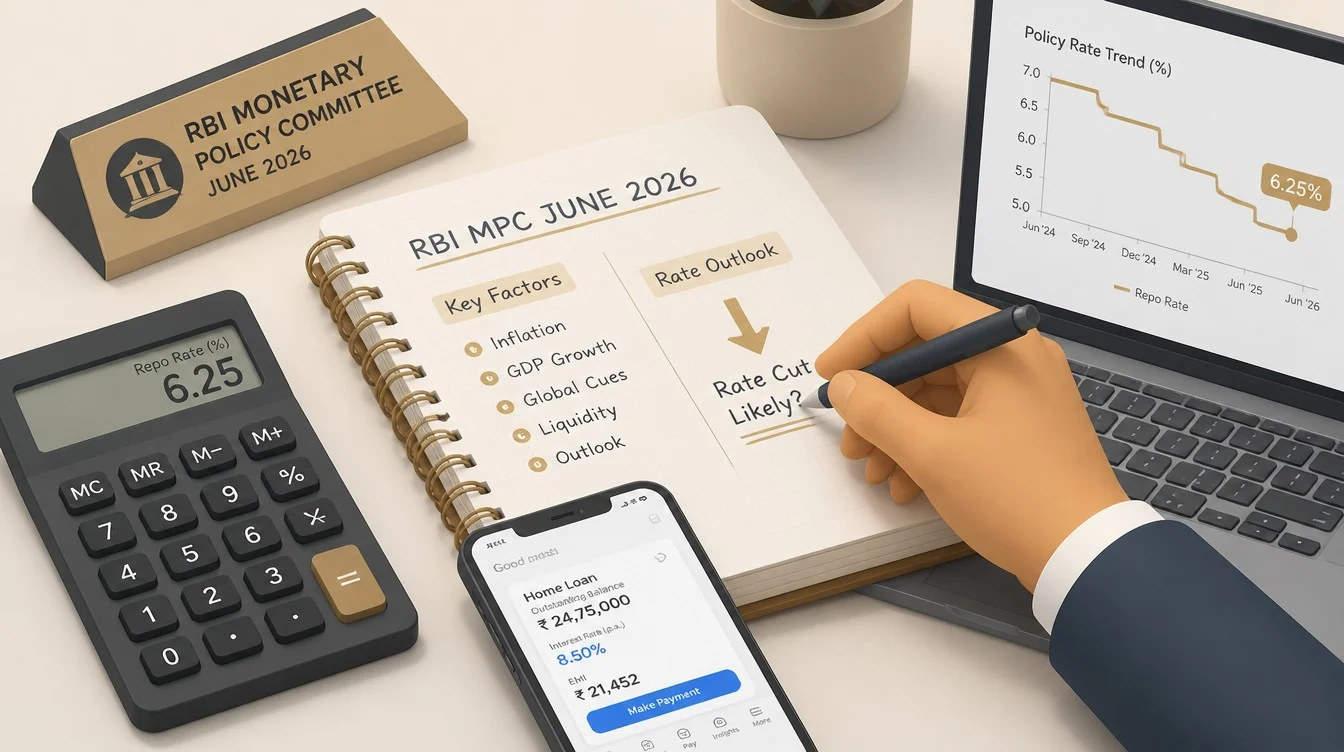
Investor playbook under a hold
Equity SIPs continue. Debt fund duration call stays conservative. The pause is a green light to focus on accrual rather than capital gains in the debt sleeve.
Scenario 3: A Surprise (Larger Cut, Hike, or Stance Shift)
A surprise is unlikely but cannot be ruled out. There are three broad surprise paths.
A 50 bps cut
This would be a surprise because the MPC has been moving in 25 bps increments through this cycle. A 50 bps cut would require a sharp downside surprise on CPI and a clear signal that growth is wobbling. Markets would likely react with a sharp bond rally and a relief equity move.
A rate hike
A hike from here looks very unlikely in the short term but is technically possible if inflation surprises sharply on the upside, the rupee falls dramatically beyond Rs.86, or geopolitical events spike oil and energy. The MPC’s neutral stance keeps this door cracked open even if it is currently unlikely.
Stance change without rate move
The committee could leave the rate at 5.25% but change the stance from neutral to accommodative or to withdrawal of accommodation. A shift to accommodative would be read as setting up a cut in August. A shift toward withdrawal would be read as the cycle being effectively complete. Either is a more durable signal than a single rate move.
How to Read Rate-Cut Probability Without Guessing
Forward-looking statements should be expressed as probabilities, not certainties. Indian retail investors can read the same signals analysts read.
Overnight Indexed Swap (OIS) rates
Tracking the 1-year and 3-month OIS rate over the weeks before the MPC gives a market-implied view of where the policy rate is expected to settle. A sustained decline in OIS rates ahead of the meeting signals the market is pricing in a cut.
10-year G-Sec yield trajectory
If the 10-year G-Sec yield drops sharply in the week before the MPC, markets are positioning for either a cut or a dovish stance change. If yields drift higher, markets are pricing in a hawkish hold.
Forward inflation prints
CPI prints in the run-up to the MPC are the single biggest input. A print below the projected band (or below 4%) makes the case for a cut. A print near or above 5% makes a cut harder to justify.
The rupee against the dollar
A rupee under heavy depreciation pressure constrains how dovish the MPC can be without further pressuring the currency. A stable rupee gives the committee more room.
Fixed Deposit Timing if a Cut Comes
If the MPC delivers a 25 bps cut on June 5, banks typically revise FD rates within one to two weeks for new deposits. Existing FDs are unaffected because they are locked at contracted rates. The timing question is for savers who have cash sitting in a savings account or sweep-in waiting to be deployed.
Pre-cut: deploy now
If a saver has a moderate probability view that the MPC will cut, the safer move is to ladder FDs now across multiple tenors. Putting it off another month risks losing 25 basis points on a fresh deposit. Senior citizens with the 50 bps premium should be especially attentive to this timing.
Post-cut: lock the next tranche fast
If the cut does come, the window to lock the higher pre-cut FD rate at most banks lasts only days. The most efficient route is to have a pre-filled FD instruction with the bank that can be triggered within hours of seeing the MPC decision.
Tax-saving 5-year FD: handle separately
The 5-year tax-saving FD under 80C operates on a longer horizon. Pure rate timing matters less here because the lock-in is the binding constraint. Pick the lender that offers the best combination of rate, branch convenience, and digital service for the five-year window.
Home Loan Borrowers: What to Do Before the June MPC
Borrowers have ten to twelve days before the June 2026 MPC. A short checklist can lock in the value of the prior cuts and prepare for the next move.
Step 1: Refresh the rate sheet from your bank
Log into the home loan account, download the latest provisional interest certificate, and verify the current effective rate. Compare against the bank’s published EBLR plus spread for the customer category.
Step 2: Decide tenure versus EMI on prior cuts
If prior cuts were absorbed via tenure reduction by default but you want the cash flow relief, request the bank to convert the benefit to EMI reduction. Get it in writing.
Step 3: Build a prepayment plan
If a 25 bps cut comes in June, use the windfall to make a prepayment of equivalent quantum once a quarter rather than letting EMI alone drop. This compresses the loan tenure and total interest faster than living off the lower EMI.
Three-Step Action Checklist for Each Type of Reader
| Reader Type | Pre-MPC (Now) | Day of MPC | Two Weeks Later |
|---|---|---|---|
| Home loan borrower | Confirm EBLR vs MCLR, refresh rate certificate | Note new rate if any change is signalled | Plan prepayment with savings from rate move |
| FD saver | Ladder FDs now across 12, 18, 24, 36 months | Watch bank rate notifications | Lock fresh FDs within the rate window |
| Equity SIP investor | Continue SIPs, do not pause | Avoid impulsive lump sum on MPC reaction | Rebalance if allocation drifts |
| Bond fund investor | Confirm duration matches goal horizon | Note yield curve reaction | Avoid chasing post-MPC bond rallies |
| NRI / FCNR holder | Verify FCNR/NRE FD rate window | Monitor rupee response | Adjust remittance timing if needed |
What Could Surprise Markets in the June 2026 Statement
Beyond the rate decision itself, the MPC statement carries several signals that markets parse carefully.
Projection revisions
If the committee revises CPI projection higher or GDP projection lower meaningfully, the bond market will react even if the rate is unchanged. Watch the FY27 GDP and CPI bands.
Vote split
A 6-0 vote signals strong consensus. A 5-1 or 4-2 vote signals brewing dissent. If even one external member dissents in favour of a cut, the market will read it as a leading indicator for August.
Liquidity language
RBI’s stance on systemic liquidity, including any signal on CRR adjustments or open market operations, sometimes matters more than the headline rate. A shift to more accommodative liquidity language can ease lending rates even without a repo move.
Regulatory announcements
MPC days often double as days for prudential announcements. Watch for any signals on bank lending norms, deposit insurance changes, or retail product rules tucked into the press conference.
Common Mistakes Around an MPC Meeting
Stopping SIPs to wait for the decision
Pausing equity SIPs to wait for an MPC outcome converts a disciplined plan into a market-timing experiment. Decades of Indian retail data show that consistent SIPs through cycles outperform attempts to time them.
Locking five-year FDs out of fear
A saver who locks the entire surplus in a 5-year FD on the assumption that rates will fall further may regret it if rates instead drift higher post-pause. Ladder, do not lump.
Switching banks the day after the MPC
The day after an MPC is a noisy moment. Banks usually adjust deposit and lending rates over the following two to three weeks. Wait for the dust to settle before making a switch decision.
Reading a single CPI print as a verdict
A single CPI print does not make a cycle. The MPC explicitly looks at multi-month trends and projections, not single data points. Retail investors should do the same.
How Salaried Indians Should Position Their Cash Buffer
The cash buffer (three to six months of essential expenses) sits in liquid funds, sweep-in FDs, or savings accounts. The MPC outcome changes the marginal yield on these but not the size.
Sweep-in FDs: still the simplest tool
A sweep-in FD is a savings account that quietly earns FD rates on idle balance above a threshold. Even a 25 bps cut leaves sweep-in rates competitive with most pure savings accounts.
Liquid funds: read the yield-to-maturity
Liquid fund yields drift roughly in line with overnight money market rates. A repo cut typically compresses liquid fund yields by a similar magnitude. The function of a liquid fund is cash management, not yield optimisation.
Ultra-short and money market funds
For investors who want a little more than overnight yield without taking duration risk, ultra-short and money market funds are a reasonable middle ground. Read the portfolio for credit quality; a lower yield with sovereign and AAA paper is preferable to a higher yield with weaker credit.
FAQs on the RBI MPC June 2026
When is the RBI MPC June 2026 meeting scheduled?
The RBI Monetary Policy Committee is scheduled to meet from June 3 to June 5, 2026, with the decision released on June 5. This is the second MPC meeting of FY 2026-27 following the April 6-8 meeting that paused the repo at 5.25%.
What is the current rate-cut probability for June 2026?
The market-implied probability shifts daily based on CPI prints, the rupee path, oil prices, and Federal Reserve signals. The three realistic outcomes are a 25 basis point cut to 5.00%, a hold at 5.25%, or a stance change without a rate move. None is guaranteed and the MPC has emphasised data dependence.
Should I lock a fixed deposit before the June MPC?
If a cut is plausible and you have cash ready to deploy, locking a 12-24 month FD before the MPC preserves the current rate. If the MPC instead holds, you have not lost anything material. Laddering across tenors is more resilient than a single lump-sum lock.
How fast will my home loan EMI change if RBI cuts?
EBLR-linked home loans must reset within roughly 90 days of an RBI policy move. Most banks reset within a single billing cycle. Confirm with your bank whether tenure or EMI was changed and request a written confirmation.
What if the MPC surprises with a hike or larger cut?
A hike from 5.25% looks very unlikely in the near term. A 50 bps cut would require sharp downside surprises on inflation and growth. Either tail outcome would move bond yields, the rupee, and equity sectors meaningfully. The right posture is a portfolio that does not depend on a specific MPC outcome.
Related deep-dives on EBLR mechanics, FD laddering, MPC statement reading, and bond fund duration are forthcoming on LearnFineEdge.