

Indian term-insurance buyers comparing quotes in early 2026 are seeing a different price list than they saw twelve months ago. Headline premium rates from most large life insurers have moved up by roughly 15 to 20 percent on standard non-smoker covers, with steeper jumps on senior-age bands and self-employed underwriting categories. The brokers selling the product blame “reinsurance rates”; the insurers blame “mortality experience”; the regulator blames “long-deferred actuarial discipline”. All three are partly right.
This guide unpacks the term insurance premium hike india 2026 in the language a retail buyer actually needs. It walks through the underlying mortality-table revision and the IRDAI risk-based capital regime, sketches an insurer-wise rate-direction snapshot, and answers the question every existing buyer is asking: should I lock in now, wait for things to settle, or hunt for an insurer that has not hiked yet?
The honest short answer is that the structural drivers of the hike are unlikely to reverse in the next eighteen months, so timing the purchase is less productive than focusing on cover adequacy and insurer selection. The rest of the article makes that case with the numbers behind it.

What Drove The Term Insurance Premium Hike In 2026
Three forces moved together to push term-insurance premiums up in early 2026. None of them is new individually, but the combination produced the largest single-year repricing the Indian term-insurance market has seen since 2014. Understanding each driver helps buyers separate the structural shift from short-term noise.
The mortality-table revision
Indian life insurers historically used legacy mortality tables that under-represented the lifestyle-disease load of urban Indians in their forties and fifties. The shift to updated mortality assumptions, drawing on more recent industry-pooled experience, raised the underlying cost of pure-term cover for the bands that contribute most of the new-business volume. The biggest impact has landed on age 35 to 50 male applicants in metros.
IRDAI risk-based capital regime
The IRDAI’s move to risk-based capital norms and Ind AS 117 reporting, effective from April 2026, has tightened the capital that insurers must hold against long-duration term liabilities. Persistently under-priced term books are no longer sustainable for insurers running thin solvency buffers, which has compressed the discount-to-pure-cost margin that insurers were willing to absorb during the 2018-2023 price war.
Reinsurance treaty repricing
Indian primary insurers cede a meaningful share of large-ticket term covers to global reinsurers under treaty arrangements that reset annually or biennially. Global reinsurer pricing tightened through 2024 and 2025, partly reflecting elevated post-pandemic mortality experience in several markets and partly reflecting cost-of-capital pressure. Treaty repricing flowed into primary insurer rate cards in late 2025 and early 2026.
Why the price war ended
For most of the late 2010s, Indian term-insurance was the cheapest in the world relative to per-capita income, partly because new-entrant insurers used pure-term as a customer-acquisition product priced near or below cost. The combination of mortality-table revision, RBC pressure, and reinsurance treaty resets has effectively ended that under-pricing era. The new rate card is closer to “actuarially sustainable” than to “competitively aggressive”.
Insurer-Wise Direction Snapshot
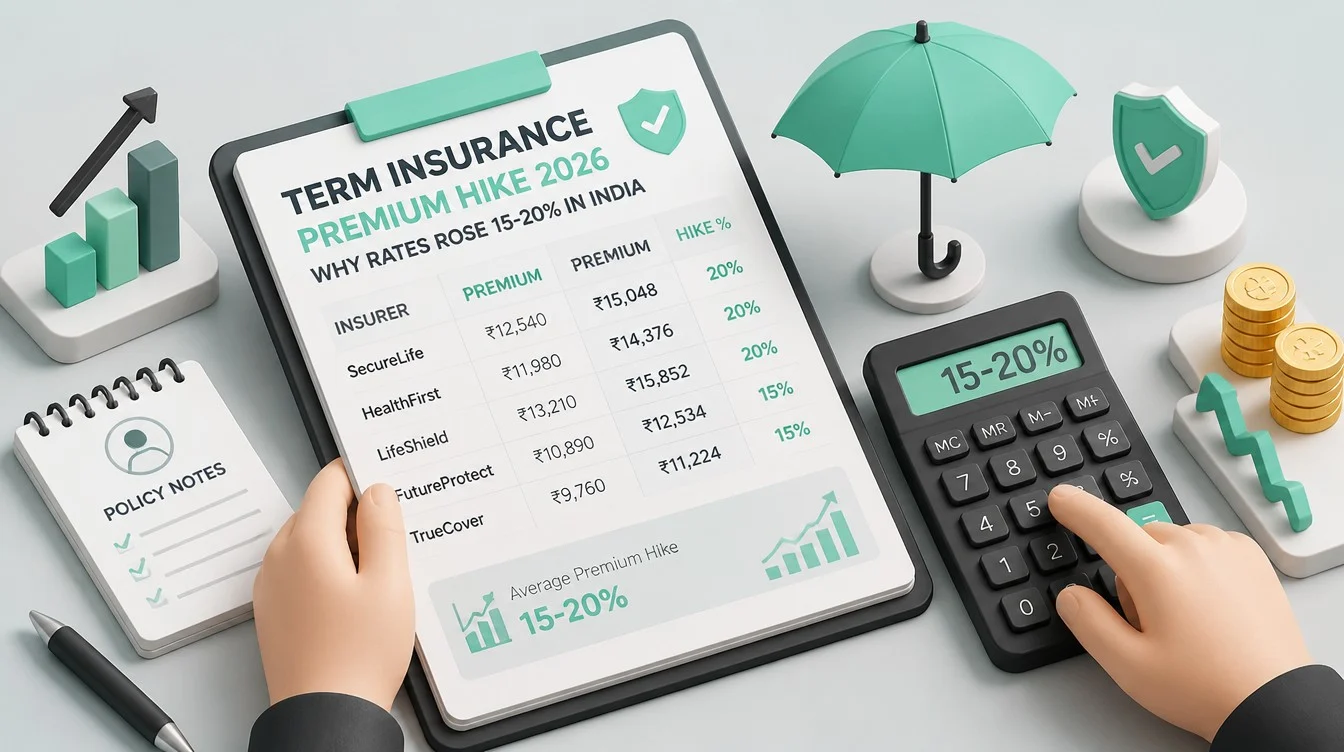
The premium hikes have not been uniform across insurers. Each insurer’s repricing decision reflects its own mortality experience, reinsurance arrangement, and competitive positioning. The table below summarises the directional pattern across major Indian life insurers as observed in Q1 2026 publicly available rate cards and broker disclosures. Numbers are approximate ranges and apply to standard non-smoker pure-term applicants in the 30 to 45 age band.
| Insurer Category | Approximate Hike Range | Notes |
|---|---|---|
| Large private life insurers | ~12 to 22 percent | Driven by mortality-table revision and RBC pressure. |
| Mid-size private life insurers | ~8 to 15 percent | Some had already repriced through 2024; smaller catch-up. |
| Public-sector life insurer | ~5 to 12 percent | Lower base hike, but stricter underwriting on senior bands. |
| Niche digital-first insurers | ~15 to 25 percent | Higher reliance on reinsurance treaty pricing. |
| Senior-citizen bands (age 50+) | ~20 to 30 percent | Largest impact across the board. |
| Self-employed applicants | ~10 to 18 percent above standard | Stricter income-proof and medical underwriting. |
How to read this table
The ranges are approximate and meant to give a sense of magnitude, not exact per-insurer numbers. Specific insurer pricing changes weekly as broker portals update rate cards, and the precise quote for any individual buyer depends on age, sum assured, smoker status, medical declarations, and rider selection. Use the table as a calibration for whether the quote you are seeing is in line with the broader market, not as a substitute for actual broker comparisons.
Where the gap between insurers has widened
The premium gap between the cheapest and the most expensive credible insurer for the same applicant profile has widened from roughly 15 to 20 percent in early 2024 to closer to 30 to 35 percent in early 2026. This means the value of comparison shopping has grown, even within the cohort of insurers with strong claim-settlement track records. The convenience of buying through the first portal that returned a quote has become more expensive.
The “smoker” surcharge cliff
The smoker-to-non-smoker premium gap has widened sharply in the 2026 reset, with smoker-loaded rates running 60 to 100 percent above non-smoker rates on most insurers, up from roughly 50 to 70 percent earlier. For applicants who genuinely quit, the cost of completing 12 to 24 months of declared non-smoker status before applying has become meaningfully more valuable.
The Lock-In Versus Wait Decision
The most common question existing-policy-shopping buyers ask in 2026 is whether to buy now at the elevated rate or to wait for a softer cycle. The question has a defensible answer once the variables are laid out.
Why waiting usually costs more
Term-insurance premium is locked at the time of policy issuance and stays flat for the full policy term, even if the insurer’s rate card rises further. A buyer who locks in at age 32 for a 30-year policy carries the age-32 premium structure to age 62. Waiting one year delays the policy by one year and reprices the entire policy at the older-age band, which is structurally more expensive even before any further rate-card hike.
The age-band math
Pure-term premium typically rises 6 to 10 percent for each year of age in the 30 to 45 band, and 10 to 14 percent per year in the 45 to 55 band. Waiting one year therefore costs at minimum the age-band increment, plus any further rate-card hike during that waiting period. Even in the unlikely scenario where rate cards reverse 5 to 10 percent in the next 18 months, the age-band increment makes waiting net-negative for most buyers.
Where waiting can make sense
For an applicant currently undergoing a transient health condition (active infection, pending surgery, pregnancy) whose underwriting would be loaded heavily during the condition, waiting until the condition resolves can produce a better long-term price than locking in a loaded policy. This is a medical-underwriting tactical wait, not a market-timing wait, and the calculation runs through the doctor and broker rather than through rate-card watching.
The “two policies, one now and one later” strategy
For buyers whose cover need is large (Rs.2,00,00,000+ or Rs.2 crore-plus), one defensible strategy is to lock in a base policy now at current rates and add an incremental policy in a year or two if rate cards soften or if income jumps justify additional cover. This preserves option value while still capturing the current age band for the core cover.
Should Existing Policyholders Worry?
The clearest comfort for existing term-insurance policyholders is that the premium locked at issuance is contractually fixed for the policy term. Rate-card hikes affect new applicants only; existing policies continue at their issued premium regardless of how high new-business rates rise.
The “switch to a cheaper insurer” temptation
Some buyers, on learning that another insurer’s old rate card is still cheaper than their current insurer’s new rate card, consider switching. Term-insurance “switching” effectively means buying a fresh policy at the current age and surrendering the old one. This recalculates the age-band premium, restarts the contestability period, and may trigger fresh medicals; for buyers above age 35 it is almost always a worse decision than holding the existing policy.
Reviewing cover adequacy
Existing policyholders should focus less on rate cards and more on whether their existing cover is still adequate. The 2026 hike will not impact their existing premium, but inflation, new dependents, and new liabilities can erode the real value of an old cover. A separate top-up term policy bought today at current rates is often the right answer; surrendering the old policy almost never is.
The contestability and free-look interactions
Most term-insurance policies have a two-year contestability period during which the insurer can reopen the application on grounds of material non-disclosure. Existing policies that have crossed the contestability window carry implicit value that should not be casually surrendered. A new policy starts a fresh contestability clock and resets that protection.

How To Save Premium Within The 2026 Rate Card
The new rate card is structurally higher, but several levers can still meaningfully reduce the premium paid by a specific applicant. None of these is a market-timing trick; each is an underwriting or product-feature choice.
- Annual versus monthly payment frequency: Annual payments typically save 4 to 6 percent versus monthly modal premium because insurers charge a frequency loading on shorter payment cycles.
- Declared non-smoker status with at least 12 months of cessation: Worth 30 to 50 percent of premium for a comfortably truthful applicant.
- Reasonable BMI: Most insurers load premium for BMI above 30 to 32. Bringing BMI into the standard band before application matters more in 2026 than it did at lower rate cards.
- Clean blood-sugar and lipid profile: Border-line elevated values can attract a loading. Completing a pre-application physician consult and addressing border-line numbers can pay back several times the cost.
- Choosing the correct policy term: Buying a term that ends at age 60 to 65 (rather than age 75 or 80) reduces premium meaningfully. Extending term beyond age 65 is rarely a high-value buy because most households are no longer financially dependent on the earner by then.
- Splitting the cover across two insurers: Above Rs.2,50,00,000 (2.5 crore) sum assured, splitting across two insurers can sometimes secure better blended rates by keeping each policy below the strict-medical and reinsurance-treaty thresholds.
The rider trade-off
Each rider adds premium. Accidental death benefit is cheap and usually defensible. Critical illness rider is more expensive and worth evaluating against a standalone critical-illness policy from a health insurer. Waiver-of-premium on disability is useful for self-employed applicants. Adding every available rider for completeness is rarely the right answer; pick riders that match identifiable risks.
The “return of premium” detour
Return-of-premium variants of term insurance have re-emerged in marketing materials around the 2026 hike, pitched as “your premiums come back if you survive the term”. The premium delta funds a low-yield endowment-style corpus that is typically beaten by even a basic debt mutual fund over the policy term. Pure term remains more cost-efficient for protection in almost every scenario.
What Buyers Often Get Wrong During A Rate-Card Reset
Premium hikes tend to surface the same buyer-side mistakes that quieter pricing periods hide. The list below covers the recurring errors in the 2026 hike cycle.
- Downsizing the cover to keep the premium “the same”. Cutting a Rs.2,00,00,000 (2 crore) cover to Rs.1,50,00,000 to stay within an old premium budget exchanges adequacy for affordability and usually leaves the household under-insured.
- Switching to a low-CSR insurer for a cheaper quote. The premium saving on a low-CSR insurer is small relative to the claim-experience risk the family takes on at the moment that matters.
- Buying single-pay instead of regular-pay. Single-pay locks a large lumpsum into the policy that would usually earn better returns deployed in income-generating assets that themselves fund regular premium.
- Skipping the pre-application medical optimisation. A 3 to 6 month window to bring BMI, blood sugar, and blood pressure into the standard band can yield more premium saving than any insurer-shopping strategy.
- Buying through a single broker portal without cross-checking direct insurer rates. Some insurers price marginally lower on their own digital channel than via aggregator portals; the difference can be 3 to 7 percent on the same product.
The “wait for LIC’s rate” trap
LIC’s pure-term offerings often sit at a different price point than private insurers’ offerings, and a portion of the buyer market waits for LIC’s rate card to settle before deciding. LIC’s pricing reflects a different business model and reinsurance arrangement; “wait for LIC” is not a substitute for evaluating the policy on its own merits, including the product features, claim-settlement record, and rider availability.
The “I’ll wait for my next bonus” delay
Many applicants postpone the purchase by three to six months on the theory that a bonus or salary hike will make the premium easier. The age-band increment and any further rate-card movement during the wait typically erodes more than the budget-comfort gain. Buying within 30 days of the decision is almost always better than waiting for the next paycheck cycle.

A Buying Framework For The 2026 Rate Card
The framework below condenses the decision into seven steps. Most buyers can complete this within a week.
- Compute the cover need. Use income replacement plus liabilities plus goals minus existing assets. Round up to the nearest Rs.25,00,000 (25 lakh) slab.
- Shortlist insurers with CSR above 98 percent and solvency above 175 percent. Use IRDAI’s latest disclosures.
- Optimise medical readiness over a 1 to 3 month window. Address BMI, lipid, and blood-sugar border-line values before submitting the application.
- Compare quotes across at least three shortlisted insurers via both broker portals and direct insurer channels.
- Select a policy term that ends at the year your youngest dependent turns 25 or your home loan ends, whichever is later.
- Select annual payment frequency and pure-term variant. Skip return-of-premium and single-pay unless there is a specific reason.
- Complete the medical, full disclosure, and document submission within 30 days of starting the process. Drift in this window typically results in the application falling out of the system and starting over.
When to involve a broker versus go direct
For high covers above Rs.1,50,00,000 (1.5 crore) or for medical histories that may require careful drafting in the proposal form, a competent broker adds meaningful value. For clean, standard applicants buying a base cover below Rs.1 crore, direct insurer channels are often equally good and sometimes cheaper.
What “comfortably truthful” disclosure looks like
Disclose everything in the proposal form, including diagnosed conditions, medications, family history of major hereditary diseases, hospitalisations, and lifestyle choices. Non-disclosure is the single most common reason for claim rejection at the contestability stage. The premium loading from honest disclosure is almost always smaller than the family-level financial damage of a rejected claim.
Frequently Asked Questions
Why did term insurance premiums rise 15 to 20 percent in 2026?
Three forces moved together: revised mortality tables reflecting updated industry experience, the IRDAI’s shift to risk-based capital and Ind AS 117 reporting from April 2026, and global reinsurance treaty repricing. Insurers can no longer sustainably under-price long-duration term liabilities, and the 2026 rate card reflects actuarially defensible pricing rather than the competitive under-pricing of the late 2010s.
Should I lock in a term policy now or wait for rates to soften?
For most buyers, lock in now. Term premium is fixed at policy issuance for the full term, and waiting one year reprices the entire policy at the older age band, which is structurally more expensive even before any further rate-card hike. Exception: applicants with a transient health condition who would be heavily loaded during the condition can sometimes wait for the condition to resolve.
Will my existing term policy’s premium go up?
No. Term-insurance premium is contractually locked at the time of policy issuance and stays flat for the full policy term. Rate-card hikes affect new applicants only. Existing policies continue at their issued premium regardless of how high new-business rates rise.
Is LIC’s term insurance cheaper than private insurers in 2026?
LIC’s pure-term offerings sit at a different price point reflecting its own business model and reinsurance arrangement, and on some applicant profiles LIC may be cheaper. On other profiles, private insurers with stronger digital underwriting offer better rates. The right comparison is on the full bundle of premium, claim-settlement record, product features, and rider availability, not on premium alone.
Should I switch from my existing term insurer to a cheaper one?
Almost never. Switching means buying a fresh policy at the current age, which is usually more expensive than the existing premium even if the new insurer’s rate card looks cheaper on paper for a new applicant. Switching also restarts the two-year contestability period. Hold the existing policy and add a top-up cover with a different insurer if more cover is needed.
Related guides on cover sizing, insurer-claim-settlement comparisons, and rider selection are forthcoming on LearnFineEdge and will be linked here once published.