
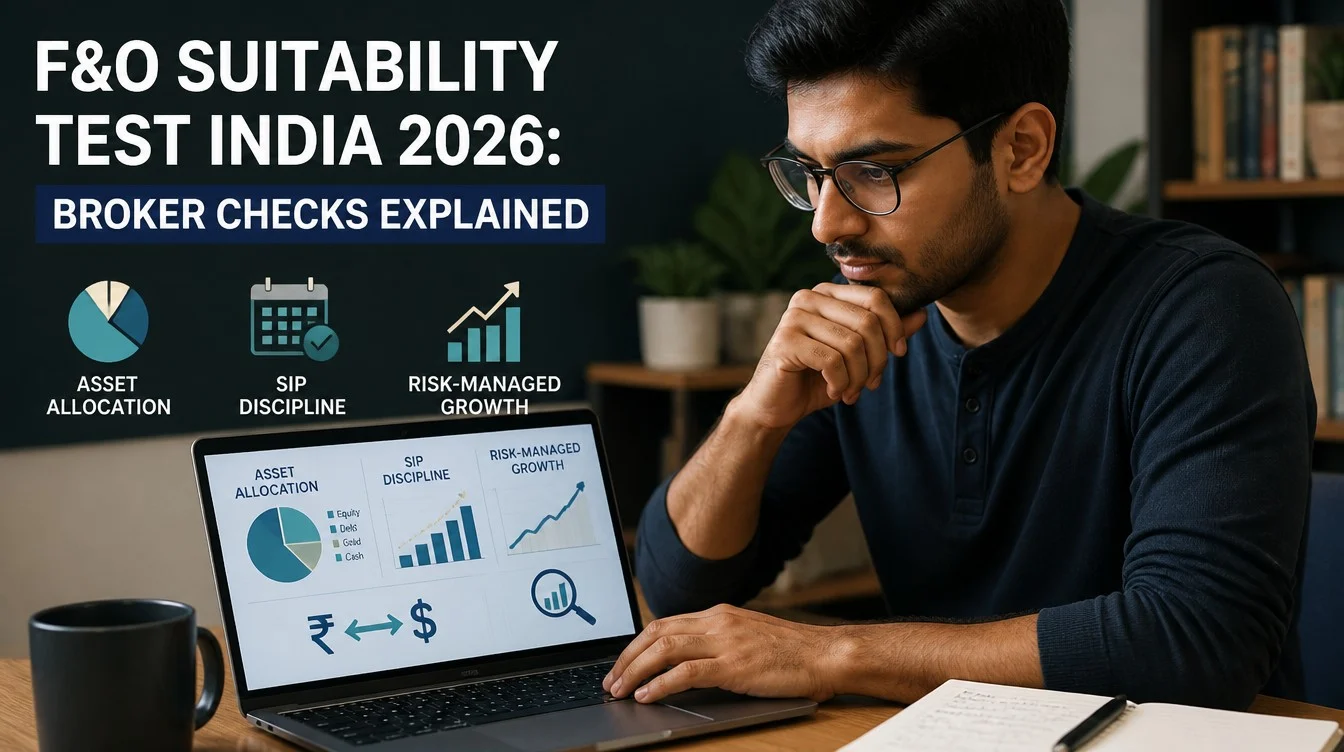
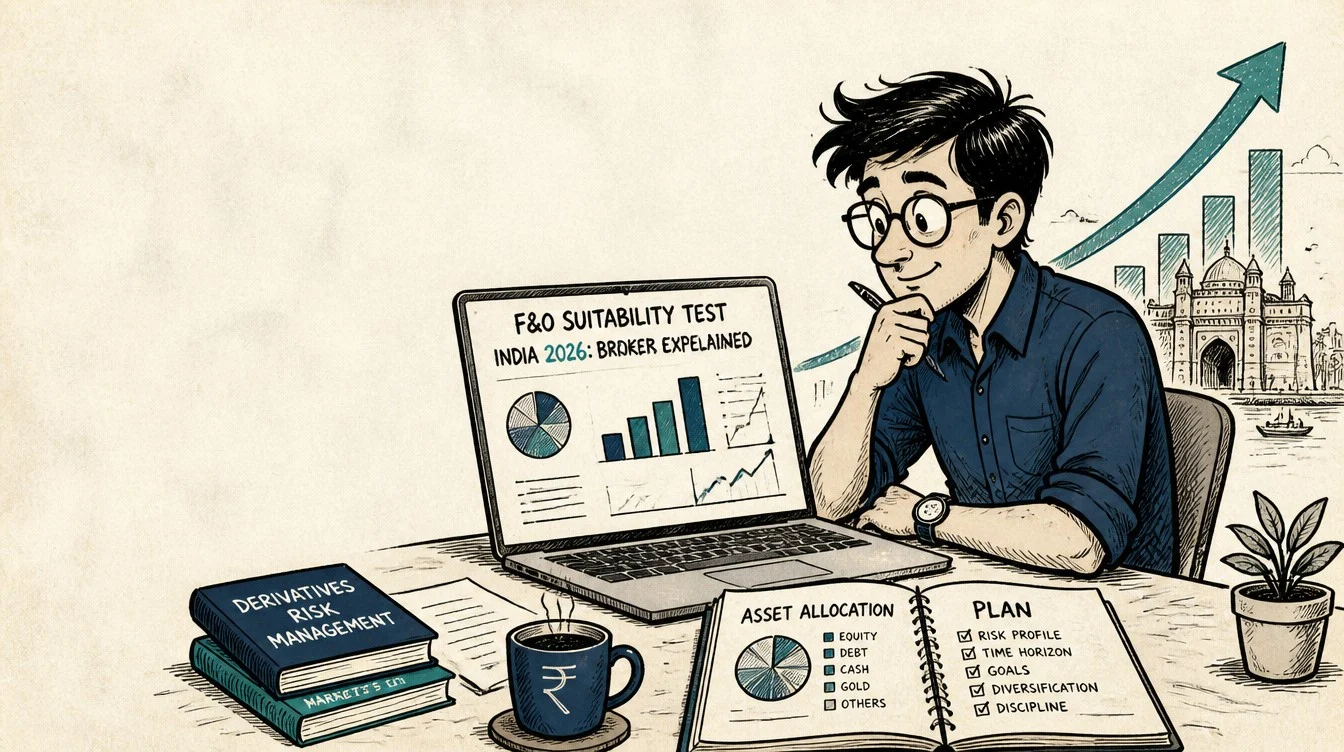
The F O suitability test in India 2026 is the door at which every retail derivatives application now stops. Under the SEBI framework that took final effect from April 2026, no broker can enable or renew F&O privileges on a retail account without running this annual suitability assessment covering income, net worth, trading history, and a basic knowledge module.
This is a structural change. F&O access used to be a one-time KYC item; now it is an annual review. A trader’s status can change from full F&O eligible to “long options only” to outright restricted, based on a few questionnaire answers and documents.
This guide walks through each criterion, what failure or a conditional pass actually does to the account, and how to prepare honestly. The standard caveat applies: F&O carries leveraged risk and is unsuitable for most retail investors, which is exactly the premise the suitability test is built on.
Why SEBI Built The F O Suitability Test
The suitability framework is the regulator’s attempt to make brokers the first line of defence against unsuitable retail F&O participation. The motivation is the same loss data that drove the rest of the 2026 package: roughly 9 in 10 retail F&O traders ended recent three-year windows in net losses, with cumulative losses crossing Rs.1.8 lakh crore.
The Working Group And The Industry Discussion
SEBI’s expert working group, which consulted brokers and industry bodies, debated whether income, net worth, education, and experience were the right parameters. The final framework settled on a combination of all four, with broker latitude to design the exact questionnaire inside SEBI’s outline.
From One-Time KYC To Annual Review
The fundamental shift is from one-time eligibility to annual recurrence. Each year, the broker reruns the assessment. A trader who passed last year but whose trading record shows persistent losses or whose declared income materially fell can be moved to a conditional or restricted status at renewal.
Broker Accountability
If a broker mechanically passes obviously unsuitable clients, the broker faces enforcement risk. This is why the suitability flow on Zerodha, Upstox, Angel One, ICICI Direct, HDFC Securities, Kotak Securities, and 5paisa is not optional dressing; it is a live compliance gate that the broker’s risk team owns.
The Four Pillars Of The Suitability Assessment
The assessment evaluates four dimensions. Each broker designs the exact form inside SEBI’s outline, so the wording varies but the substance is consistent.
Pillar 1: Declared Income
The broker asks for annual income and supporting documentation. Income tax returns, Form 16, salary slips, or business income statements are the common acceptable proofs. The income figure feeds into thresholds that gate access to more complex F&O strategies. Higher declared income broadens permissible activity; lower or unverified income tightens it.
Pillar 2: Net Worth
Net worth is the second pillar. Demat holdings, mutual fund holdings, bank deposit confirmations, and property declarations may all feed into the broker’s net worth calculation. The principle is direct: a trader’s net worth must be large enough to absorb potential losses without compromising household financial stability.
Pillar 3: Trading Experience And P&L History
The broker examines historical trading activity. Number of years active in equity markets, number of years active in derivatives, and historical realised and unrealised P&L all feed in. A persistent losing record over multiple cycles is itself a flag that the trader may not have an edge in the segment.
Pillar 4: Knowledge Module
The knowledge module is a structured questionnaire covering options basics (call versus put, intrinsic versus time value), margin mechanics (SPAN, exposure, MTM), risk concepts (maximum loss on long options, undefined loss on naked shorts), and rule awareness (lot size, cash margin, MWPL). NISM’s investor awareness materials align closely with the question pool brokers use.

What The Three Outcomes Look Like
The suitability assessment ends in one of three outcomes. Each carries practical consequences for the next 12 months of trading.
Outcome 1: Clean Pass
A clean pass means the account retains full F&O access. The trader can buy and sell options, run multi-leg strategies, take stock futures and stock options positions, and access the entire derivatives suite subject to per-account exposure limits, the 50% cash margin rule, and the 10% MWPL retail cap.
Outcome 2: Conditional Pass
A conditional pass typically restricts the account to long options only. The trader can buy calls and buy puts; the trader cannot sell options (write naked or covered options) and cannot enter multi-leg strategies that include short legs. The restriction is sometimes time-bound (re-tested in six months) and sometimes annual.
Outcome 3: Restricted Or Failed
A clear fail blocks F&O entirely until the trader either retakes the assessment after completing a SEBI-approved education module (NISM’s investor awareness tests align directly with this) or provides updated income and net-worth evidence. The cash equity segment remains untouched; the bar is specifically on derivatives.
How Brokers Implement The Test
While SEBI sets the outline, brokers design the user-facing flow. Across major retail brokers, three broad patterns have emerged.
The Inline Assessment
Some brokers run the assessment as an inline web flow inside the trading app or web portal. The trader answers 20 to 40 questions across the four pillars in a single session, uploads supporting documents, and receives the outcome within one to three business days.
The Document-Then-Quiz Flow
Other brokers ask for income and net-worth documentation first, score those, and only then present the knowledge module if the financial pillars do not already restrict the account. This sequencing is efficient because a trader whose documents already place them in a conditional band may not need to take the full knowledge module.
The Renewal Reminder
Each broker now maintains a renewal calendar at the account level. Roughly 30 days before the annual anniversary, the trader receives a renewal prompt. Failing to complete the renewal by the anniversary leads to a temporary suspension of F&O privileges until the assessment is completed.
What The Knowledge Module Tests
The knowledge module is where many otherwise eligible traders stumble. The questions are basic by professional standards but are designed to catch retail traders who have been clicking buttons without understanding the product.
Options Mechanics
Typical questions cover the difference between a call and a put, intrinsic versus time value, in-the-money versus at-the-money versus out-of-the-money, and the asymmetric payoff of long versus short positions. A trader who cannot answer these reliably is, by SEBI’s definition, not yet ready to trade options.
Margin And Settlement
SPAN margin, exposure margin, mark-to-market, premium settlement, expiry-day settlement, and the impact of the 50% cash margin rule all appear in the question pool. Some questions ask the trader to compute approximate margin requirements for a sample position.
Risk Concepts
Maximum loss on long options (the premium paid), maximum loss on short calls (theoretically unlimited), maximum loss on cash-secured puts (strike less premium received), and the difference between defined-risk and undefined-risk strategies form a core block of questions.
Rule Awareness
The 2026 rule set itself is fair game. Lot-size rules, weekly-expiry restrictions, the 50% cash margin requirement, the MWPL cap, and the algo framework can all appear. SEBI’s intent is that any retail trader still in the segment understands the framework they are operating inside.
Income And Net Worth Thresholds: What Levels Matter
SEBI did not publish a single national threshold. Each broker designs its own bands inside the SEBI outline, but a rough pattern is visible across published broker disclosures and industry commentary.
Indicative Bands
A broker might use bands such as: annual declared income below Rs.5,00,000 paired with net worth below Rs.10,00,000 leads to a conditional outcome; annual income above Rs.10,00,000 paired with net worth above Rs.25,00,000 supports a clean pass; intermediate ranges go to broker-discretion review.
The Document-Vs-Declaration Gap
Some brokers accept self-declaration up to a threshold and require documentary evidence beyond it. A trader can self-declare income up to a certain level; above that, ITR or Form 16 evidence is required. Self-declaration without backing documents typically caps F&O access at a conditional level.
Why Honest Declaration Matters
Filling false income or net-worth figures to clear the test is a contract and regulatory violation. The broker’s internal risk team cross-checks the declared figures against transaction patterns, ITR cross-uploads where available, and macro plausibility. Inconsistent figures trigger a manual review, which may revoke F&O access entirely.
The Test Side By Side
The table below summarises how the four pillars combine to determine the outcome.
| Pillar | What it measures | How it affects outcome |
|---|---|---|
| Declared income | Annual gross income with documentation | Lower income narrows permissible strategies |
| Net worth | Investible assets minus liabilities | Lower net worth restricts to long options or blocks F&O |
| Experience and P&L | Years active, realised and unrealised history | Persistent losses can move account to conditional status |
| Knowledge module | Options, margin, risk, and 2026 rule awareness | Below threshold score blocks F&O until module retaken |
How To Prepare For The Test Honestly
Preparing for the suitability test is not exam cramming. It is genuine readiness for the segment. The five steps below align with the broker flows now in market.
Step 1: Gather Documentation
Latest ITR, Form 16, bank statements for the trailing 12 months, demat holding statements, and mutual fund consolidated account statements. Having these ready before starting the assessment turns an open-ended exercise into a one-hour task.
Step 2: Compute Honest Net Worth
Add up investible assets (demat, mutual funds, fixed deposits, savings balances, cash, gold) and subtract liabilities (home loan principal outstanding, personal loans, credit card revolving balances). The number that emerges is the net worth the broker is looking for.
Step 3: Pull The Trading History
Most brokers automatically read the trading history of the account being assessed. If the trader has accounts at multiple brokers, declaring those at the assessing broker is honest practice; concealment that surfaces later can trigger restrictions.
Step 4: Take A SEBI-Approved Education Module
NISM’s investor awareness test and the broader NISM derivatives modules align directly with the knowledge module. Completing one before the assessment, even if not strictly required, raises the chance of a clean pass and provides a fallback if the first attempt does not clear.
Step 5: Sit The Knowledge Module Calmly
Read each question carefully. Most questions are not trick questions; they are calibrated to a basic competence level. A trader who has genuinely traded options for a year and read standard reference material on derivatives should clear the module comfortably.

Common Mistakes At The Suitability Stage
Across broker support tickets and industry forums through FY 2025-26, three patterns of failure recur.
Mistake 1: Treating It As Paperwork
Some traders rush through the assessment by selecting plausible-sounding answers without reading the questions. This produces conditional outcomes that the trader could have avoided. The five hours of careful preparation up front are worth the year of unrestricted F&O access on the other side.
Mistake 2: Inflated Income Or Net Worth
Inflating income or net worth on the form to clear the financial pillars is a contract violation. Brokers cross-check; when the inflation surfaces, F&O access can be revoked outright and the broker may report the inconsistency to the exchange.
Mistake 3: Skipping The Annual Renewal
Letting the annual renewal lapse causes the account to drop into temporary F&O suspension on the anniversary date. Existing positions remain (and can be reduced or closed); fresh entries are blocked. Setting a calendar reminder 45 days before renewal avoids the gap.
What Happens If You Fail Or Get Conditional
A conditional or failed outcome is not the end of the road. It is a structured rerouting.
Conditional: Use The Time Wisely
With long-options-only access, the trader can still take directional bets on Nifty and Sensex weeklies, but cannot sell options or run defined-risk multi-leg strategies. The right use of a conditional period is to journal every trade, complete one or two NISM modules, and prepare to retest at the renewal anniversary with a stronger base.
Failed: Education Path
A failed outcome typically means completing a SEBI-approved education module before retesting. NISM offers several derivatives-relevant modules. The cost is bounded (each module is in the Rs.1,500 to Rs.3,000 range), and the syllabus is published openly. Six to eight weeks of preparation is typical.
Reassessment
After completing the required module and updating any necessary documentation, the trader can request a reassessment. Many brokers allow off-cycle reassessment requests, but the broker’s risk team decides the timing. The reassessment runs the same four-pillar evaluation.
How The Suitability Test Interacts With Other 2026 Rules
The suitability test is the gatekeeper. Every other 2026 rule operates inside the access the suitability test grants.
Lot Size And Suitability
The lot-size rule (Rs.15 lakh notional) does not change with suitability outcome. A conditional pass account is still bound by the new lot size; it simply cannot take the short side. This means very small accounts on a conditional pass face the worst of both worlds: the lot size is full, but only premium-paying positions are allowed.
Algo Framework And Suitability
An algorithm operates inside the account’s suitability rating. A long-options-only account cannot run an algo that places short option orders. The algo inherits the account’s restrictions; it does not bypass them.
Cash Margin And Suitability
The 50% cash margin rule applies to short positions. A conditional pass account that is restricted to long options sees the cash margin rule less directly because long-option buyers post the premium upfront and do not face the cash-collateral split.
The Outlook For Suitability Through FY 2026-27
The first full annual cycle of the suitability framework is now in progress. Several patterns are emerging.
Renewal Fatigue
Some retail traders treat the annual renewal as a hassle and let it lapse. Brokers have responded with friendlier renewal flows, in-app reminders, and shorter knowledge-module re-tests for accounts with clean histories. The drop-off rate at renewal is one of the metrics SEBI is watching.
Cohort Migration
A non-trivial share of pre-2026 retail F&O accounts has shifted to conditional or restricted status. The aggregate effect on the segment is exactly what SEBI intended: fewer, better-prepared retail participants.
The Broader Investor Maturity Signal
For the Indian retail investor base as a whole, the suitability test is one more nudge toward index funds, ETFs, and SIPs as the default equity vehicle, with F&O reserved for the smaller set of well-capitalised, well-informed participants. That is the regulatory intent, and the early data is consistent with it.
Frequently Asked Questions
What is the F&O suitability test India 2026?
The F&O suitability test India 2026 is an annual assessment that every retail broker must run before enabling or renewing F&O trading rights on a client account. It evaluates declared income, net worth, trading experience and P&L history, and a knowledge module covering options mechanics, margin rules, and the broader 2026 SEBI framework.
What documents do I need for the assessment?
Common required documents include the latest ITR or Form 16, recent salary slips or business income statements, bank statements covering the trailing 12 months, demat and mutual fund holding statements, and any property or business valuation documents supporting the net-worth declaration. Each broker publishes its exact list inside the assessment flow.
What happens if I fail the suitability test?
A clear fail blocks F&O activity until the trader retakes the assessment, typically after completing a SEBI-approved education module such as a relevant NISM module. The cash equity segment is not affected. A conditional outcome restricts the account to long options only until the next assessment.
Do I have to retake the test every year?
Yes. The framework is built around annual renewal. The broker reruns the assessment at the account anniversary. A trader whose financial pillars or trading history materially weaken can drop from a clean pass to a conditional outcome at renewal.
Can I appeal a conditional outcome?
Most brokers allow a reassessment request after completing a SEBI-approved education module or providing updated income and net-worth evidence. The broker’s risk team controls the timing. Falsifying documentation to upgrade the outcome is a contract violation and can result in outright revocation of F&O access.
Related LearnFineEdge guides on the broader SEBI 2026 framework, the 50% cash margin rule, MWPL position sizing, and trading psychology are forthcoming.