
Every Indian crypto investor eventually faces the same question: where should the coins actually live? Leave them on the exchange that bought them and risk a hack, a freeze, or a regulatory event. Move them to a software wallet on a phone and risk a malicious app or a stolen device. Buy a hardware wallet, write down a seed phrase, and risk losing the slip of paper that controls a year’s salary. Crypto wallet security India 2026 is not about finding the perfect product; it is about matching the storage choice to the size of the holding and the realism of the user.
This guide is written for the salaried retail investor who has accumulated meaningful exposure on a domestic exchange and is now wondering whether to self-custody. It covers wallet categories, hot-versus-cold tradeoffs, the practical reality of hardware-wallet ownership in India, and the seed-phrase hygiene that separates a secure holding from a permanently lost one. Crypto carries leveraged volatility risk; do not invest more than you can afford to lose.
What Crypto Wallet Security India Really Means
The word “wallet” in crypto is a misnomer. A wallet does not store coins; it stores the cryptographic keys that prove ownership of coins on the blockchain. Security, then, is the discipline of controlling who can access those keys.
The two failure modes
Every wallet decision is a trade-off between two failure modes: loss (you cannot access your own keys, often because the seed phrase is misplaced) and theft (someone else accesses your keys, often through phishing, malware, or exchange compromise). Hardware wallets reduce theft risk but increase loss risk through bad seed-phrase practices. Exchanges reduce loss risk (the exchange remembers for you) but multiply theft risk through custodial concentration.
The probability frame
A useful mental model is that loss risk is high-probability and low-skill (most retail self-custody failures are forgotten passwords and damaged paper slips). Theft risk is lower-probability but high-impact and rising as Indian retail exposure grows. The right answer for most investors is a layered approach, not a single product.
The Indian regulatory layer
Indian regulations under the Prevention of Money Laundering Act treat crypto exchanges as reporting entities. Self-custody wallets are not licensed or regulated, which means there is no consumer-protection backstop if the seed phrase is lost. The April 1, 2026 reporting framework under Section 509 also captures withdrawals to unhosted (self-custody) wallets, recording the destination address.
The Wallet Categories: A Map of the Landscape
Before choosing, it helps to see the landscape. Indian retail investors typically encounter five categories of wallet, each with its own risk profile.
| Category | Where the key lives | Strength | Weakness | Best for |
|---|---|---|---|---|
| Exchange (custodial) | With the exchange | Convenient, recoverable, integrated with Indian payments | Counterparty risk, custodial concentration | Small balances, active trading |
| Hot software wallet (mobile) | On your phone | Easy access, multi-chain support, DeFi-ready | Phone malware, app phishing | Day-to-day spending balance |
| Hot software wallet (desktop / browser) | On your computer | Better than phone for active DeFi use | Browser-extension supply-chain attacks | Active DeFi users, NFT collectors |
| Hardware wallet (cold) | On a dedicated offline device | Keys never touch the internet | Up-front cost, seed-phrase risk, harder UX | Long-term holding above Rs.2-3 lakh |
| Multisig or social-recovery | Split across multiple keys/people | No single point of failure | Operationally complex | Large holdings, family-office style |
The 80% answer for retail
For most Indian retail investors with Rs.50,000 to Rs.5,00,000 of crypto, the practical answer is: keep a small balance on a regulated domestic exchange for liquidity, and move the rest to a hardware wallet once the holding crosses a threshold (commonly Rs.2,00,000 of total exposure). Below that threshold, the hardware-wallet UX overhead and the seed-phrase loss risk often outweigh the theft-risk reduction.
Hot vs Cold: The Real Tradeoff
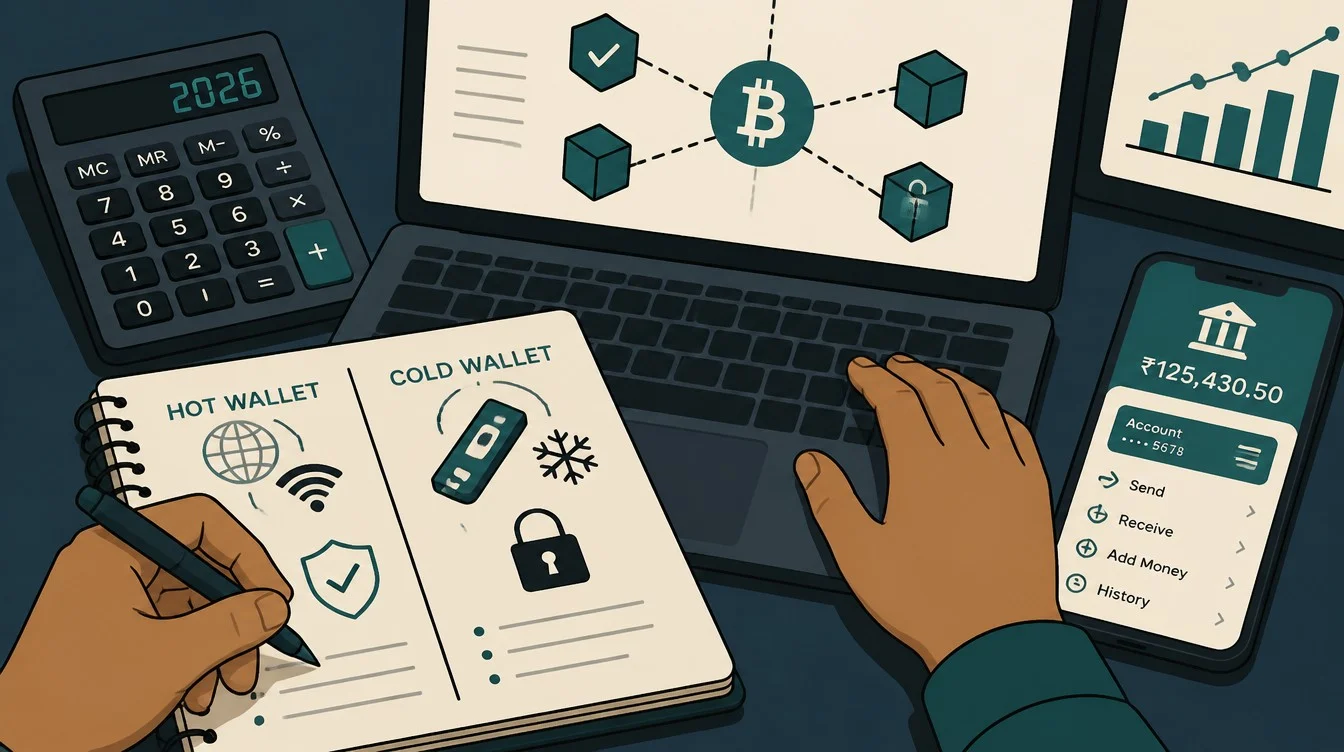
The hot-versus-cold framing dominates crypto-security discussions, but the practical decision is more nuanced than the binary suggests.
What “hot” means
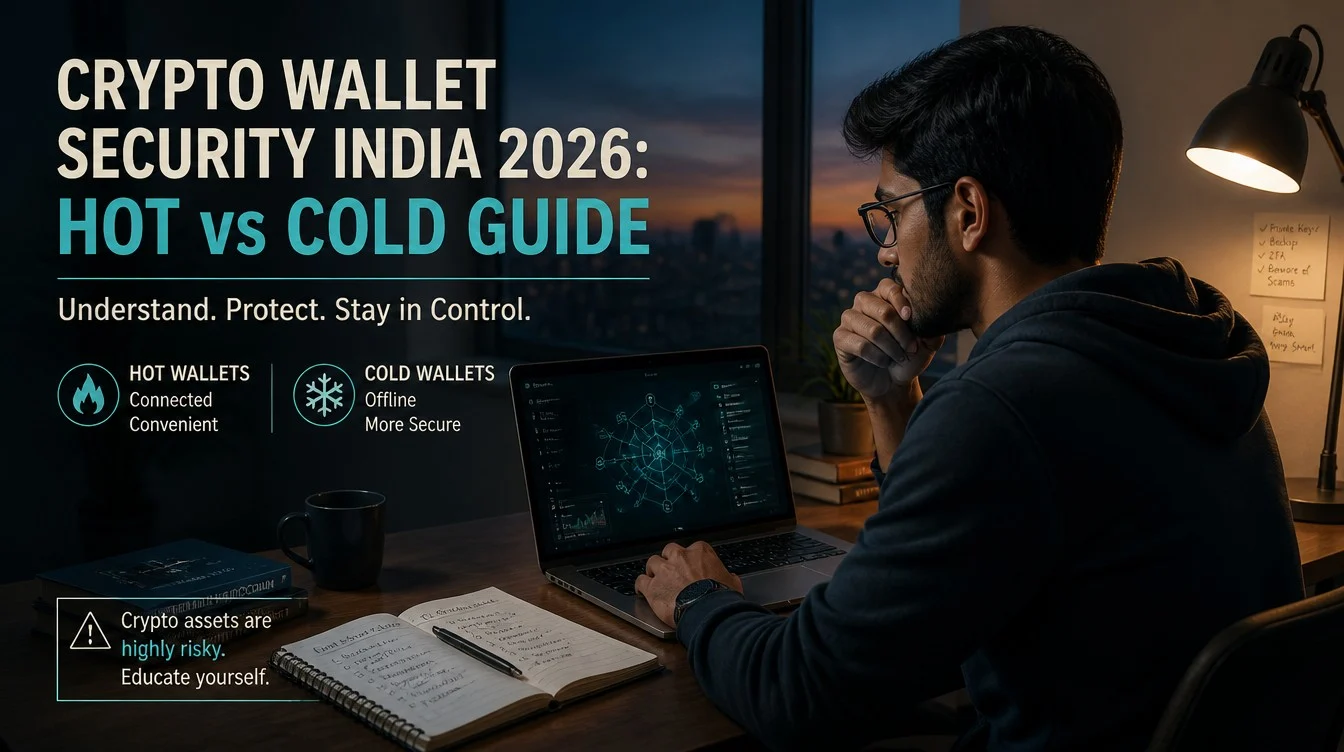
A hot wallet is any wallet whose private keys are accessible to a device connected to the internet. This includes exchange accounts, mobile wallets like MetaMask or Trust Wallet, browser extensions, and any custody arrangement where a server holds the key on your behalf.
What “cold” means
A cold wallet stores the private keys on a device that is air-gapped from the internet. Hardware wallets are the most common form: a small dedicated device that signs transactions internally and never reveals the private key to the connected computer. Paper wallets (a printed private key) are technically cold but practically unsafe due to single-point-of-failure storage.
The honest reality
Most Indian retail investors run a hybrid: a hot exchange account for monthly DCA buys, a hot mobile wallet for small-value spending or DeFi experimentation, and a cold hardware wallet for the long-term holding stack. The hybrid is more secure than any single choice because it limits the attack surface for the largest part of the portfolio.
Hardware Wallets in India: Ledger, Trezor, and Availability
The two best-known hardware wallet brands are Ledger and Trezor. Both are available to Indian buyers but with caveats that often surprise first-time purchasers.
Sourcing the device
Buying directly from the official manufacturer’s website (Ledger.com or Trezor.io) is the safest route. The device ships to India via international courier; expect customs duty and a few weeks of transit. Buying through Amazon India or another marketplace is convenient but carries a non-trivial risk: tampered devices have been seized at customs and in supply chains in the past, and a compromised device can leak the seed phrase the first time you use it.
The setup discipline
A new hardware wallet must be initialised on its own. The device generates a fresh seed phrase, displays it on its own screen (not on the connected computer), and asks the owner to write it down on paper or steel. The seed phrase should never be photographed, typed into a phone, emailed, or stored in cloud notes. Any device that arrives with a pre-set seed phrase or asks you to type a seed into a website is compromised; the only correct action is to return it.
The model question
Both Ledger and Trezor offer entry-level and premium models. The entry-level Ledger (Nano S Plus) and Trezor (Model One or Safe 3) are functionally adequate for Indian retail use. Premium models add Bluetooth, larger screens, and broader coin support but do not materially improve security for the average investor.
Indian-specific considerations
Indian buyers should plan for paying customs duty (typically 15-30% of the declared value plus IGST), keeping the invoice for warranty purposes, and not registering the device with personally identifying details on optional account dashboards. The 2020 Ledger data breach exposed customer email addresses and physical addresses to phishing attackers; declining to share unnecessary personal data with the vendor is good hygiene.
Seed-Phrase Hygiene: The Single Most Important Discipline
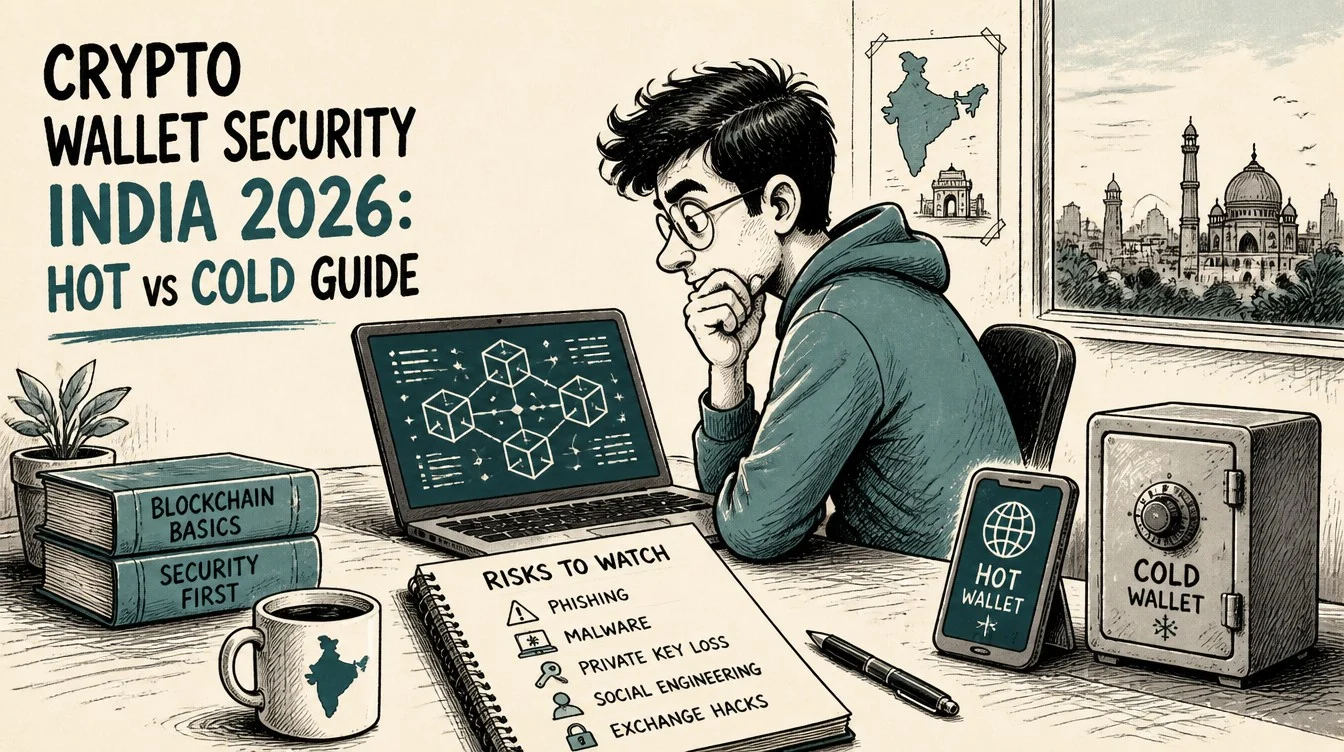
If there is one paragraph in this guide worth re-reading, it is this section. Most permanent crypto losses in India are not the result of sophisticated hacks; they are the result of a forgotten password, a misplaced slip of paper, or a moment of phishing-induced panic.
The eight non-negotiables
- Write the seed phrase on paper or steel, never on a phone, computer, or cloud note.
- Store the copy in a fire-resistant safe at home or a bank locker, not in a drawer.
- Make two physical copies in separate locations to survive a single-site disaster (a flood, a theft).
- Never share the seed phrase with anyone, including support agents claiming to help. Legitimate support never asks for it.
- Never type the seed phrase into any website, even one that claims to be the wallet provider. Hardware wallets do not need the seed re-entered for normal use.
- Periodically test that the seed phrase still works by restoring it onto a second device in a controlled setting.
- Plan for inheritance: a sealed note with the safe-deposit location and recovery instructions, accessible to a spouse or executor.
- Avoid memorising the seed phrase as a sole strategy; human memory is unreliable across decades.
The steel-plate question
For holdings worth more than a few lakh, stamping or engraving the seed phrase on a steel plate (commercially available products exist) protects against fire, water, and time. Paper degrades; steel is the long-term medium of choice for serious holders.
The 12 vs 24 word debate
Modern hardware wallets default to 24-word seed phrases. Twelve-word phrases provide adequate entropy for retail use, but most current devices use 24 words for forward compatibility. Either is secure; consistency matters more than length.
Common Wallet-Security Mistakes Indian Retail Makes
Across thousands of incident reports compiled by Indian-facing crypto-security researchers, a small set of mistakes recurs with depressing regularity.
Treating the exchange as the destination
Leaving the entire holding on an exchange “because trading is easier” is the most common retail mistake. Exchange accounts can be frozen during regulatory action, locked during a hack, or drained in a credential-stuffing attack. Even a modest cold storage habit (move anything beyond a “trading float” off the exchange weekly) reduces exposure significantly.
Reusing wallet addresses across personas
Using the same self-custody address for a salary-funded buy and for a public DeFi farm exposes your full balance to anyone who watches that address. Modern wallets allow multiple sub-accounts; using a separate sub-account per purpose preserves on-chain privacy.
Approving unlimited token spend
DeFi protocols often request “unlimited” token approvals to save gas. Granting unlimited approval to a contract means a future bug or exploit in that contract can drain the entire balance of that token. Setting approval to the exact amount needed, and revoking approvals after use, is basic hygiene that retail users skip.
Connecting wallets to unverified dApps
Wallet-drainer phishing sites disguise themselves as legitimate dApps, particularly around NFT mints and airdrops. Before connecting a wallet, verify the contract address on a reputable source (Etherscan, CoinGecko’s verified link, the project’s official channel) and avoid clicking links from Twitter ads or Telegram groups.
Falling for “support” DMs
Legitimate exchanges and wallet providers never DM users first. Any direct message offering to help, asking to verify a seed phrase, or asking to install a “tool” is a scam. Indian retail has lost crores to this single pattern in the past two years.
Practical Setup: A Phased Wallet Strategy
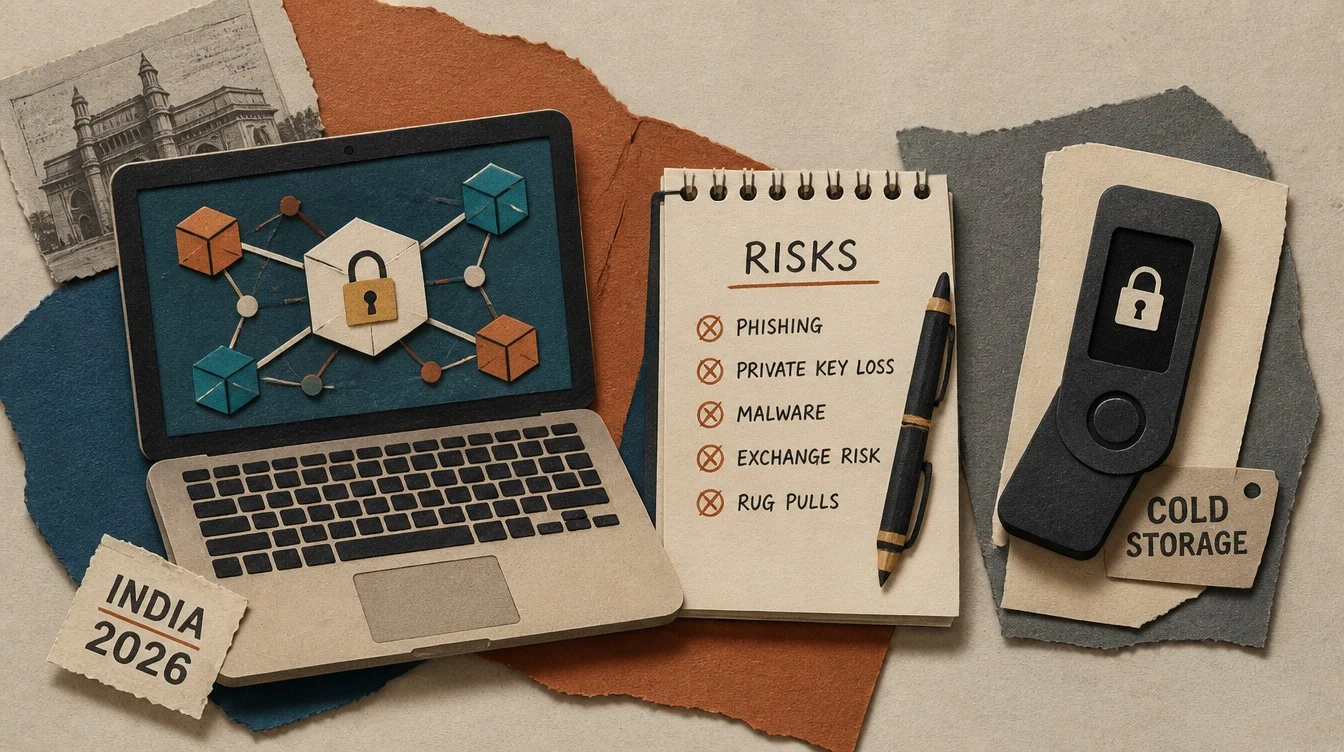
The transition from “everything on an exchange” to “secure long-term holding” should be staged, not sudden. A phased plan reduces the chance of a single mistake destroying everything.
Phase 1: Tighten the exchange account
- Enable two-factor authentication using an authenticator app (Google Authenticator or Authy), never SMS.
- Set up a withdrawal whitelist if the exchange supports it, locking new withdrawal addresses for 24-48 hours.
- Use a unique, long password and store it in a password manager, not in a notes app or browser autofill.
- Lock down the email account linked to the exchange with the same 2FA discipline; email is the recovery vector for everything else.
Phase 2: Set up a hot wallet for daily use
Install a reputable mobile or browser wallet (such as MetaMask, Rabby, or Trust Wallet) and create a fresh seed phrase. Move a small amount (Rs.5,000 to Rs.10,000) from the exchange to test the address, confirm the transaction, and store the seed phrase on paper before transferring anything larger.
Phase 3: Add a hardware wallet for the long stack
Order a Ledger or Trezor from the official site once the holding crosses the threshold where the device’s cost (typically Rs.6,000 to Rs.15,000 including duty) is small relative to the holding. Initialise on its own, store the seed on steel, and migrate the long-term position from the exchange or hot wallet to the hardware-wallet address. Verify the address on the device’s own screen before sending.
Phase 4: Build the inheritance plan
Document where the seed phrase is stored, what wallets are in use, and how a trusted person can recover the holding. The document should not contain the seed phrase itself; it should point to its location. Without this step, a sudden incapacity or death can permanently lock the family out of the holding.
Wallet Security and the April 2026 Reporting Rule
The Section 509 reporting framework affects self-custody users in two specific ways.
Withdrawals to unhosted wallets are reported
Every transfer from a domestic exchange to a self-custody wallet is reported, with destination address attached. The IT Department now has a record of which addresses belong to which PANs (at least at the time of withdrawal). Self-custody is therefore not anonymity; it is just custody.
What this means for filing
The Schedule VDA filing remains based on transfers, not on storage location. Moving coins from exchange to hardware wallet is not a taxable event by itself, but every subsequent sale or swap (even from the hardware wallet) is. Keeping clean transaction records that reconcile against AIS becomes harder when transactions span multiple wallets and exchanges.
The compliance habit
Maintain a master spreadsheet that lists every wallet (exchange and self-custody), with creation date and a one-line description. Each row should support reconciliation: “This address holds the long-term Bitcoin position; transactions visible at this Etherscan/blockchain explorer link.” When the assessing officer asks about a flagged AIS entry, the spreadsheet becomes the audit trail. Crypto carries leveraged volatility risk; do not invest more than you can afford to lose, and do not assume self-custody removes the compliance burden.
Frequently Asked Questions
Should I keep all my crypto on an Indian exchange or move it to a hardware wallet?
A hybrid is the standard answer. Keep a small trading float on a regulated domestic exchange for liquidity, and move the long-term holding (typically anything above Rs.2,00,000 of total exposure) to a hardware wallet whose seed phrase you control. The exchange offers convenience and recoverability; the hardware wallet offers custody control and reduces counterparty risk.
Are Ledger and Trezor available in India?
Yes. Both ship to India through the official manufacturer websites. Customs duty and IGST apply on import. Buying from the official source is safer than buying from third-party marketplace listings, where tampered devices have been documented in the past.
What is the most important seed-phrase rule?
Never type the seed phrase into any internet-connected device, never share it with any support agent, and never store it in cloud notes, photos, or password managers. Write it on paper or stamp it on steel, store the copy in a fire-resistant safe or bank locker, and keep a second copy in a separate location.
Is a mobile wallet less safe than a hardware wallet?
Yes, in the technical sense. Mobile wallets are hot wallets: the keys exist on an internet-connected device, exposed to malware and phishing. Hardware wallets keep the keys offline. For small balances (Rs.10,000-Rs.50,000), a well-secured mobile wallet is a reasonable trade-off; for larger holdings, the hardware-wallet upgrade is worth the cost.
Does moving crypto to a self-custody wallet hide it from the Income Tax Department?
No. From April 1, 2026, withdrawals from domestic exchanges to unhosted wallets are reported under Section 509, including the destination address. Self-custody does not provide tax invisibility; it provides custody control. The Schedule VDA filing and 30% Section 115BBH tax apply regardless of where the asset is stored.
Related LearnFineEdge guides on choosing a regulated Indian crypto exchange, Schedule VDA filing, and recognising crypto scams are forthcoming and will be linked here as the cluster expands.