
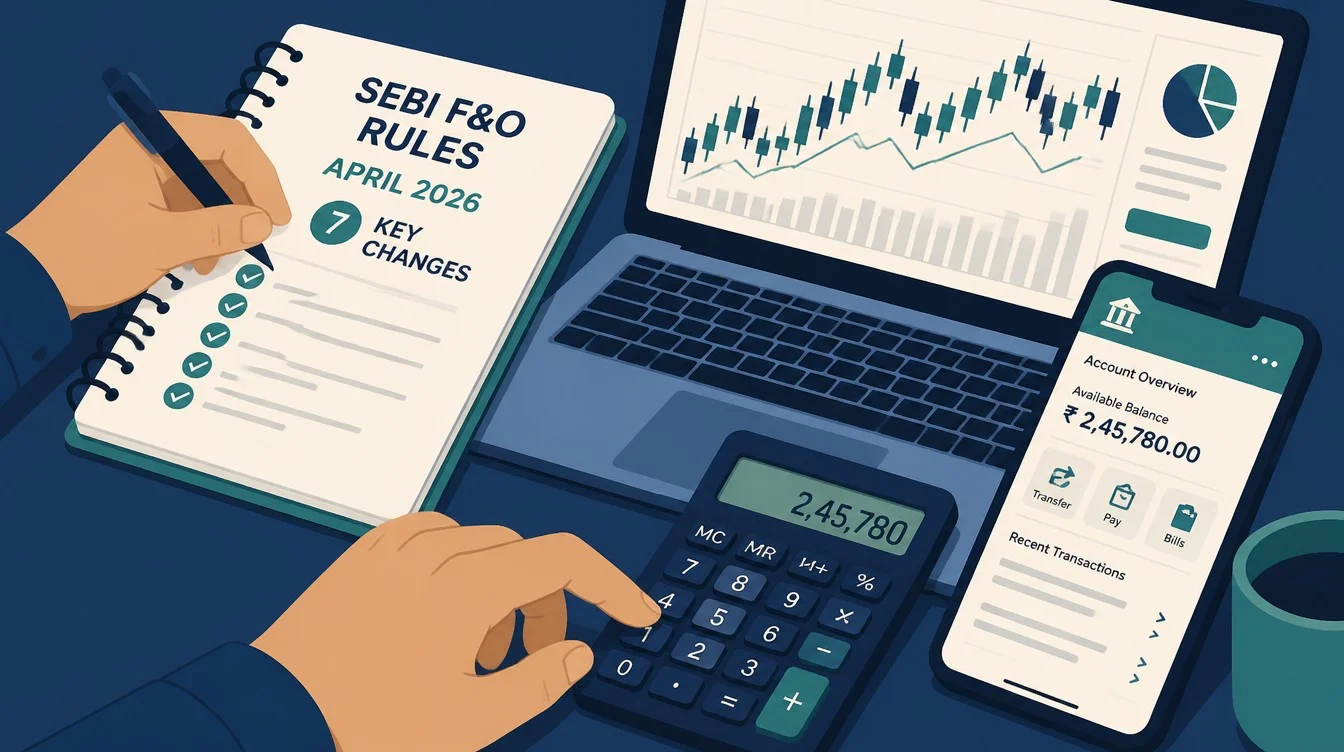
The SEBI F O rules that took effect on April 1, 2026 mark the most aggressive retail-protection package the regulator has issued for the futures and options segment, and this SEBI F&O rules April 2026 India overhaul touches contract size, expiry calendars, margin mechanics, and even the question of who is allowed to trade.
The motivation is no secret. SEBI’s own studies have repeatedly shown that the vast majority of retail options buyers lose money, and the cumulative losses across the segment run into trillions of rupees. The 2026 framework is the regulator’s attempt to slow that bleed without shutting the door on serious retail participation.
This pillar walks through seven structural changes that reshape derivatives in India from FY 2026-27 onward, and what each one means for a salaried Indian trader sizing positions on Nifty, Sensex, Bank Nifty, or stock F&O. F&O carries leveraged risk and is unsuitable for most retail investors; treat the rest of this article as education, not as a prompt to trade.

Why the SEBI F O Rules Changed From April 2026
The rule package did not appear overnight. It is the culmination of a multi-year SEBI study into retail behaviour in the equity derivatives segment, a string of consultation papers, and phased implementation that began in late 2024 and finished by April 6, 2026.
The Loss Data That Triggered the Rewrite
SEBI has publicly stated that roughly 85% of individual options buyers lose money over the typical study window, and a broader study found that more than 9 in 10 retail F&O traders ended the three-year window in cumulative losses running into lakhs of crores. Those numbers framed every clause that followed.
The regulator’s view is that derivatives are a hedging and risk-transfer tool, not a wealth-building tool, and that retail flows had drifted into pure speculation. The 2026 rules try to push the segment back toward its original purpose.
The Phased Rollout, Not A Big-Bang Switch
Several pieces of the package, such as upfront premium collection and extreme-loss margin add-ons on expiry day, were already live through 2025. The April 1, 2026 deadline is the date the remaining items – mandatory algo framework, suitability assessment, and the final margin tightening – became enforceable across brokers.
Who The Rules Actually Touch
The framework applies to every retail derivatives trader on NSE and BSE, every broker offering algo or API access, and every vendor selling strategy products. The institutional segment was largely already operating under stricter controls. The redesign is squarely aimed at the retail tail.
Change 1: Minimum F&O Contract Size Raised To Rs.15 Lakh
The headline change is the rise in the minimum notional value of an index derivatives contract from the earlier Rs.5-7 lakh band to roughly Rs.15 lakh (15,00,000), with stock options contracts repriced to around Rs.7.5 lakh (7,50,000). The exchanges revise lot sizes periodically to keep notionals inside the SEBI-mandated Rs.15 lakh to Rs.20 lakh band.
What The New Lot Sizes Look Like
For Nifty 50 the lot size moved to 75 contracts per lot, and for Sensex it sits at 20. Bank Nifty and other indices were retired from weekly expiries (more on that below) but their monthly contracts also reflect the larger notional. The exact lot size for each scrip is published on the NSE and BSE contract specification pages and is reviewed at each contract launch.
The Practical Capital Math
A single Nifty options lot now has a notional of about Rs.15 lakh. To trade even one out-of-the-money call, the buyer must put up the full premium upfront, and a seller must post SPAN plus exposure margin, which can easily exceed Rs.1 lakh per lot. A genuinely diversified F&O strategy of three to five lots needs working capital in the Rs.3-5 lakh range at the bare minimum.
Who Gets Priced Out
The trader who was previously running Rs.50,000 of risk capital across a few quick weekly trades is, in most cases, structurally out of the segment. SEBI’s signal is explicit: if the position cannot be carried at the new lot size with proper margin, the retail trader should not be there at all. Equity ETFs, index mutual funds, and SIP-based investing remain the appropriate substitutes for that capital level.
Change 2: Weekly Options Restricted To One Benchmark Per Exchange
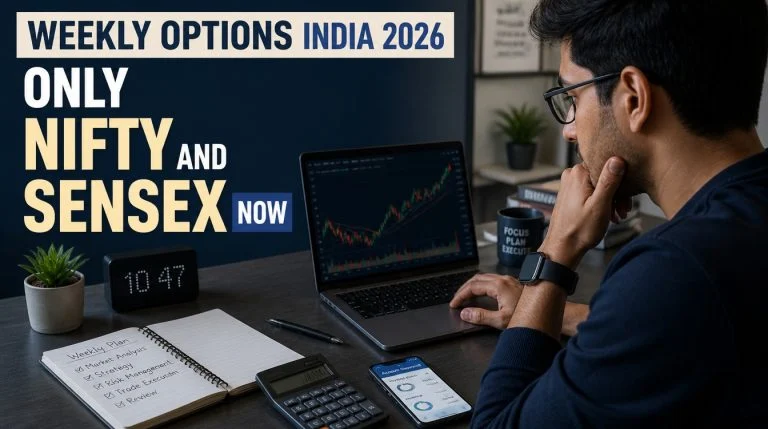
The second pillar of the SEBI F&O rules April 2026 India overhaul reshapes the expiry calendar itself. From the 2024-25 phased rollout onward, each exchange is allowed to run weekly options on only one benchmark index. NSE retained Nifty 50; BSE retained Sensex.
What Was Discontinued
Bank Nifty weekly options, Fin Nifty weekly options, Nifty Midcap Select weekly options, and Sensex 50 weekly contracts were all retired. Only monthly expiries remain for those indices. The weekly options ecosystem on Indian exchanges is now effectively a two-product market: Nifty 50 (Tuesday expiry on NSE) and Sensex (Thursday expiry on BSE, with periodic exchange-driven adjustments).
Why SEBI Made The Cut
SEBI’s analysis of expiry-day flows showed that intra-week and expiry-day speculation on Bank Nifty and similar indices was where the heaviest retail losses clustered. By collapsing weekly expiries to a single index per exchange, the regulator removed multiple “lottery days” per week and forced traders into longer holding periods.
The Premium-Decay Side Effect
Premium decay on monthly contracts behaves differently from weeklies. Theta is slower, gamma is gentler, and the option chain is deeper. Retail traders who built their playbook around five-day premium decay on Bank Nifty have had to relearn how to size, when to roll, and where to take profit on the slower monthly cycle.
Change 3: Upfront Premium Collection And The 50% Cash Margin Rule
The third change rewrites how brokers fund retail F&O activity. Two pieces interlock: upfront premium collection on options buys (in force since February 1, 2025) and the 50% cash margin requirement that took final effect on April 1, 2026.
Upfront Premium Collection
An options buyer can no longer take a position and rely on the broker’s intraday float to fund the premium. The full premium must hit the trading account before the order is accepted. This shut down the common pattern of buying multiple far-OTM lots on tiny ledger balances and hoping for a single explosive expiry.
The 50/50 Cash-Collateral Split
For sellers and complex strategies, SEBI now requires that at least 50% of the total margin be in cash or cash-equivalent (bank fixed deposits, bank guarantees, central government securities), with the remaining 50% allowed as pledged equity or eligible securities. The earlier model of running mostly on pledged stock collateral with thin cash buffers is no longer permitted.
What Counts As Cash Equivalent
The cash leg is wider than literal bank balance. Bank guarantees, bank fixed deposits issued in favour of the clearing corporation, and central government securities all qualify. Equity pledges, ETF pledges, and mutual fund pledges sit on the non-cash side and can fund only the remaining half.
Shortfall And Pledge Mechanics
If the cash leg falls below 50%, the broker is required to either square off positions or apply a penalty. Pledging works the same way it did, through CDSL or NSDL margin pledge instructions, but the daily margin file the broker submits must show the 50% cash split or the account is flagged. In practice, this pushes serious option sellers to keep one to two months of expected margin in a sweep-in FD or short-term liquid instrument linked to the trading bank account.
Change 4: Mandatory F&O Suitability Assessment
This is the rule that decides who is allowed in the door. From April 2026, every broker must run an annual F&O suitability assessment on each client before enabling or renewing derivatives trading rights.
What The Test Measures
The assessment looks at four broad inputs: declared annual income, declared net worth, prior trading experience and historical P&L, and a knowledge module covering basic options mechanics, margin rules, and risk concepts. Each broker designs the exact format inside SEBI’s outline, so the questionnaire on Zerodha, Upstox, Angel, ICICI Direct, and HDFC Securities looks similar but not identical.
Pass, Conditional, And Fail Outcomes
A clean pass enables the full F&O suite, including option selling and multi-leg strategies. A conditional pass typically restricts the account to long options (buying calls and puts) only. A clear fail blocks F&O entirely until the trader either re-takes the test after a SEBI-approved education module or provides updated income and net-worth evidence.
Why This Is Not Just Paperwork
The suitability assessment is the regulator’s way of forcing brokers to be a first line of defence. A broker that mechanically passes obviously unqualified clients faces enforcement risk. For the trader, the practical effect is that F&O access is now an annual privilege, not a permanent feature of a demat account.

Change 5: Mandatory Algo Trading Framework From April 1, 2026
SEBI’s algo trading framework moved from optional to mandatory on April 1, 2026. The rule applies to every broker offering API access and every retail trader running any form of automated order placement.
The Algo-ID Concept
Every algorithmic order must now carry an exchange-assigned Algo-ID. The Algo-ID is tied to a strategy that has been registered by the broker with the exchange. Orders without a valid Algo-ID are rejected at the exchange gateway. The intent is full traceability: every automated trade can be linked back to a named strategy and a named broker.
Black-Box, White-Box, And DIY Scripts
Vendor algos and third-party strategy products fall into the “black-box” category and must be registered by the vendor in partnership with the broker. Self-coded Python scripts that hit broker APIs are treated as “white-box” algos and require the trader to register the strategy under the broker’s algo framework. The era of plugging an unregistered Jupyter notebook into a broker’s REST API and trading at will is over.
What Order Frequency Triggers Algo Classification
SEBI and exchange circulars classify any order generated by code, by a scheduling tool, or above a threshold order-per-minute rate, as algorithmic. A retail trader who runs even a simple OCO (one-cancels-other) bracket script needs to confirm whether the broker classifies that as manual or algo, and register accordingly.
Login, 2FA, And Session Rules
API sessions must use OAuth-style logins with two-factor authentication, and the session is required to expire and re-authenticate at least once per trading day, typically before the pre-open session. Long-running, indefinite API tokens are no longer compliant.
Change 6: 10% MWPL Per-Retail Cap
Market Wide Position Limit (MWPL) is not new; what is new is the explicit retail-investor cap. From the 2026 framework, individual retail traders cannot hold more than 10% of the prevailing MWPL in any single underlying.
MWPL In Plain English
MWPL is the maximum number of open positions allowed in a stock’s F&O contracts across the whole market. It is set at a percentage of the free-float share count and is published daily by the exchanges. When the open interest in a scrip touches 95% of MWPL, that scrip enters a ban period and only existing positions can be reduced.
Why The Retail Cap Matters
The 10% cap closes a workaround where a single individual or a coordinated group could accumulate an outsized share of a low-MWPL counter and effectively distort the order book. For most large-cap names with deep MWPL, the 10% cap is not binding. For small-cap and mid-cap F&O names, the cap can become a hard sizing constraint long before the broker’s exposure margin does.
How To Track MWPL Daily
NSE publishes the MWPL utilisation file each evening, and most retail terminals expose a “ban list” view. Sizing any single F&O position should start with the current MWPL utilisation, not with the account balance. A 10% individual cap on a counter that is already at 60% MWPL utilisation is a different conversation from the same cap on a counter at 10% utilisation.

Change 7: Tighter Expiry-Day Margin And Position Monitoring
The seventh change is technical but consequential. SEBI removed the calendar spread margin benefit on expiry day, added an extreme-loss margin on the expiring contract, and required exchanges to monitor index derivatives position limits multiple times during the trading day rather than only at the end of the day.
End Of The Calendar Spread Free Lunch
Earlier, a trader holding a near-month long and a next-month short in the same index could enjoy a meaningful margin offset right up to expiry. From the 2026 framework, that calendar spread treatment ends in the final session of the expiring contract, so the expiring leg has to be fully margined on its own.
Extreme-Loss Margin Add-On
On expiry day, an extreme-loss margin (ELM) add-on of 2% applies to short positions in the expiring contract. The effect is to make the last-day gamma blowout less attractive and to discourage thin-margined, last-hour expiry punts.
Intraday Position-Limit Checks
Exchanges now check position limits at multiple snapshots through the day, not only at end-of-day. A retail trader whose position drifts above the per-client limit during the session can find the broker blocking further entries or forcing a partial square-off well before the closing bell.
The Rules Side By Side: Before And After April 2026
The table below summarises the seven changes in the form a retail trader can use as a quick checklist.
| Area | Before April 2026 | After April 1, 2026 |
|---|---|---|
| Minimum index contract notional | Rs.5-7 lakh band | Rs.15 lakh to Rs.20 lakh band |
| Weekly options availability | Multiple indices on each exchange | One index per exchange (Nifty on NSE, Sensex on BSE) |
| Premium collection | End-of-day settlement | Upfront, before order acceptance |
| Margin composition | Mostly pledged collateral allowed | Minimum 50% cash or cash-equivalent |
| F&O access | One-time KYC, permanent | Annual suitability assessment required |
| Algorithmic trading | Optional registration | Mandatory Algo-ID for every automated order |
| Individual position cap | Per-client limit only | 10% of MWPL per retail trader |
| Expiry-day margin | Calendar spread offsets allowed | Offsets removed + 2% ELM add-on |
How To Re-Evaluate Your F&O Plan Under SEBI 2026
The new framework forces every retail derivatives trader to redo three calculations: capital adequacy, expected hold period, and edge.
Step 1: Capital Adequacy
Take the strategy with the largest typical position and compute the new lot-size margin. If a single Nifty options sell needs roughly Rs.1.5 lakh of SPAN plus exposure margin, a portfolio that needs three concurrent positions needs Rs.4.5 lakh just for margin, plus a cash buffer of at least the same amount to absorb MTM swings. Anything thinner is structurally undercapitalised.
Step 2: Expected Hold Period
If the original edge was a five-day Bank Nifty weekly play, that product no longer exists. The honest question is whether the same setup works on a monthly contract. Many short-dated retail strategies do not survive the move to a longer expiry, because their edge was specific to a near-expiry gamma curve.
Step 3: Honest Edge Check
SEBI’s loss data is not a bug, it is the base rate. A retail trader who, after the rule change, still believes they have an edge needs to be able to articulate where that edge comes from, with at least one year of journaled trades. A six-month win streak in a directional bull market is not an edge.
Common Mistakes Retail Traders Make Under The New Rules
Three patterns are already visible across broker advisories and exchange communications since April 2026.
Mistake 1: Stacking Lots To Mimic Old Sizing
Some traders are trying to recreate their pre-2026 exposure by stacking multiple new-style lots. A Nifty position that used to be one lot at Rs.5 lakh notional becomes three lots at Rs.15 lakh each, which is three times the prior risk, not the same risk. This is the most expensive misreading of the rule package.
Mistake 2: Treating The Suitability Test As A Formality
Filling false income or experience figures to clear the suitability test is a regulatory and broker-contract violation. The right approach is to take the test honestly, accept the rating, and use the conditional period to build genuine experience inside the allowed segment.
Mistake 3: Running Unregistered Scripts
Self-coded scripts that place orders through a broker API, but are not registered under the broker’s algo framework, are non-compliant from April 1, 2026. The fix is to either disclose the script to the broker and register it, or run it strictly in paper-trading mode with no live order routing.
Alternatives For Investors Priced Out Of The Segment
For a salaried Indian whose capital base is in the Rs.50,000 to Rs.5,00,000 range, the cleanest alternative to F&O is a layered equity exposure built on index ETFs, index mutual funds, and a disciplined SIP. The market exposure is the same; the leverage and the gamma are not.
ETF And Index Fund Routes
A Nifty 50 ETF or a Nifty index mutual fund gives the same broad-market exposure as a Nifty options play, without leverage and without expiry pressure. For a long-only retail saver, this is almost always the more sensible vehicle, and the new lot-size rule arguably nudges the segment toward exactly that conclusion.
Hedging Rather Than Directional Betting
The remaining legitimate retail use case for derivatives is hedging an existing equity portfolio against drawdowns, not directional speculation. A protective put on a Nifty ETF holding, sized to actual portfolio value, is the textbook retail F&O use that the 2026 framework still permits and arguably encourages.
Education First, Capital Second
SEBI’s investor education portal and NISM modules on derivatives are free or low cost and align directly with the suitability test’s knowledge module. Completing one before re-attempting any F&O activity is the cheapest hedge available.
What This Means For The Indian Markets In FY 2026-27
The macro effect of the package is already visible in segment data. Retail F&O turnover has compressed, average ticket size has risen (because the surviving accounts are larger), and weekly options open interest has consolidated heavily into Nifty and Sensex.
Liquidity Concentration
With weekly expiries collapsed into two products, liquidity in those two products has deepened. Bid-ask spreads on Nifty and Sensex weeklies are tighter than ever, while monthly Bank Nifty and stock options have wider spreads than in 2024.
Broker Business Model Shifts
Brokers heavily dependent on retail F&O volumes have shifted their revenue mix toward delivery-based broking, mutual fund distribution, and margin-trading facilities. This is broadly aligned with SEBI’s intent: the regulator wanted retail intermediation to look more like wealth management and less like a casino.
The Quiet Winner: Long-Only Indian Equity
Money that used to revolve in and out of weekly options in five-day cycles is, in aggregate, finding its way into SIPs, ETFs, and index funds. The 2026 framework is essentially a regulatory tailwind for long-only Indian equity participation, even if that was not its stated objective.
Frequently Asked Questions
What is the new minimum F&O contract size in India from April 2026?
The minimum notional value of an index derivatives contract has been raised to roughly Rs.15 lakh (15,00,000), with stock options contracts at about Rs.7.5 lakh (7,50,000). Exchanges revise lot sizes periodically so that the notional sits inside SEBI’s Rs.15 lakh to Rs.20 lakh band at every review.
Are Bank Nifty weekly options still available?
No. Under the SEBI F&O rules April 2026 India framework, weekly options are restricted to one benchmark index per exchange, which is Nifty 50 on NSE and Sensex on BSE. Bank Nifty, Fin Nifty, and other indices retain only monthly expiries.
What is the 50% cash margin rule?
Effective April 1, 2026, at least 50% of the total margin for F&O positions must be in cash or cash-equivalent (bank fixed deposits, bank guarantees, central government securities). The remaining 50% can be funded through pledged equity or eligible securities. The earlier model of running mostly on pledged stock collateral is no longer permitted.
Do I have to take a test every year to trade F&O?
Yes. Brokers are required to run an annual F&O suitability assessment covering income, net worth, prior trading experience, and a knowledge module. A pass enables full F&O access; a conditional outcome restricts the account to options buying; a fail blocks F&O until the trader retakes the assessment, often after a SEBI-approved education module.
Do the new rules apply to my Python trading script?
Yes. From April 1, 2026, every automated order must carry an Algo-ID assigned by the exchange and registered through the broker. Self-coded scripts, including simple Python or Excel-based order routers, must be disclosed and registered under the broker’s algo framework or they cannot legally route live orders.
Related LearnFineEdge guides on each of these seven changes – lot size impact, suitability test, weekly options, algo framework, cash margin, position sizing under MWPL, and trading psychology under the new regime – are forthcoming.