
The Indian crypto exchange landscape in 2026 looks nothing like it did in the 2021 bull run. After three Budgets, a FIU-IND registration mandate, a 1% TDS, the WazirX security incident of July 2024, and the Section 509 reporting framework that goes live on April 1, 2026, the only platforms still credibly serving Indian retail are the ones that have leaned into compliance. An Indian crypto exchange comparison 2026 is therefore less about chasing the lowest fee and more about matching a platform’s regulatory posture, custody quality, and support depth to the user’s actual needs.
This guide is for the salaried retail investor weighing where to open a primary account. It walks through how FIU-IND registration works, what fee and spread mean in practice, how the top platforms compare on visible features, and the questions to ask before sending the first INR transfer. Crypto carries leveraged volatility risk; do not invest more than you can afford to lose. This article does not pick a “best” exchange because the right answer depends on individual priorities.

What Changed Between 2022 and 2026
The structural changes in the Indian crypto exchange market over the past four years are the backdrop for any current comparison.
The FIU-IND registration mandate
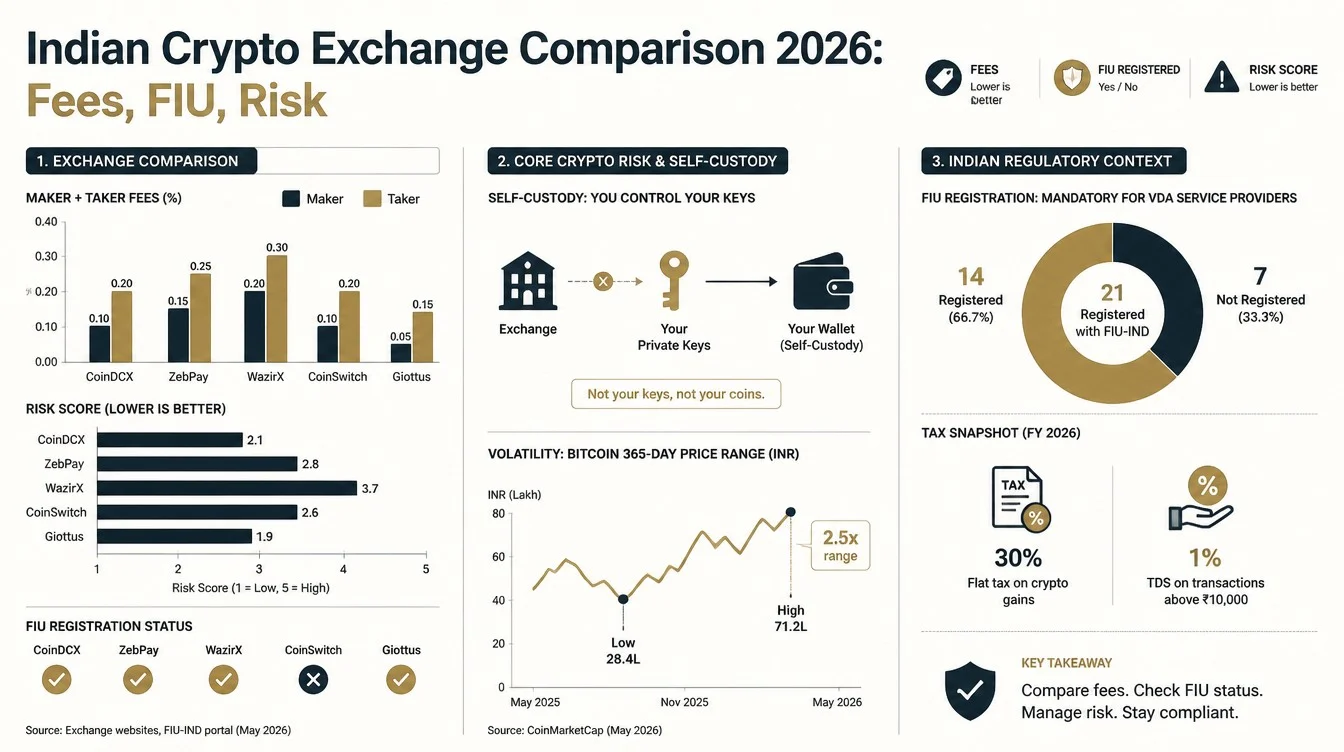
In March 2023, the Ministry of Finance brought virtual digital asset service providers under the Prevention of Money Laundering Act. Every domestic exchange now must register with the Financial Intelligence Unit (FIU-IND), implement KYC and transaction-monitoring controls, and file Suspicious Transaction Reports. Operating without FIU registration is a PMLA violation. As of early 2026, around 50 entities are registered, and the FIU’s published list is the definitive starting point for any exchange shortlist.
The tax and reporting layer
The 30% flat tax under Section 115BBH, the 1% TDS under Section 194S, and the Schedule VDA disclosure in the ITR are now permanent fixtures. From April 1, 2026, Section 509 requires exchanges to file user-level transaction statements with the Income Tax Department. The reporting load increases compliance costs and pushes weaker platforms out of the market.
The WazirX incident and what it taught the market
The July 2024 WazirX hack, in which roughly USD 235 million of user assets were drained from a multi-signature wallet, was the largest crypto security incident in Indian history. The aftermath, including extended withdrawal freezes and a restructuring process, forced retail investors to reassess counterparty risk and pushed many to diversify across multiple exchanges and to move long-term holdings to self-custody.
What the surviving exchanges look like
The 2026 market is dominated by a small number of FIU-registered domestic platforms that have invested in compliance: CoinDCX, ZebPay, CoinSwitch, Mudrex, and Unocoin among them, with WazirX in a restructuring posture. Each emphasises a different combination of UI simplicity, advanced trading, coin coverage, fees, and security disclosures. Retail investors should evaluate each on its own terms.
Indian Crypto Exchange Comparison: The Top 5 at a Glance
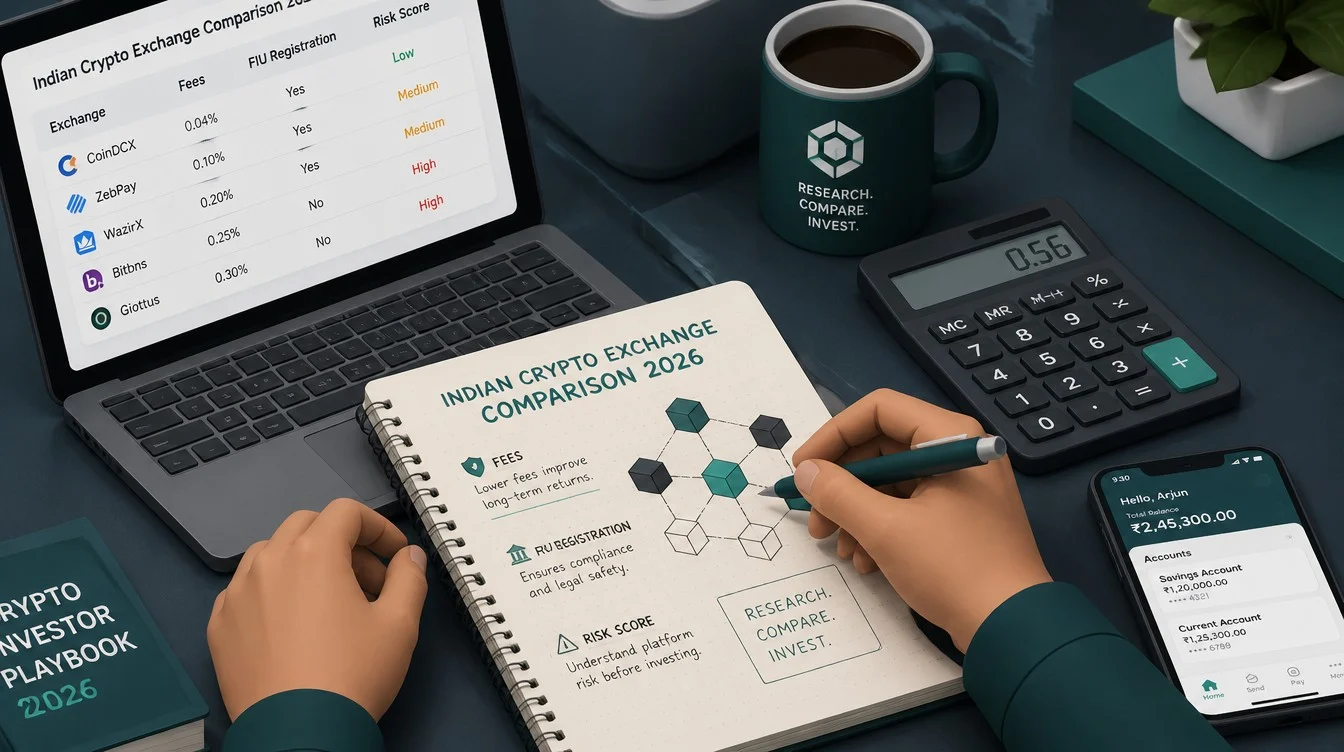
The table below summarises the publicly available positioning of five major Indian crypto exchanges as of mid-2026. Specific fee numbers can change without notice; verify directly on the platform before transacting.
| Exchange | FIU-IND registered | Typical retail interface | Visible fee model | Notable strength | Notable caveat |
|---|---|---|---|---|---|
| CoinDCX | Yes | Simple + Pro modes | Maker/taker on Pro, all-in spread on Simple | Broad coin coverage, active compliance posture | Verify current fee tier in app before trading |
| ZebPay | Yes | Web + mobile | Maker/taker percentage on each trade | One of the oldest Indian platforms, long operating history | Smaller listed-coin set than newer rivals |
| CoinSwitch | Yes | Aggregator-style mobile UX | Bundled spread (no separate fee shown) | Lowest-friction onboarding for first-time users | Bundled spread can be wider than maker/taker on Pro venues |
| Mudrex | Yes | Web + mobile, Coin Sets product | Per-trade fee + spread | Curated basket products for passive allocators | Basket products carry product-level fee on top of trading fee |
| Unocoin | Yes | Web + mobile | Maker/taker on trading; SIP product available | Long-standing Bitcoin-first focus, INR SIP feature | Smaller altcoin universe |
The table is a starting point, not a ranking. The right primary exchange depends on whether the user values UI simplicity (CoinSwitch, Mudrex), advanced trading (CoinDCX Pro, ZebPay), Bitcoin-first SIP (Unocoin), or curated basket allocation (Mudrex Coin Sets).
FIU-IND Compliance: What “Registered” Actually Means
FIU-IND registration is often presented as a binary tick mark, but the underlying obligation is operational.
The obligations a registered entity carries
A registered VDA service provider must conduct full KYC on every user, run sanctions and PEP screening, monitor transactions against typologies of money laundering and terrorist financing, file Suspicious Transaction Reports with the FIU, and maintain records for at least five years. The platform must also nominate a Principal Officer who is personally accountable for compliance.
How a user can verify registration
FIU-IND publishes a list of registered VDA service providers; checking that list is a quick way to confirm a platform’s status. Any exchange that markets to Indian retail without appearing on the list is operating outside the PMLA framework, with all the risk that implies for both the platform and the user.
What registration does not guarantee
FIU registration is a compliance status, not a solvency or security guarantee. The WazirX incident occurred at an FIU-registered entity. Registration says the platform meets anti-money-laundering obligations; it does not say the platform has flawless custody, robust treasury management, or perfect operational uptime.
Fees and Spreads: How the Real Cost Adds Up
The headline fee number on a marketing page is rarely the full cost. Indian exchanges layer multiple charges that, taken together, determine the effective spread.
The visible maker-taker fee
On Pro or order-book venues, the platform displays a maker fee (charged when your order rests on the book) and a taker fee (charged when your order hits the book). Domestic platforms typically run these in the 0.10% to 0.50% range per leg, often with volume-based discounts for active traders.
The hidden spread on simple/aggregator interfaces
On “Simple” or aggregator interfaces, no separate fee is shown; the platform builds its margin into the buy and sell quote. The effective spread on these interfaces is typically wider than the visible maker-taker fee on the same platform’s Pro venue. Comparing the buy and sell quote at the same moment, then computing the percentage gap, is the only reliable way to measure the effective spread.
The 1% TDS sits on top
Whether the platform displays a fee or a spread, the Section 194S TDS adds another 1% to every sell transaction above the threshold. The TDS is creditable against final tax via the ITR, but it is a real working-capital drag during the year.
Withdrawal and INR-payment fees
INR withdrawal fees are typically modest but vary across platforms and payment rails. Crypto withdrawal fees depend on the network and the asset; these are passed through to the user. For an exchange used primarily for INR-on, INR-off transactions, the INR-withdrawal cost is the relevant friction.
Putting it together
The honest effective cost of a typical Indian retail crypto trade is the sum of: platform fee or spread, network or gas cost (for transfers), 1% TDS on the sell leg, and the 30% Section 115BBH income tax that lands at year-end on the gain. The platform-level cost is often less than half of the total.
Custody and Security: The Questions Worth Asking
Security is invisible in the UI but enormous in consequence. The WazirX incident showed that questions retail used to skip should now be standard pre-flight checks.
How are user funds held?
Some exchanges segregate user assets in dedicated wallets; others pool user balances with operating treasury. Segregation is the safer model. The platform should be willing to disclose the broad architecture in plain language, even if specific addresses are confidential.
What is the cold-storage ratio?
The percentage of user assets held in offline cold storage (versus hot wallets used for daily withdrawals) is a useful security metric. A higher cold-storage ratio is generally safer, though it can also slow withdrawals. Some Indian platforms publish this ratio quarterly; many do not.
Is there a proof-of-reserves attestation?
Proof-of-reserves is a public-facing attestation (typically using cryptographic Merkle-tree techniques) that user balances on the platform are matched by on-chain reserves. Several Indian exchanges have introduced proof-of-reserves dashboards after WazirX. The dashboard is informational, not regulated, but its existence and update cadence is a signal.
What is the insurance posture?
Some exchanges carry self-funded reserves or third-party insurance for specific incident types. Coverage is usually capped, narrowly defined, and not a substitute for solvency. Read the fine print before assuming a “user fund safe” or “insured” tag means full protection.
What was the platform’s response to past incidents?
A platform’s response to historical pressure points (a network outage, a regulatory inquiry, a hot-wallet incident) is the best predictor of how it will handle the next one. Public communication, restitution policies, and operational uptime in stressed periods are all worth reviewing on news archives before committing capital.
Listings, Liquidity, and the Coin Universe
For most Indian retail investors, the basics (Bitcoin, Ether, a few large-cap altcoins, stablecoins) are listed on every major platform. Differentiation appears in the long tail.
Long-tail listing variation
Smaller-cap altcoins, recently launched tokens, and meme tokens are listed unevenly across Indian platforms. Some exchanges (notably Mudrex and CoinDCX) emphasise breadth; others stay conservative for compliance reasons. Investors who plan to trade outside the top 20 coins should verify each token’s availability before opening the account.
Liquidity within a coin
Even when a coin is listed, the order-book depth can vary significantly. Thin order books on Indian platforms mean wider spreads on larger orders, slippage on market orders, and difficulty exiting in volatile periods. Comparing the visible depth and spread on a few representative pairs (BTC-INR, ETH-INR, a mid-cap pair) on each candidate platform is a useful exercise.
Stablecoin handling
USDT and USDC handling is now a sensitive area. After the regulatory pressure on stablecoin off-ramps globally, Indian platforms vary in how they price stablecoin-INR conversions and what limits they apply. Heavy stablecoin users should ask explicit questions before committing.
Common Mistakes Indian Retail Makes When Choosing an Exchange
Across thousands of grievance posts and tax-help conversations, a recurring set of choice mistakes emerges.
Chasing the lowest visible fee
A platform with a 0% trading fee that builds a 1.5% spread into the quote is significantly more expensive than a platform with a 0.30% maker-taker fee and tight spreads. The visible number is rarely the right ranking criterion.
Putting all assets on one exchange
The WazirX experience showed the cost of single-counterparty exposure. For retail holdings above a meaningful threshold, splitting across two FIU-registered platforms (or one platform plus a hardware wallet) reduces concentration risk.
Ignoring the customer-support layer
When something goes wrong (a stuck withdrawal, a KYC re-verification, a tax-statement discrepancy), the speed and quality of customer support determines whether the issue costs days or weeks. Reading recent grievance posts on the platform’s social channels and Reddit before signing up is a useful, free signal.
Skipping the tax-statement test
The single most useful operational test of an exchange, for compliance-minded users, is its tax-statement export. Download a sample statement before committing capital. A statement that is complete, INR-denominated, time-stamped, and reconciles cleanly with Form 26AS is worth a modest premium on fees.
Confusing offshore platforms for cheap onshore
Indian residents transacting on offshore exchanges still owe 30% under Section 115BBH and 1% under Section 194S (the buyer deduction obligation). The offshore platform does not deduct, but the user remains liable. Using offshore platforms as a cost-reduction strategy is rarely effective once the tax burden is properly accounted for.
A Practical Choice Framework
Rather than ranking exchanges, the following framework helps the reader pick the right primary platform for their own situation.
For the first-time buyer (Rs.5,000-Rs.50,000 portfolio)
Optimise for UI simplicity, clear KYC flow, and clean tax-statement export. Aggregator-style interfaces (CoinSwitch, Mudrex) reduce friction. The wider bundled spread is a fair trade for fewer mistakes at small ticket sizes.
For the regular SIP investor (Rs.50,000-Rs.5,00,000 portfolio)
Optimise for fee transparency and a credible compliance posture. Platforms with maker-taker fee disclosure and SIP-product features (Unocoin’s Bitcoin SIP, Mudrex Coin Sets) suit this profile. Use the platform for regular accumulation; consider moving long-term holdings to self-custody.
For the active trader (frequent rotations, multi-coin)
Optimise for Pro interface depth, low maker-taker fees, broad coin listing, and a solid API. CoinDCX Pro and ZebPay’s order-book venues are the typical choices. Maintain a tight tax-record discipline because high trade volume amplifies the 30% and 1% TDS impact.
For the long-term holder (multi-year horizon)
Use the exchange as an INR-on, INR-off corridor only. Move the long-term holding to a hardware wallet after each significant accumulation. The platform choice matters less than the custody discipline once the position is off the exchange.
Reading Between the Lines on Marketing Claims
Crypto marketing has historically over-promised; the post-2024 environment has tempered the language, but caution remains warranted.
“Bank-grade security”
The phrase has no defined meaning in Indian regulation. Ask for specifics: cold-storage ratio, segregation policy, audit cadence, incident history.
“Zero trading fee”
If a platform charges zero fee, it earns through the spread. Compute the effective spread on a representative pair before treating the claim as a saving.
“User funds 100% safe”
No platform can credibly make this claim. The right interpretation is that the platform is asserting its current best-practice posture; the residual risk does not vanish.
“Highest returns”
Indian exchanges market trading platforms, not return products. Any claim of “highest returns” should be read as a marketing line about the underlying asset class, not a feature of the platform. Crypto carries leveraged volatility risk; do not invest more than you can afford to lose, and do not let an exchange advertisement set return expectations.
Frequently Asked Questions
What does FIU-IND registration mean for an Indian crypto exchange?
FIU-IND registration confirms that the exchange has met anti-money-laundering and counter-terrorism-financing obligations under the Prevention of Money Laundering Act, including KYC, transaction monitoring, and Suspicious Transaction Reporting. Registration is mandatory for operating legally in India but does not by itself guarantee custody quality or solvency.
Which is the best Indian crypto exchange in 2026?
There is no single best exchange. The right choice depends on the user’s priorities: UI simplicity, fee structure, coin coverage, security disclosures, and tax-statement quality all matter. First-time buyers often favour aggregator-style interfaces, while active traders typically prefer Pro venues with transparent maker-taker fees.
How do I compare fees across Indian crypto exchanges?
Compare the visible maker-taker fee plus the effective spread on a representative pair (BTC-INR or ETH-INR) at the same moment across candidate platforms. Add the 1% TDS on sells and the year-end 30% Section 115BBH tax to get the true cost picture. The visible trading fee is usually a small portion of the total.
Is it safe to keep crypto on an Indian exchange?
Keeping a small operating float on a FIU-registered exchange is reasonable. Keeping the entire holding on any single exchange carries counterparty risk, as the WazirX incident demonstrated. For holdings above a meaningful threshold, splitting across two registered platforms or moving the long-term stack to a hardware wallet reduces concentration risk.
Are offshore crypto exchanges cheaper for Indian users?
Visibly cheaper, often, but the saving usually disappears once the 30% Section 115BBH tax and the 1% Section 194S TDS-collection obligation are factored in. Offshore platforms do not deduct TDS, leaving the buyer in India directly liable. Compliance complexity and the upcoming Crypto-Asset Reporting Framework (expected from 2027) make offshore use a less attractive strategy than it appears.
Related LearnFineEdge guides on Section 115BBH tax math, the April 2026 reporting rule, and crypto wallet security are forthcoming and will be linked here as the cluster goes live.