

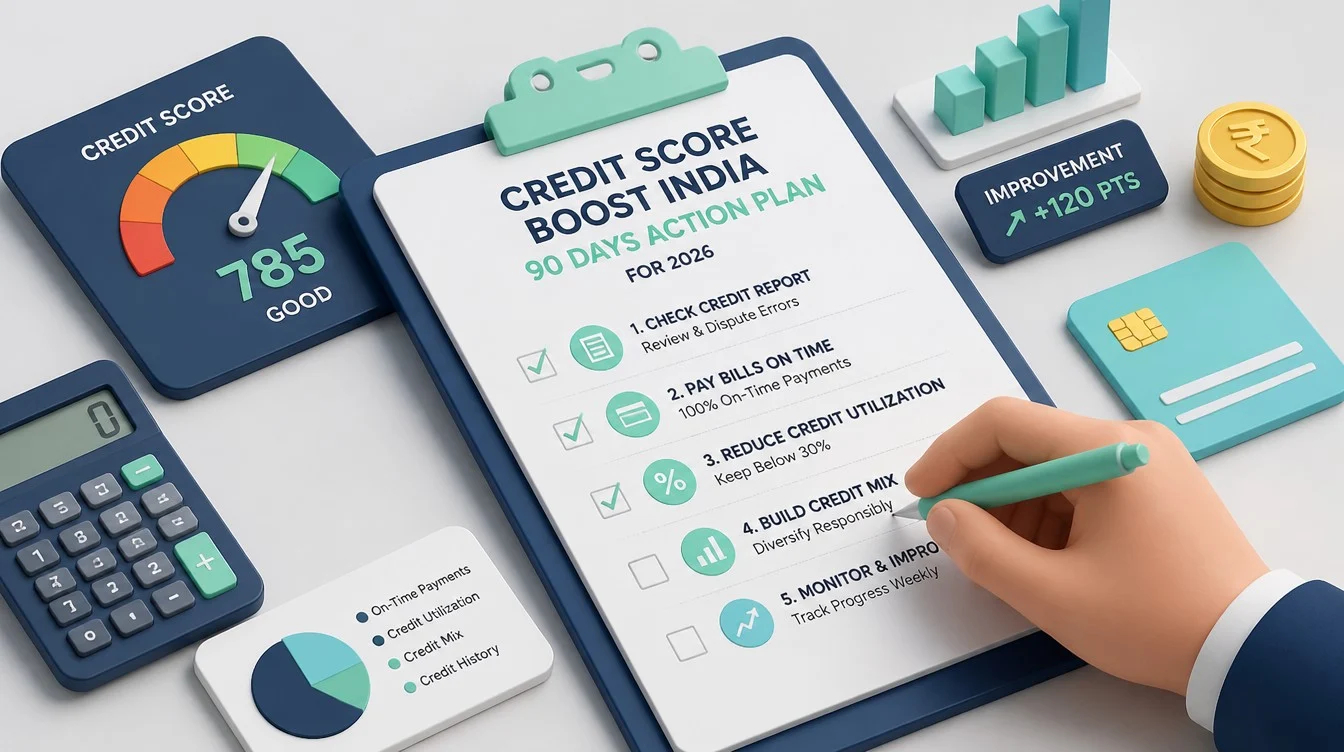
A 90-day window is rarely enough to transform a credit score from 600 to 800, but it is more than enough to move a salaried Indian household’s score by 50 to 150 points in most cases. The credit-bureau machinery in India (CIBIL, Experian, Equifax, CRIF High Mark) updates on monthly billing cycles, which means three full cycles in 90 days are usually sufficient to reflect concrete behavioural changes. A working credit score boost india 90 days plan focuses on three high-leverage levers: credit utilisation, on-time payment behaviour, and credit-report hygiene, while avoiding five common traps that flatten or reverse the gains.
This guide walks through the week-by-week checklist for the 90-day plan, the credit-utilisation math that drives the largest single score component, and the five traps that derail otherwise good plans. The framework assumes a salaried earner with at least one credit card and one loan on the credit report; the principles still apply to thinner files, with a few adjustments.

What Determines an Indian Credit Score
The CIBIL, Experian, Equifax, and CRIF High Mark scores in India typically range from 300 to 900, with 750 and above considered “good” for loan-pricing purposes by most lenders. The underlying factors are similar across the four bureaus.
The five main components
The five components that drive the score, roughly in order of weight, are payment history (whether EMIs and credit-card dues were paid on time), credit utilisation (how much of available credit limits is being used), credit mix and tenure (variety and age of accounts), recent enquiries (loan and card applications), and total credit exposure. The exact weights are not publicly disclosed by the bureaus but payment history and utilisation together account for the bulk of the score.
The 750 threshold
A score of 750 and above generally unlocks the best loan and credit-card pricing from most Indian banks and NBFCs. The 750 to 799 band is the practical sweet spot; the 800 to 850 band adds marginal pricing improvements but rarely meaningfully different terms. Crossing into 750 from below is usually where the largest financial benefit accrues.
The monthly reporting cycle
Banks and NBFCs report customer credit behaviour to the bureaus typically once a month, usually within 7 to 15 days of the statement date. The score is recomputed on a fresh report from any subscriber, which is why scores can move noticeably from one month to the next without any apparent reason. The 90-day window captures three full reporting cycles.
Week 1 to Week 2: Pull the Reports and Map the Baseline
The first two weeks of the 90-day plan are about getting the data right. Without an accurate baseline, the plan optimises against the wrong target.
Pulling the free annual reports
Each of the four bureaus is required to provide one free credit report to consumers per calendar year on request. The reports can be pulled from cibil.com, experian.in, equifax.co.in, and crifhighmark.com respectively, using PAN, date of birth, mobile number, and one verification challenge. Pulling all four is worth the effort because each lender reports to one or two bureaus, and the picture across all four is the complete view.
Mapping every account
The first task is to list every account on every report: each credit card with its limit, statement date, outstanding balance, and payment status; each loan with its principal outstanding, EMI, and on-time status; each closed account in the last seven years. A spreadsheet or a printed worksheet is enough. The list is the map for the next 90 days.
Spotting errors
Bureau reports often contain errors: a closed loan still marked as active, a credit-card limit reported lower than actual, a duplicate account, an old name or address. Errors are disputed through the dispute-resolution mechanism on each bureau’s website, typically with a 30-day resolution timeline. Filing the dispute in Week 1 ensures any correction lands within the 90-day window.
Identifying the levers
The map usually surfaces two or three high-impact issues. The classic patterns to look for are listed below.
- One or two credit cards close to the limit, producing high utilisation.
- A missed payment on a small loan or card in the last 12 months.
- Multiple recent enquiries from comparison-site applications.
- A closed account incorrectly tagged as “settled” rather than “closed”.
The Credit Utilisation Math
Credit utilisation is the single most tractable lever in the 90-day window because it can be changed by behaviour without taking on new credit or closing old accounts.
The 30 percent rule
The widely cited benchmark is that credit-card utilisation should be kept below 30 percent of the card limit at the time the statement is generated. A card with a Rs.2,00,000 (2 lakh) limit should ideally show an outstanding of less than Rs.60,000 on the statement date. The same rule applies at the aggregate level across all cards (total balance across all cards divided by total limits across all cards).
Worked example
| Card | Limit (Rs.) | Current balance (Rs.) | Utilisation |
|---|---|---|---|
| Card A | 2,00,000 | 1,40,000 | 70 percent |
| Card B | 1,50,000 | 30,000 | 20 percent |
| Card C | 50,000 | 10,000 | 20 percent |
| Total | 4,00,000 | 1,80,000 | 45 percent |
In the example, both the per-card utilisation on Card A (70 percent) and the aggregate utilisation (45 percent) are above the 30 percent benchmark. The 90-day action is to pay down Card A to bring it under 30 percent before the next statement date, even if the bills are not yet due, because the statement-date balance is what gets reported.
Paying before the statement, not just before the due date
The single most useful technical tip for credit utilisation is to pay the credit card balance fully (or partially down to under 30 percent of the limit) a few days before the statement-generation date, not just before the due date. The bank reports the balance as it stood on the statement date; paying after the statement but before the due date keeps the account current but does not reduce the reported utilisation.
The limit-increase route
If the household is using a credit card responsibly but the limit is too low relative to monthly spend, requesting a credit-limit increase reduces the utilisation ratio at the same spend level. The request is made to the issuing bank; banks typically grant increases for customers with 12 to 24 months of clean repayment history. The new limit does not require any increase in actual spend; it just lowers the denominator.
Week 3 to Week 8: Behaviour and Payment Hygiene
The middle six weeks of the plan are about putting on-time payment behaviour on rails and starting the utilisation reduction.
Automating every credit-card payment
Setting up auto-debit for the full statement balance on every active credit card eliminates the single most common reason for credit-score damage: a missed payment. The auto-debit should be configured for at least the “minimum due” with a calendar reminder to pay the full balance manually before the statement date. The two-layer approach prevents both late-payment penalties and high reported utilisation.
Standing instructions for EMIs
Every active loan EMI should be on a NACH mandate or standing instruction from the salary account, with the EMI date set 5 to 7 days after the typical salary credit date to allow for any payroll delay. A bounced EMI affects the credit score for months; the preventive cost of automation is essentially zero.
The utilisation step-down plan
If the aggregate utilisation is above 30 percent, plan a three-month step-down: bring it down to 50 percent by end of Month 1, 35 percent by end of Month 2, and below 30 percent by end of Month 3. The path is funded by reducing card spend (using debit or UPI instead of credit for the period) and paying down balances in tranches. The step-down has to land on the statement date, not just the due date.
Disputing any remaining errors
Any errors flagged in Week 1 that have not been corrected by Week 4 to Week 6 should be escalated. The escalation chain runs from the bureau’s online dispute portal, to the bank or NBFC’s customer-service team for the underlying account, to the RBI Banking Ombudsman if the issue is not resolved. The paper trail (acknowledgement of every complaint, with reference numbers) is the case.
Week 9 to Week 12: Re-Pull and Optimise
The last three weeks of the plan are about verification and fine-tuning before the next credit application or loan negotiation.
Re-pulling the report
In Week 10 to Week 12, pull the credit reports again from the bureau or bureaus most likely to be checked by the next lender (CIBIL is the most widely used in India). Compare the new report against the Week 1 baseline. The expected movements are: lower utilisation across cards, no new missed payments, any disputed errors corrected, and a higher score.
What a successful 90-day plan typically delivers
For a starting score in the 650 to 720 range, a disciplined 90-day plan can typically lift the score by 50 to 120 points. The largest contributor is usually the utilisation reduction. The smaller contributors are dispute corrections and the on-time payment record for the new 90 days. Starting scores below 600 or above 780 see smaller absolute moves.
Negotiating with lenders on the new score
If a loan or credit-card application is the target, the new score is a negotiation lever. Lenders typically price loans in bands tied to the credit score; moving from 730 to 770 can translate into a meaningfully lower interest rate on a home loan or personal loan. The negotiation is most effective when the borrower can show both bureaus and a recent statement of clean behaviour.
The post-plan steady state
The 90-day plan should transition into a steady state that maintains the score: aggregate utilisation under 30 percent, every payment on time via auto-debit, an annual report pull to check for errors, and no unnecessary new credit applications. Maintenance is much easier than recovery.

The Five Traps to Avoid During the 90 Days
The same handful of mistakes flatten or reverse otherwise good 90-day plans. Awareness of the traps is half the protection.
Trap 1: Closing old credit cards to “simplify”
Closing an old, low-utilisation credit card reduces the total available limit, which immediately raises the utilisation ratio on the remaining cards. It also shortens the average account age, which is a small but real negative for the score. The rule is: keep old cards open unless they carry a fee that is not justified by their use. Even an unused old card with zero balance contributes positively to the score by lowering the aggregate utilisation.
Trap 2: Applying for multiple loans or cards “to compare offers”
Every formal credit application creates a “hard enquiry” on the credit report, which slightly lowers the score for 6 to 12 months. Four or five enquiries in a 90-day window can shave 10 to 30 points off the score and signal credit-hungry behaviour to lenders. Use pre-approved offers (which are “soft enquiries”) or comparison sites that explicitly check eligibility without a hard pull.
Trap 3: Paying only the minimum due
Paying the minimum due (typically 5 to 10 percent of the statement balance) keeps the account technically current but leaves the remaining 90 to 95 percent revolving at 36 to 42 percent APR. The reported utilisation stays high, the interest cost compounds, and the score gain plateaus. The minimum-due habit needs to be broken first.
Trap 4: Settling a defaulted account instead of paying the full dues
A “settled” tag on the credit report is materially worse than “closed”. A settlement implies that the borrower paid less than the full dues, which signals higher credit risk to future lenders. If a defaulted account can be paid in full (with negotiated waiver of penalties, where possible), the resulting “closed” tag is much better for the long-term score than a “settled” tag, even if it costs a bit more upfront.
Trap 5: Reacting to weekly score updates
Many free credit-score services in India provide near-weekly score updates, which can fluctuate by 5 to 15 points without any meaningful change in behaviour. Reacting emotionally to the weekly noise (closing cards, opening new ones, panicking about small dips) does more damage than good. Check the score monthly at most; the 90-day plan is a quarterly cadence, not a daily one.
Special Situations: Thin Files, NRIs, and Joint Borrowers
The standard 90-day plan assumes a typical salaried Indian credit footprint. Three situations require adjustments.
The thin file: limited credit history
A borrower with only one or two credit accounts (often the case for first-time card holders or younger borrowers) has limited data for the bureau to score. The fastest way to build the file is to use the existing card responsibly for 12 months, then add a second card with a different lender, and let the file thicken over time. There is no shortcut. In the 90-day window, the focus is on clean payment history and very low utilisation on the existing accounts.
The NRI scenario
NRIs (Non-Resident Indians) with Indian credit history can still operate within the bureau system, but the activity is limited to the Indian accounts they hold. Foreign credit history does not transfer to Indian bureaus. NRIs planning to return to India and seek a loan should ensure at least one Indian credit card is active and used regularly during the NRI period.
The joint borrower
For joint loans (typically home loans), each co-borrower’s credit report carries the loan and any missed payment affects both scores equally. The 90-day plan needs to be coordinated between co-borrowers: both should ensure on-time EMIs, low utilisation on their personal credit cards, and no new credit applications during the window. A clean joint borrower file is one of the more powerful tools in any household credit-score strategy.
FAQ
Can my credit score really move by 100 points in 90 days?
For a starting score in the 650 to 720 range, with high utilisation on one or two cards and clean payment history otherwise, a 90-day plan focused on utilisation reduction and any error corrections can produce a movement of 50 to 120 points. Larger gains are possible for borrowers cleaning up specific errors or settled-tag entries. Smaller gains are typical for starting scores above 780 or below 600.
How often should I check my credit score?
Once a month is the practical cadence; once a quarter is the minimum. Checking your own credit score through the bureau or an authorised provider is a “soft enquiry” and does not affect the score. The free annual report from each bureau is a useful annual deep-check; the monthly score services are for tracking trend.
Does closing a credit card hurt my credit score?
Closing a credit card reduces the total available credit limit, which usually raises the aggregate utilisation ratio on the remaining cards and can negatively impact the score by a small but real amount. Older accounts also contribute positively to credit age. The rule of thumb is to keep old cards open unless they carry a fee that is not justified by the card’s benefits, and to close cards only after the main 90-day plan is complete and the score is stable.
Will paying off my credit card before the statement date really show up in my score?
Yes. Banks report the credit-card outstanding as it stood on the statement-generation date, not the due date. Paying down the balance to under 30 percent of the limit 2 to 3 days before the statement date lowers the reported utilisation, which feeds into the next score calculation. This is one of the most reliable behavioural changes in the 90-day plan.
What if my credit report has an error that the bank refuses to correct?
The first step is to file a written dispute with the bureau through its online portal; the bureau is required to investigate and respond within 30 days. If the bureau confirms the bank’s reporting, the next step is to escalate to the bank’s customer service and then to the RBI Banking Ombudsman through the CMS portal. Maintain copies of every communication, screenshots of the disputed entry, and any supporting documents; the paper trail is what carries the case.
Related guides on this topic are coming to learnfinedge.com soon.