

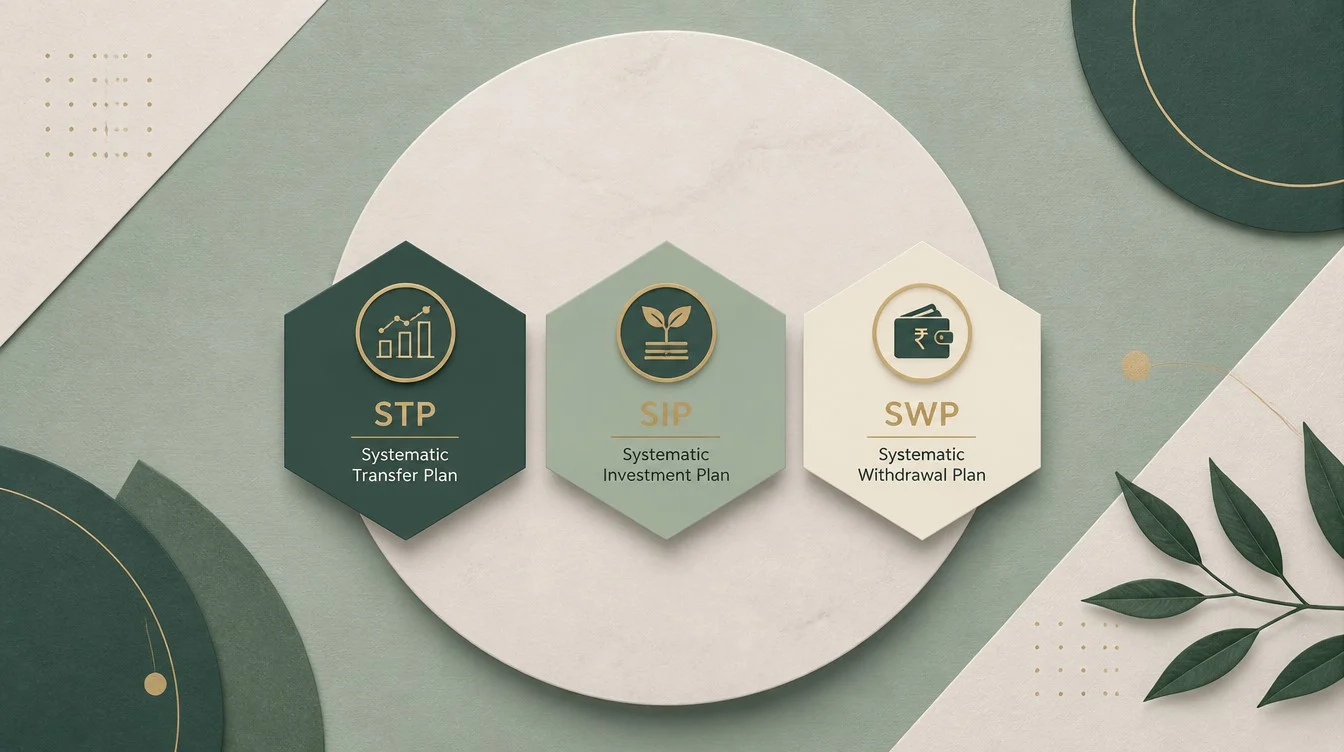
Three of the most useful mutual-fund mechanisms available to Indian investors share a common acronym pattern but solve different problems. SIP is for accumulation: a regular monthly purchase from the bank account into a mutual fund. STP is for staged movement: a regular transfer from one fund to another, usually from a liquid or short-duration fund into an equity fund over 6 to 24 months. SWP is for distribution: a regular withdrawal from a mutual fund into the bank account, typically used in the post-retirement phase. The decision between stp vs sip vs swp india is rarely a question of which is better in the abstract; it is a question of which one fits the investor’s current life stage, market view, and cash-flow need. Market-linked instruments carry market risk; read scheme-related documents carefully before investing.
This guide builds a one-page decision diagram in prose, walks through the tax treatment of each mechanism, and lays out the execution mechanics including the cut-off times and the NAV-applicability rules that determine the price at which the transaction settles. The aim is a working framework that a salaried Indian investor can apply to any portfolio decision in the next 12 months.
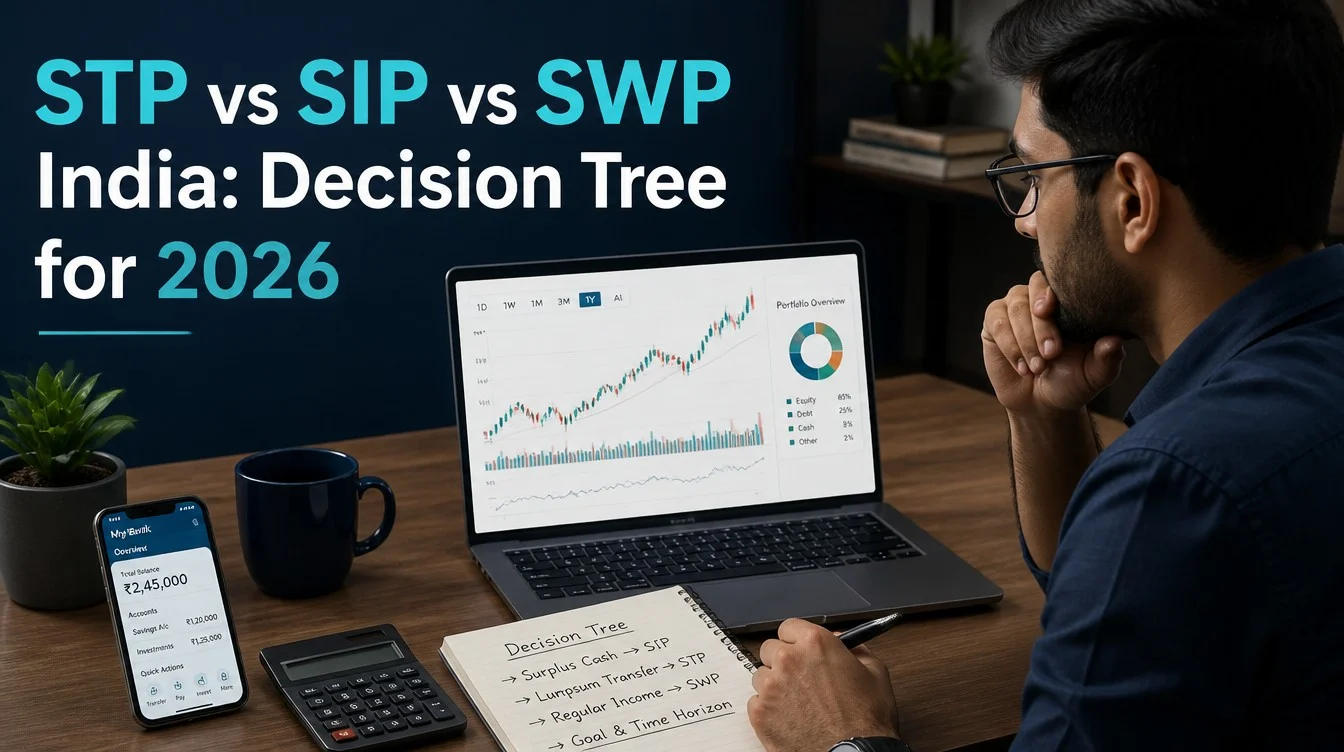
What Each Acronym Actually Means
Before the decision tree, a clean definition of each mechanism, including what it does and what it does not do.
SIP: Systematic Investment Plan
A SIP is a standing instruction to invest a fixed rupee amount into a chosen mutual fund scheme on a fixed date every month (or week or quarter), funded from the investor’s bank account. The amount is debited via NACH or auto-debit, the units are credited at the applicable NAV, and the process repeats until the SIP is paused or stopped. SIPs are the default accumulation tool for most salaried Indian investors.
STP: Systematic Transfer Plan
An STP is a standing instruction within the same AMC to transfer a fixed rupee amount (or fixed number of units) from one mutual fund scheme (the “source”) to another scheme (the “target”) at a fixed frequency. The classic use case is parking a lumpsum in a liquid or ultra-short-duration fund and transferring it into an equity fund in measured instalments over 6 to 24 months.
SWP: Systematic Withdrawal Plan
An SWP is a standing instruction to redeem a fixed rupee amount (or a fixed percentage of value) from a mutual fund scheme at a fixed frequency, with the proceeds credited to the investor’s bank account. SWPs are most often used in the post-retirement or income-drawdown phase, where a fund corpus needs to generate regular monthly cash flow.
How they relate to each other
A typical lifecycle for an Indian household might look like SIPs through the accumulation decades (20s, 30s, 40s), STPs to deploy occasional lumpsums (bonus, inheritance, ESOP proceeds) gradually rather than at once, and SWPs in the distribution phase (60s and beyond) to convert a corpus into regular income. The three are complementary rather than competing.
The Decision Tree in Prose
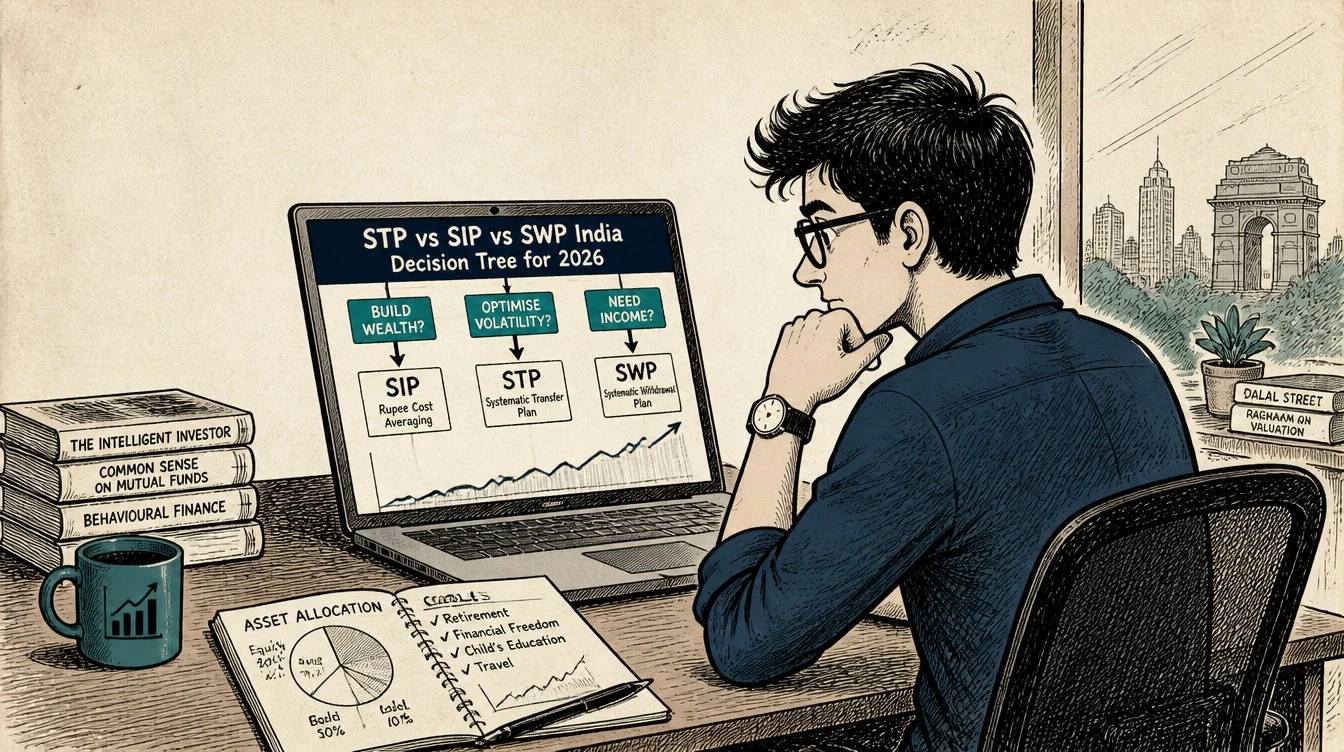
The choice between SIP, STP, and SWP can be reduced to a sequence of three questions. The answers narrow to one of the three (or a combination).
Question 1: Is the money already in a mutual fund, or in the bank account, or being withdrawn from a fund?
If the money is in the bank account and the household wants to add it to mutual funds gradually, the answer is SIP (if monthly from salary) or STP (if a lumpsum that should be deployed over time). If the money is already in a debt or liquid fund and needs to move to equity over a window, the answer is STP. If the money is in a fund and needs to leave for living expenses, the answer is SWP.
Question 2: Is the cash flow from salary or from a one-time event?
Recurring cash flow (salary, rental income, business income) goes via SIP because the source itself is recurring. One-time events (annual bonus, inheritance, sale of property, ESOP exercise) go via STP because the source is lumpy but the deployment should be staggered. A retiree’s monthly need is best served by SWP because the cash flow is going out, not in.
Question 3: What is the time horizon for the deployment or withdrawal?
SIPs continue for the full accumulation horizon (typically 10 to 30 years). STPs typically run for 6 to 24 months and then stop, by which point the source fund is exhausted. SWPs run for the distribution phase, often 15 to 30 years, with the rate adjusted periodically to balance corpus depletion against inflation. The horizon shapes both the choice of source and target funds and the rupee amount per instalment.
The combined picture for a typical salaried household
A 35-year-old salaried investor receiving a Rs.4,00,000 (4 lakh) annual bonus might run a monthly SIP of Rs.40,000 from salary throughout the year and additionally set up a 12-month STP for the Rs.4,00,000 bonus, parked in a liquid fund and transferred at Rs.33,000 per month into a flexi-cap fund. Twenty-five years later, the same investor in retirement might run a Rs.40,000 monthly SWP from the accumulated corpus.

Tax Treatment of Each Mechanism
Each mechanism creates a different set of taxable events, and understanding the trigger points is essential before setting up the standing instruction.
SIP tax treatment
In a SIP, each monthly instalment is a separate purchase with its own holding period. Each unit acquired in January 2026 starts its holding-period clock in January 2026; the same SIP’s December 2026 units start their clock in December. On redemption, capital gains are computed on a FIFO basis (first-in-first-out): the oldest units are deemed redeemed first. For equity-oriented funds, units held for more than 12 months attract long-term capital gains tax under Section 112A of the Income Tax Act, 1961, subject to the per-year exempt threshold and the LTCG rate applicable for that year. Units held for less than 12 months are short-term and taxed under Section 111A.
STP tax treatment
Each STP instalment is a redemption from the source fund and a fresh purchase in the target fund. The redemption triggers a taxable event on the source fund’s gains, computed for the units being redeemed. For debt-oriented source funds under recent Finance Act provisions, gains are taxed at the investor’s slab rate without indexation regardless of holding period for most schemes; for liquid or short-duration funds used as source, the gain per instalment is usually small but is still a taxable event. The fresh purchase in the target fund starts its own holding-period clock.
SWP tax treatment
Each SWP instalment is a partial redemption from the mutual fund, with capital gains computed on the units redeemed. The applicable tax rate depends on the type of fund (equity-oriented vs debt-oriented under current rules) and the holding period of the units being redeemed (FIFO basis). For an equity-oriented fund with units held for more than 12 months, the LTCG rules apply to that portion of the SWP redemption; units held for less attract STCG.
The strategic implication
The most tax-efficient ordering is to start SIPs early (so units accumulate the long-term holding period), use STPs only when the alternative is sitting on a lumpsum that would underperform, and run SWPs only after the underlying units have crossed the 12-month threshold so that withdrawals attract LTCG rather than STCG treatment. Each mechanism has a natural alignment with the corresponding life stage.
Execution Mechanics and Cut-Off Times
The price at which a mutual-fund transaction settles is governed by the NAV applicability rules, which depend on the type of scheme and the time of order.
The cut-off times
For purchase and switch-in transactions in equity-oriented and most other mutual fund schemes, the cut-off time is 3:00 PM. Transactions where the funds are realised in the AMC’s bank account by 3:00 PM on the business day receive the same day’s NAV; transactions realised after the cut-off receive the next business day’s NAV. For liquid and overnight funds, the cut-off rules differ for purchase. For redemption (including SWP and switch-out), the standard cut-off is also 3:00 PM, with same-day NAV applicable for orders placed before the cut-off.
SIP NAV applicability
For a SIP, the standing instruction is processed on the SIP date, and the NAV applicable depends on when the funds are realised in the AMC’s bank account. NACH-based SIPs typically realise funds on the scheduled SIP date itself, so the same day’s NAV applies. The investor cannot influence the SIP NAV timing once the SIP is set up; this is a feature, not a bug, because automation removes timing decisions.
STP NAV applicability
An STP involves two legs: a redemption from the source fund and a purchase in the target fund. Both legs are typically processed on the STP date, with NAV applicability following the standard cut-off rules. Because both the source and target are within the same AMC, the operational settlement is faster than a separate redemption-and-purchase across AMCs.
SWP NAV applicability
For an SWP, the redemption is processed on the SWP date with the same-day NAV (subject to cut-off compliance), and the proceeds are credited to the investor’s bank account typically within T+1 or T+2 business days, depending on the scheme type. The investor should align the SWP date with the date the household actually needs the cash, factoring in the settlement window.
When Each Mechanism Is the Wrong Tool
The same mechanisms that are powerful in the right context can be counter-productive in the wrong one.
When SIP is wrong
SIP is the wrong tool when the investor has a large lumpsum already sitting in the bank account and is using a small monthly SIP to deploy it. The bulk of the lumpsum then sits at the savings-account rate of 2.5 to 3 percent for many months, losing real value to inflation while waiting its turn. The right tool in that case is an STP from a liquid fund.
When STP is wrong
STP is the wrong tool when the household’s actual goal is to deploy a lumpsum into the same broad equity allocation it already has, and the source fund’s expected return for the next 6 to 12 months is barely above the target’s. The STP buys time but does not buy meaningful averaging if the source and target are similarly placed in the cycle. For very large lumpsums where the immediate-lumpsum-into-equity option feels behaviourally too aggressive, STP is a compromise that costs some expected return for some behavioural comfort.
When SWP is wrong
SWP is the wrong tool when the household’s monthly income needs can be met by salary, rental income, or other sources, and the SWP is being used to “lock in” gains during a strong equity year. Booking SWP just because the markets are high creates unnecessary tax events and disrupts compounding. SWPs are best deployed when the household genuinely needs the cash flow.
The combination trap
A household that runs simultaneous SIPs into one fund and SWPs out of another fund within the same AMC is essentially churning money through the tax system. Unless the SIP and SWP are in genuinely different asset categories (an equity SIP for accumulation and a debt-fund SWP for income, for example), the net economic position has hardly moved while two streams of capital gains are being triggered.
Practical Setup Tips
A few small practices make the standing instructions actually work over multiple years.
The setup tips that matter
A short checklist captures the practical tips for each mechanism.
- SIP date 5 to 7 days after salary credit, maximum tenure offered by the AMC, annual step-up of 10 percent.
- STP source in a liquid or ultra-short-duration fund within the same AMC; duration 6 to 12 months in moderate markets, up to 24 months for elevated ones.
- SWP rate of 4 to 6 percent of corpus per year for equity-heavy retirement portfolios, reviewed every 2 to 3 years.
- SWP date matched to the household’s bill-payment cycle.
- Annual review every April for amount, source, target, and underlying scheme fit.
Comparing the Three Side by Side
The table below brings the three mechanisms into one view.
| Dimension | SIP | STP | SWP |
|---|---|---|---|
| Direction of cash flow | Bank to fund | Fund to fund (intra-AMC) | Fund to bank |
| Typical use case | Accumulation from salary | Staggered deployment of lumpsum | Income withdrawal in distribution phase |
| Typical duration | 10 to 30 years | 6 to 24 months | 15 to 30 years |
| Tax event per instalment | No (purchase only) | Yes (redemption from source) | Yes (redemption from target) |
| Operational complexity | Lowest | Moderate (intra-AMC standing instruction) | Moderate (calibration to needs) |
| Right life stage | 20s to 50s | Any with a lumpsum to deploy | Retirement, distribution |
| NAV cut-off | 3:00 PM, subject to fund realisation | 3:00 PM, both legs same day | 3:00 PM for redemption |
The combined household setup
Most salaried Indian households at age 35 to 50 are running SIPs as the dominant mechanism, with one or two short STPs in years where bonuses or windfalls arrive, and no active SWP. The SWP enters the picture in the late 50s or 60s as the household plans the transition from accumulation to distribution. Setting up the SWP a year or two before it is actually needed allows the mechanics to be tested at a small scale before they are relied upon.
Avoiding analysis paralysis
The decision between SIP, STP, and SWP is rarely a fine balance; the right answer is usually obvious once the household clarifies whether money is coming in, sitting in a fund, or going out. The most expensive mistake is to do nothing while debating the choice. A SIP started today at 80 percent of the optimal amount beats a perfectly sized SIP started three months from now.
FAQ
Can I run a SIP and an STP into the same fund at the same time?
Yes. The SIP brings in fresh money from the bank account each month; the STP brings in money from a source fund within the same AMC. The two are independent standing instructions and both can target the same destination fund. The combined cash flow into the destination fund is the sum of the SIP and the STP instalments for the period.
If I switch from one equity fund to another via STP, do I trigger capital gains tax?
Yes. Each STP instalment is a redemption from the source fund and a fresh purchase in the target fund. The redemption triggers capital gains tax on any gains on the units redeemed. For equity-oriented funds, units held for more than 12 months attract LTCG; for less than 12 months, STCG. The tax cost is one of the factors to weigh against the rationale for switching.
Should my SWP be a fixed rupee amount or a fixed percentage of the corpus?
A fixed rupee amount provides predictable monthly income, which is what most retirees want from an SWP. A fixed percentage adjusts for corpus growth or depletion but produces variable monthly cash flow, which is harder to budget against. Most households use a fixed rupee amount with an annual review and a small inflation-linked increment each April. The fixed rupee is the cleaner default.
What is the cut-off time for setting up a SIP or STP order?
For a standing instruction, the relevant cut-off is on the scheduled execution date, not the date the instruction is registered. For purchase orders in equity-oriented and most other schemes, the standard cut-off is 3:00 PM, subject to funds being realised in the AMC’s bank account by that time. Liquid and overnight funds have additional rules. Always check the latest AMC scheme information document for the exact applicable cut-off.
If my SIP fails because of insufficient balance, what happens?
The AMC marks the instalment as missed and does not retry until the next scheduled date. A few consecutive failures can lead the bank to flag or cancel the NACH mandate; some banks also levy a bounce charge per failed debit. Maintaining a salary-day-plus-buffer of at least 5 to 7 days before the SIP date and keeping a small buffer balance in the salary account prevents the cascade. Investors should monitor the SIP debits in the bank statement during the first 3 to 6 months of any new SIP.
Related guides on this topic are coming to learnfinedge.com soon.