

The mutual fund expense ratio 2026 India story is no longer a single Total Expense Ratio (TER) number printed at the bottom of a factsheet. From April 1, 2026, SEBI’s new framework splits the headline cost into a Base Expense Ratio (BER) and a separately disclosed set of statutory levies and transaction costs. The split looks like a small accounting tweak. In practice, it changes how a careful investor compares two schemes, evaluates direct versus regular plans, and reads the real cost of holding a mutual fund through a long-horizon SIP.
This guide walks through what the BER includes, what sits outside it, how the new brokerage caps interact with the BER read, and how direct and regular plans of the same scheme look under the new framework. The numbers used are illustrative of the structure; specific BERs vary by AMC and scheme. Market-linked instruments carry market risk, and read all scheme-related documents carefully.

Why the TER Number Was Hard to Compare Before April 2026
Until April 1, 2026, the TER on every Indian mutual fund factsheet bundled together a long list of items: investment-management fee, distribution commission, trustee fee, custodian fee, audit fee, RTA fee, marketing expenses, and statutory levies such as GST on management fees, plus the impact of certain transaction-related costs. A reader who saw “Regular Plan TER: 1.85%” had no easy way to know how much of that 1.85% was the AMC’s economics, how much was distributor commission, and how much was tax.
The opacity created three problems. First, comparing two regular-plan schemes across AMCs was a like-for-like exercise only at the headline level. Second, the gap between direct and regular plans (the embedded distributor commission) was visible only in aggregate, not in clean form. Third, statutory levies are not negotiable by the AMC; bundling them into TER muddied the management-economics conversation.
The disclosure problem in plain language
Consider two flexi-cap funds with TERs of 1.50% and 1.60%. Are they equally expensive in management terms? Under the old framework, the answer required digging into the scheme’s annual report. Under the new framework, the BER on each factsheet answers the question directly: it is the management-economics number, with everything else separately disclosed.
What the Base Expense Ratio (BER) Includes
SEBI’s framework defines BER as the ongoing fund-management cost charged to the scheme. The components inside the BER are the items the AMC actually controls and competes on.
Components inside the BER
- Investment management and advisory fee paid to the AMC for running the portfolio.
- Trustee fee, registrar and transfer agent (RTA) fee, and custodian fee.
- Audit fee and other recurring administrative expenses.
- Marketing and selling expenses, including the commission paid to distributors for regular plans.
- Additional charges allowed under SEBI’s slab structure for AUM size and B-30 city incentives, within prescribed limits.
Components outside the BER
- Goods and Services Tax (GST) on the management fee.
- Securities Transaction Tax (STT) on portfolio trades.
- Stamp duty on unit allotments and portfolio transactions.
- Brokerage and other transaction costs, subject to the new caps described below.
The total cost to the investor is still the sum of all of these. The difference is that the investor can now see each layer separately on the factsheet and the half-yearly disclosures.

Mutual Fund Expense Ratio: BER vs Old TER Side-by-Side
The cleanest way to read the change is a comparison of the same scheme under the two frameworks. The numbers below are illustrative and describe the structure, not a quoted fee from any specific AMC.
| Cost component | Under old TER (pre-April 2026) | Under new BER (post-April 2026) |
|---|---|---|
| Management and advisory fee | Bundled inside TER | Inside BER |
| Trustee, RTA, custodian, audit | Bundled inside TER | Inside BER |
| Distributor commission (regular plan) | Bundled inside TER | Inside BER |
| GST on management fee | Bundled inside TER | Disclosed separately |
| STT and stamp duty | Reflected in scheme NAV | Disclosed separately and reflected in NAV |
| Brokerage | Up to 12 bps cash, 5 bps derivative | Up to 6 bps cash, 2 bps derivative |
| Headline number on factsheet | TER (bundled) | BER plus separately stated levies |
| Comparison usefulness | Like-for-like only at headline | Like-for-like at each layer |
How to read the new factsheet in 60 seconds
The factsheet from May 2026 onward should show the BER on the first page, the breakdown of items inside it (if the AMC chooses to provide that level of detail) and the separately disclosed statutory levies. A 60-second read should answer four questions: What is the BER? What is the brokerage charged in the last reporting period? What was the GST element? What is the implied total cost of ownership for the most recent 12 months?
Lower Brokerage Caps: Cash 12 to 6 bps, Derivative 5 to 2 bps
The brokerage caps tightened materially under the 2026 framework. SEBI cut the cap on cash-segment brokerage from 12 basis points to 6 basis points and on derivative-segment brokerage from 5 basis points to 2 basis points. The earlier additional five-basis-point allowance linked to exit-load schemes was removed.
What this means for high-churn funds
An equity scheme with high portfolio turnover (say, 100% turnover in a year) used to absorb meaningful brokerage cost at the scheme level. Cutting the cap nearly in half means either the scheme renegotiates brokerage with counterparties (most AMCs already pay below the cap, but some pay near the old ceiling), or the absolute brokerage spend per crore of trades drops, which flows back into NAV.
What this means for low-churn funds
Index funds, large-cap funds with steady portfolios, and target-maturity debt funds have low turnover by design. The brokerage-cap cut is less impactful in absolute rupee terms for these schemes, but the structural cleanup matters.
Why the derivative cap matters
Arbitrage funds, equity-hedge variants of balanced advantage funds, and some categories of debt funds use derivatives meaningfully. The derivative-side cap of 2 basis points (down from 5) tightens the cost ceiling on these strategies. Investors in arbitrage funds should monitor whether the cap change affects the gross arbitrage spread these funds can deliver.
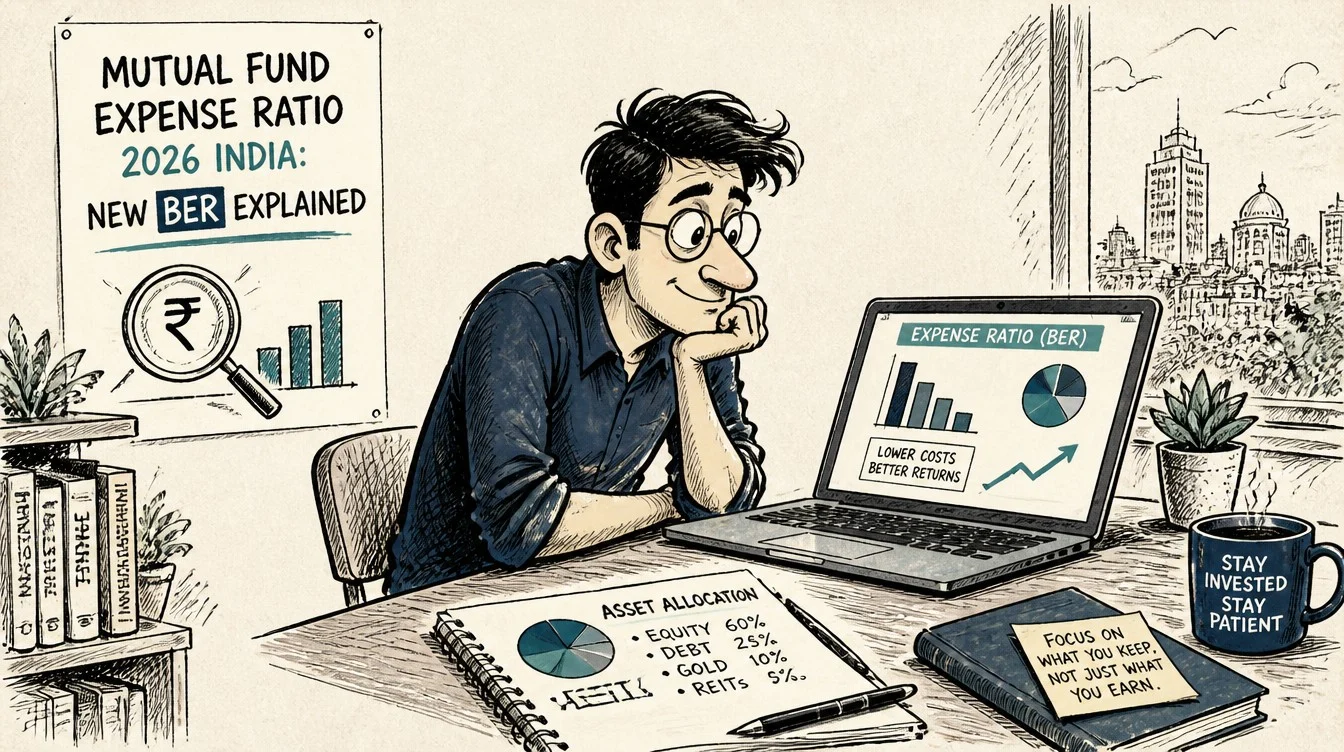
Direct vs Regular Plans Under the New BER Framework
The most-asked retail question is whether the BER changes the direct-vs-regular plan equation. The short answer is that the equation is unchanged in substance, but easier to read.
The distributor commission is now visible by inference
Under the old TER, the regular-plan TER minus the direct-plan TER of the same scheme gave a rough estimate of the distributor commission (gross of distributor’s own taxes). Under the new BER, the same arithmetic works, and the resulting number is cleaner because it is no longer mixed with statutory levies.
A worked illustration
Consider a hypothetical flexi-cap scheme. Under the old TER, the regular plan showed 1.85% and the direct plan showed 0.55%. The 1.30 percentage-point gap was the embedded commission plus the slight differential in some bundled levies. Under the new BER, the regular plan might show BER of 1.62% and the direct plan BER of 0.48%; the gap of 1.14 percentage points is the cleaner distributor-commission read. The statutory levies (GST and others) are now shown separately and apply equally to both plans.
Does direct still beat regular over the long run?
A long-standing principle of personal-finance planning is that cost compounds. A 1 to 1.5 percentage-point annual cost gap, compounded over 15 to 20 years, materially changes the final corpus on an SIP. The new BER does not change this arithmetic; it makes the gap easier to see in the first place. Investors who are comfortable with self-service execution and have access to a paid advisor or a research stack typically prefer direct. Investors who rely on a human distributor for end-to-end handholding accept the regular-plan trail commission as the cost of that service.
Impact on Different Fund Categories
The new framework affects categories differently because the cost mix varies. The headline BER number does not capture everything; the brokerage and turnover characteristics matter.
Equity funds (active)
Active equity funds typically carry the highest BERs in the industry. The new framework caps the management fees implicitly (because total cost competes on the BER number) and explicitly cuts brokerage on the high-turnover end. Active equity funds with strong long-term records can defend higher BERs; new entrants and laggards face pressure to compress.
Index funds and ETFs
Index funds and ETFs already operate at thin BERs (often below 0.30% in direct plans). The new framework is mildly favourable: lower brokerage caps reduce the small drag from index rebalancing trades. The competitive pressure on index BERs in FY 2026-27 should keep them tight.
Debt funds
Debt funds are more sensitive to absolute basis-point levels because their gross returns are tighter than equity. The unbundling of statutory levies and the brokerage-cap cut both help. Debt-fund investors who used to chase 25-basis-point YTM differences should add a BER overlay to the YTM read.
Hybrid and balanced advantage funds
Hybrid funds carry mixed turnover profiles. The derivative-side brokerage-cap cut matters more for balanced advantage funds that hedge equity exposure with futures. The new BER number lets investors compare the explicit fund management cost across hybrid variants more cleanly.
How Investors Should Use the BER Disclosure
The BER is a tool, not a verdict. A patient investor uses it in three ways.
1. Compare schemes within a category
List three or four candidate flexi-cap funds. Compare BER, the separately disclosed brokerage, and the GST element. Choose the scheme with the best risk-adjusted long-term track record at a reasonable BER, not the lowest BER for its own sake. A small BER advantage matters; a large track-record disadvantage matters more.
2. Audit the direct-vs-regular gap on existing holdings
For every regular-plan SIP in the household, compute the direct-vs-regular BER gap on the same scheme. If the gap exceeds 100 basis points and the regular-plan distributor is not providing comparable service value, consider redirecting fresh SIPs to the direct plan. Do not redeem existing units reflexively; the embedded capital-gains tax often outweighs the cost saving in the first year.
3. Re-evaluate high-churn equity funds
A scheme with turnover above 80% per year is now operating under a tighter brokerage ceiling. If the scheme’s manager generates alpha through high-frequency repositioning, the cap may compress that edge. Read the half-yearly portfolio turnover disclosure and consider whether the strategy still suits a long-horizon SIP investor in FY 2026-27.
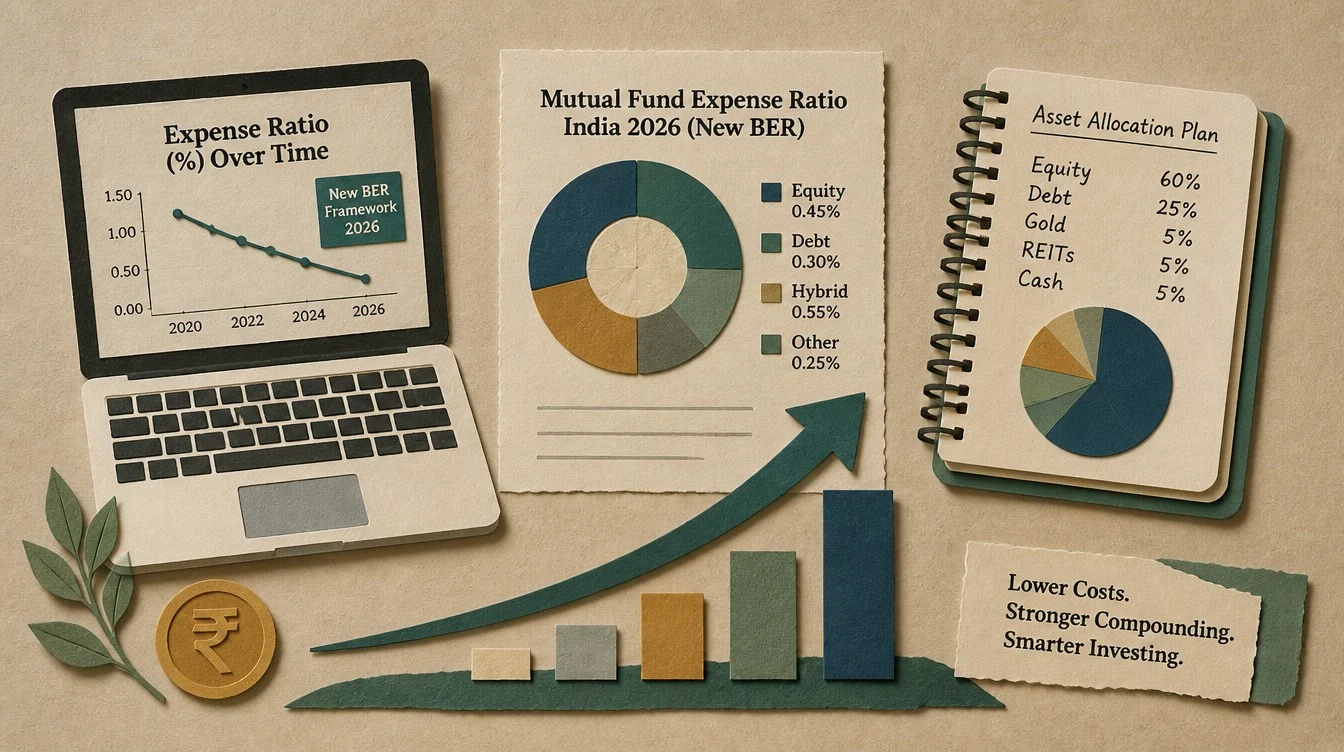
Common Mistakes Investors Make Around Expense Ratios
The new disclosure framework will not eliminate the classic mistakes; it will only make some of them more avoidable. The list below captures the recurring ones.
Mistake 1: Chasing the lowest BER without context
A scheme with a 0.30% BER is not automatically better than one with a 0.55% BER. The first might be an index fund tracking a narrow benchmark with high tracking error; the second might be a well-managed active fund with consistent alpha. Cost matters, but it is not the only number.
Mistake 2: Ignoring statutory levies and brokerage
The BER is the management-economics number. The total cost of ownership includes GST, STT, stamp duty, and brokerage. A high-churn fund with a low BER can still cost more in total than a low-churn fund with a slightly higher BER. Look at the full stack on the half-yearly disclosure.
Mistake 3: Switching to direct just to save cost
Direct plans are cheaper. They are also self-service. An investor who used to lean on a distributor for category selection, asset allocation, and tax-loss harvesting needs to either replace that service or accept that the cost saving is partial. The switch is right for some investors, not all.
Mistake 4: Comparing TER of FY 2025-26 against BER of FY 2026-27
The two are not directly comparable. The TER number bundled levies inside it; the BER does not. A reader who compares “1.85% TER last year vs 1.62% BER this year” without adjusting for the levies that are now separate will overestimate the cost cut. The cleaner comparison is BER plus statutory levies and brokerage now, against the old TER then.
What To Do in the First Three Months After April 1, 2026
The first quarter under the new framework is mostly a reading exercise. A structured approach prevents knee-jerk redemptions and helps the investor extract real value from the new disclosures.
A four-step routine
- Pull the May 2026 or June 2026 factsheet of every mutual fund the household holds. Note the BER for each plan (direct or regular).
- Pull the half-yearly portfolio disclosure for end-March 2026 to see the statutory levies and brokerage charged in the last reporting period. Add to BER for a total cost of ownership estimate.
- Compute the direct-vs-regular BER gap for each scheme. Make a list of regular-plan schemes where the gap is above 100 basis points and where the distributor service is not commensurate.
- For each flagged scheme, decide whether to switch fresh SIPs to direct (often yes), redeem existing units (often no, given capital-gains tax), or have a clearing conversation with the distributor on service expectations.
Three things not to do in the first quarter
- Do not redeem long-held equity units just to reduce expense ratio. The capital-gains hit often exceeds the cost saving for at least one to two years.
- Do not pick schemes purely on BER. Track record, category fit, and overlap with existing holdings matter more in most cases.
- Do not assume the BER will keep falling each year. Cost compression has limits; below a certain BER, the AMC cannot sustain the operations.
Frequently Asked Questions
Is my mutual fund cheaper under the new BER framework?
Possibly, but not automatically. BER is a cleaner disclosure rather than an automatic price cut. Total cost can be slightly lower in some schemes due to lower brokerage caps and tighter governance, but the headline BER number alone is not the whole story. Compare BER plus statutory levies plus brokerage against the old TER for a like-for-like read.
Does the BER apply to both direct and regular plans?
Yes. Each plan has its own BER. Direct plans typically have a lower BER because they do not include distributor commission. The same scheme can have a direct-plan BER of (illustratively) 0.50% and a regular-plan BER of 1.65% under the new framework.
Will index funds in India become even cheaper after April 1, 2026?
Index funds already operate at thin BERs in their direct plans. The new framework reduces the small drag from index rebalancing brokerage. Some AMCs may compete by trimming index BERs further, but the room for cuts is limited and the differences across leading index funds are already narrow.
Should I switch from regular to direct plans immediately?
A switch is a redemption followed by a fresh purchase under Indian tax law, which can trigger capital-gains tax and exit load. The cleaner path for most investors is to stop fresh SIPs into the regular plan, redirect new SIPs to the direct plan, and let the older regular-plan units run down naturally over the long term.
Where do GST and STT show up under the new framework?
GST on the management fee is disclosed separately on the factsheet and half-yearly disclosures. STT and stamp duty are reflected in the NAV (since they apply at the trade and allotment level) and also disclosed in the scheme’s annual report. The new framework does not exempt mutual funds from these levies; it makes them visible as discrete line items rather than burying them inside a single TER number.
Related guides on this topic are coming to learnfinedge.com soon.