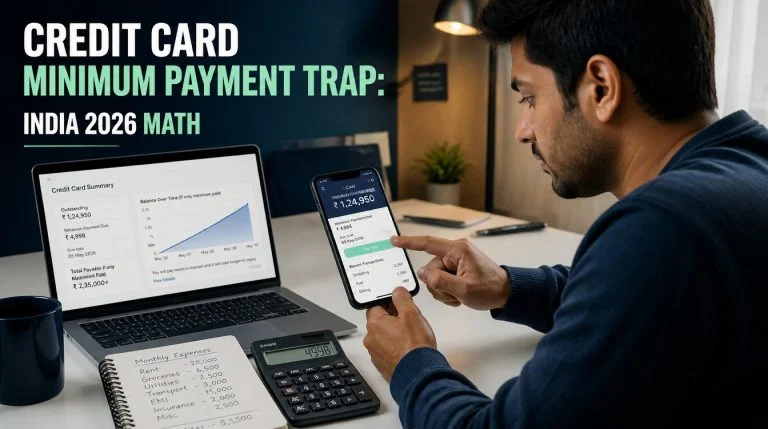

Need Rs. 10 lakh for home renovation, a child’s education, or a medical event? The default for many salaried Indians is to call the salary-account bank and ask for a personal loan. There is often a better option sitting quietly on the existing home loan account. The personal loan vs top up home loan india decision in 2026 can swing the cost of the same Rs. 10 lakh borrowing by a factor of two over a five to ten year tenure.
This guide walks through the rate gap between the two products, the tax interplay under Section 24(b), the paperwork and turnaround differences, and the specific scenarios where each option wins. The aim is a clean checklist a homeowner can use the next time a large expense lands, instead of defaulting to the costlier route.
What a top-up home loan is and how it differs from a personal loan
A top-up home loan is a fresh sanction extended by the existing home loan lender, secured against the same property, on top of the current outstanding principal. The interest rate is anchored to the home loan rate, the tenure is typically aligned with the residual home loan tenure, and the security is the same mortgage. The disbursal is incremental to the existing loan account.
A personal loan is a fully unsecured retail credit product. There is no collateral, the tenure is shorter, the eligibility math is based purely on income and credit score, and the interest rate is materially higher because the bank carries all the credit risk.
Headline differences at a glance
- Security: top-up is secured by your existing mortgage; personal loan is unsecured.
- Interest rate range in 2026: top-up typically 8.40% to 9.50%; personal loan typically 11% to 18%.
- Tenure: top-up up to the residual home loan tenure (often 15-20 years); personal loan capped at 6-7 years.
- Tax benefit: top-up qualifies for Section 24(b) under specific use; personal loan generally does not.
- Turnaround: top-up 7-15 working days; personal loan 1-3 working days (sometimes hours).
Why the rate gap exists
The top-up is secured by the existing mortgage and is offered to a borrower whose payment behaviour is already visible to the bank through the original home loan. Both factors shrink the credit risk, and the bank passes part of that saving back as a lower rate.
Who is eligible for a top-up
Borrowers with a clean repayment record on the base home loan, typically a minimum of 12 to 24 months of on-time EMIs, are usually eligible for a top-up. Some lenders extend the option to borrowers who have completed the registration of the property and a minimum number of EMIs, which can be as low as 6 months in select cases.
Personal Loan vs Top Up Home Loan India: Interest Rate Comparison in 2026
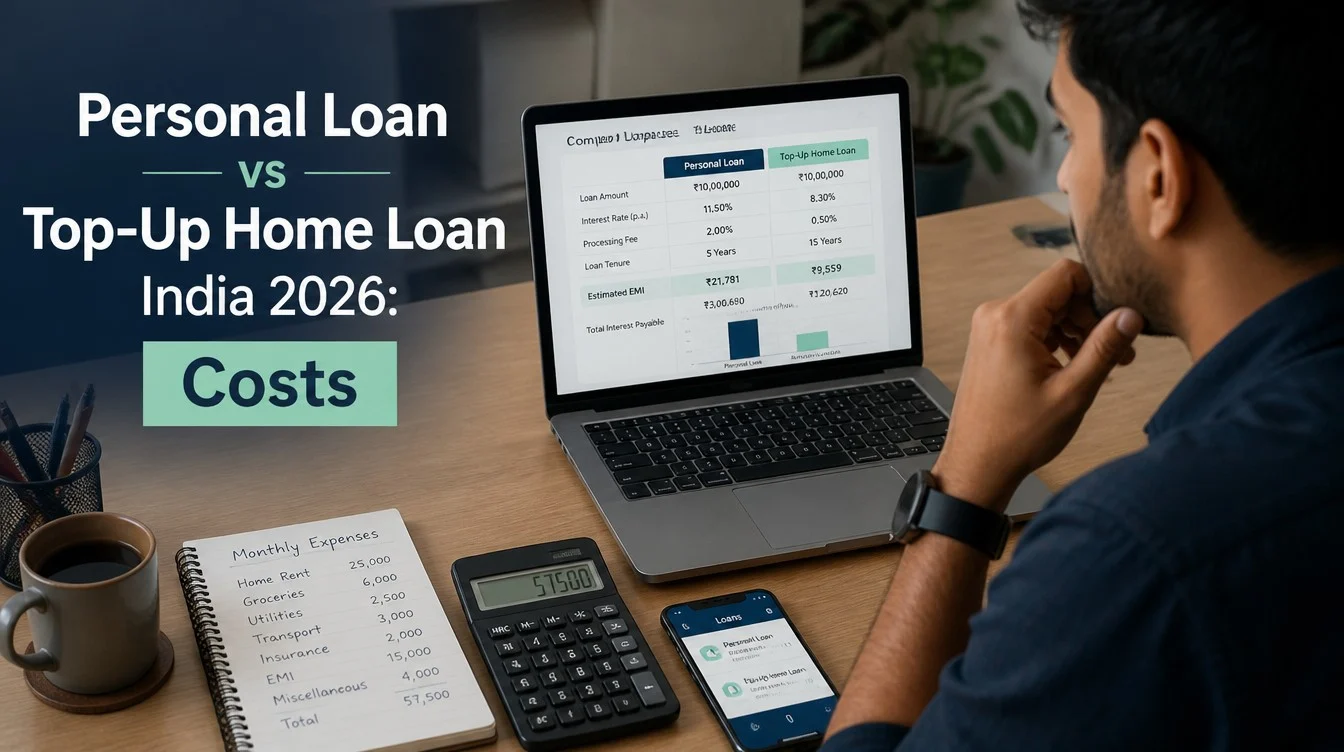
The rate gap is the single biggest variable in this decision. The table below illustrates representative ranges for a salaried borrower with a CIBIL score above 760, taking a Rs. 10 lakh loan from a major Indian bank in 2026.
| Parameter | Top-up home loan | Personal loan |
|---|---|---|
| Typical interest rate | 8.40% to 9.50% | 11.00% to 18.00% |
| Tenure | Up to residual home loan tenure (15-20 yr) | 1 to 6-7 years |
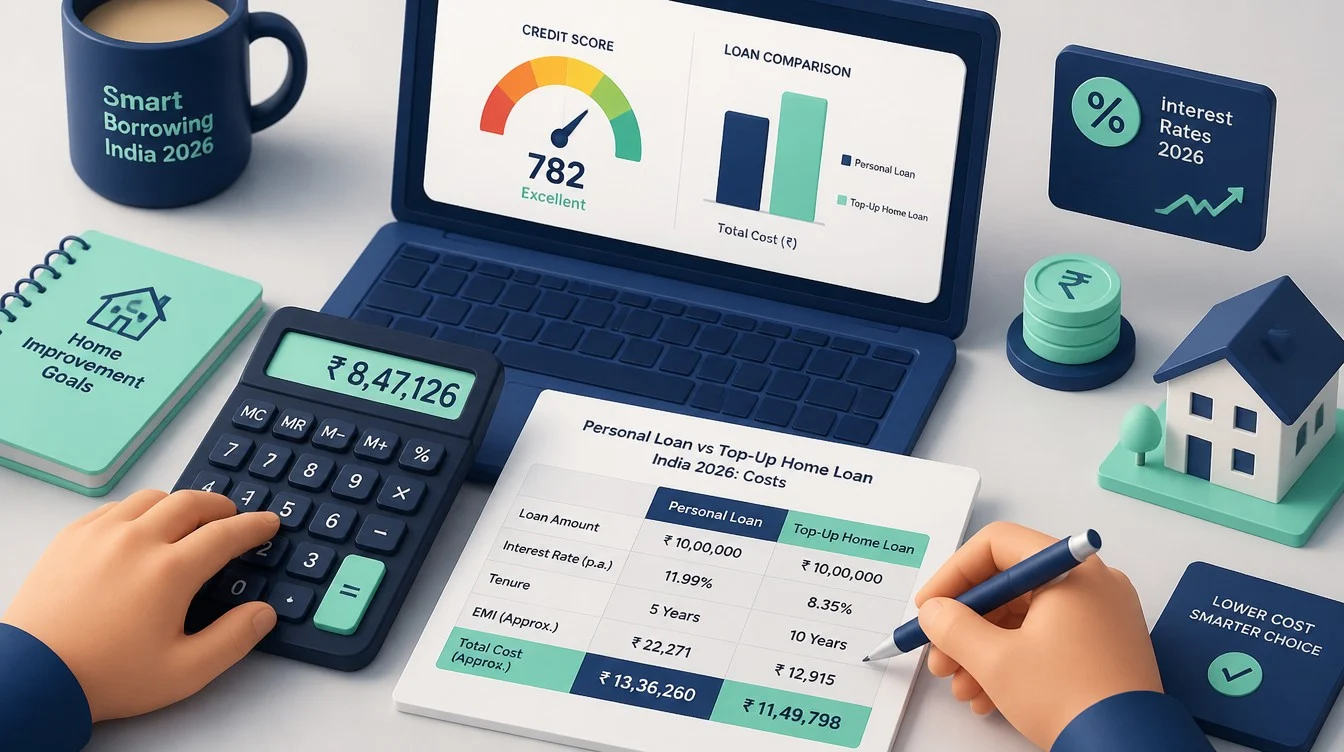
| EMI on Rs. 10 lakh, 7 years | ~Rs. 15,800 at 9.00% | ~Rs. 17,160 at 14.00% |
| Total interest paid over 7 years | ~Rs. 3,27,000 | ~Rs. 4,41,000 |
| Processing fee | 0.25% to 0.50% + GST | 1% to 2.5% + GST |
| Prepayment / foreclosure charges (floating) | Nil for individuals | Nil for floating-rate personal loans to individuals (typical) |
On a Rs. 10 lakh, 7-year horizon, the top-up route saves roughly Rs. 1,10,000 in interest before tax benefits. Once Section 24(b) eligibility is added for qualifying use, the gap widens further for borrowers under the old tax regime.
Why borrowers still pick personal loans
Speed. A salary-account bank can disburse a personal loan within 24 to 72 hours with minimal documentation. A top-up requires a property valuation, a fresh sanction process, and stamp duty on the supplementary loan agreement. For a same-week medical emergency, a personal loan is often the only realistic option.
The compounding tenure advantage
A 15-year top-up at 9.00% on Rs. 10 lakh produces an EMI of about Rs. 10,140. A 7-year personal loan at 14% on the same amount produces an EMI of about Rs. 17,160. The top-up’s longer tenure reduces monthly outflow by Rs. 7,000, which is meaningful for a household juggling other commitments.
The hidden cost of the longer tenure
The longer tenure also extends the total interest cost. A 15-year top-up at 9.00% costs roughly Rs. 8.25 lakh in interest on a Rs. 10 lakh principal, compared with Rs. 4.41 lakh on the 7-year personal loan. A 7-year top-up is the apples-to-apples comparison; the 15-year option only makes sense if monthly cash flow is the binding constraint.
How processing fee changes the math
Personal loans frequently carry a processing fee of 1% to 2.5% plus 18% GST. On Rs. 10 lakh, that is Rs. 11,800 to Rs. 29,500 deducted upfront. A top-up at 0.25% to 0.50% caps the upfront cost between Rs. 2,950 and Rs. 5,900. The fee shifts the break-even on smaller loans.
Section 24(b) and the tax-benefit angle
The tax benefit is the second decisive variable, and it applies only under the old tax regime. Section 24(b) of the Income Tax Act allows a deduction on home loan interest for a self-occupied property up to Rs. 2,00,000 per financial year, with no cap for let-out properties (subject to the overall Rs. 2 lakh house-property loss set-off).
A top-up home loan can qualify for this benefit, but only if the funds are used for the purchase, construction, repair, renovation, or extension of the residential property. Funds used for a wedding, vacation, or general personal expenses do not qualify.
Top-up tax benefit for self-occupied property
For a self-occupied house, the interest on a top-up loan used for repair or renovation is deductible up to Rs. 30,000 per year, and this amount is subsumed within the overall Rs. 2,00,000 Section 24(b) ceiling. A borrower who has already maxed out the Rs. 2 lakh limit on the base home loan does not get an incremental benefit from the top-up.
Top-up tax benefit for let-out property
For a let-out or deemed-let-out property, there is no per-loan-component cap on interest deductibility under Section 24(b). The Rs. 2,00,000 cap applies to the net loss from house property that can be set off against other income, with any excess carried forward for up to eight assessment years.
Documentation required to claim the deduction
Borrowers must retain the top-up sanction letter, the bank’s annual interest certificate, and proof of how the funds were used (invoices from contractors, receipts for material, agreements for property purchase). The Income Tax Department can call for these during scrutiny.
Section 80C on principal repayment
Principal repayment on the top-up qualifies for Section 80C up to the overall Rs. 1,50,000 ceiling, again only if the funds are used for the qualifying purpose and the borrower is under the old tax regime.
Personal loan tax angle
Personal loan interest is generally not deductible. A narrow exception exists: if a personal loan is demonstrably used to repair, renovate, or construct a residential property, the interest can be claimed under Section 24(b) within the same Rs. 30,000 sub-limit for self-occupied homes. The lender does not issue a “home loan” interest certificate, which makes documentation harder. Most borrowers do not claim it.
Paperwork and turnaround compared
The paperwork differential is the biggest reason personal loans win on convenience. A top-up brings the property back into the picture, which means a fresh valuation, a fresh legal opinion in many cases, and a fresh stamp duty on the supplementary loan agreement.
Top-up documentation checklist
- Application form and KYC refresh.
- Last 6 months’ salary slips and last 6 months’ bank statements of the salary account.
- Form 16 for the previous two financial years.
- Property valuation report (paid for by the borrower, typically Rs. 2,000-Rs. 5,000).
- Fresh legal title clearance, if the base home loan was sanctioned long ago.
- Latest property tax receipts and society no-objection certificate.
- Stamp duty on the supplementary loan agreement (state-specific; ranges from 0.1% to 0.3% of the top-up amount in most states).
Personal loan documentation checklist
- Application form and KYC refresh.
- Last 3 months’ salary slips and last 6 months’ salary-account bank statements.
- Form 16 for the previous financial year.
- End-use declaration in some cases (lender-specific).
Realistic turnaround windows in 2026
For an existing home loan customer with a strong repayment track, a top-up sanction takes 7 to 15 working days. A personal loan from the salary-account bank typically takes 1 to 3 working days, sometimes a few hours when the borrower already has a pre-approved offer.
Where digital lenders fit in
Some non-banking finance companies and fintech lenders disburse personal loans in under 24 hours via fully digital pipelines. Rates are usually at the higher end of the personal loan range (15% to 20%), and ticket sizes are capped at Rs. 5 lakh to Rs. 10 lakh.

Scenarios where the top-up clearly wins
The top-up route is the right pick when the use of funds aligns with the qualifying purposes under Section 24(b), the timeline can absorb a two-week sanction window, and the residual home loan tenure is long enough for the rate advantage to compound.
Home renovation or extension
This is the textbook fit. The funds qualify for Section 24(b) within the Rs. 30,000 sub-limit for self-occupied properties, the rate is materially lower than a personal loan, and the work itself adds value to the property securing the loan. Most banks ask for renovation invoices to release tranches.
Construction of an additional floor
A top-up to fund the construction of an additional floor on an existing property typically qualifies for the full house-property interest deduction (within the overall ceiling) and is offered at the base home loan rate plus a small premium.
Buying a second property
If the use of the top-up is to fund the down payment or part-payment for a second residential property, the interest is deductible against the rental income (or notional rental income) from that property under Section 24(b). The top-up rate is often lower than what the borrower would get on a fresh standalone home loan for the second property.
Long-horizon, large-ticket expenses
Any expense above Rs. 8 lakh with a payback horizon longer than five years and no immediate cash crunch favours the top-up. The rate gap of 3 to 6 percentage points compounds into substantial savings.
Borrowers with maxed personal loan eligibility
The personal loan eligibility math caps total unsecured borrowing at a multiple of net monthly income, typically 12 to 24 times. A borrower close to that ceiling cannot take more personal credit but can usually still access a top-up because it is secured.
Scenarios where a personal loan still wins
Speed, smaller ticket sizes, and use-of-funds outside the qualifying purposes all favour a personal loan. Each scenario has its own arithmetic.
Medical or family emergencies
When funds are needed within 24 to 72 hours, the top-up timeline simply does not work. A personal loan from the salary-account bank, or a digital lender, is the realistic option. The higher rate is the cost of speed.
Wedding, vacation, or non-property uses
These uses do not qualify for Section 24(b), so the tax-benefit advantage of a top-up disappears. The pure rate comparison still favours the top-up, but the documentation overhead and the longer turnaround often tilt the choice toward a personal loan for smaller ticket sizes.
Small ticket sizes under Rs. 3 lakh
The fixed costs of a top-up (valuation, stamp duty, legal opinion) erode the rate advantage on smaller amounts. A Rs. 2 lakh top-up may end up costing nearly as much as a Rs. 2 lakh personal loan once the upfront fees are netted in.
Short tenure under 24 months
For a payback intended in under two years, the absolute interest cost is small regardless of the rate, and the convenience of a personal loan dominates. Top-ups also do not usually run on tenures shorter than the residual home loan tenure.
When the property is part-let to family members
Where the property’s status creates complications (joint ownership disputes, pending mutation, society NOC delays), the top-up sanction can stall. A personal loan sidesteps the property paperwork entirely.
The combined-effective-cost framework
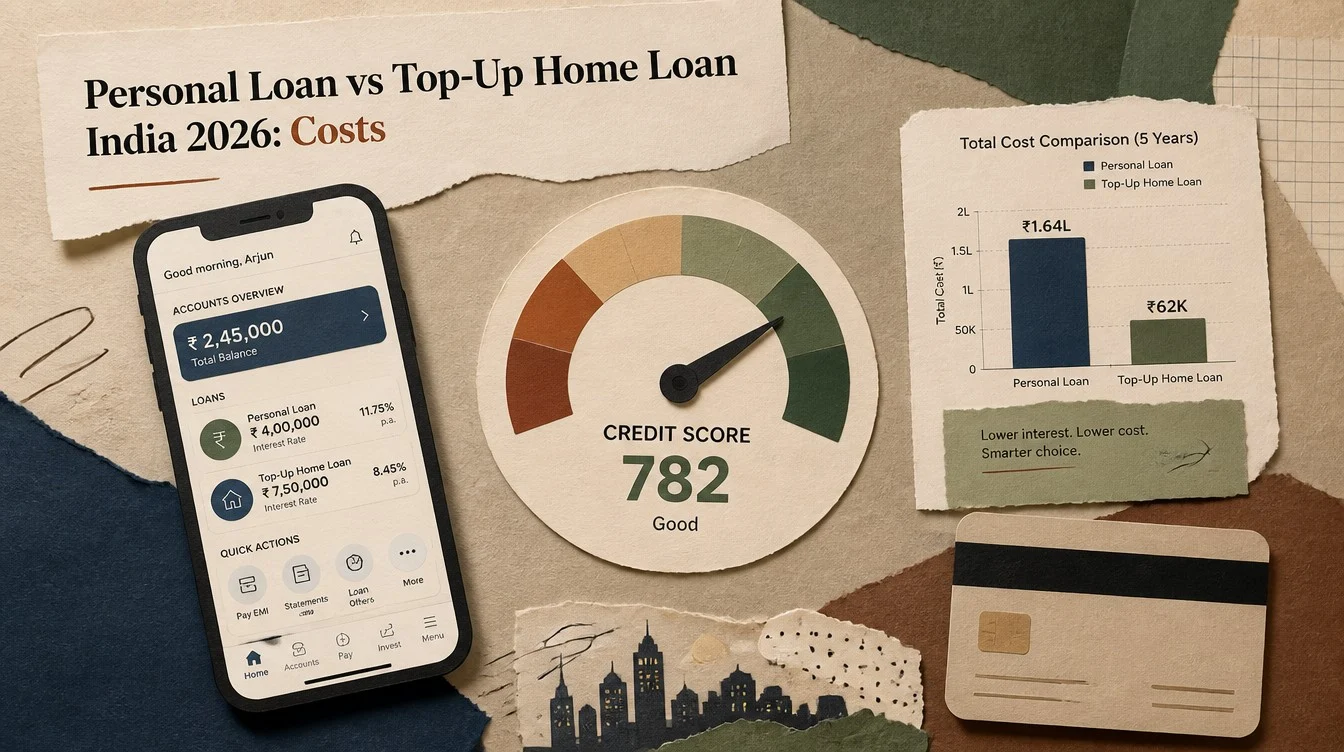
The cleanest way to choose between the two is a single number: the combined effective cost over the intended tenure, net of tax benefits and upfront fees. The framework below works on a spreadsheet in fifteen minutes.
Step 1: Equalise the tenure
Compare the two options at the same tenure. A 7-year top-up versus a 7-year personal loan is a fair fight. A 15-year top-up versus a 7-year personal loan is a comparison of EMI affordability, not cost.
Step 2: Layer in the pre-tax interest cost
Use a standard EMI calculator or an amortisation spreadsheet to compute the total interest paid over the full tenure for each option at the offered rates.
Step 3: Subtract the tax benefit, if any
If the use of funds qualifies under Section 24(b) and the borrower is under the old regime, multiply the annual interest deductible (capped at the relevant sub-limit) by the borrower’s marginal tax rate and the number of years. Subtract this from the gross interest cost of the top-up.
Step 4: Add upfront fees
Add processing fee, stamp duty on the top-up’s supplementary agreement, valuation fee, and legal opinion fee to the top-up side. Add processing fee and any insurance bundled into the loan to the personal loan side.
Step 5: Compare the bottom line
The lower combined-effective-cost number wins, with one caveat: if the difference is below 10% and the timeline is tight, convenience may still justify the personal loan.
Worked example
Rs. 10 lakh, 7 years, salaried borrower in the 30% old-regime slab, top-up used for renovation. Top-up at 9.00% costs Rs. 3,27,000 in interest. The Section 24(b) benefit on Rs. 30,000 per year for 7 years, at the 30% marginal slab, is roughly Rs. 63,000 in tax saved. Net top-up cost is about Rs. 2,64,000 plus Rs. 5,000 in fees, total Rs. 2,69,000. Personal loan at 14% costs Rs. 4,41,000 in interest plus Rs. 15,000 in fees, total Rs. 4,56,000. The top-up wins by roughly Rs. 1,87,000 over the seven-year horizon.
Common mistakes Indian borrowers make in this decision
Mistakes here are usually about defaults, not preferences. The top-up exists, but no one tells the borrower about it at the point of need.
Not asking the existing home loan bank first
Banks rarely volunteer the top-up option. Borrowers default to the personal loan because it is what their salary-account dashboard advertises. A single phone call to the home loan relationship manager is enough to surface the top-up offer and rate.
Treating the top-up rate as fixed
The top-up rate is usually the base home loan rate plus a small premium. The premium is negotiable for borrowers with a strong CIBIL score and a clean repayment record. Ask for it.
Ignoring the tax benefit because the regime defaulted to new
The new tax regime is the default for most filers from FY 2025-26 onwards, but borrowers can still opt for the old regime if the math favours them. A meaningful home loan plus a top-up for qualifying use can flip the regime decision.
Mixing use of funds and breaking the tax claim
If part of the top-up is used for renovation and part for a wedding, the deduction is available only on the renovation portion, and the documentation must clearly split the use. Mixing use without records often kills the entire claim under scrutiny.
Picking a top-up tenure that drags into retirement
A 15-year top-up taken at age 50 lands the EMI well into retirement. Match the tenure to the income horizon, not to the residual home loan tenure mechanically.
Quick decision rules
For borrowers who do not want to build a spreadsheet, the rules of thumb below cover most situations.
Rule 1: Use of funds is renovation, extension, or property
Default to a top-up unless the timeline is binding. The combination of a lower rate and Section 24(b) eligibility almost always wins.
Rule 2: Use of funds is non-property, ticket size above Rs. 5 lakh
Compare net interest cost at the same tenure. The top-up still usually wins on pure rate, but the tax-benefit edge is gone.
Rule 3: Use of funds is non-property, ticket size under Rs. 3 lakh
The personal loan is usually fine. Fixed costs of the top-up eat the rate advantage at small ticket sizes.
Rule 4: Timeline under one week
The personal loan is the only realistic option. The cost of speed is roughly 4 to 7 percentage points of additional APR, which is the price of certainty for a tight emergency.
Rule 5: Borrower already at unsecured-credit ceiling
The top-up is the only viable option. Use it carefully and stick to the qualifying purposes to retain tax benefits.
FAQ
What is the typical interest rate gap between a top-up home loan and a personal loan in 2026?
In 2026, top-up rates from major Indian banks sit in the 8.40% to 9.50% band for prime borrowers, while personal loan rates run between 11% and 18% depending on score and lender. The pure rate gap is typically 3 to 6 percentage points, before fees and tax benefits.
Can a top-up home loan be used for any purpose?
Most banks allow flexible end-use for a top-up, including non-property expenses like education, medical events, or weddings. The tax benefit under Section 24(b), however, is restricted to use for purchase, construction, repair, renovation, or extension of a residential property.
How much tax can be saved on a top-up home loan?
For a self-occupied property used for repair or renovation, up to Rs. 30,000 per year of top-up interest is deductible under Section 24(b), within the overall Rs. 2,00,000 ceiling. For let-out properties, there is no per-loan cap on interest, subject to the Rs. 2,00,000 house-property loss set-off.
Is there a foreclosure penalty on a top-up home loan?
Floating-rate top-up home loans to individual borrowers carry no foreclosure or prepayment penalty under RBI rules. Fixed-rate top-ups may carry a penalty in the range of 2% to 4% of the outstanding amount, subject to the sanction letter.
How long does a top-up home loan take to disburse?
For an existing customer with a clean repayment record, a top-up sanction typically takes 7 to 15 working days, including a fresh property valuation. Personal loans from the salary-account bank are usually disbursed within 1 to 3 working days.
Related guides on this topic are coming to learnfinedge.com soon.