

The economics of paying off a loan early in India changed materially with RBI’s directions on prepayment charges that took effect from 1 January 2026. For most retail floating-rate loans to individuals, prepayment and foreclosure charges have been prohibited; for fixed-rate loans and certain other categories, charges are still permitted but must be disclosed cleanly in the Key Facts Statement and loan agreement. Understanding the loan foreclosure penalty rbi india 2026 framework is the difference between paying Rs.50,000 in needless penalties on an Rs.40,00,000 home loan part-prepayment and paying nothing at all.
This guide walks through the new framework category by category (home loan, personal loan, auto loan, education loan, gold loan, MSE loan), the floating-versus-fixed treatment, the part-payment frequency rules, and the practical steps to claim the zero-charge benefit where it applies. The aim is a working understanding for the salaried Indian borrower who is considering a part-prepayment or a full foreclosure in the next 12 months.
What Changed on 1 January 2026
RBI issued directions on prepayment charges on loans, which became applicable for loans sanctioned or renewed on or after 1 January 2026. The directions prohibit prepayment or foreclosure charges on floating-rate term loans to individual borrowers (and to certain micro and small enterprises), regardless of the source of funds used for the prepayment.
The basic prohibition
For a floating-rate term loan sanctioned or renewed on or after 1 January 2026 to an individual borrower for a non-business purpose, the lender cannot levy a prepayment or foreclosure charge. The borrower can foreclose the loan in full or make a part-prepayment of any amount, at any time after disbursement, without paying a penalty to the bank or NBFC.
Why the change matters
Under the earlier regime, banks and NBFCs were prohibited from charging foreclosure penalty on floating-rate loans only for certain categories (notably individual home loans). Personal loans, education loans, and many other floating-rate retail loans carried prepayment penalties of 2 to 5 percent of the outstanding principal, which could amount to Rs.15,000 to Rs.50,000 on a typical loan. The 2026 directions extend the protection significantly.
What did not change
Fixed-rate loans are still permitted to carry prepayment charges, subject to disclosure. Loans sanctioned before 1 January 2026 continue to operate under their original terms unless the loan is renewed after the cut-off date. Specific categories (foreign currency loans, export credit, business loans above defined thresholds for non-MSE borrowers) are outside the scope of the new directions.
Floating Rate vs Fixed Rate: The Single Most Important Distinction
The treatment of prepayment under the 2026 directions depends primarily on whether the loan is on a floating or fixed interest rate. This is the first thing to verify in the loan agreement.
Floating-rate loans
A floating-rate loan has an interest rate linked to an external benchmark (the repo rate is the most common reference for retail loans in 2026 under the EBLR framework introduced in 2019) or to a bank-internal MCLR. The rate moves up or down with the benchmark; the EMI typically adjusts in tenure or, less commonly, in amount. For these loans sanctioned or renewed on or after 1 January 2026 to individual borrowers (and many MSE borrowers), prepayment charges are prohibited.
Fixed-rate loans
A fixed-rate loan has an interest rate that does not change for the loan tenure or for a defined initial period. Prepayment charges on fixed-rate loans are still permitted under the new directions, subject to clean disclosure. Typical charges range from 2 to 5 percent of the principal outstanding, plus applicable GST.
Hybrid loans
Some loans, particularly home loans, offer a hybrid structure: fixed rate for an initial 3 to 5 years, then floating. The treatment under the 2026 directions depends on the rate regime in effect at the time of prepayment. During the fixed period, charges may apply per the agreement; during the floating period, the prohibition applies for loans sanctioned or renewed on or after 1 January 2026.
How to verify the rate type
The loan sanction letter and the Key Facts Statement (KFS) explicitly state whether the loan is on a floating or fixed rate, and the benchmark used in the floating case. The bank’s mobile or net banking app also typically displays the current interest rate and the reset schedule. If in doubt, a formal letter to the branch requesting confirmation produces a paper record.
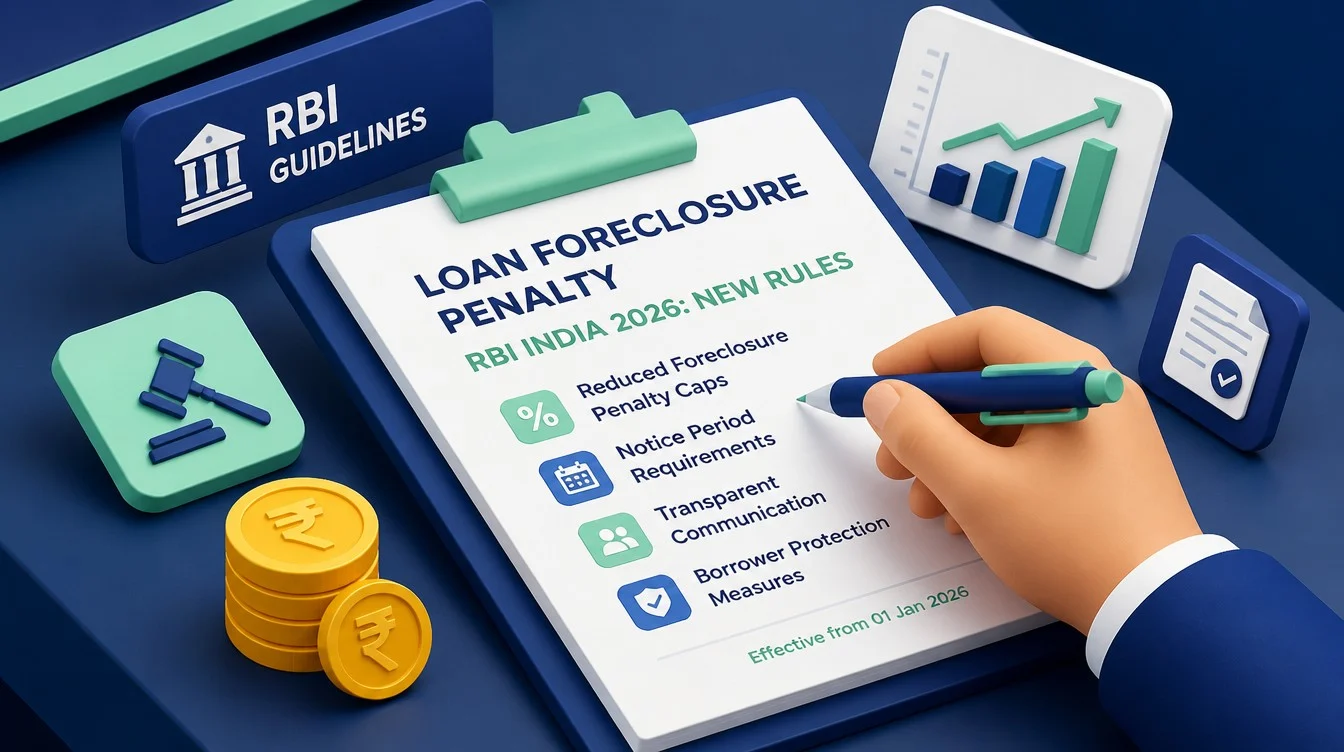
Category-Wise Treatment of Loans Under the 2026 Rules
The table below summarises the prepayment and foreclosure treatment by loan category for loans sanctioned or renewed on or after 1 January 2026. Individual readers should always cross-check against the loan agreement and the lender’s Key Facts Statement.
| Loan category | Floating-rate treatment | Fixed-rate treatment |
|---|---|---|
| Home loan (individual) | No prepayment / foreclosure charge | Charges permitted per loan agreement |
| Personal loan (individual) | No prepayment / foreclosure charge | Charges permitted per loan agreement |
| Auto loan (individual) | No prepayment / foreclosure charge | Charges permitted per loan agreement |
| Education loan (individual) | No prepayment / foreclosure charge | Charges permitted per loan agreement |
| Loan against property (individual, non-business) | No prepayment / foreclosure charge | Charges permitted per loan agreement |
| Gold loan (individual) | No prepayment / foreclosure charge | Charges permitted per loan agreement |
| MSE working capital or term loan | No charge if covered by directions | Charges permitted per loan agreement |
| Foreign currency loan | Outside scope; per agreement | Outside scope; per agreement |
Pre-2026 loans
For loans sanctioned before 1 January 2026 and not renewed after, the original loan agreement governs the prepayment charges. The earlier RBI guidance prohibited foreclosure charges on individual floating-rate home loans even before 2026; other categories under older sanctions may still carry the contractual charges. A 10-minute reading of the sanction letter clarifies the position.
The “renewed” trigger
A loan that is restructured, renewed, or converted on or after 1 January 2026 brings the new directions into play. Borrowers with older loans who are negotiating a rate reduction or a tenure extension can ask the lender whether the renewed terms include the no-foreclosure-charge benefit, since the renewal itself triggers the new regime.
Part-Payment Frequency and Quantum Rules
RBI directions do not specify a minimum or maximum frequency for part-payments under the new regime, but lender-level policies often impose practical limits.
Typical lender part-payment rules
Most banks and NBFCs allow part-payments on a monthly or quarterly basis through net banking, with a minimum part-payment amount typically set between Rs.5,000 and Rs.50,000 depending on the lender. Some lenders restrict the number of part-payments to one or two per quarter to limit operational overhead. These are lender-level rules, not RBI rules.
Cumulative part-payment cap
Some lenders cap cumulative part-payments at a percentage of the principal outstanding per financial year (e.g., 25 percent of the principal in a single year). The cap is rarely an issue for typical salaried borrowers making annual lumpsum part-prepayments from the bonus, but matters for borrowers planning aggressive multi-tranche prepayments.
Tenure reduction vs EMI reduction
When a part-prepayment is made, the borrower can usually choose between reducing the EMI (keeping the original tenure) or reducing the tenure (keeping the original EMI). Tenure reduction produces materially higher interest savings over the life of the loan for the same prepayment amount and is the standard recommendation. The choice should be made explicitly in writing at the time of the part-payment.
The 30-day rule for confirmation
A part-payment should be confirmed by the lender within a defined period, typically 5 to 30 days, with a revised amortisation schedule reflecting the reduced principal and revised tenure or EMI. Borrowers should retain the revised schedule and the part-payment receipt as the paper trail.
The Practical Foreclosure Process
Full foreclosure is the process of closing the loan in full before the original tenure ends. The steps are similar across most lenders, with minor variations.
Step by step
- Request a foreclosure quote from the lender, which states the principal outstanding, accrued interest up to the foreclosure date, any applicable charges (zero for eligible floating-rate loans), and the total amount payable.
- Verify the quote against the loan account statement and the original sanction letter.
- Pay the foreclosure amount through the prescribed channel (net banking, NEFT, RTGS) on or before the quoted valid-till date.
- Obtain a “no dues certificate” from the lender within the prescribed timeline.
- For secured loans (home, auto, LAP), collect all original title documents and security papers from the lender and confirm the lien release.
- For home loans specifically, ensure the encumbrance entry at the sub-registrar office is updated to reflect the loan closure.
Documents to collect after foreclosure
The “no dues certificate” is the primary post-foreclosure document. For home loans, the original property documents (sale deed, prior chain of title, EC, and any other documents held by the lender as security) must be returned within a defined period. For auto loans, the lien removal on the RC (Form 35) is the key document. For LAP, the property documents and the lien-release letter are required.
CIBIL and credit bureau update
After foreclosure, the loan should be reported as “closed” or “settled – closed” to the credit bureaus (CIBIL, Experian, Equifax, CRIF High Mark) by the lender. The borrower should pull a credit report 45 to 60 days after foreclosure to verify the update. Any incorrect “settled” tag (which implies a non-payment settlement rather than a clean closure) should be raised with the lender for correction.
When Foreclosure Is and Is Not a Good Idea
The new RBI rules remove the foreclosure charge for many categories, but the foreclose-versus-invest decision still depends on the loan’s interest rate, the investor’s expected after-tax returns, and the household’s liquidity needs.
When foreclosure makes sense
Foreclosure is usually attractive when the loan’s effective interest rate (post-tax for home loans under the old regime where Section 24(b) benefit applies) is higher than the after-tax expected return on the alternative deployment. A personal loan at 14 to 18 percent or a credit-card balance at 36 to 42 percent should generally be paid down before adding to equity SIPs. A home loan at 8 to 9 percent floating is a closer call.
When part-payment beats full foreclosure
For most salaried households, a series of annual part-payments funded by the bonus is more practical than a single full foreclosure. Part-payments preserve the credit history (an active loan being paid on time is a positive signal), maintain liquidity, and capture the interest saving incrementally.
The emergency-fund check before foreclosure
Before deploying surplus cash to foreclose a loan, ensure the emergency fund (six months of household expenses in liquid form) is intact. Foreclosing a loan and then needing to take a fresh personal loan three months later at 14 percent is worse than carrying the original loan at a lower rate.
The tax interaction for home loans
For self-occupied home loans, Section 24(b) of the Income Tax Act, 1961 allows deduction of interest paid up to Rs.2,00,000 (2 lakh) per financial year, and Section 80C allows deduction of principal up to Rs.1,50,000 (1.5 lakh) within the overall 80C limit, subject to conditions. The post-tax effective interest cost is materially lower than the headline rate for borrowers in the higher tax slabs. The new tax regime under Section 115BAC removes most of these deductions; borrowers should compute the post-tax cost under their applicable regime before deciding.
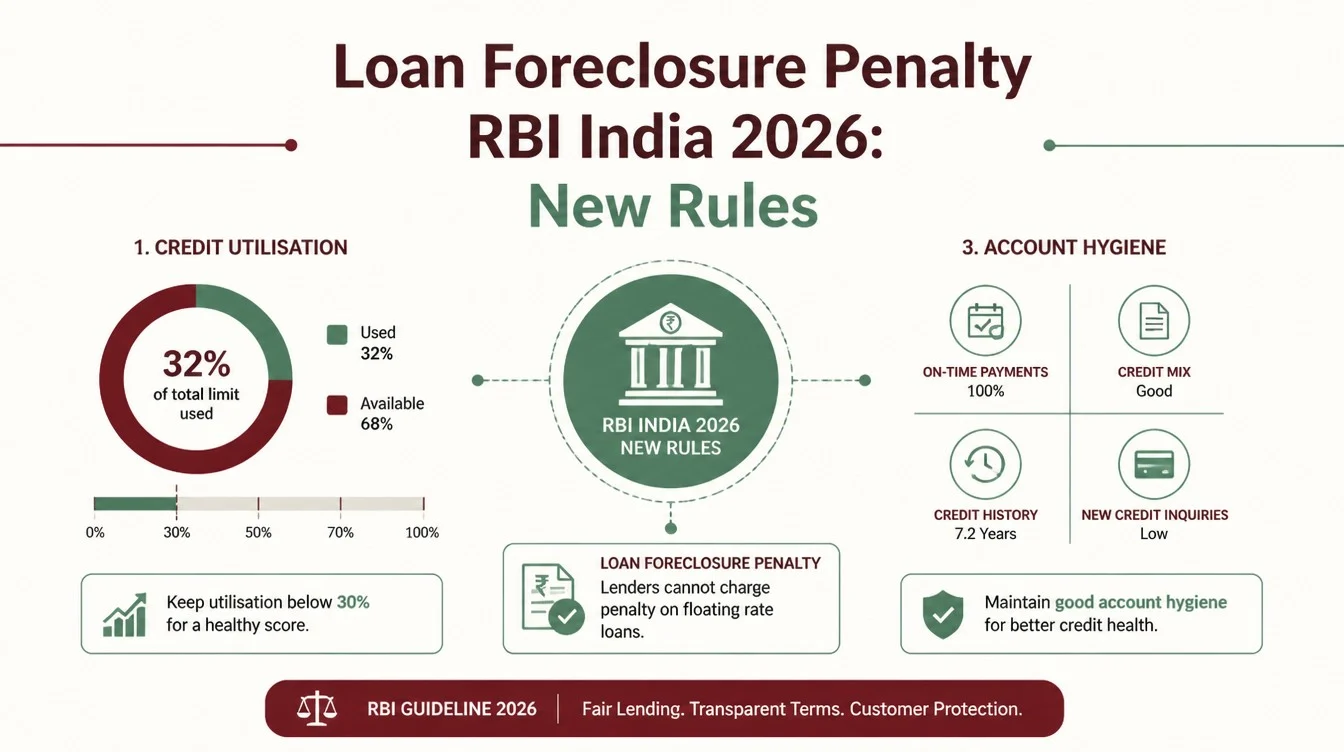
Common Mistakes Borrowers Still Make
Despite the simpler 2026 regime, the same handful of mistakes show up in foreclosure conversations.
Paying a charge that is no longer payable
Some lenders, particularly smaller NBFCs, take time to update their internal systems to reflect the new directions. Borrowers should always ask for a written foreclosure quote and verify that the charges line is zero for an eligible floating-rate individual loan. If a charge appears, citing the RBI directions on prepayment charges (the borrower can reference the directions by date) usually leads to a corrected quote.
Not asking for the revised amortisation schedule
A part-payment reduces the principal but the EMI continues at the original amount unless the borrower explicitly elects to recompute. The default at most lenders is tenure reduction with the same EMI, but the customer should request and retain the revised amortisation schedule to verify.
Forgetting to collect original property documents
For home loans, the bank or NBFC holds the original sale deed, the prior chain of title, and other property documents during the loan tenure. These are returned only when the loan is foreclosed and the lien is released. Borrowers occasionally forget to collect the documents promptly, and retrieving them months or years later (especially after lender mergers or branch closures) becomes a slow process.
Ignoring the CIBIL update window
The credit bureau update after foreclosure typically lags by 30 to 60 days. Borrowers planning a new loan application or a credit-card application immediately after foreclosure can find that the closed loan still shows as active on their credit report, which can affect the credit score. Waiting for the update and verifying it before the next credit application is a small but valuable habit.
FAQ
Do the new RBI rules apply to my existing home loan taken in 2022?
For most individual floating-rate home loans, RBI guidance even before 2026 already prohibited foreclosure charges, so an existing 2022 floating-rate home loan should not attract such a charge in either case. If the loan is on a fixed rate or is being renewed in 2026 or later, the 2026 directions apply to the renewed terms. The cleanest check is to ask the lender for a written foreclosure quote and verify that the charges line is zero.
Can I foreclose a personal loan taken in 2025 without paying a penalty?
A personal loan sanctioned before 1 January 2026 continues under its original terms, which often included a prepayment penalty of 2 to 5 percent of the outstanding principal. If the loan was renewed or restructured after 1 January 2026, the new directions apply. For a floating-rate personal loan sanctioned on or after 1 January 2026, no prepayment or foreclosure charges are payable.
How often can I make part-payments on my home loan?
RBI directions do not impose a frequency limit, but most lenders allow monthly or quarterly part-payments through net banking, with a minimum amount typically between Rs.5,000 and Rs.50,000. Annual cumulative caps (such as 25 percent of principal per year) exist at some lenders. Check the lender’s net-banking interface or the loan agreement for the specific policy.
Should I choose EMI reduction or tenure reduction when I make a part-prepayment?
Tenure reduction (keeping the EMI the same and shortening the loan tenure) produces materially higher interest savings over the life of the loan compared to EMI reduction (keeping the tenure the same and lowering the EMI). For most borrowers in stable employment, tenure reduction is the recommended choice. EMI reduction can make sense in specific situations like reduced household income or planned career change.
Does foreclosing a loan early hurt my credit score?
Foreclosing a loan in full and on clean terms is generally neutral or slightly positive for the credit score over the medium term. The closed loan continues to appear on the credit report as a successfully completed account. The short-term effect can be a small dip because the active loan diversification and the on-time payment record on the closed account stop contributing to the score, but the longer-term effect is benign. A “settled” tag (implying a settlement at less than full dues) is materially negative and should be avoided by paying the full quoted foreclosure amount.
Related guides on this topic are coming to learnfinedge.com soon.