
An Indian salaried professional receives a 15 percent annual hike in April. By July, the new salary feels normal. By December, the bank balance at month-end looks roughly the same as it did before the hike. By April of the following year, the only visible upgrade is a slightly newer phone, a slightly larger flat, and a slightly higher restaurant bill on weekends. The hike has not disappeared into a black hole; it has been quietly absorbed by lifestyle inflation india, the steady upgrade of household spending that tracks every income increase almost in real time.
This guide is a behavioural look at lifestyle creep in the Indian context: how it shows up, which categories absorb it fastest, what a typical before-and-after looks like after a 20 percent hike, why saving half of every raise is the single most effective counter, and the 10-year compounding cost of letting one creep go unchecked. It is a planning framework, not financial advice; individual portfolios benefit from input from SEBI-registered investment advisers.

What Lifestyle Inflation Actually Means in an Indian Salary Context
Lifestyle inflation, sometimes called lifestyle creep, is the steady increase in household spending that tracks income increases over time. The household’s nominal income grows; spending grows in tandem; the savings rate stays flat or falls. The longer the cycle, the larger the spending base becomes, and the harder it is to retreat without it feeling like a downgrade.
The Indian version of lifestyle creep is shaped by three local features: relatively high consumer-price inflation, peer-visibility pressure in dense urban housing, and a rapidly upgrading consumer market that makes premium options available across categories. The combination makes lifestyle inflation almost the default behaviour for the urban Indian salaried earner unless an explicit countermeasure is put in place.
Why this is different from inflation in the economic sense
Headline CPI inflation, reported by the Ministry of Statistics and Programme Implementation and tracked by the RBI in its monetary policy reports, measures the rising price of a fixed basket of goods. Lifestyle inflation is different: the basket itself is upgrading. A household that moves from a mid-range smartphone to a flagship model has not just paid more for the same product; it has changed the product. The cost increase is partly real inflation, partly category creep.
The slow-cooker nature of the problem
Lifestyle inflation rarely arrives as a single visible decision. It accumulates in small upgrades that feel reasonable at each step: a slightly better restaurant, a slightly bigger flat at the next lease renewal, a slightly higher car EMI on the next purchase. Each step seems minor; the cumulative drift over five to ten years is large.
Why the income hike makes the problem worse, not better
The hike removes the immediate budget constraint that previously enforced restraint. With more in-hand pay, the household is no longer forced to choose, and choice without an explicit savings rule almost always flows toward upgrades. The hike does not cause the spending; it removes the friction that previously contained it.
A Before-and-After Worked Example: 20 Percent Hike
A specific scenario makes the dynamic concrete. Take a salaried earner with monthly in-hand pay of Rs.80,000 who receives a 20 percent hike, taking pay to Rs.96,000 a month. The Rs.16,000 monthly increment translates to Rs.1,92,000 over a year.
The before snapshot
Before the hike, the household spent roughly Rs.40,000 on essentials (rent, groceries, utilities, transport, insurance), Rs.25,000 on discretionary spending (dining out, OTT, weekend travel, shopping), and Rs.15,000 on savings (SIP, EPF voluntary, sweep-FD top-up). The split is close to 50-31-19, broadly aligned with the popular 50-30-20 framing.
The “natural” after snapshot, six months in
Without an explicit savings rule, the Rs.16,000 increment usually finds its way to the discretionary bucket. A typical post-hike profile is Rs.42,000 on essentials (slight grocery upgrade, marginally higher utility bills), Rs.39,000 on discretionary (better restaurants, a streaming service upgrade, slightly more travel), and Rs.15,000 on savings (unchanged in absolute terms). The split has shifted to 44-41-15. The savings rate has fallen from 19 percent to 15 percent even though gross income rose by 20 percent.
The “intentional” after snapshot
With an explicit rule to save half of every raise, the post-hike profile becomes Rs.42,000 on essentials, Rs.31,000 on discretionary (modest upgrade), and Rs.23,000 on savings. The split is 44-32-24. The savings rate has actually improved, the lifestyle has visibly upgraded, and the long-term portfolio is now growing materially faster.
Why the Rs.8,000 monthly difference matters over time
The natural after snapshot saves the same Rs.15,000 a month as before the hike. The intentional snapshot saves Rs.23,000. The Rs.8,000 monthly difference is Rs.96,000 per year. Over 25 years at an assumed 10 percent compound annual return on equity mutual funds (with the standard caveats that past performance is not indicative of future results and that equity carries market risk), the difference grows to over Rs.1 crore. A single hike, handled differently, materially changes the retirement number.
The Categories Most Prone to Lifestyle Creep in India
Not all categories of household spending absorb hikes equally. Three categories do most of the damage in the Indian urban context: food and dining, travel, and gadgets and consumer electronics.
Food and dining
Food spending creep is hard to spot because it accumulates across many small transactions rather than one large purchase. A weekday office lunch upgrade from Rs.150 to Rs.300, two extra weekend dining-out occasions a month, and a doubling of food-delivery frequency can together add Rs.6,000 to Rs.10,000 to the monthly spend. None of the individual choices feel extravagant; the aggregate is meaningful.
Travel
Travel is the most visible category and arguably the most justified-feeling. A short domestic weekend becomes a long-weekend hill station trip; one annual leisure trip becomes two; budget hotels become mid-range; mid-range becomes premium. The travel category often absorbs 30 to 40 percent of post-hike discretionary spending, particularly for younger urban earners without dependents.
Gadgets and consumer electronics
The Indian consumer-electronics market has matured rapidly, with premium smartphones, laptops, smart-home devices, and audio gear all available in attractive financing options. The combination of one-tap EMIs and frequent product refresh cycles creates a steady drip of category upgrades that the household barely notices until the credit-card statement arrives.
Housing and rent
Rent upgrades absorb hikes very efficiently because they convert a one-time decision into a permanent monthly commitment. Moving from a Rs.20,000 to a Rs.32,000 rental at lease renewal is functionally a Rs.12,000 monthly raise to the landlord, indexed upward each year. Housing decisions deserve the most caution because they are the hardest to reverse.
Vehicle ownership and upgrades
Vehicle EMIs work similarly to rent: a one-time choice that becomes a long-running monthly commitment. The upgrade from a hatchback to a mid-sized sedan, or sedan to SUV, frequently lines up with a major income jump. Insurance, fuel, parking, and maintenance scale with the vehicle category, multiplying the underlying cost beyond the EMI itself.
The 50 Percent Hike Rule: Save Half of Every Raise
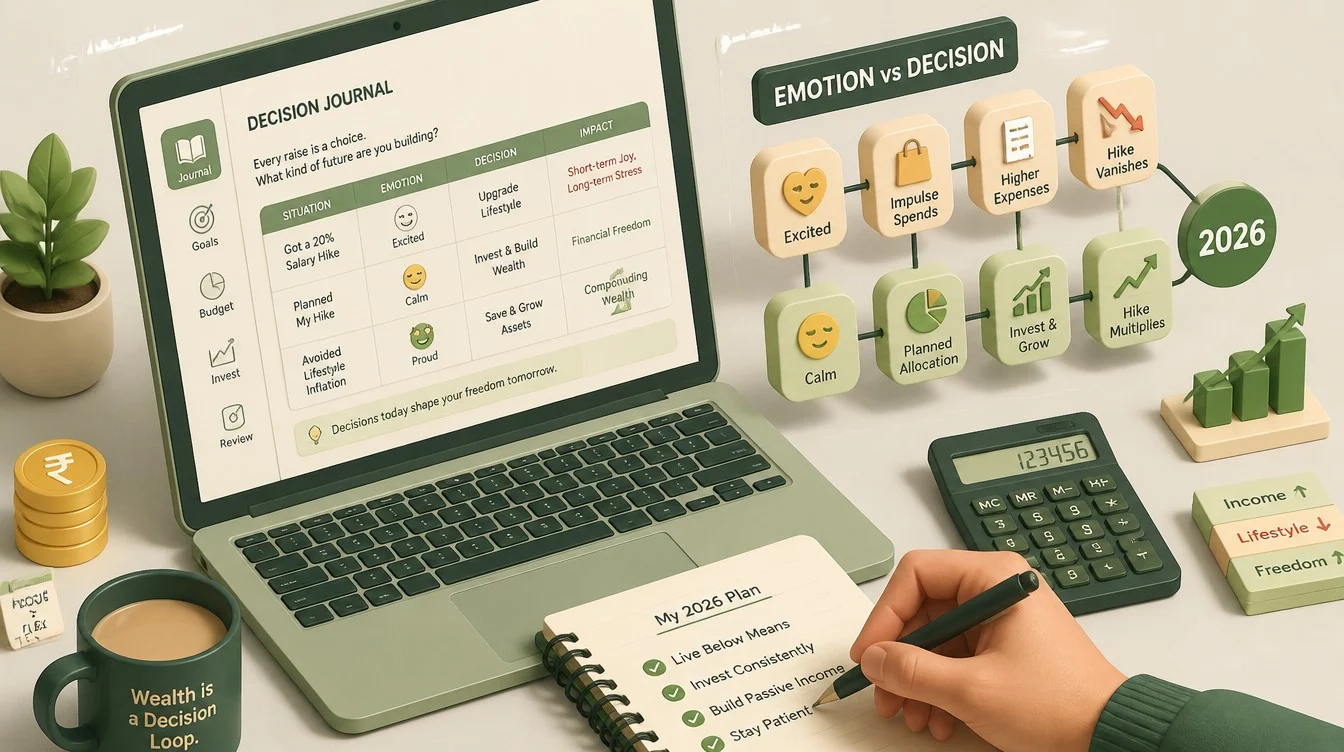
The most widely cited counter to lifestyle inflation in personal-finance writing is also one of the simplest: take half of every income increase and route it directly into savings before it ever lands in the spending account.
Featured-snippet answer
The 50 percent hike rule allocates half of every salary increase directly to savings or investments and the remaining half to lifestyle. For a Rs.16,000 monthly hike, Rs.8,000 flows into an automated SIP, voluntary EPF, or sweep-in FD on payday, and Rs.8,000 expands discretionary spending. The rule preserves the felt benefit of the raise while preventing the household savings rate from falling each time income rises.
Why 50 percent and not 100 percent
Saving 100 percent of every raise sounds disciplined but rarely lasts. Salary hikes carry a psychological signal that the household has earned a meaningful improvement; suppressing that signal entirely creates resentment and eventual rule-breaking. Half is large enough to materially shift the long-term portfolio while leaving enough headroom for visible lifestyle improvement.
Operationalising the rule on payday
The mechanical step is to set up an automated transfer of the new savings amount on payday plus one, so the money moves before any other transaction. Increasing an existing SIP by the appropriate amount, raising voluntary EPF, or topping up a sweep-in FD all work. The principle is to make the new savings invisible to the discretionary bucket from day one.
What to do with the other half
The remaining half of the hike can be deployed deliberately rather than diffused across many small upgrades. A defensible practice is to identify two or three specific lifestyle improvements that genuinely matter (a better commute, a meaningful travel goal, a hobby investment) and channel the discretionary half into those. The contrast with the diffuse creep that absorbs the same money invisibly is striking.
The 10-Year Compounding Cost of One Lifestyle Creep
The case against lifestyle creep is strongest when expressed in compounding terms. A single Rs.10,000-per-month creep that goes unchecked from age 30 to age 40 is not a Rs.12 lakh lifestyle expense; it is a much larger loss when the alternative use of the money is compounded.
The base arithmetic
Rs.10,000 per month invested in a diversified equity mutual fund SIP over 10 years, assuming an illustrative 10 percent CAGR (with the standard caveat that equity returns are not guaranteed and past performance is not indicative of future results), grows to approximately Rs.20.6 lakh. The cumulative principal is Rs.12 lakh; the rest is compounded return. The same Rs.10,000 spent monthly leaves the household exactly Rs.0 of corresponding net worth.
The next 10-year layer
Extending the same Rs.10,000 monthly SIP from year 10 to year 20 (no further contributions, just the existing corpus compounding) takes the Rs.20.6 lakh figure to roughly Rs.53 lakh. The cost of letting one lifestyle creep go unchecked at age 30 is not Rs.12 lakh; over a working life it is closer to Rs.50 lakh.
The “two creeps” scenario
Households facing two simultaneous creeps (say, a vehicle upgrade and an apartment upgrade) of Rs.10,000 each are silently giving up the same Rs.50 lakh per creep over a 20-year horizon. The number sounds aggressive but reflects standard compounding math at illustrative equity returns, not a worst-case projection.
What this implies for the hike rule
The arithmetic argues for tightening the 50 percent rule when income jumps are large. A 50 percent hike that doubles the household’s previous savings rate looks very different from a 5 percent inflation-driven adjustment. Bigger hikes warrant a higher share routed to savings.
The Behavioural Drivers of Lifestyle Creep
Understanding the behavioural roots of the problem makes the countermeasures stick. Three drivers do most of the work in the Indian urban context.
Anchoring to peers
Social anchoring is powerful in Indian dense urban housing. The neighbour’s new car, the colleague’s recent vacation, and the social-media-visible weekend dining all create reference points that drift upward over time. The household ends up benchmarking against the visible spending of peers rather than against an internal savings goal.
Hedonic adaptation
Hedonic adaptation is the well-documented phenomenon where the joy of a new purchase fades quickly, prompting the next upgrade. A new phone delights for two weeks and feels normal in three months. A new flat impresses for six months and feels routine in a year. The lifestyle treadmill is the operational reality of hedonic adaptation, and the only mathematical defence is to accept that the next upgrade will not solve the problem either.
Convenience-driven micro-spending
Cab rides, food delivery, on-demand groceries, and one-tap purchases reduce the friction of spending to near zero. Decisions that would have required two or three steps in the cash era now require one. The aggregate effect is a steady upward drift in monthly outflows that no single decision triggered.
Social media and visible consumption
Social-media platforms amplify visible consumption disproportionately. Travel destinations, dining experiences, and curated lifestyle moments dominate feeds. The household sees an unusually high concentration of “peak consumption” moments, which subtly recalibrates expectations.
The aspiration-cost gap
Aspirational consumption can outrun actual income through credit-card financing and BNPL options. The aspiration is set by the visible peer reference; the income may not have caught up; credit fills the gap. The household ends up paying premium interest rates on lifestyle upgrades, which compounds the long-run cost.
Spotting Lifestyle Inflation in Your Own Numbers
The diagnostic step is straightforward: compare the savings rate from this year to two and five years ago. If the savings rate has not risen with income, lifestyle creep has been quietly absorbing the gains.
The savings-rate trend test
Pull the December bank statement from this year, two years ago, and five years ago. Compute the savings rate (savings as a fraction of in-hand) for each. If the rate is flat or declining despite hikes, creep is the culprit. A rising savings rate is the cleanest indicator of healthy income growth.
The discretionary-spending audit
Categorise the last three months of UPI and credit-card transactions into needs and wants. Compare the discretionary total against the same exercise from a year ago (most banks now offer downloadable transaction histories that go back at least 12 months). Anything that has grown by more than 25 percent without a deliberate decision is a candidate for review.
The subscriptions test
Add up every active monthly subscription: OTT, music, cloud storage, software, fitness apps, premium delivery, and category-specific services. Many urban households are now paying Rs.5,000 to Rs.8,000 a month on recurring subscriptions, often with overlapping coverage. Pruning by 30 to 50 percent is usually feasible without any visible lifestyle hit.
The fixed-monthly-cost ratchet
Each major fixed commitment (rent, EMI, school fee, vehicle insurance) ratchets the baseline upward. Tracking the share of in-hand pay locked into fixed commitments and watching it stay below 50 percent is one of the most effective long-term defences. Above 55 percent, the household has very little flexibility to respond to a shock.
Practical Rules to Contain Lifestyle Creep
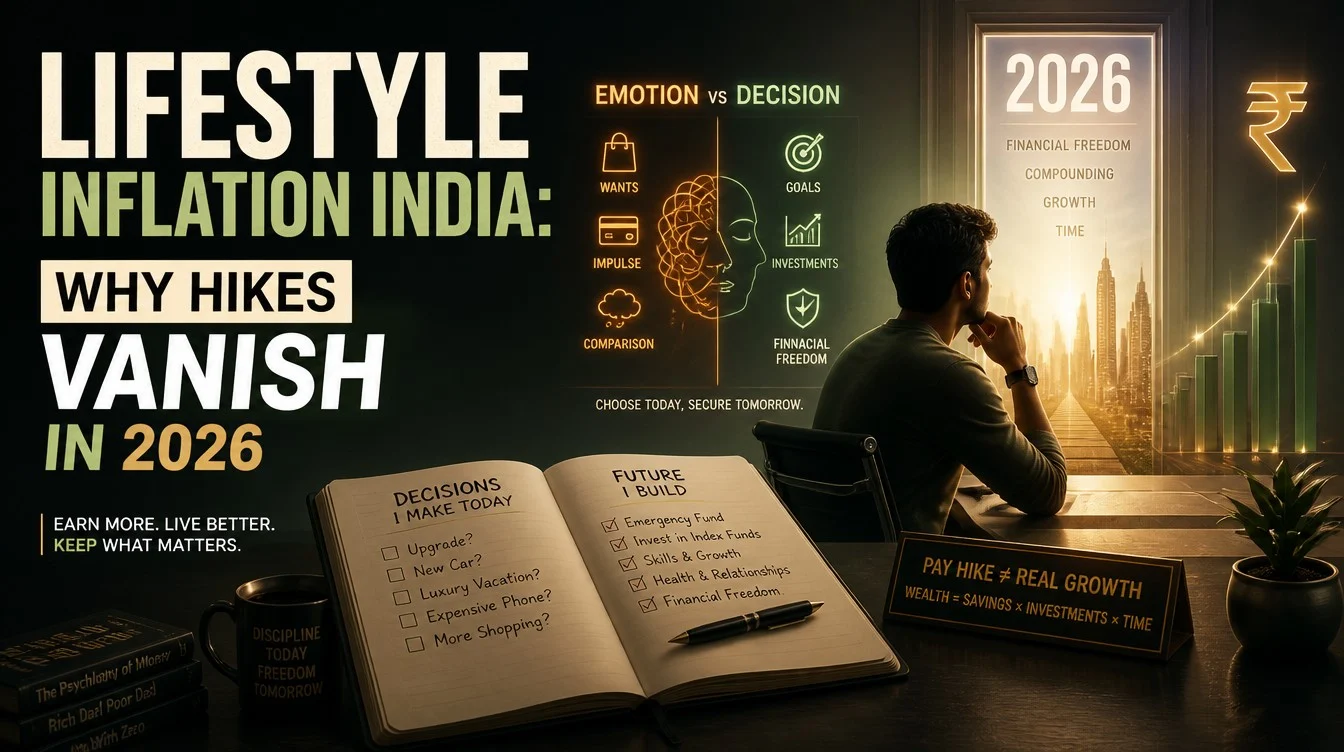
A small set of habits can keep the savings rate rising even as income grows. The rules below are not exhaustive; they are the ones that compound the hardest.
The hike rule
Save 50 percent of every hike on payday plus one. The rule is operationally simple and behaviourally powerful because the savings happen before the spending account ever sees the increase.
The 30-day rule for big purchases
For any discretionary purchase above Rs.10,000 (or any threshold the household sets), wait 30 days before buying. Most of the time, the urgency fades and the purchase does not happen. The 30-day rule does not block legitimate upgrades; it filters out the impulse layer that hedonic adaptation amplifies.
The needs vs wants re-tag
Once a year, re-tag every recurring expense as need or want. Categories quietly drift from want to need over time (a premium gym, a premium grocery service, a particular delivery membership). The annual re-tag forces the household to consciously confirm or reject the drift.
The fixed-cost ceiling
Cap fixed monthly commitments (rent, EMIs, insurance premiums) at 45 to 50 percent of in-hand. The cap is not arbitrary; it reflects the level at which most Indian salaried households retain enough flexibility to handle a shock without distress. Breaching it should be a deliberate decision, not a drift.
The annual financial review
Once a year, run a 90-minute review covering current savings rate, year-on-year change in essential and discretionary spending, fixed-commitment ratio, and progress against long-term goals. The review is the single most leveraged hour the household spends on its finances, and it usually surfaces one or two creeps that can be reversed.
What Lifestyle Inflation Looks Like Across Life Stages
Lifestyle creep has different signatures at different life stages. The defensive playbook needs to flex with the stage.
Early career, ages 22 to 28
The most common creep at this stage is dining out, travel, and apparel. Hikes are usually steep on a percentage basis because income starts low, which makes the absolute hike easy to absorb invisibly. The early-career years are the highest-leverage time to install the 50 percent hike rule because the long compounding window magnifies every additional rupee saved.
Mid-career with family, ages 30 to 40
Creep at this stage is concentrated in housing, school fees, and vehicle upgrades. The decisions are often justified through family considerations, which makes them harder to resist. The defensive move is to lock down the housing and vehicle category before the family rationalisation kicks in, and to revisit explicitly only at multi-year intervals.
Peak earning, ages 40 to 50
The creep at this stage is travel, education for children, and a quiet acceleration of premium services across the board. Savings rates can credibly rise to 30 percent or higher at this stage. The household has the highest absolute capacity to add to the long-term portfolio, and lifestyle creep is the single biggest threat to that opportunity.
Pre-retirement, ages 50 to 60
Late-stage creep often centres on adult children, parents’ medical needs, and travel. The defensive move is to ensure the FIRE-relevant portfolio is on track before any new commitment is added, and to size new commitments against the post-retirement income, not the current peak income.
Tools and Habits That Help Indian Earners Resist Creep
Tools matter less than habits, but the right tool removes friction from the right habit. The combinations below work for most Indian urban households.
Automated SIP step-ups
Most mutual fund platforms offer SIP step-up facilities that auto-increase the monthly contribution by a chosen percentage each year. Setting a step-up of 10 to 12 percent annually closely mirrors typical salary hikes and bakes the 50 percent hike rule into the system without manual effort.
Salary account vs spending account separation
Routing the entire salary into one account and then transferring only the discretionary budget into a separate spending account each month is one of the simplest behavioural tools available. The spending account naturally caps spending; the savings account naturally accumulates the residual.
UPI category summaries
Most UPI apps and bank apps now offer monthly category summaries. A five-minute review on the first weekend of each month against a fixed target (say, Rs.X on dining, Rs.Y on shopping) catches creep within weeks rather than years.
Annual goal milestones
Anchoring the savings to specific, named goals (retirement corpus by age 55, child’s higher-education corpus by age 18, home down-payment within five years) makes the trade-off concrete. “Buy this gadget or move closer to the corpus goal” is a sharper question than “buy or save”.
The Honest Counter-Argument: When Lifestyle Upgrades Are Worth It
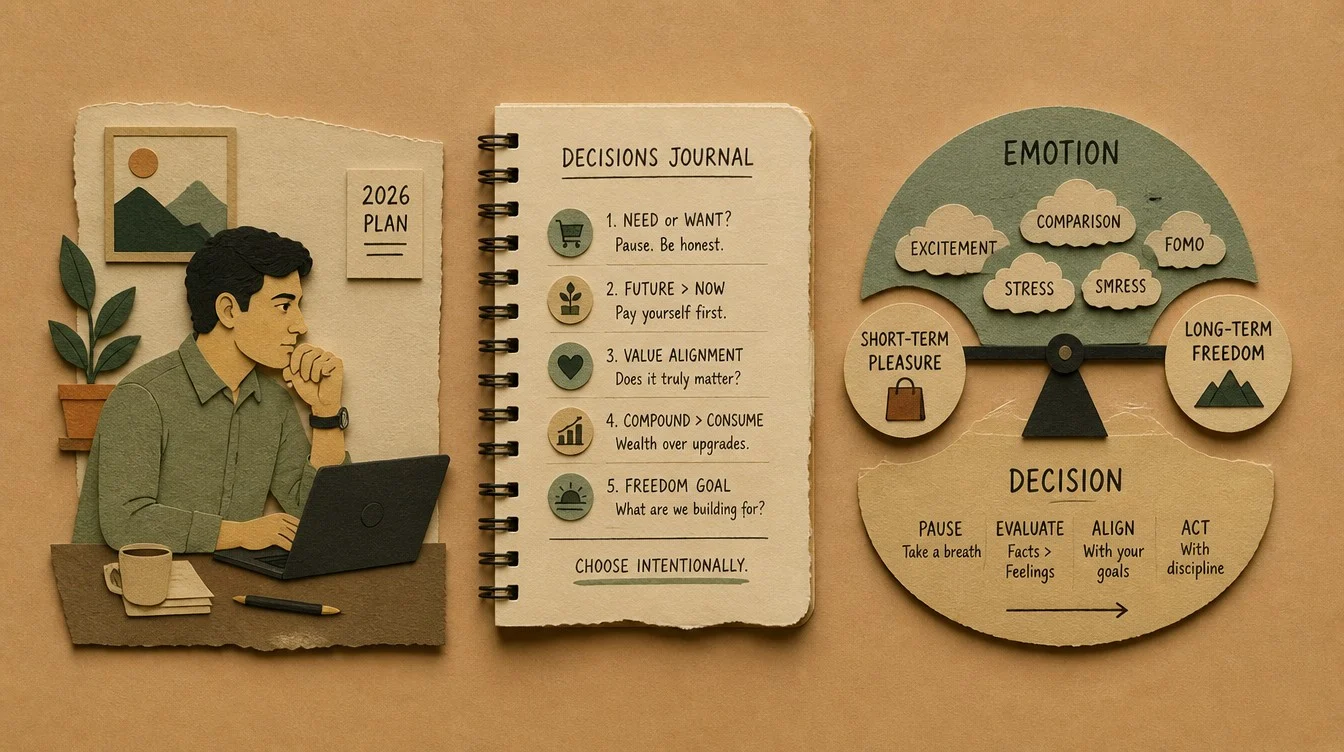
Not every upgrade is creep. Some lifestyle expansions are well-targeted, deliver lasting improvement, and justify their cost. Recognising the difference is part of a balanced approach.
Upgrades that compound back
A shorter, less stressful commute often delivers measurable productivity and health improvements that compound over time. A more comfortable home that supports remote work, a better mattress and ergonomic setup, and proper health investments often pay for themselves in retained earning capacity. These are not creep; they are infrastructure.
Experiences vs material upgrades
Personal-finance literature consistently notes that experiential spending (travel, learning, time with family) tends to generate longer-lasting satisfaction than material upgrades. Within the discretionary half of a hike, leaning into a few well-chosen experiences can deliver more lifestyle benefit per rupee than a diffuse drift across many small material categories.
One-time purchases vs recurring commitments
A one-time purchase, even a substantial one, is bounded in its long-term impact. A recurring commitment (a new EMI, a new subscription bundle, a higher rent) creates a permanent draw on monthly cash flow. Concentrating discretionary upgrades on one-time purchases and minimising new recurring commitments is one of the cleanest defences against creep.
The “would I still want this in three months” test
For any upgrade above the household’s threshold, the cleanest test is: would I still want this if it arrived three months from now. Most genuine improvements pass the test easily; most impulse upgrades fail it. The test is operationally identical to the 30-day rule but framed prospectively rather than retroactively.
FAQ
Is some lifestyle inflation healthy?
Yes, within limits. Income should improve quality of life, and a household that earns 50 percent more after a decade but lives identically has missed part of the point. The defensible balance is to upgrade lifestyle modestly while increasing the savings rate, not just the savings amount. The 50 percent hike rule operationalises that balance.
How is lifestyle inflation different from CPI inflation in India?
CPI inflation, measured by the Ministry of Statistics and used in RBI monetary policy decisions, tracks the price of a fixed basket of goods. Lifestyle inflation tracks the upward drift of the basket itself, with upgrades to premium versions of products and services. Both compound; the second is usually larger and is the one the household can actively control.
What is the easiest first step to stop lifestyle creep?
The easiest first step is to automate a higher savings transfer on payday so the spending account never sees the increase. SIP step-ups, voluntary EPF increases, and sweep-in FD top-ups all work. The cleanest version is to increase the automated transfer by half of every hike on the date the hike takes effect.
Should I use credit cards if I am prone to lifestyle creep?
Credit cards amplify spending convenience and reward upgrades, which can accelerate creep. They are still useful for reward-driven savings on essential spending if balances are paid in full each month. The risk is the revolving balance, which carries interest in the 30 to 42 percent annualised range per RBI data on consumer credit. The rule “credit cards yes, revolving balances no” handles most of the problem.
Does inflation justify the lifestyle creep I see in my own spending?
Partially, not fully. If essentials have grown by 6 to 7 percent a year aligned with CPI, that share is real inflation, not creep. Anything beyond that figure, particularly in discretionary categories, is category upgrade. The cleanest diagnostic is to separate essentials from discretionary in year-on-year comparisons, then compare each against the relevant inflation reference.
Related guides on this topic are coming to learnfinedge.com soon.