

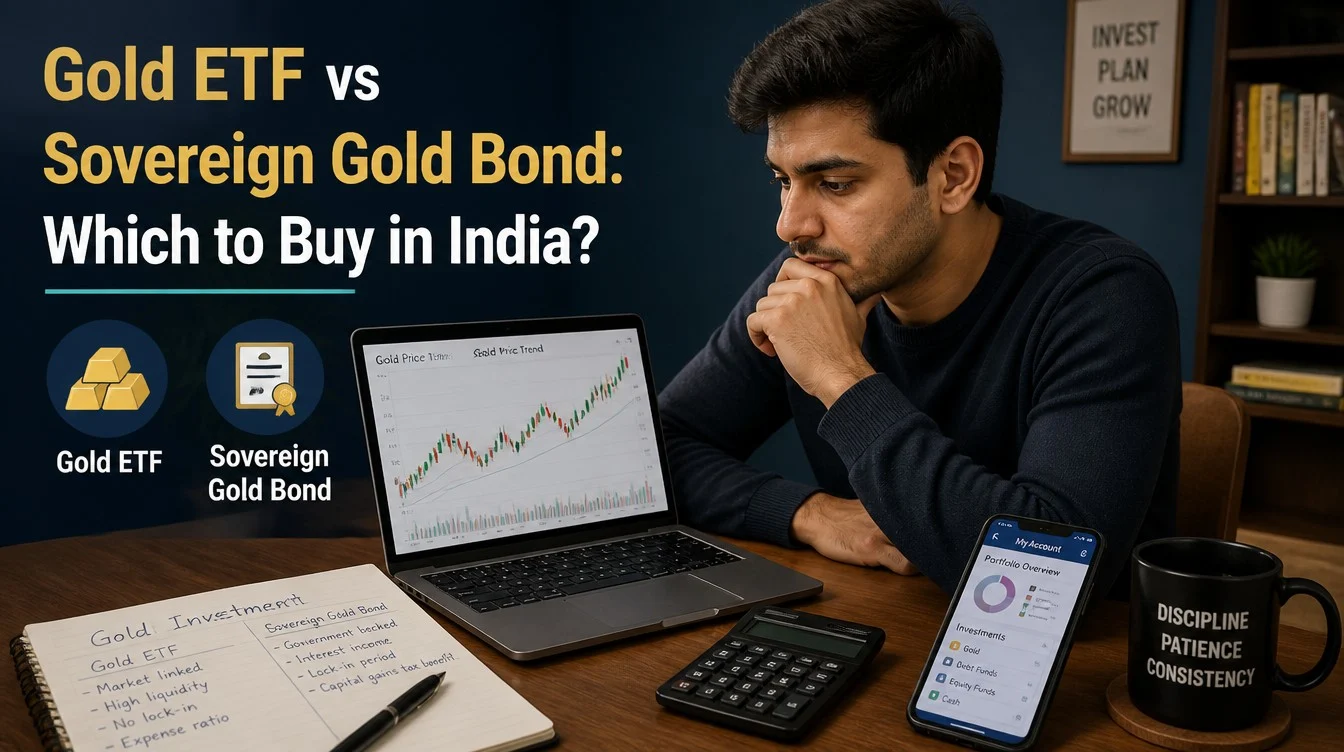
Gold ETF vs Sovereign Gold Bond: Which Should Indian Investors Buy?
Both gold etf vs sovereign gold bond give you gold price exposure without physically owning gold, but they are fundamentally different instruments with different return profiles, liquidity characteristics, and tax treatments. The choice between them is not arbitrary – it depends on your investment horizon, liquidity requirement, and tax situation. This article gives you a complete comparison so you can make the right decision for your specific goal.
What Is a Gold ETF?
A Gold ETF (Exchange-Traded Fund) holds physical gold in a vault on behalf of investors. Each unit represents approximately 1 gram of 99.5% purity gold. The NAV tracks domestic gold prices (which reflect the international gold price adjusted for the USD/INR exchange rate and import duty). You buy and sell Gold ETF units on NSE or BSE during market hours through a demat account, exactly like buying shares.
Gold ETFs are managed by mutual fund AMCs regulated by SEBI. The physical gold is held with designated custodians. Returns equal the change in gold prices minus the fund’s expense ratio (typically 0.50-0.65% per annum for large Gold ETFs). There is no additional return beyond gold price appreciation – no interest, no dividend.
What Is a Sovereign Gold Bond?
Sovereign Gold Bonds (SGBs) are government securities issued by the Reserve Bank of India on behalf of the Government of India. Each unit represents 1 gram of gold. SGBs pay a fixed interest rate of 2.5% per annum on the issue price (paid semi-annually) in addition to the gold price return at maturity. The bond has an 8-year maturity with early exit options from the 5th year.
SGBs carry the sovereign guarantee of the Government of India – there is zero credit risk. At maturity, the investor receives the equivalent of the prevailing gold price plus the accumulated interest. SGBs are listed on exchanges, but secondary market liquidity is very limited for most series.
Gold ETF vs Sovereign Gold Bond: Complete Comparison
| Feature | Gold ETF | Sovereign Gold Bond |
|---|---|---|
| Additional return | None; only gold price return minus expenses | 2.5% per annum interest on issue price |
| Tenure | None; buy and sell anytime | 8 years; early exit from year 5 |
| Liquidity | High; exchange-traded with daily volume | Very low on secondary market; must hold to exit window |
| Tax on capital gains | STCG 20% (under 1 yr); LTCG 12.5% (over 1 yr) | Capital gains at maturity (8 years) are tax-free |
| Tax on interest | Not applicable | Added to income; taxed at slab rate |
| Purchase mode | Exchange via demat account | RBI via banks, post offices, brokers (during issuance) |
| Minimum investment | 1 unit (1 gram); Rs 6,000-7,000 approximately | 1 gram minimum; 4 kg maximum per person per year |
| Expense ratio | 0.50-0.65% per annum | None |

The SGB Advantage: 2.5% Extra Return
The 2.5% annual interest on SGBs is the most significant advantage over Gold ETFs. On a Rs 1 lakh investment in gold, 2.5% per annum compounds to Rs 21,899 over 8 years (not accounting for changes in the issue price, since interest is fixed on the initial issue price). This extra return is pure outperformance relative to Gold ETFs, which earn zero interest.
Combined with zero expense ratio, SGBs effectively outperform Gold ETFs by approximately 2.5% + 0.55% (expense ratio saved) = approximately 3% per annum over an 8-year holding period, before tax. This is a substantial and consistent advantage for investors who can commit to the 8-year horizon.
The Gold ETF Advantage: Liquidity
Gold ETFs trade on exchanges during market hours and can be sold within minutes for settlement in T+1 or T+2. If you need the money for an emergency, a large purchase, or an investment opportunity, you can liquidate your Gold ETF position immediately.
SGBs are listed on exchanges but have extremely thin secondary market liquidity. Most SGB series trade only a few hundred units per day – if you need to sell before the 5th-year exit window, you may have to accept a discount to NAV or wait significantly to find a buyer. The practical reality is that SGBs should be considered illiquid until the 5th-year exit window. If gold forms part of your emergency reserve, Gold ETFs are the only appropriate form given this liquidity difference.
Tax: The SGB Wins Decisively for Long-Term Holders
For investors who hold SGBs to 8-year maturity, the capital gain is completely tax-free. This is a substantial benefit in a high tax bracket. A 30% tax bracket investor who earns Rs 3 lakh in gold price appreciation on a Rs 7 lakh SGB holding over 8 years saves Rs 37,500 in LTCG tax (12.5% of Rs 3 lakh) by holding to maturity versus selling an equivalent Gold ETF.
The interest on SGBs (2.5% annually) is added to income and taxed at the slab rate. In the 30% bracket, this effectively reduces the net yield from 2.5% to 1.75% after tax. But the capital gains tax exemption at maturity is separate and fully preserved. Understanding your effective tax rate under the new vs old regime helps you calculate the precise post-tax advantage of SGB’s tax-free maturity proceeds.

When to Buy: SGB Issuance and Discount
SGBs are issued by the RBI in tranches throughout the year (typically 6-8 tranches). Each tranche is open for subscription for 5 days. The issue price is based on the average gold price of the preceding week, and investors who apply online through their bank or broker account receive a Rs 50 per gram discount. This discount is automatic for online applications and effectively makes the online SGB purchase price slightly below the prevailing spot gold price.
Previously issued SGB series can also be bought on secondary markets (NSE/BSE) where they trade, often at a discount to gold NAV due to low liquidity. Buying on secondary markets at a discount (when available) can enhance returns, but requires active monitoring of secondary market prices for SGB series trading at discounts.
Practical Decision Framework
The choice is clearer than it seems once you identify your investment parameters:
Choose Gold ETF if: Your gold investment horizon is under 5 years. You may need the money for other purposes (emergency, investment opportunity, goal-based use). You prioritize simplicity and exchange-traded liquidity. You are already making small monthly gold purchases (Gold ETF SIP is possible, SGB SIP is not). The detailed three-way comparison of digital gold, SGB, and Gold ETF covers the full range of gold investment options for different investor profiles.
Choose Sovereign Gold Bond if: Your horizon is 8 years (full maturity for tax-free exit). You are in a high tax bracket (30%+ effective rate) where the capital gains tax exemption provides maximum value. You do not need the money for other purposes during the holding period. You invest in a single tranche (not needing monthly purchases). SGBs are most suited as a long-term wealth accumulation vehicle where the combined benefit of interest, zero expense, and tax-free capital gains makes them significantly superior to Gold ETFs.

Can You Hold Both? Portfolio Allocation
Many investors hold both Gold ETFs and SGBs in different roles. SGBs serve as the long-term, high-return gold allocation locked for 8 years. Gold ETFs serve as the liquid gold allocation that can be accessed without waiting for an exit window. Together they provide both the return optimization of SGBs and the liquidity flexibility of ETFs. Alongside REITs for real estate exposure, a combination of SGBs and Gold ETFs provides diversification across two historically inflation-resistant asset classes.
Frequently Asked Questions
Is it better to buy gold ETF or SGB in India?
For investors with an 8-year horizon, SGBs are better due to 2.5% additional interest, zero expense ratio, and completely tax-free capital gains at maturity. For investors needing liquidity within 1-5 years, Gold ETFs are better because SGBs cannot be easily sold before the 5-year exit window. The choice depends entirely on your investment horizon and liquidity requirement.
What happens to SGB at maturity?
At 8-year maturity, the RBI redeems the SGB at the prevailing market gold price (based on the average of the preceding 3 business days’ prices). The redemption amount is credited to your linked bank account. This maturity redemption is completely exempt from capital gains tax, regardless of the gain size. The interest received over the 8 years is taxed at the slab rate as it accrues, but the final principal repayment and embedded gold price gain are tax-free.
Can I sell SGB before 8 years?
Yes, through two routes. First, from the 5th year, you can redeem SGBs on the coupon payment dates (the RBI provides early exit facility at market gold prices on those dates). Capital gains from this early exit may be taxable (the tax-free treatment applies specifically to full-8-year maturity redemption – consult a tax advisor for current rules on early exit taxation). Second, you can sell SGBs on the secondary market (NSE/BSE) at any time, but secondary market liquidity is very limited for most series.
What is the expense ratio of Gold ETF in India?
Gold ETF expense ratios in India typically range from 0.50% to 0.65% per annum for direct plans. The largest Gold ETFs from HDFC, Nippon India, and ICICI Prudential are at the lower end. This ongoing cost compounds significantly over an 8-year period – 0.55% annually over 8 years reduces your effective gold return by approximately 4.4% cumulatively, compared to zero expense in SGBs. This cost difference is a significant component of the SGB advantage for long-term investors.
Is digital gold better than Gold ETF or SGB?
Digital gold (offered by platforms like Paytm, PhonePe, and SafeGold) allows small-amount gold purchases starting from Rs 1 but has higher effective costs (spread, storage fee, no SEBI regulation) and should not be confused with regulated investment products. For any gold investment beyond Rs 5,000-10,000, Gold ETFs (regulated by SEBI, SEBI-mandated physical gold backing) are more appropriate than digital gold. SGBs are better than both for long-term committed holding periods.
Related Articles
- Digital Gold vs Sovereign Gold Bond vs Gold ETF: Full Comparison
- New Tax Regime vs Old: Which Saves More in 2026?
- How to Invest Your Emergency Fund