

Few mutual-fund categories in India have polarised investors as much as small caps over the last cycle. The same funds that delivered triple-digit returns in 2020 to 2023 also entered double-digit drawdowns in single weeks during 2024 and 2025 corrections. For a salaried Indian investor evaluating whether to allocate to small cap mutual funds india 2026, the question is not whether the category has produced eye-catching returns over discrete periods (it has) but whether the household’s actual time horizon, liquidity needs, and behavioural tolerance match the drawdown profile that the category structurally carries. Market-linked instruments carry market risk; read scheme-related documents carefully before investing.
This guide unpacks the small-cap definition under SEBI’s categorisation framework, the AUM cap discussion that has shaped the category in 2024 and 2025, the historical drawdown table that every prospective investor should look at before allocating, and the practical allocation framework for different risk profiles. The aim is not to argue for or against small caps but to give a realistic picture so the decision is made with eyes open.

What Counts as a Small-Cap Fund Under SEBI Rules
SEBI’s October 2017 mutual fund scheme categorisation circular standardised the definition of small-, mid-, and large-cap stocks for mutual fund categorisation. The framework has been the operative definition since 2018.
The 250th rank threshold
Under the SEBI framework, large-cap stocks are the top 100 listed companies by full market capitalisation, mid-cap stocks are the next 150 (ranks 101 to 250), and small-cap stocks are the remaining listed universe from rank 251 downwards. AMFI publishes the categorised list every six months on its website, and AMCs are required to maintain their portfolios in line with the categorisation.
The 65 percent rule
A small-cap mutual fund scheme is required to invest at least 65 percent of its total assets in equity and equity-related instruments of small-cap companies as defined above. The remaining up to 35 percent can be invested in mid-cap stocks, large-cap stocks, debt, or cash, subject to the fund’s stated strategy. This 65 percent floor is the structural reason small-cap funds cannot meaningfully reduce their small-cap exposure when valuations turn frothy.
One scheme per AMC
Under the categorisation rules, each AMC can offer only one small-cap scheme. This single-scheme-per-category rule limits the proliferation of near-identical funds and forces each AMC to make a single bet on its small-cap thesis. The choice of fund from each AMC is therefore meaningful rather than cosmetic.
How small caps differ from mid caps
The mid-cap category invests at least 65 percent in mid-cap stocks (ranks 101 to 250 by market cap). Mid caps have larger underlying businesses, more analyst coverage, deeper trading liquidity, and historically lower drawdowns than small caps. The mid-cap category often offers a more moderate version of the small-cap thesis for investors who want some part of the alpha potential with less of the downside risk.
The Historical Drawdown Table Every Investor Should See
The single most useful exhibit before allocating to small caps is the historical drawdown table: the maximum peak-to-trough fall over various holding periods. Past data does not predict future drawdowns but it does set realistic expectations.
Indicative drawdowns by holding period
| Holding period | Indicative max drawdown observed for small-cap indices | Practical implication |
|---|---|---|
| 1 year | 40 to 60 percent in adverse cycles | Allocation should be money the investor is not depending on in the next 12 months |
| 3 years | 30 to 50 percent at trough, often recovered within the period | Tolerable for investors willing to hold through a full cycle |
| 5 years | Typically positive on rolling basis, but with deep intermediate dips | Minimum recommended horizon for a meaningful small-cap allocation |
| 7 years | Almost always positive over rolling 7-year periods historically | Aligns well with long-term goals like retirement equity sleeve |
| 10 years | Historically attractive returns versus large caps, but with much higher volatility | Suitable for the long-duration corpus of younger investors |
These ranges are illustrative based on observed behaviour of Indian small-cap indices over multiple cycles and should not be read as guarantees. Actual fund-level drawdowns can be more or less than the index, depending on the fund manager’s positioning. Market-linked instruments carry market risk; read scheme-related documents carefully before extrapolating.
The 2024 to 2025 lesson
The corrections in Indian small-cap indices during the 2024 to early 2025 period reminded investors that the category can produce double-digit single-week falls when valuation excesses unwind. Funds with concentrated positions or smaller AUMs handled the redemptions differently, which exposed the structural fragility that less-liquid small-cap holdings present.
Why drawdowns matter more than averages
Average annual returns for small caps over 7 to 10 years have historically been attractive in India relative to large caps. The trap is that the path to those averages is highly uneven. An investor who exits at the bottom of a 50 percent drawdown after two negative years gets none of the average; the average is captured only by those who hold through the drawdown.
The AUM Cap Discussion and Why It Matters
One of the defining themes in Indian small-cap mutual fund discussions during 2024 and 2025 has been the question of how much AUM a small-cap fund can responsibly carry without distorting its own positions.
The liquidity constraint
Small-cap stocks have structurally lower trading liquidity than large caps. A fund with Rs.50,000 crore (Rs.500 billion) AUM that needs to buy or sell a meaningful position in a small-cap stock with a daily traded value of Rs.50 crore (Rs.500 million) cannot execute without materially moving the price. The execution friction can erode the very returns the fund is trying to capture.
Soft closures and AUM management
Several Indian AMCs have, at various points, restricted or paused fresh inflows into their small-cap and mid-cap schemes to keep AUMs at levels they can deploy responsibly. SEBI has also engaged with AMCs on stress-testing small- and mid-cap schemes for liquidity. The investor takeaway is to favour funds whose AUM is in a range the manager can actually deploy effectively, rather than funds attracting the largest inflows simply because of recent performance.
What “responsible AUM” looks like
There is no single correct AUM for a small-cap fund; the right size depends on the manager’s style, the typical position size, and the small-cap universe’s overall liquidity. Investors evaluating funds should look at AUM trajectory (rapid growth often signals reactive inflows), the fund’s stated stance on accepting fresh subscriptions, and the position concentration disclosed in the monthly factsheet.
The redemption pressure flip side
The same illiquidity that constrains deployment also constrains redemption in bad markets. If a fund faces large redemption requests during a small-cap correction, the manager may have to sell positions at depressed prices, further depressing the NAV for remaining unitholders. SEBI stress-test outputs, where disclosed, give some indication of how prepared a fund is for an adverse redemption scenario.
Right-Sized Allocation by Risk Profile
The right allocation to small caps depends primarily on the investor’s risk profile, not on the recent performance of the category.
Conservative investors
For conservative investors (typically older, lower risk tolerance, shorter remaining accumulation horizon), the right small-cap allocation is often zero or a single-digit percentage of the equity sleeve. The volatility that small caps add does not pay for itself when the holding horizon is short.
Moderate investors
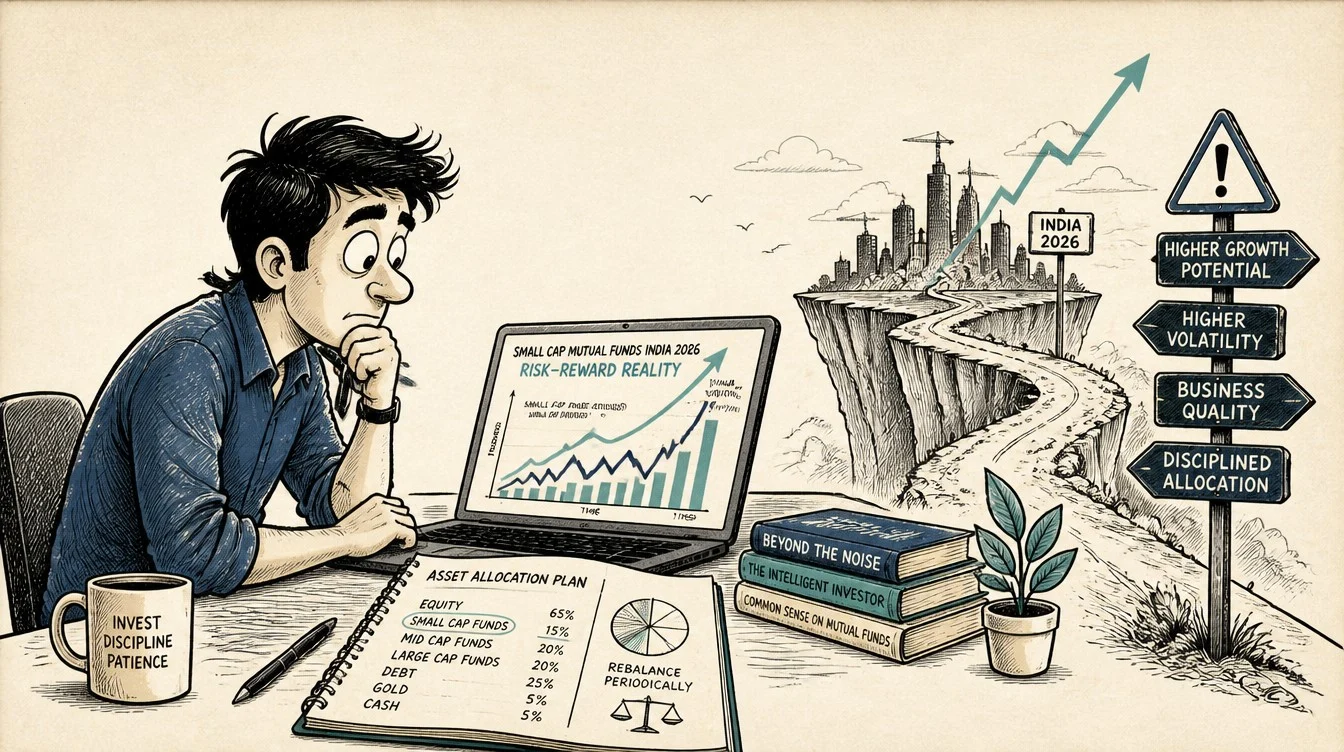
For moderate investors with a 7 to 10 year horizon and the behavioural tolerance to hold through 30 to 40 percent drawdowns, a small-cap allocation of 5 to 10 percent of the total equity sleeve is a common range. The allocation is large enough to matter to long-term returns and small enough that a major drawdown does not derail the financial plan.
Aggressive investors
For aggressive investors in their twenties and thirties with a 15+ year horizon, no near-term liquidity needs from the equity sleeve, and demonstrated behavioural tolerance, a small-cap allocation of 10 to 20 percent of the equity sleeve is defensible. Allocations above this range are uncommon outside specialist mandates and tend to introduce concentration risk that is not compensated by expected return.
The SIP route over lumpsum
For most retail investors entering small caps, a SIP route over 12 to 24 months is structurally safer than a lumpsum entry. The SIP averages the entry price across the cycle and avoids the worst-case scenario of a lumpsum at a near-term peak. The SIP can be continued in the accumulation phase and tapered in the consolidation phase as the corpus grows.
Selecting a Small-Cap Fund: What to Look At
Within the category, the selection criteria emphasise process, consistency, and structure over recent returns.
Long-term rolling returns and other selection inputs
One-year and three-year point-to-point returns are entertainment for the small-cap category because they are dominated by entry timing. A more robust selection checklist includes the items below.
- Rolling 5- and 7-year returns over the last 10 to 15 years, not point-to-point.
- Drawdown behaviour in past corrections (2008-09, 2018-19, 2020, 2024-25).
- Direct-plan expense ratio relative to category median.
- Current AUM and the fund house’s stance on accepting fresh subscriptions.
- Manager tenure across at least one full bull-bear cycle.
Drawdown behaviour
The fund’s drawdown profile during the 2008-09, 2018-19, 2020, and 2024-25 corrections (where applicable) tells the investor how the manager handles downside. A fund that protected meaningfully better than the index in past drawdowns offers a real-world signal of risk management. Outperformance only in rallies is less reliable.
Expense ratio and direct plans
Small-cap direct-plan expense ratios in India typically range from 0.5 to 1.2 percent annually, with regular plans 0.7 to 1.5 percentage points higher. The difference compounds materially over a long holding period. Direct plans through CAMS, KFintech, AMC websites, or registered platforms (subject to applicable terms) save the distributor commission and put the saving directly into the investor’s return.
Manager tenure and AMC discipline
A small-cap fund with a manager who has been in the seat through at least one full bull-bear cycle, and an AMC that has demonstrated discipline around AUM (soft closures during peak inflow periods, transparent communication during drawdowns), is structurally better positioned than a new launch chasing the cycle.
Tax Treatment of Small-Cap Mutual Funds
The tax treatment of equity-oriented mutual funds in India applies to small-cap funds as well, with no special carve-out for the category.
Short-term and long-term capital gains
Gains on units held for up to 12 months are short-term capital gains, taxed at the rate applicable to short-term equity gains under Section 111A of the Income Tax Act, 1961. Gains on units held for more than 12 months are long-term capital gains taxed under Section 112A, with a long-standing per-financial-year exemption threshold and a defined LTCG rate beyond that threshold. Current rates and thresholds should be verified against the latest Finance Act position for the financial year of redemption.
The hold-for-LTCG trap
Investors who switch in and out of small-cap funds based on short-term performance often end up paying short-term capital gains tax on whatever gains they do realise. Holding for at least 12 months to qualify for LTCG treatment is the minimum tax-sensible discipline; holding for the full thesis (typically 5+ years) aligns with the underlying investment rationale and the tax structure.
Dividend option and tax
Dividends distributed by mutual funds are taxed in the hands of the investor at slab rate. The “growth” option, where dividends are reinvested into NAV and capital gains tax is triggered only on redemption, is generally more tax-efficient for accumulation-phase investors than the dividend or IDCW option.
STP and harvesting strategies
Some investors use Systematic Transfer Plans (STP) from a liquid or short-duration fund into a small-cap fund over 12 to 18 months as a deliberate averaging strategy. The STP triggers small short-term capital gains on each transfer leg from the liquid fund, which are typically immaterial. The discipline of the transfer schedule and the averaging benefit usually outweigh the small tax leakage.
Common Mistakes Retail Investors Make with Small Caps
The same handful of mistakes show up in retail small-cap allocations across cycles.
Chasing the top performer of the last year
Last year’s top-performing small-cap fund is, on average, not next year’s top performer. Recency bias drives flows into the headline name; the manager often inherits a wave of fresh AUM at exactly the wrong point in the cycle. The selection should be process-based, not performance-table-based.
Allocating beyond risk tolerance
Many investors discover their true risk tolerance only during a drawdown. A 20 percent small-cap allocation feels exciting in a bull market and unbearable in a 40 percent drawdown, when the household watches a Rs.20,00,000 (20 lakh) position drop to Rs.12,00,000. The allocation should be sized so that even the worst plausible drawdown does not break the financial plan or the investor’s behavioural discipline.
Stopping the SIP during a drawdown
Stopping a small-cap SIP in the middle of a 30 to 50 percent drawdown is the precise opposite of what the SIP is structurally designed to do. The SIP is most valuable during drawdowns because it accumulates units at lower prices; stopping it locks in the high-price accumulation and forgoes the low-price accumulation. The right rule is to set the SIP, set the horizon, and stop watching the daily NAV.
Confusing the small-cap fund with a quick-win trade
Small caps are a long-duration thesis with high volatility, not a tactical position. Investors who treat the category as a short-term punt usually lose the volatility battle (entering on rallies, exiting on dips) and miss the structural return. The mindset has to match the category, or the category should not be in the portfolio.
FAQ
What is the minimum holding period to make small-cap mutual funds make sense?
Most experienced advisers in India suggest a minimum of 5 to 7 years and ideally 10 years or more, both because the category needs that long to ride through a full cycle and because the long-term capital gains tax treatment requires at least 12 months of holding. Investors with horizons shorter than 5 years are usually better served by large-cap or flexi-cap funds, or by hybrid funds with lower drawdown profiles.
Are small-cap funds suitable for first-time mutual fund investors?
Usually not as the first holding. First-time mutual fund investors typically benefit more from starting with a flexi-cap, large-cap, or index fund to build the SIP habit and gain comfort with NAV fluctuations. Adding a small-cap allocation in year 2 or 3, once the behavioural pattern is established, is structurally safer than starting with the highest-volatility category.
Should I choose an active small-cap fund or a small-cap index fund?
Active small-cap funds have historically delivered alpha over the Nifty Smallcap 250 index, partly because the small-cap universe is under-researched and information edges exist for skilled managers. Passive small-cap index funds carry lower expense ratios and tracking-error risk instead of manager risk. A blended approach with one active and one index small-cap can capture both, but for most retail investors a single well-chosen active fund is enough exposure.
How much of my portfolio should be in small caps if I am 35 and earning well?
A common moderate-to-aggressive allocation for a 35-year-old salaried investor with a long horizon and stable income is a small-cap share of 8 to 15 percent of the total equity sleeve, with the equity sleeve itself being a large share of the long-term portfolio. The exact number should reflect the household’s other goals, existing debt, emergency fund, and behavioural tolerance for drawdowns.
What should I do during a small-cap drawdown?
The default action during a drawdown is to do nothing different: continue the SIP, do not switch out to “safer” categories at the bottom, and do not increase the allocation impulsively because the fund is “cheap”. Periodic rebalancing back to the target allocation is the only mechanical action; the rest is behavioural discipline. If the drawdown is producing genuine sleeplessness, the lesson is that the original allocation was too aggressive, not that the category is broken.
Related guides on this topic are coming to learnfinedge.com soon.