

Indian retail investors have never had as many index-fund options as they do in 2026. A decade ago, the choice was effectively between a Nifty 50 ETF or a Nifty 50 index fund, with one or two AMCs running them. Today the menu includes Nifty 50, Nifty Next 50, Nifty 100, Nifty Midcap 150, Nifty Smallcap 250, Nifty 500, Nifty 500 Multicap 50-25-25, several smart-beta or factor indices (momentum, value, low-volatility, quality), and a growing number of theme indices. The right index fund selection india 2026 for any household requires matching the index to the time horizon, the role in the portfolio, and the household’s tolerance for the underlying volatility. Market-linked instruments carry market risk; read scheme-related documents carefully before investing.
This guide compares the three major broad-market indices (Nifty 50, Nifty 500, and the Nifty 500 Multicap 50-25-25), walks through what expense ratio and tracking error mean in practice, lays out which index suits which time horizon, and introduces the smart-beta and factor-based add-ons that can sit on top of a core index allocation.
What Makes a Good Index Fund
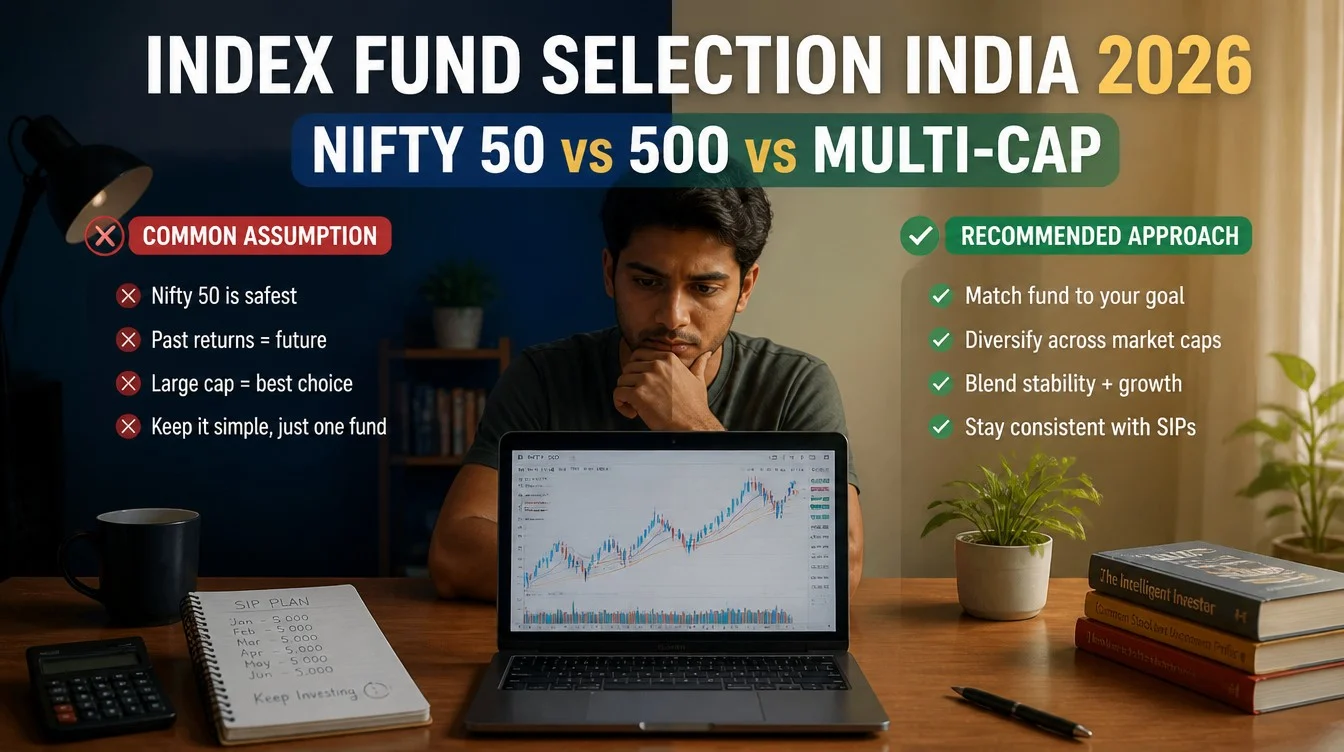
The thesis of index investing is simple: buy the market at low cost, do not try to pick winners, and let compounding do the work. The execution depends on three operational factors.
Expense ratio
The expense ratio is the annual fee charged by the AMC for running the fund. Direct-plan index funds tracking Nifty 50 in India typically have expense ratios in the 0.05 to 0.30 percent range, while broader-index funds (Nifty 500, Nifty Midcap, Nifty Smallcap, multi-cap indices) often range 0.15 to 0.50 percent. The expense ratio compounds against the investor every year and is the single largest controllable variable in long-term index returns.
Tracking error
Tracking error is the annualised standard deviation of the difference between the fund’s daily return and the index’s daily return. A well-run index fund typically delivers tracking error of 0.10 to 0.50 percent. Higher tracking error indicates the fund is drifting from the index, usually because of cash drag (cash held to manage redemptions), rebalancing lags, or sub-optimal replication.
Tracking difference
Tracking difference is the realised gap between the fund’s total return and the index’s total return over a period. Tracking difference is typically the expense ratio plus a small operational drag, and is the more useful measure for comparing funds because it captures the actual return shortfall an investor experiences. AMCs are required to disclose tracking difference and tracking error.
Liquidity and AUM
For index ETFs, liquidity on the exchange (bid-ask spread, daily traded volume) matters at the time of purchase and sale. A thinly traded ETF can carry a meaningful bid-ask spread even if its NAV mirrors the index. For index mutual funds, the daily NAV-based subscription and redemption eliminates this concern. AUM is a secondary consideration: very small index funds occasionally face survival risk (mergers, scheme closures), but the AUM threshold is much lower than for active funds.
The Nifty 50 Index: India’s Default Large-Cap Benchmark
The Nifty 50 is the most widely tracked Indian equity index and is the default starting point for most retail index investors.
What the Nifty 50 contains
The Nifty 50 is a free-float market-cap weighted index of the 50 largest listed companies in India by free-float market capitalisation. Sectors are dominated by financial services, IT, energy, consumer goods, and automobiles, with the exact weights changing as constituent prices move. The top 10 constituents typically account for 50 to 60 percent of the index.
The role in the portfolio
A Nifty 50 index fund is the lowest-volatility broad-market equity exposure available in Indian mutual funds. It is the most appropriate core holding for conservative-to-moderate investors and for shorter equity horizons (5 to 7 years), where exposure to mid- and small-cap volatility would be a poor fit.
The known limitation
The Nifty 50 excludes mid- and small-cap stocks entirely. Over very long horizons (10+ years), Indian mid- and small-cap stocks have historically outperformed the large-cap segment with higher volatility. A pure Nifty 50 allocation captures the safer part of the equity return distribution but misses the higher-return tail that broader indices reach into.
Selecting among Nifty 50 funds
Differences between Nifty 50 index funds from various AMCs are usually small but real. The selection checklist comes down to four observable items.
- Direct-plan expense ratio, where lower is better, ideally under 0.20 percent.
- Recent one- to three-year tracking error and tracking difference, where lower is better.
- AUM, where medium-to-large is preferable for stability and scheme survival.
- The AMC’s overall passive-fund management track record and operational discipline.

The Nifty 500 Index: The Broad Indian Equity Market
The Nifty 500 is a broader index that captures the bulk of the listed Indian equity universe across market-cap sizes.
What the Nifty 500 contains
The Nifty 500 represents the top 500 companies by free-float market capitalisation on the NSE, covering approximately the top 95 percent of the listed equity market by market cap. It includes large caps (the Nifty 100 segment), mid caps (the next 150, the Nifty Midcap 150), and small caps (the remaining segment within the 500). The index is free-float market-cap weighted, which means large caps dominate the index weight even though all 500 stocks are constituents.
The role in the portfolio
A Nifty 500 index fund provides single-fund access to the broad Indian equity market. It is a more complete passive expression of “the Indian equity market” than the Nifty 50 alone, with some exposure to mid- and small-cap segments. For investors who want one passive holding to cover the entire equity sleeve, the Nifty 500 is the cleanest single choice.
The market-cap-weighting consequence
Because the index is market-cap weighted, the top 50 constituents (the Nifty 50 segment) still account for roughly 70 to 75 percent of the index weight. Mid caps contribute around 15 to 20 percent and small caps around 5 to 10 percent. The mid- and small-cap segments of the Nifty 500 are not a substitute for dedicated mid- or small-cap exposure if the investor wants meaningful weights there.
Why the Nifty 500 is gaining traction
Direct-plan expense ratios on Nifty 500 funds have dropped to competitive levels (0.20 to 0.50 percent range typically) over the last few years, narrowing the cost gap with Nifty 50 funds. The added diversification across the broader universe makes the Nifty 500 attractive for investors seeking a slightly more representative passive exposure.
The Nifty 500 Multicap 50:25:25 Index: Forced Diversification
A more recent innovation is the Nifty 500 Multicap 50:25:25 index, which mechanically allocates the 500 constituents into a fixed 50 percent large-cap, 25 percent mid-cap, and 25 percent small-cap weighting.
What the index does differently
Instead of letting market-cap weighting determine the small-cap and mid-cap share, the 50:25:25 index forces a fixed allocation. Within each market-cap bucket, the constituents are weighted by free-float market cap, but the bucket totals are fixed at 50, 25, and 25 percent. The index rebalances periodically to maintain the bucket weights.
The diversification benefit
The 50:25:25 index gives the investor materially more small- and mid-cap exposure than a pure Nifty 500 in a single passive vehicle. For investors who want a multi-cap exposure without picking and weighting separate funds, the 50:25:25 index is the cleanest single-fund expression.
The volatility trade-off
Higher small- and mid-cap weight means higher volatility. The 50:25:25 index has historically shown deeper drawdowns than the Nifty 500 during corrections. The investor needs to be comfortable with the additional volatility, in exchange for the higher expected long-term return that the historically out-performing small- and mid-cap segments may contribute.
Expense ratios on 50:25:25 funds
Direct-plan expense ratios on Nifty 500 Multicap 50:25:25 index funds are in the 0.25 to 0.50 percent range from major AMCs in 2026. The rebalancing requirement makes them slightly more expensive than a pure Nifty 500 fund, but the expense is small compared to active multi-cap funds (typically 0.50 to 1.50 percent direct plan).
Comparison Table: Nifty 50 vs Nifty 500 vs Multi-Cap 50:25:25
The table below summarises the structural and operational differences between the three broad indices.
| Dimension | Nifty 50 index fund | Nifty 500 index fund | Nifty 500 Multicap 50:25:25 index fund |
|---|---|---|---|
| Market-cap coverage | Top 50 large caps | Top 500 (top 95 percent of market cap) | Top 500 across forced 50-25-25 split |
| Mid-cap exposure | None | ~15-20 percent (market-cap weighted) | 25 percent (forced) |
| Small-cap exposure | None | ~5-10 percent (market-cap weighted) | 25 percent (forced) |
| Typical direct-plan expense ratio | 0.05-0.30 percent | 0.20-0.50 percent | 0.25-0.50 percent |
| Typical tracking error | 0.10-0.30 percent | 0.15-0.50 percent | 0.20-0.60 percent (rebalancing drag) |
| Historical volatility | Lowest of the three | Moderate | Highest of the three |
| Drawdown in corrections | Most cushioned | Moderate | Deepest |
| Suitable horizon | 5+ years | 7+ years | 10+ years |
| Suitable for | Conservative-to-moderate core | Single-fund broad equity exposure | Multi-cap exposure in one passive fund |
The horizon-driven rule
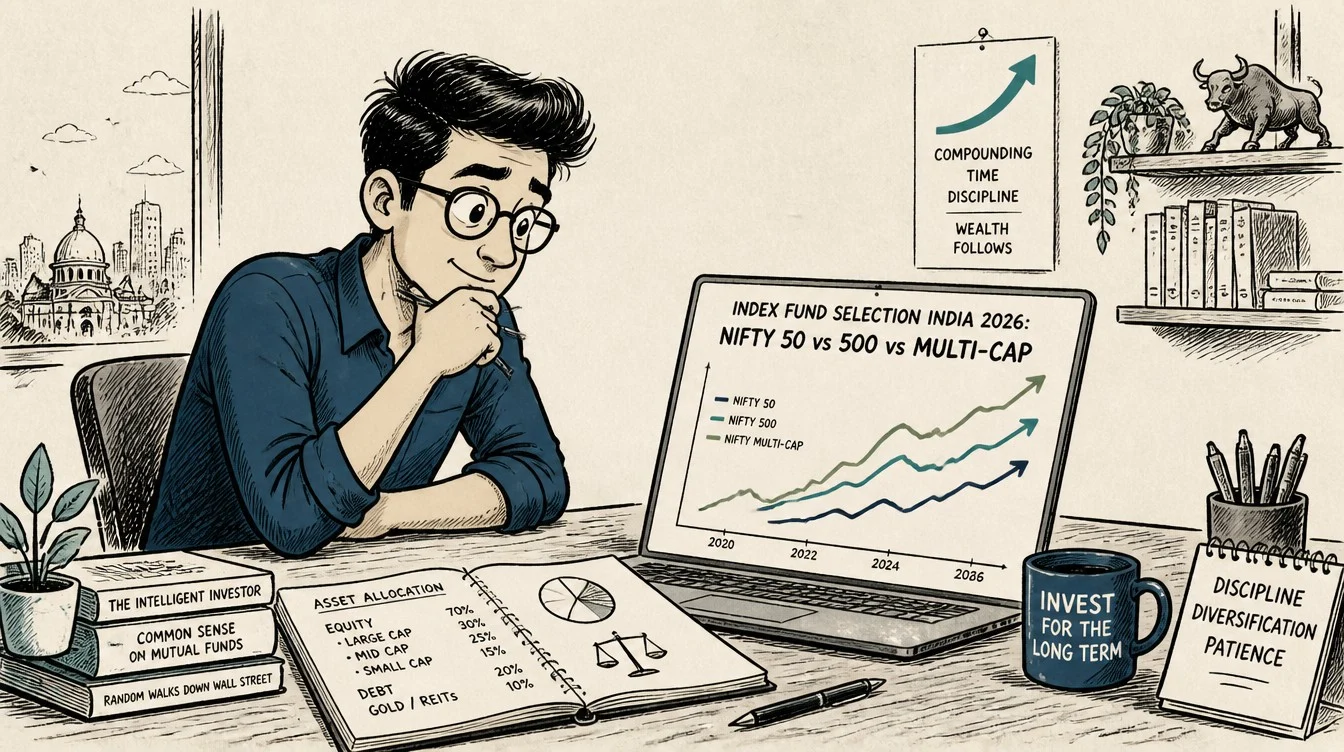
Time horizon is the single most important variable in choosing between the three. Below 5 to 7 years, the Nifty 50 is the safest of the three. From 7 to 10 years, the Nifty 500 balances coverage and volatility. Beyond 10 years, the 50:25:25 Multicap rewards the longer holding period that the higher mid- and small-cap weight requires.
The combination approach
Many sophisticated retail investors run a combination: a Nifty 50 or Nifty 500 fund as the core (60 to 80 percent of equity), with a separate Nifty Midcap 150 and Nifty Smallcap 250 index fund added in smaller weights. The combination produces a customised multi-cap exposure that can be rebalanced independently for each cap segment, which the 50:25:25 single fund cannot.
Which Index for Which Time Horizon
The horizon-driven framework lays out the typical recommendation for different goal time horizons.
3 to 5 years: tactical or short-duration goals
For equity allocations within a 3 to 5 year horizon (a planned home down payment, a child’s near-term overseas-education contribution), index-fund exposure should be modest and concentrated in the Nifty 50. The Nifty 500 and 50:25:25 indices carry too much intra-period volatility for a horizon this short. Hybrid funds or large-cap index funds dominate at this horizon.
5 to 10 years: core long-term goals
For 5 to 10 year goals (a child’s college fund, a planned business launch), the Nifty 500 is often the single-fund default. The mid- and small-cap segments add diversification without dominating the portfolio’s volatility profile. Investors uncomfortable with the volatility can stay with the Nifty 50 for the equity sleeve.
10+ years: retirement and very long horizons
For 10+ year horizons (retirement, a child’s age 35 corpus), the 50:25:25 Multicap or a combination of broad-market and dedicated mid- and small-cap index funds is suitable. The longer holding period absorbs the higher intra-period volatility, and the historically higher return of the broader market segments has more time to compound.
The dynamic-allocation approach
For investors with a 25+ year horizon (someone in their late 20s saving for retirement), the typical recommendation is a higher initial allocation to the 50:25:25 or to a combination heavy in mid- and small-cap index funds, with a gradual shift toward Nifty 50 as the horizon shortens. The shift can be programmed mechanically (e.g., 5 percent of the allocation moves from 50:25:25 to Nifty 50 every five years past age 50).

Smart-Beta and Factor Index Add-Ons
Beyond the broad-market indices, the Indian passive fund space now offers smart-beta and factor indices that tilt toward specific characteristics. These are typically used as satellite holdings, not as the core.
The major factors available
The most widely available factor indices in India in 2026 include momentum (Nifty 200 Momentum 30, Nifty 500 Momentum 50), value (Nifty 50 Value 20), low-volatility (Nifty 100 Low Volatility 30), quality (Nifty 200 Quality 30), and equal-weight (Nifty 50 Equal Weight). Each tilts the portfolio toward stocks with the named characteristic.
The role as a satellite
Factor indices are typically used as satellite positions of 5 to 15 percent of the equity sleeve, on top of a broad-market core. They are not substitutes for the broad-market core because individual factors go through long periods of underperformance (a momentum index after a sharp market reversal, for example, can lag the broad market for years before mean-reverting).
The expense and tracking-error trade-off
Smart-beta index funds typically have higher expense ratios than vanilla broad-market index funds (0.30 to 0.70 percent direct plan, occasionally higher) and higher tracking error because of the more frequent rebalancing required to maintain the factor exposure. The premium has to be earned through the factor’s long-term return premium, which is not guaranteed.
The disciplined satellite approach
The cleanest way to use factor indices is to pick one or two factors with documented long-term return premia (typically value or quality are the most studied), allocate 5 to 10 percent of the equity sleeve to each, and rebalance annually back to the target. Chasing the latest hot factor is the equivalent of chasing the latest hot active fund and produces similar results.
FAQ
Is a Nifty 50 fund enough for my entire equity allocation?
For conservative-to-moderate investors with a 5 to 10 year horizon, the Nifty 50 alone is a defensible single-fund equity allocation. For investors with longer horizons or higher risk tolerance, adding broader exposure (Nifty Midcap 150, Nifty Smallcap 250, or the Nifty 500 / 50:25:25) brings the historically higher-return mid- and small-cap segments into the portfolio. The Nifty 50 is the cleanest entry point, not necessarily the final structure.
Should I prefer an index fund or an index ETF?
For monthly SIP-based investing, an index mutual fund is typically more convenient because purchase and redemption happen at NAV without exchange-side execution. For lumpsum investments above Rs.10,00,000 (10 lakh), an index ETF can be marginally cheaper, but the bid-ask spread and exchange-trading risk needs comfort with the demat workflow. The simpler default for most retail investors is the index mutual fund.
What is the difference between tracking error and tracking difference?
Tracking error is the annualised standard deviation of the difference between the fund’s daily return and the index’s daily return; it measures how consistently the fund tracks the index. Tracking difference is the realised gap between the fund’s total return and the index’s total return over a period; it measures how much return the investor lost to costs and operational drag. Both are useful: tracking error indicates how the fund behaves on a daily basis, tracking difference measures the long-term cost.
Why does the same index have different returns from different AMCs?
The differences come from variations in expense ratio, tracking error, cash drag, rebalancing efficiency, and the AMC’s operational discipline. Over a single year, the gap between two Nifty 50 funds from major AMCs is typically small (0.10 to 0.40 percentage points), but it compounds over a decade. Selecting the lowest-cost, lowest-tracking-error fund from a stable AMC produces the best long-term outcome.
If I am investing for the first time, where should I start?
For a first-time investor with a 7+ year horizon, a monthly SIP into either a low-cost Nifty 50 or Nifty 500 direct-plan index fund is a defensible starting structure. The Nifty 50 is the cleanest, lowest-volatility entry point; the Nifty 500 adds diversification at the cost of slightly more volatility. Both choices put the investor on the right side of low cost and passive discipline. The specific fund within the index can be chosen on the basis of expense ratio, tracking error, and AMC stability.
Related guides on this topic are coming to learnfinedge.com soon.