
Nifty 50 vs Nifty Next 50: Which Index Fund Should You Choose?
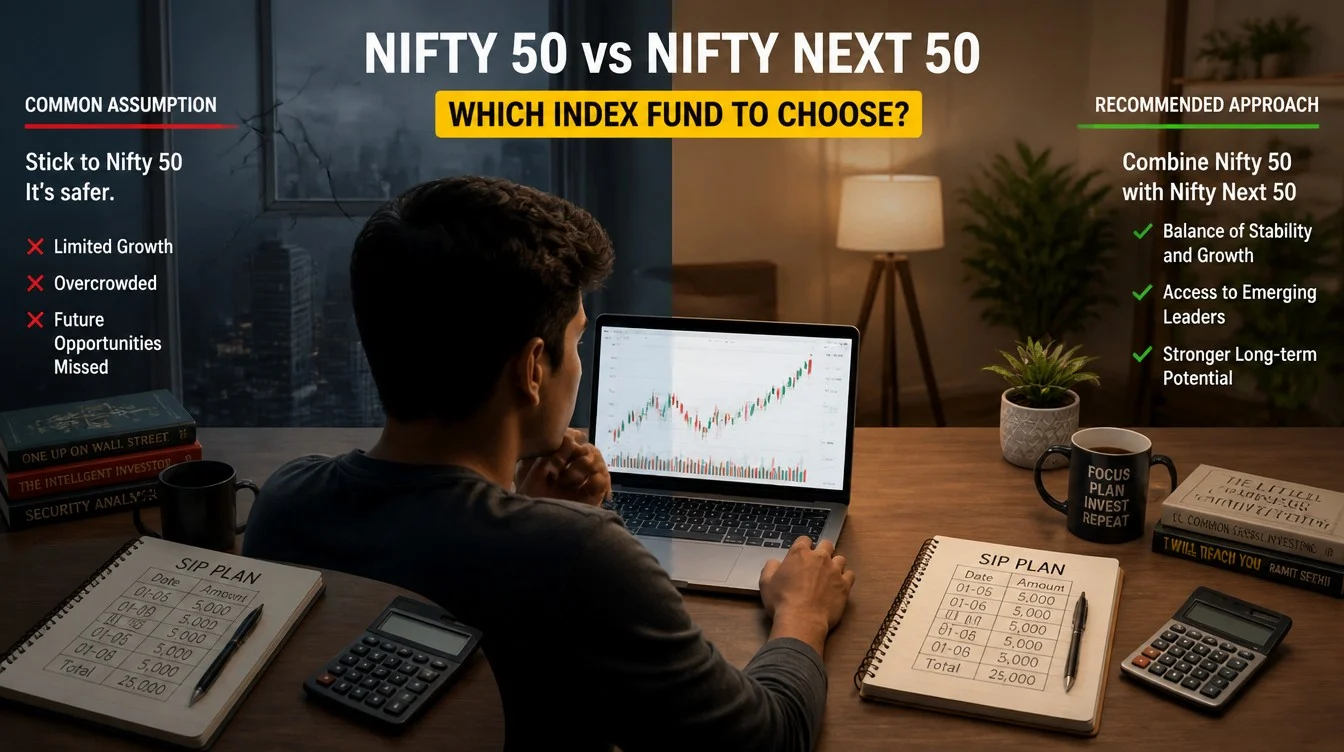
The nifty 50 vs nifty next 50 choice is one that every Indian index fund investor eventually faces. Both indices track large companies listed on the NSE. Both are available as low-cost index funds with direct plans. But they behave differently – the Nifty 50 is stable and representative of the largest Indian companies, while the Nifty Next 50 is more volatile, more growth-oriented, and has historically delivered higher long-run returns with larger drawdowns. This guide compares both indices on all dimensions that matter for investment decisions.
What Is the Nifty 50?
The Nifty 50 is the index of the 50 largest companies by free-float market capitalization listed on the National Stock Exchange of India. These 50 companies together represent approximately 65-70% of the total NSE market capitalization. The index is reviewed semi-annually (March and September) and companies are added or removed based on eligibility criteria including market cap ranking, trading liquidity, and listing history.
Current Nifty 50 sector weights (approximate): Financial services 30-35%, IT 12-15%, Oil and Gas 10-12%, Consumer goods 8-10%, Automobiles 7-9%. The index is concentrated in large financial and technology companies. HDFC Bank, ICICI Bank, Infosys, TCS, and Reliance Industries together represent approximately 30-35% of the Nifty 50 by weight.
What Is the Nifty Next 50?
The Nifty Next 50 (also called Nifty Junior) tracks the 50 companies ranked 51-100 by market capitalization on the NSE. These are large companies – not small or mid-cap – but smaller than the Nifty 50 constituents. Companies in this index are often described as “tomorrow’s Nifty 50” because strong performers in the Next 50 eventually graduate into the Nifty 50 (and weak Nifty 50 performers may fall into the Next 50 on rebalancing).
The Nifty Next 50’s sector composition is more diversified than the Nifty 50, with less concentration in financials and more exposure to consumer, pharma, and emerging sector companies. The top 5 stocks in the Nifty Next 50 represent a lower combined weight than the equivalent in the Nifty 50, making the Next 50 a more evenly distributed index.
Nifty 50 vs Nifty Next 50: Head-to-Head Comparison
| Metric | Nifty 50 | Nifty Next 50 |
|---|---|---|
| Number of stocks | 50 | 50 |
| Market cap range | Top 50 by free-float market cap | Ranks 51-100 by free-float market cap |
| Historical volatility | Lower (more stable large-caps) | Higher (30-40% higher than Nifty 50) |
| Historical returns (15-20 years) | 12-13% CAGR | 13-15% CAGR (with significant variation by period) |
| Maximum drawdown | 55-60% (2008 crisis) | 65-70% (2008 crisis) |
| Available index funds | Many (SBI, HDFC, UTI, Nippon, ICICI, Axis etc.) | Fewer (UTI, HDFC, SBI, Nippon) |
| Minimum expense ratio (direct) | 0.10% or lower | 0.25-0.35% |
The higher returns of the Nifty Next 50 come with higher risk. The index can underperform the Nifty 50 for multi-year periods when large-caps are in favour and small/mid-caps are not. Investors who cannot tolerate 3-4 years of underperformance should stick to the Nifty 50. Long-term systematic investors who continue SIPs through underperformance periods have historically captured the Nifty Next 50’s return premium.
The Graduation Effect: Why Nifty Next 50 Has Potential
One structural characteristic of the Nifty Next 50 is the “graduation effect.” Companies that grow strongly in the Next 50 eventually qualify for the Nifty 50, usually at higher weights. This means the Next 50 index naturally self-selects for companies on growth trajectories. When a company “graduates” from Next 50 to Nifty 50, its price typically reflects that growth already. The Next 50 constantly replenishes with newer companies lower in their growth curve.
This graduation dynamic is an argument for holding both – a combined Nifty 100 exposure (top 100 companies) captures both the stability of the Nifty 50 and the growth potential of the Next 50. Some investors achieve this with a single Nifty 100 index fund rather than holding separate Nifty 50 and Next 50 funds.
How to Combine Nifty 50 and Nifty Next 50 in a Portfolio
Common allocation approaches:
- 80/20 split: 80% Nifty 50, 20% Nifty Next 50. Closer to pure large-cap with a small growth tilt. Lower volatility, modest return enhancement over pure Nifty 50.
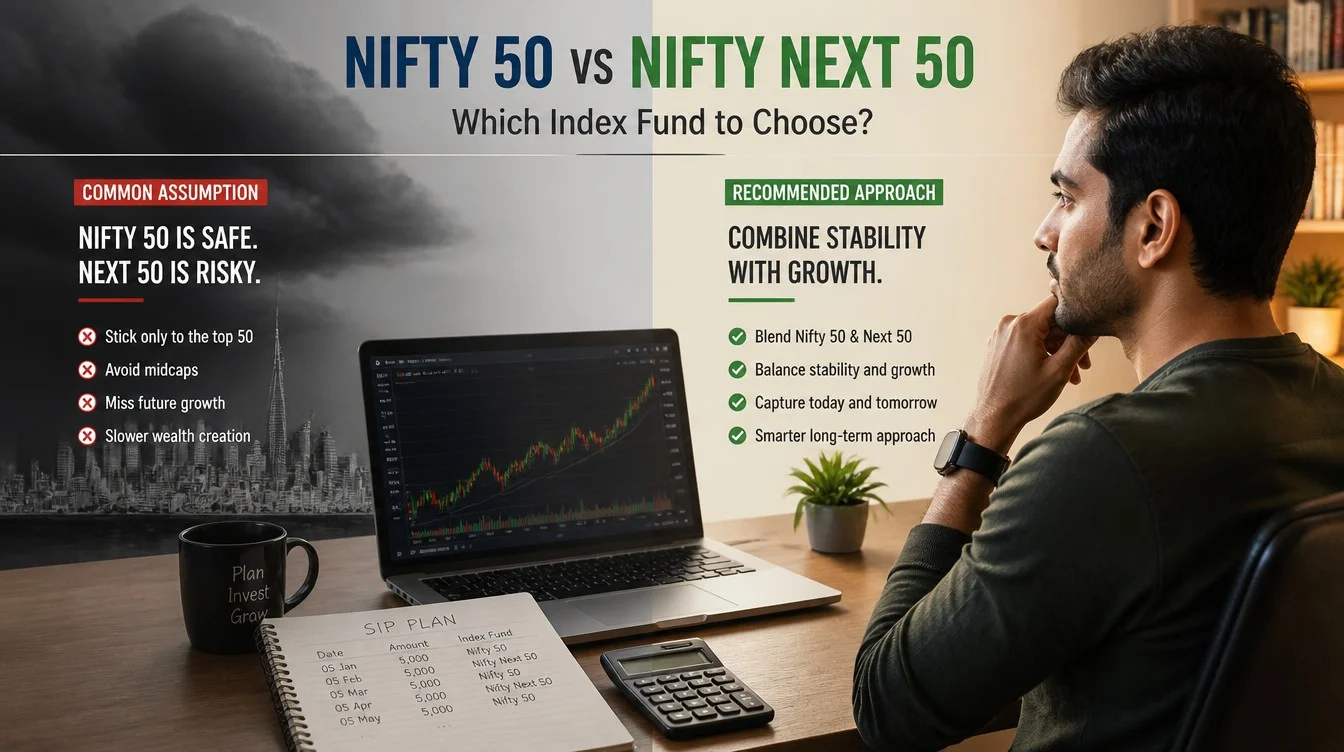
- 70/30 split: 70% Nifty 50, 30% Nifty Next 50. The most common recommendation among passive investors. Meaningful tilt toward growth while maintaining large-cap core stability.
- 50/50 split: Equal allocation. Significantly higher volatility than pure Nifty 50. Suitable for investors with 15+ year horizons and high risk tolerance. Has historically outperformed the 70/30 split over very long periods.
There is no single right answer – the optimal split depends on your horizon, risk tolerance, and behavioral ability to sit through underperformance. The worst outcome is a 50/50 split that you abandon during a correction period. A 70/30 split you maintain through all market cycles delivers better real-world outcomes than an “optimal” allocation you exit at the wrong time. For complete portfolio construction, consider how this equity allocation interacts with your debt, gold, and real estate exposure.
Which Should You Choose: Nifty 50 or Nifty Next 50?
Choose Nifty 50 as your primary holding if: you are just starting out and want the simplest approach, you have a horizon of 5-10 years where taking on extra volatility has less time to recover, or you are within 5 years of needing the money.
Add Nifty Next 50 as a satellite (20-30% of equity) if: you have 10+ year horizon, you have demonstrated ability to stay invested through bear markets, and you want to tilt your portfolio toward higher long-run returns while accepting higher short-term volatility.
Use a Nifty 100 index fund if: you want the benefits of both indices in a single fund with one expense ratio and one NAV to track. The Nifty 100 is effectively a market-cap weighted combination of Nifty 50 and Next 50 and requires no manual allocation between the two.

Frequently Asked Questions
Has Nifty Next 50 always outperformed Nifty 50?
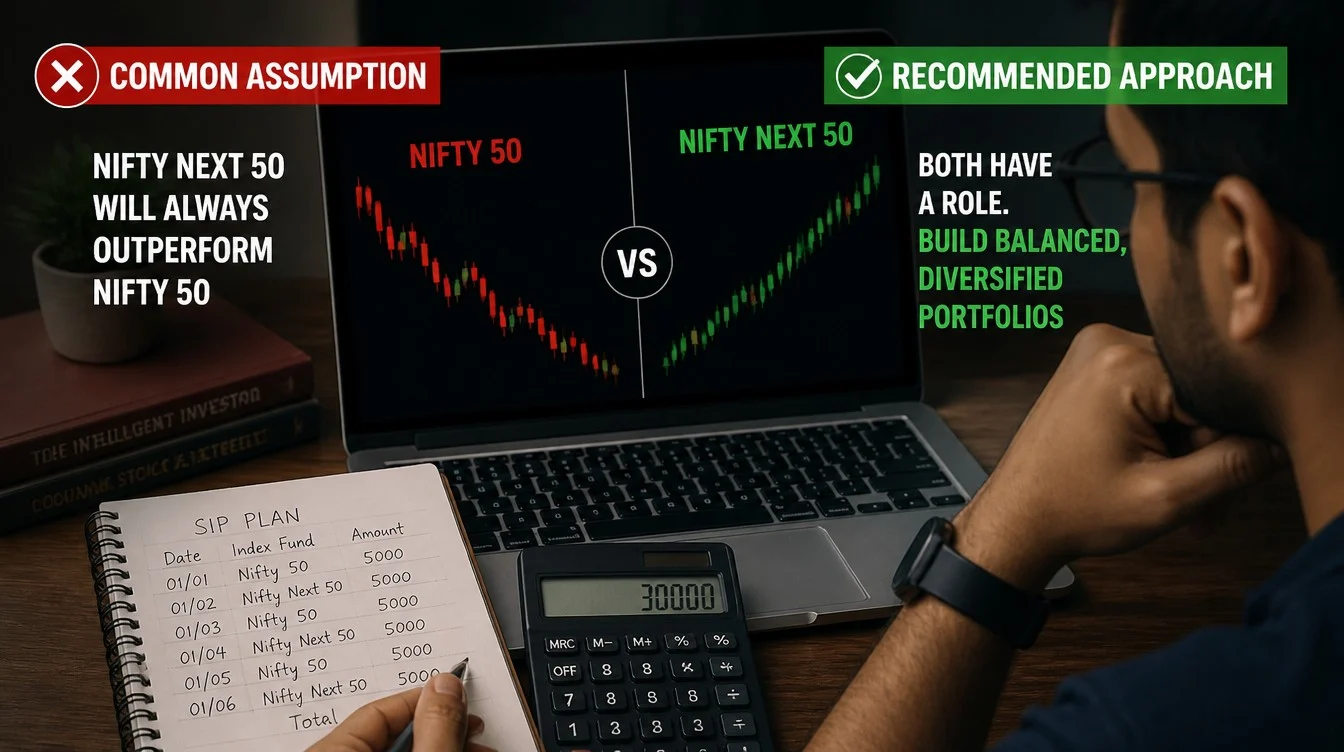
No. The Nifty Next 50 has outperformed the Nifty 50 over some 10-15 year periods but underperformed over others. The return premium is not consistent year-by-year or even decade-by-decade. The Next 50 significantly underperformed during the 2010-2013 period when large-cap defensive stocks were favoured and the 2018-2020 period when liquidity drove flows to the very largest stocks. Investors must be comfortable with multi-year underperformance to capture the long-run return premium of the Next 50.
Is the Nifty Next 50 a midcap index?
No. Despite being outside the Nifty 50, the Nifty Next 50 is classified as a large-cap index by SEBI. Both the Nifty 50 and the Next 50 comprise SEBI’s definition of large-cap stocks (top 100 companies by market cap). Midcap stocks are those ranked 101-250. This is an important distinction: Nifty Next 50 volatility is lower than true midcap indices, and its drawdown profile is closer to the Nifty 50 than to the Nifty Midcap 150.
What is the expense ratio for Nifty Next 50 index funds?
Direct plan expense ratios for Nifty Next 50 index funds are typically 0.25-0.35%, higher than Nifty 50 index funds (which can be as low as 0.10%). This is because AUMs for Next 50 funds are smaller, so fixed operating costs are spread over fewer assets. As Next 50 funds grow in popularity and AUM, expense ratios should decline over time. Always check current expense ratios on the AMC website or Value Research before investing.
Should I switch from Nifty 50 to Nifty Next 50 after a correction?
No. Timing the switch between indices is a form of market timing that rarely adds value. If you believe the Next 50 has better long-run prospects (which the historical data supports with caveats), add a Next 50 allocation to new investments going forward rather than switching existing Nifty 50 holdings. Switching triggers capital gains tax and disrupts the compounding of existing investments. The allocation decision should be made upfront based on your horizon and risk profile, not based on recent market performance.
Can I invest in both Nifty 50 and Nifty Next 50 with a single SIP?
No. They are separate funds and require separate SIP mandates. However, many mutual fund platforms (Groww, Zerodha Coin, Paytm Money) allow you to set up multiple SIPs in a single session. You can set Rs 7,000/month in a Nifty 50 fund and Rs 3,000/month in a Next 50 fund simultaneously, each with its own SIP date and auto-debit. Alternatively, a single Nifty 100 index fund SIP gives you combined exposure without managing two SIPs.
Related Articles
- SIP vs Lumpsum: 20-Year Backtest
- REIT Investment India: Complete Guide
- NPS Vatsalya Scheme: Complete Guide