

The single largest financial decision most Indian dual-income couples take in their thirties is whether to fund the family home through a single-borrower loan or a joint home loan with both spouses on the deed and the loan. The decision has three intertwined components: the EMI affordability built from two incomes, the tax deductions available under Section 24(b) and Section 80C of the Income Tax Act, 1961, and the legal ownership share in the property. A working joint home loan tax india framework brings these three components together so the couple does not optimise one in isolation and lose elsewhere.
This guide walks through the difference between a “joint borrower” and a mere “co-applicant”, the 80C and 24(b) split scenarios for couples on the old tax regime, the EMI affordability math when both incomes are used, and the ownership-share implications that drive who gets what tax benefit. The framework applies primarily to self-occupied home loans on properties held in the names of both spouses.
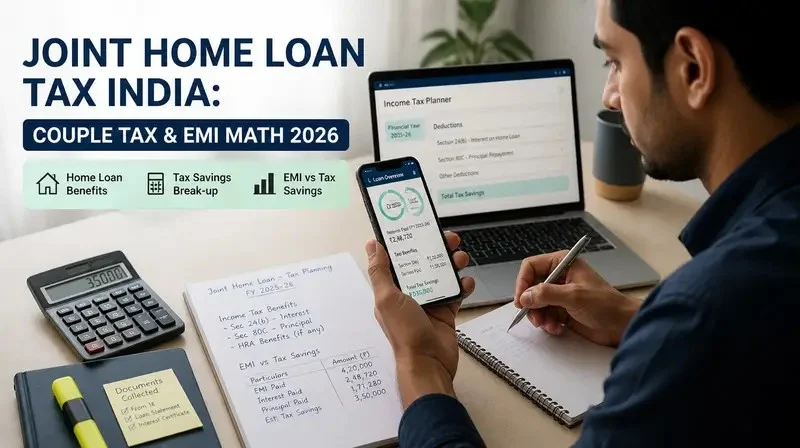
Joint Borrower vs Co-Applicant vs Co-Owner: Three Different Roles
The three terms are often used loosely but mean different things, and only the right combination unlocks the doubled tax benefit.
Joint borrower
A joint borrower is a person who is jointly liable to repay the loan. The lender can recover the entire outstanding from either borrower in the event of default. Joint borrowers are both reported to credit bureaus and the loan affects both credit scores equally.
Co-applicant
A co-applicant is anyone whose income is considered for loan eligibility, but who may or may not be a joint borrower legally. A non-earning spouse listed as a co-applicant to strengthen the application but who is not added as a joint borrower does not assume liability. This distinction is important because the tax benefits flow from being a joint borrower, not just a co-applicant.
Co-owner
A co-owner is a person whose name appears on the sale deed or title document of the property, with a defined ownership share (50-50 is the most common for couples; other ratios are possible). The income-tax benefits on a home loan are available only to a person who is both a joint borrower and a co-owner of the property.
The combination that unlocks full benefits
For both spouses to claim independent home-loan tax deductions, all three of the conditions below must be true at the same time.
- Both spouses are joint borrowers on the loan agreement.
- Both spouses are co-owners on the registered sale deed, with a defined share.
- Each spouse actually pays their share of the EMI from their own account, evidenced by bank statements.
The third condition is often ignored and is the one most commonly flagged during income-tax scrutiny.
The 80C and 24(b) Math for Joint Home Loans
For couples on the old tax regime, the doubling of deductions on a joint home loan is the single largest tax saving available to a salaried household.
Section 24(b) on interest
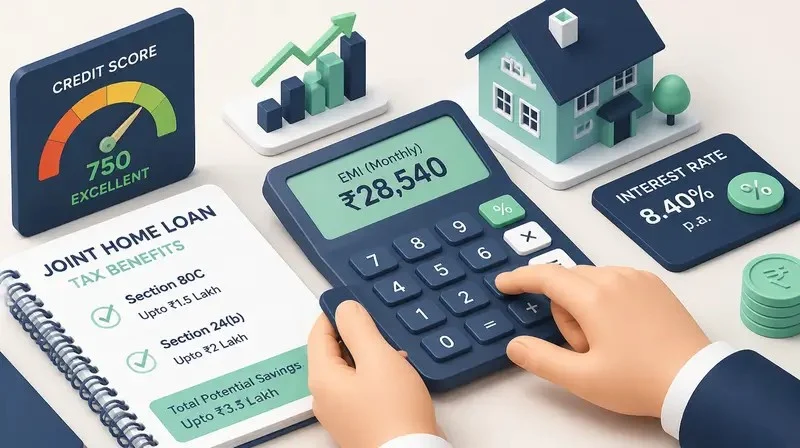
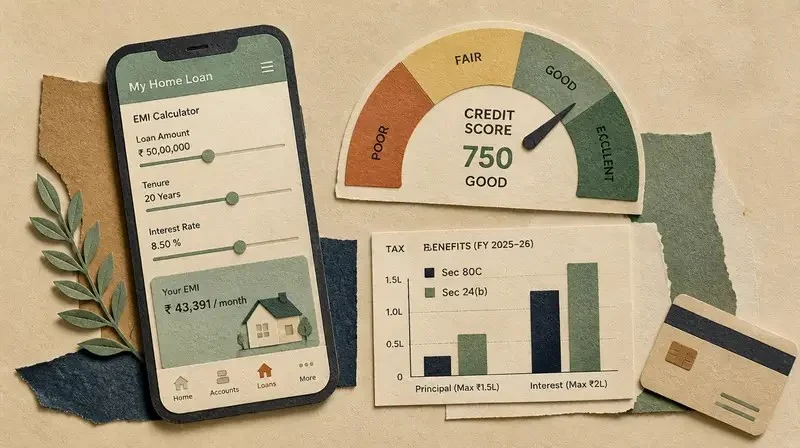
Section 24(b) of the Income Tax Act, 1961 allows deduction of interest paid on a home loan, up to Rs.2,00,000 (2 lakh) per financial year for a self-occupied property. For a joint home loan held by spouses who are both joint borrowers and co-owners, each spouse can claim up to Rs.2,00,000 of interest in their own return, subject to actually paying the interest. The combined household deduction is therefore up to Rs.4,00,000 (4 lakh) per year.
Section 80C on principal
Section 80C allows deduction of principal repayment on a home loan, within the overall Rs.1,50,000 (1.5 lakh) 80C cap that also includes EPF, PPF, ELSS, life insurance premiums, and certain other items. Each spouse on a joint home loan can claim principal up to their respective 80C cap, again subject to actually paying. The combined household principal deduction can be up to Rs.3,00,000 (3 lakh) per year, although the 80C cap is usually saturated by EPF and other items, so the marginal home-loan principal benefit is smaller in practice.
Section 80EEA for first-time buyers
Section 80EEA provides an additional deduction of up to Rs.1,50,000 (1.5 lakh) for interest on home loans, over and above the Section 24(b) limit, for first-time buyers meeting specific conditions including stamp-duty value of the property up to Rs.45,00,000 (45 lakh) at the time of sanction. The benefit is available subject to the loan being sanctioned in qualifying financial years; the latest position should be confirmed against current Finance Act notifications.
The new tax regime caveat
The new tax regime under Section 115BAC, which is the default for individual taxpayers from FY 2024-25 onwards, removes the Section 24(b) deduction for self-occupied home loans entirely. The Section 80C deduction is also unavailable under the new regime. A couple opting for the new regime gives up the joint-home-loan tax benefits in exchange for lower tax slabs. The break-even computation between the two regimes is the most important pre-decision step.
Split Scenarios: How to Apportion Deductions Between Spouses
The deduction split between spouses on a joint home loan is governed by the actual ratio of contributions to the EMI, subject to the ownership-share ratio in the property.
The 50-50 default
The most common arrangement is a 50-50 ownership share with EMI contributions split 50-50 from a joint bank account or two separate accounts in equal proportion. Each spouse claims half of the interest and half of the principal, up to their own caps. This is the cleanest structure and produces the highest combined deduction for households where both spouses are in similar tax slabs.
The proportional split
If the ownership share is unequal (e.g., 60-40), the deduction split should follow the same ratio. The EMI contribution should also be in the same ratio from each spouse’s accounts. Misalignment between ownership share, EMI contribution, and claimed deduction is the most common point of friction during income-tax scrutiny.
The single-claimant scenario
If only one spouse is in the higher tax slab (e.g., 30 percent) and the other is in a lower slab or below the basic exemption, the tax-efficient design can be to have only the higher-slab spouse claim the full deduction. This requires the higher-slab spouse to be the dominant EMI contributor and to own the larger share of the property. The other spouse, while still a joint borrower for liability purposes, does not claim any deduction.
Worked example for a couple in the 30 percent and 20 percent slabs
Consider a couple with EMI of Rs.50,000 a month on a joint home loan, of which Rs.30,000 is interest and Rs.20,000 is principal in the first year. Annual interest is Rs.3,60,000; annual principal is Rs.2,40,000. With a 50-50 split, each spouse claims Rs.1,80,000 of interest under 24(b) (well within the Rs.2,00,000 cap each) and Rs.1,20,000 of principal under 80C. The combined household tax saving in the 30 percent and 20 percent slabs, with full 80C utilisation from other items, is materially higher than a single-claimant version.
EMI Affordability with Two Incomes
The EMI affordability math is the structural backstop on any home-loan decision; the tax benefits are downstream of getting the loan amount right in the first place.
The 40 percent EMI-to-income rule
A common rule of thumb in Indian banking is that the total EMI burden across all loans for a household should not exceed about 40 percent of the household net monthly income. For a couple with combined net monthly income of Rs.2,00,000 (2 lakh), the total EMI ceiling is approximately Rs.80,000. The home-loan EMI competes with any auto loan, education loan, and credit-card minimum due for that budget.
Lender-side eligibility
Lenders compute eligibility differently. Most large banks use a “fixed obligation to income ratio” or FOIR that limits total EMIs to a percentage of gross income, with the percentage varying by income band (typically 50 to 60 percent for higher-income brackets, lower for lower brackets). The lender’s eligibility computation is usually the binding constraint, not the borrower’s rule of thumb.
Two incomes vs one for eligibility
Adding the spouse’s income to the loan application typically increases the eligible loan amount by 40 to 80 percent, depending on each spouse’s income and existing obligations. The increase is largest when the second income is comparable to the first and the second spouse has no existing loans.
Stress-testing the EMI
Floating-rate home loans in 2026 are typically benchmarked to the repo rate plus a spread (the External Benchmark Lending Rate framework). A 100 to 200 basis-point rise in the repo rate over the loan tenure is plausible. The household should stress-test the EMI at the current rate plus 200 basis points and ensure the stressed EMI still fits within the 40 percent rule of thumb. A loan that fits today’s EMI but breaks the stressed EMI is structurally fragile.
The Joint vs Single Borrower Comparison Table
The table below summarises the structural differences between a single-borrower home loan and a joint home loan for an Indian couple.
| Dimension | Single borrower | Joint borrower (spouse) |
|---|---|---|
| Loan eligibility | Based on one income | Based on combined income, often 40-80 percent higher |
| Section 24(b) deduction (old regime) | Up to Rs.2,00,000 in one return | Up to Rs.2,00,000 in each return, Rs.4,00,000 combined |
| Section 80C principal (old regime) | Up to Rs.1,50,000 in one return | Up to Rs.1,50,000 in each return, subject to 80C cap |
| Liability on default | Single borrower only | Both spouses jointly and severally liable |
| Credit-score impact | One credit report affected | Both credit reports affected equally |
| Ownership of property | Single owner | Co-owners per defined share |
| Stamp duty (some states) | Standard rate | Reduced rate possible when one owner is a woman (state-dependent) |
| Tax benefit under new regime | Not available for self-occupied | Not available for self-occupied (regime-level removal) |
The stamp-duty optimisation
Several Indian states offer a reduced stamp-duty rate on property registration when one of the co-owners is a woman (the discount is typically 1 to 2 percentage points off the headline rate). For couples buying a property in a state with this provision, a joint ownership structure with the wife as a co-owner produces a one-time saving on stamp duty in addition to the recurring annual tax deductions.
The liability flip side
Joint borrowing also means joint liability. If one spouse’s income drops or the marriage ends, the surviving income still has to service the EMI, and any default damages both credit scores equally. Adequate life and critical-illness cover for both spouses is the conventional risk mitigant; a joint home loan without commensurate life insurance is a structural exposure.
Ownership-Share Implications and the Sale Deed
The ownership share documented on the sale deed has implications well beyond tax deductions: it governs the share of any future sale proceeds, the share that passes under succession, and the legal say in any decision about the property.
Documenting the share
The sale deed should clearly state the percentage ownership of each co-owner. In the absence of an explicit ratio, the default presumption is equal ownership. For couples with significantly different contributions to the down payment or different intended ownership shares, the sale deed must reflect the intended ratio explicitly.
The capital gains treatment on sale
When a jointly owned property is sold, the capital gains accrue to each co-owner in the ratio of their ownership share. The exemption under Section 54 (reinvestment in another residential property) is claimed independently by each co-owner against their respective share of the gain. This produces flexibility that single ownership does not.
Succession and inheritance
On the demise of one co-owner, the share of the deceased passes per the personal succession law applicable (Hindu Succession Act for Hindus, Indian Succession Act for non-Hindu non-Muslim individuals) or per the will. A registered will is the cleanest way to ensure the deceased’s share goes to the intended beneficiary, which in most spousal cases is the surviving co-owner.
What changes on a marital break
Divorce or separation makes the joint ownership a contested asset. The cleanest path is a documented mutual agreement on either a buy-out of one share by the other, a sale of the property and division of proceeds per the share ratio, or continued joint ownership with a clear use and contribution agreement. Litigation over jointly owned property without explicit shares is one of the more painful and expensive scenarios.
Common Mistakes Couples Make with Joint Home Loans
A handful of mistakes show up consistently in joint home-loan setups and are easier to prevent than to fix later.
Listing one spouse as co-applicant but not co-owner
Lenders sometimes add a non-earning spouse as a co-applicant to boost eligibility, without insisting on joint ownership. The arrangement provides loan eligibility but does not unlock tax benefits, because the spouse is not a co-owner and therefore cannot claim deduction. Always confirm that joint borrower status is matched by joint ownership on the sale deed.
Paying EMI from one spouse’s account only
If the EMI is debited entirely from one spouse’s bank account, the income-tax department may treat the entire interest and principal as contributed by that spouse, regardless of what the joint borrowership says. The cleanest practice is to debit from a joint account or to split the EMI debit across both spouses’ accounts in the intended ratio.
Mismatched ownership and deduction claims
If the ownership is 70-30 but each spouse claims 50 percent of the deduction, the lower-ownership spouse’s deduction claim is exposed during scrutiny. The deduction ratio should match the ownership ratio (and the EMI-contribution ratio should match both).
Ignoring the new-regime trade-off
Many couples take a joint home loan expecting the tax benefits and then opt for the new tax regime at filing time without computing the impact. The new regime removes the entire home-loan deduction stack, which can erase the basis for the joint structure. The regime choice should be re-evaluated each year against the actual tax liability under both regimes.
FAQ
If my spouse is not earning, should I still make the home loan joint?
Adding a non-earning spouse as a joint borrower does not increase loan eligibility (no second income to add) and the tax benefits are available only if the non-earning spouse actually pays interest from their own account, which is typically not the case. The structure that often makes more sense is single-borrower-with-joint-ownership, where the working spouse is the sole borrower and the property is jointly owned for stamp-duty and succession reasons.
Can both spouses claim Section 80EEA on the same joint home loan?
Section 80EEA conditions, including the stamp-duty value cap of Rs.45,00,000 and the first-time-buyer condition, apply at the loan level. If both spouses are joint borrowers and joint co-owners on a qualifying property, each can claim the deduction within their respective return, subject to actually paying the qualifying interest. The latest position should be verified against current Finance Act notifications, since 80EEA eligibility has been time-bound in prior years.
Do I have to actually transfer money to claim the deduction?
Yes. The income-tax department looks at who actually paid the interest and principal, not just whose name is on the loan agreement. The cleanest evidence is the bank statement showing the EMI debit from each spouse’s account in the intended ratio, along with the lender’s annual interest certificate apportioned to each borrower. Some lenders issue separate interest certificates to each joint borrower on request, which simplifies filing.
Does the joint home loan affect my spouse’s separate loan eligibility later?
Yes. The joint home loan appears on both spouses’ credit reports and is counted as an active liability in any future loan application. The spouse seeking a separate car loan or personal loan will have their eligibility reduced by the share of the home-loan EMI considered as their obligation. This is one of the trade-offs of joint borrowing and should be factored into long-term loan planning.
What happens to the joint home loan if my spouse passes away?
The surviving spouse remains jointly and severally liable for the entire outstanding balance. Many lenders bundle group credit-life insurance with home loans, which can pay off the outstanding principal in the event of the borrower’s demise; the policy terms determine which borrower’s death triggers the payout and at what level. Independent term life insurance for both spouses, sized to cover the home-loan principal plus a reasonable buffer, is the standard mitigation and is the cleanest way to ensure the surviving spouse is not financially exposed.
Related guides on this topic are coming to learnfinedge.com soon.