
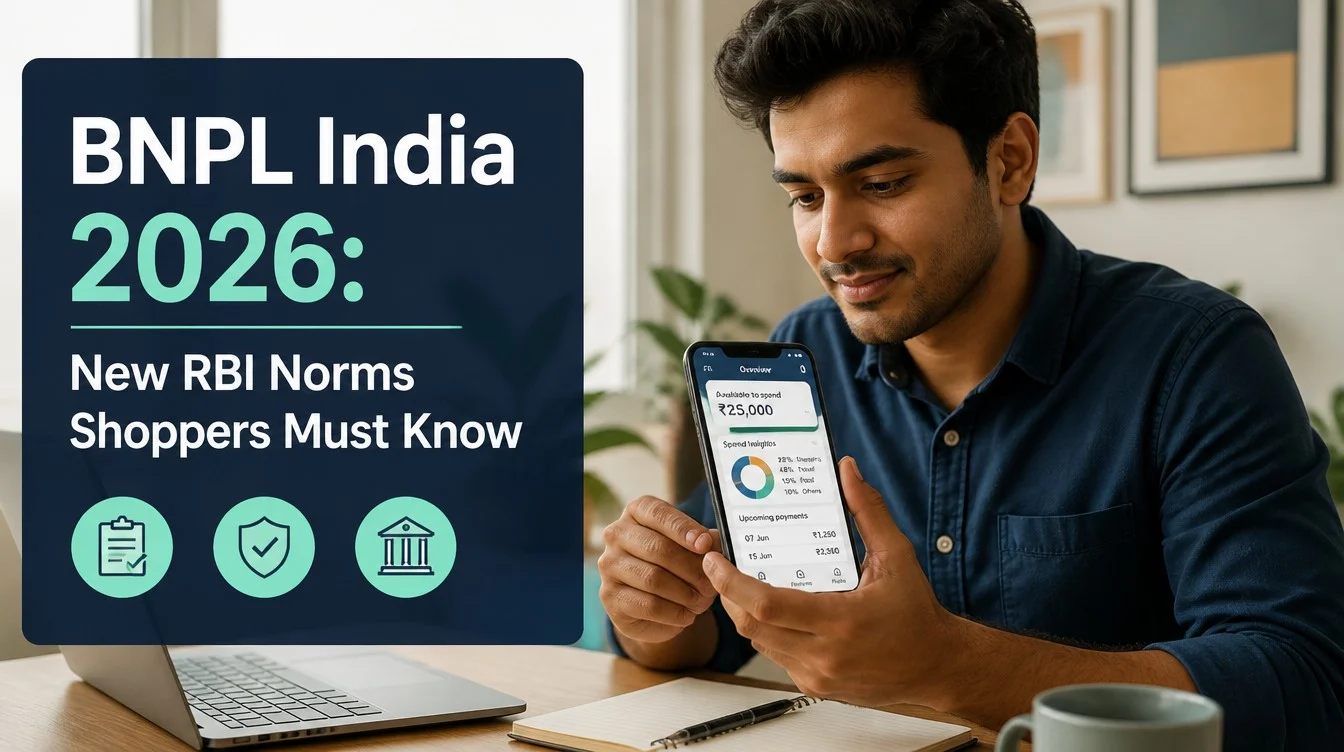
Buy-now-pay-later (BNPL) sat in a regulatory grey zone in India for most of the early 2020s. By 2026, that ambiguity is gone. The Reserve Bank of India has tightened the framework with explicit rules on who can lend, how disclosures must read, and how every BNPL transaction is reported to the credit bureaus. The phrase bnpl india rbi rules 2026 now describes a fundamentally different product than the one many shoppers first signed up for at checkout.
This guide breaks down the three biggest rule changes a shopper should be aware of, compares the all-in cost of BNPL with a credit card EMI on the same transaction, and explains how a missed BNPL payment now affects the CIBIL score. The aim is to leave readers with a working checklist for the next “no cost EMI” pop-up at checkout.
What BNPL actually is and why it grew so fast in India
BNPL is short-term credit dressed up as a checkout button. The shopper splits a purchase into a small number of instalments (often three or four), pays no interest if the schedule is met, and gets the goods or service immediately. Behind the scenes, a regulated lender funds the merchant in full at the time of sale.
The format took off in India because it solved a real problem. A salaried buyer with no credit card or a low credit limit could pay for an electronics purchase, a travel booking, or a fashion order in three to four parts without a separate loan application.
The original BNPL stack
The early Indian BNPL stack typically combined a prepaid payment instrument (a wallet), a non-banking finance company (NBFC) lender, and a merchant agreement. The shopper rarely knew which entity was actually extending the credit. The interest rate, late fees, and credit bureau implications were often buried in click-wrap terms.
Where the original model broke down
Several breakdowns triggered regulator attention. Disbursals were routed through prepaid wallets in ways that obscured the lending entity. Late fees and rollover interest spiralled into rates well above 40% per year on small balances. Customers stacked multiple BNPL lines across apps and discovered the cumulative liability only when a payment finally bounced.
What the BNPL India RBI Rules 2026 Changed
The 2026 framework treats every BNPL line as a loan, the lender of record as a regulated entity, and the credit bureau report as the truth source. The shopper still sees a clean checkout button, but the data trail behind it now lands cleanly on the borrower’s CIBIL report and is bound by the same conduct rules as any other consumer loan.
The three biggest rule changes shoppers must know
Among many fine-print changes, three rules redraw the relationship between the shopper and the BNPL provider in a way that affects everyday decisions.
Rule change 1: BNPL credit must come from an RBI-regulated lender
The clearest change is the bright line on who can extend BNPL credit. The lender of record must be an RBI-regulated entity (a bank or an NBFC) and disbursals must move directly between the borrower’s bank account and the lender’s bank account. Routing through a fintech’s pooled wallet to fund a purchase is no longer permitted.
What this means for the shopper
The terms-and-conditions screen at signup now identifies the actual lender by name. A shopper can look up that lender’s track record, ombudsman jurisdiction, and grievance redress system. The fintech operating the front-end is still part of the journey, but it is acting as a digital lending service provider, not the lender itself.
Rule change 2: Every BNPL transaction reports to the credit bureau
Every BNPL line, regardless of ticket size or tenure, must be reported to the credit bureaus. A Rs. 4,000 split-into-four purchase at an electronics site now lands on the CIBIL report as a small personal loan with a defined EMI schedule.
Why this matters for the score
On-time payments build a positive payment history, which helps the score. Missed or rolled-over payments now create a delinquency marker that can hurt the score for up to seven years. The convenience of a small BNPL transaction now carries the same credit-reporting weight as a more conventional loan.
Rule change 3: Mandatory full disclosure of all charges before consent
The lender must disclose, in a structured key-fact statement, the all-in cost of the credit (annual percentage rate, processing fee, late fees, cooling-off period, and grievance contact) before the borrower commits. The disclosure has to be in plain language and available in a permanent record the shopper can refer back to later.
Why this matters at checkout
“No cost EMI” claims at checkout are now policed against actual all-in cost. Where a discount has been front-loaded to mask an interest charge, the key-fact statement makes the underlying APR visible. A shopper has the right to a cooling-off period in which the loan can be cancelled with limited or no charges, depending on the lender.
BNPL versus credit card EMI: a side-by-side cost view
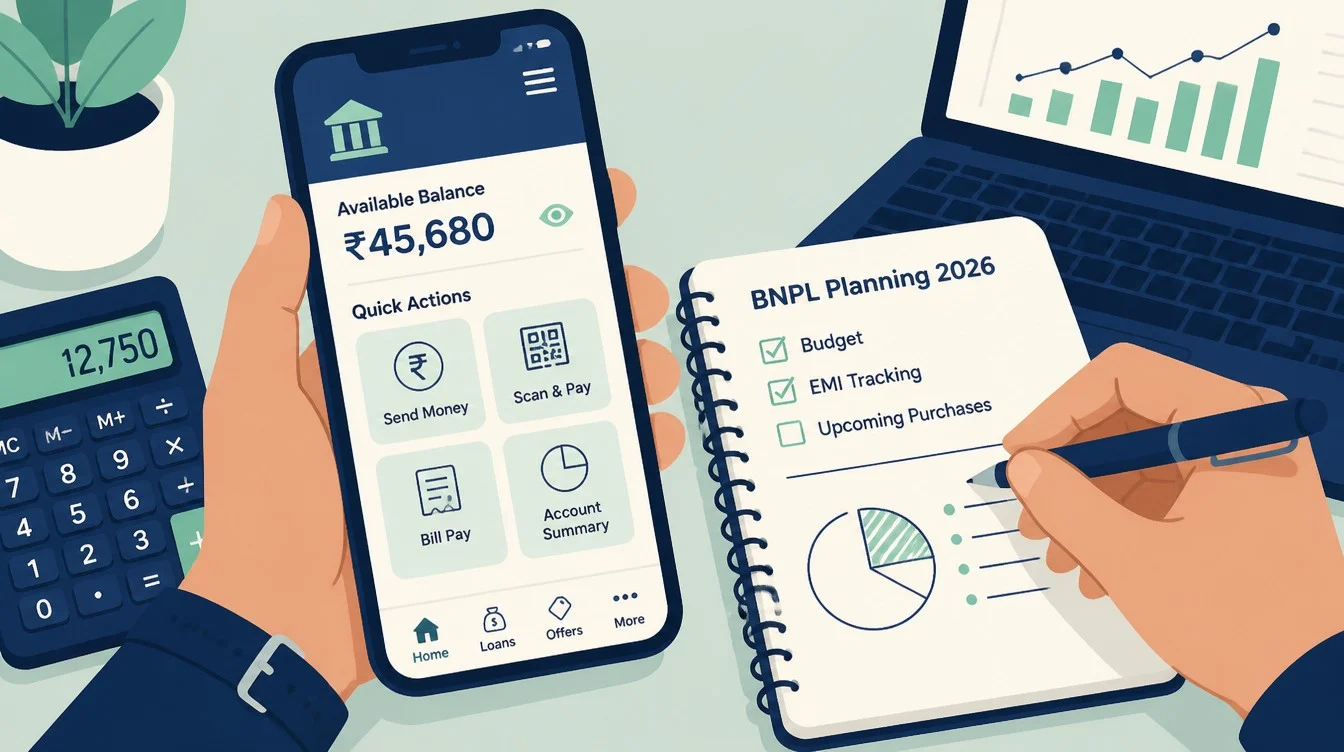
The most common question shoppers ask in 2026 is whether a BNPL line at checkout is cheaper than a credit card EMI for the same purchase. The answer depends on the specific offer, but the structure of the trade-offs is consistent.
| Parameter | BNPL (3-4 split) | Credit card EMI (6-12 months) |
|---|---|---|
| Typical interest rate | 0% to 24% APR depending on offer | 12% to 18% APR typical |
| Processing fee | Rs. 0 to Rs. 250 + GST | 1% to 2% of amount + GST |
| Tenure | Usually 3 to 4 instalments over 30-120 days | 3 to 36 months |
| Reports to credit bureau | Yes, every transaction (from 2026) | Yes, as part of card account |
| Late fee on missed instalment | Rs. 200 to Rs. 600 + GST + interest | Rs. 400 to Rs. 1,300 + GST + interest |
| Impact on grace period | None; standalone loan | Grace period continues if EMI is the only outstanding |
When BNPL really is cheaper
A genuine 0% BNPL offer over three or four instalments, with the merchant absorbing the interest as a marketing cost, is materially cheaper than a credit card EMI. The shopper must verify two things in the key-fact statement: that the APR is indeed 0% and that there is no processing fee netted off elsewhere.
When the credit card EMI wins
For tenures beyond four to six months, the credit card EMI usually carries a lower headline rate than rollover BNPL, and the existing relationship with the card issuer simplifies grievance handling. The card EMI also leaves the existing credit limit largely intact, while a BNPL line shows up as a fresh account.
The hidden cost: declined first payment
If the first BNPL instalment fails (insufficient balance on auto-debit, mandate not yet active), the late fee plus penal interest can wipe out any discount and trigger a credit bureau marker. Confirm that the auto-debit mandate is active and the salary account is funded before clicking the BNPL button.
The stacking risk
Three BNPL lines opened across three different apps for three different purchases create a meaningful cumulative liability that the shopper may not view in one place. A single credit card EMI plan, by contrast, shows up on the next card statement in full.
How a BNPL default actually affects the CIBIL score in 2026
Because every BNPL transaction now reports to the credit bureau, a missed instalment carries the same weight as a missed personal loan EMI. The score impact is not “small because the amount is small”. It is shaped by the type of event, not the ticket size.
The 30-day rule
A payment that is 30 days past due begins to show up as a delinquency on the credit bureau report. Even on a Rs. 2,000 BNPL line, a 30-day delinquency can drag the CIBIL score by 50 to 80 points and remain visible for seven years.
The 90-day rule
If the missed instalment stretches to 90 days, the lender typically classifies the loan as a non-performing asset (NPA) and reports it accordingly. This is a substantially harder marker to clear from the credit history.
How fast the score recovers
The score begins to recover from the next monthly bureau refresh after the missed payment is regularised, but the historical marker remains. Salaried borrowers who clear a small BNPL default within thirty days typically recover most of the lost score within six to nine months.
Why utilisation now matters
Multiple open BNPL lines increase the borrower’s total outstanding unsecured credit, which can push utilisation ratios up across the combined credit footprint. A salaried shopper with two credit cards, one personal loan, and four open BNPL lines suddenly looks credit-hungry to the bureau even if each individual line is in good standing.
How to monitor BNPL on the bureau report
Pull a free CIBIL or Experian report each year and scan the list of open loans for any BNPL line you no longer recognise. Closed BNPL loans should be marked “closed” with the final paid date. Disputes are filed on the same portal as any other bureau error.
The “no cost EMI” claim under the 2026 framework
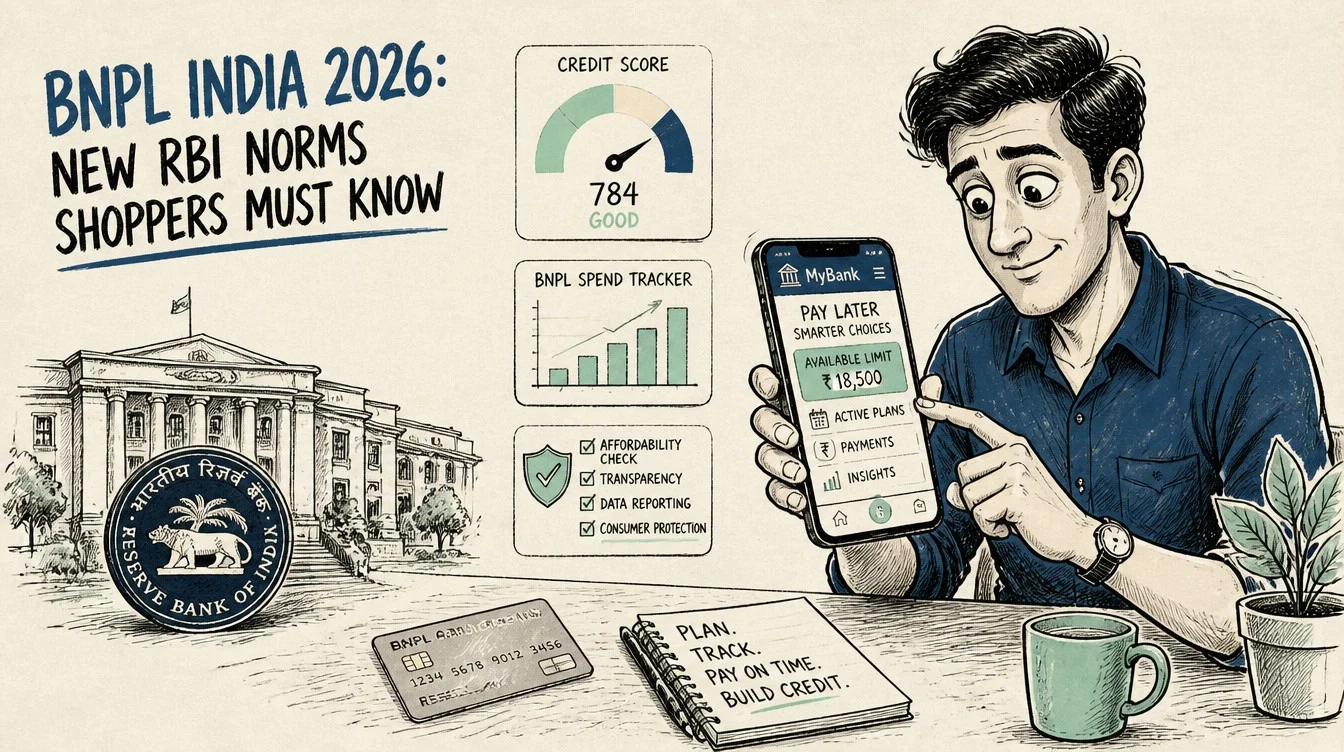
The phrase “no cost EMI” has been everywhere on Indian shopping screens for years. Under the 2026 framework, it must mean what it says or come with an explicit disclosure of how the discount and interest are linked.
The three common patterns
“No cost EMI” in practice falls into three categories. First, a genuine zero-interest offer funded by the merchant. Second, an upfront discount equal to the interest charge, where the headline price is inflated by the interest amount and then discounted back. Third, a bundling with a higher base price than the cash price for the same item, where the interest is absorbed into the markup.
What the disclosure should show
The key-fact statement now lists the APR, the principal amount, the total interest payable, any processing or convenience fee, and the net cost compared with the cash price. A genuine no-cost EMI offer shows zero in the APR and total-interest fields. A loaded offer shows the disguised cost.
The right question at checkout
The single most useful question to ask is: “what is the cash price for this product if I pay in full today, without the EMI offer?” A non-trivial gap between cash price and EMI price is the giveaway that “no cost” is really a price reframe.
GST treatment under no-cost EMI
GST applies on the actual price paid by the customer, not on the headline-then-discounted price. Where a discount has been offered to make an EMI nominally interest-free, ensure the invoice reflects the net price. This affects warranty value and refund processing.
When no-cost EMI is genuinely a good deal
For a true zero-APR offer on a planned purchase, the BNPL or EMI route improves cash flow at zero financial cost. It is essentially short-duration interest-free credit. The catch is solely discipline: a missed instalment converts the deal into expensive credit overnight.
Common mistakes Indian shoppers make with BNPL in 2026
Most BNPL trouble is not caused by predatory pricing. It is caused by absent-minded use of a convenient checkout button. The list below covers the patterns regulators and finance writers see most often.
Forgetting how many BNPL lines are open
A shopper with five open BNPL lines across three apps often cannot recite the next four payment dates from memory. The auto-debit mandates land in clusters and a single salary delay can bounce multiple instalments at once.
Not reading the key-fact statement
The 2026 framework gives the shopper a structured disclosure. Skipping it forfeits the benefit. A ten-second read often surfaces convenience fees, late fee slabs, and cooling-off windows worth knowing.
Treating BNPL as “free money”
A Rs. 4,000 BNPL line on a phone accessory feels too small to matter. The score impact of a missed instalment, however, is identical to a missed EMI on a Rs. 4 lakh loan. The bureau does not weight delinquencies by ticket size.
Using BNPL to plug recurring monthly gaps
If BNPL is funding groceries, fuel, or utility bills month after month, the household is structurally short on cash flow. BNPL is solving a symptom, not the underlying problem. The right intervention is a budget review, not another credit line.
Not closing inactive BNPL accounts
Open but unused BNPL accounts can sit on the bureau report indefinitely. Periodically log into each app and confirm closure of accounts you no longer plan to use. A clean credit footprint is easier to defend than a cluttered one.

Smart use cases for BNPL even with the tighter rules
BNPL is not inherently bad. Used with intent, it solves problems other credit products cannot. The use cases below illustrate when the format is a clear win.
True 0% APR on a planned high-ticket purchase
A laptop, a smartphone, or an appliance with a genuine three- or four-instalment 0% BNPL offer is a clean way to smooth a Rs. 50,000 to Rs. 1,00,000 purchase without dipping into emergency savings. Discipline on the instalment dates is the only requirement.
Travel and event bookings with refund risk
A BNPL split on travel or event bookings reduces the upfront cash outflow before the trip. If the trip is cancelled within the cooling-off window, only a small portion of the cost is at risk, while a full upfront payment would have to be recovered through a refund process.
Building credit history for a young earner
For a fresh graduate without a credit card, BNPL lines repaid on time can quietly build a positive history on the bureau report. Three to six months of clean BNPL behaviour helps the first credit card application later in the year.
Splitting medical or veterinary bills
Where the merchant offers a BNPL split on medical or veterinary payments, the format can soften an unexpected expense better than a credit card. Always confirm the APR and confirm that the merchant is on a partner network of a regulated lender.
Bridging a salary delay
A short, deliberate BNPL line to bridge a one-time salary delay is fine. Sustained use to bridge recurring delays is not. The signal of distress to the credit bureau is the same either way.
Step-by-step BNPL hygiene checklist for 2026
The list below condenses the rules above into a workflow a salaried shopper can run in five minutes at checkout.
- Confirm the lender of record is a bank or RBI-regulated NBFC, by name, on the key-fact statement.
- Read the APR, processing fee, and late fee slab. If the screen does not show these clearly, do not proceed.
- Check the auto-debit mandate against your actual salary account and confirm sufficient balance for the first instalment.
- Note all instalment dates in your phone calendar with alerts two days before each due date.
- Cap your total open BNPL lines at a number you can recite from memory; three is usually the practical ceiling.
- Pull a free credit bureau report at least once a year and confirm every BNPL line on it is one you opened.
- Close any BNPL account you no longer use, ideally within thirty days of clearing the last instalment.
Auto-debit failure recovery
If an auto-debit fails, manually top up the salary account and trigger the lender’s re-attempt flow on the app on the same day. Waiting even forty-eight hours can cross the 30-day reporting threshold for older instalments and create a delinquency marker.
Cooling-off and cancellation
Most BNPL lenders provide a cooling-off window of three to five days during which the loan can be cancelled with limited or no charges. The exact terms vary by lender and are listed in the key-fact statement. Use this window if the purchase is reconsidered.
Grievance escalation
If the lender or app does not resolve a dispute within thirty days, escalate to the RBI Integrated Ombudsman Scheme. Keep transaction screenshots, the original key-fact statement, and all correspondence as evidence.
Tax angle on BNPL
BNPL is treated as consumer credit. Interest paid is not generally tax-deductible, with the same narrow exception as a personal loan if the funds are demonstrably used for a residential property repair under Section 24(b). Most BNPL use will not qualify.
What lenders are now obliged to do under the framework
The 2026 rules redistribute responsibility. Shoppers are not the only ones who have a checklist; lenders and digital lending service providers carry obligations the framework can be enforced against.
Direct disbursal and repayment flows
Funds must move directly from the lender’s account to the merchant or borrower, and repayments must flow back the same way. Wallet-based pass-throughs designed to obscure the lender are not permitted.
Standard key-fact statement
A standardised, machine-readable key-fact statement must be presented to the borrower before consent. The structure is consistent across lenders so shoppers can compare apples-to-apples.
Cooling-off and grievance commitments
Each loan must have a defined cooling-off window and a documented grievance officer. Both must be discoverable in the app and on the lender’s website.
Credit bureau reporting cadence
Every disbursal, repayment, and closure must be reported within the standard monthly cadence followed by other regulated loans. The bureau ecosystem treats a BNPL line as another retail loan, full stop.
Limits on penal charges
RBI’s broader 2024-25 framework on penal charges has been extended to BNPL too, restricting punitive penalty rates and clarifying that penal charges cannot be capitalised into the loan balance and re-charged interest on. Late fees remain, but compounding penal interest is curbed.
FAQ
Does using BNPL hurt my CIBIL score?
Used responsibly with on-time payments, BNPL can mildly improve a thin credit file by adding positive payment history. Missed BNPL instalments under the 2026 framework, however, create delinquency markers that can drag the score by 50 to 80 points and remain visible for up to seven years.
Is BNPL cheaper than a credit card EMI?
A genuine 0% BNPL offer over three or four instalments is cheaper than almost any credit card EMI. Beyond four months, or where the BNPL APR is non-zero, credit card EMIs from major issuers usually win on rate. Always compare the key-fact statement against the card EMI offer for the specific transaction.
Can I cancel a BNPL loan after I have used it?
Most regulated lenders offer a cooling-off window of three to five days after disbursal during which the loan can be cancelled with limited or no charges. The exact window and conditions are stated in the key-fact statement provided at consent.
What happens if my BNPL auto-debit fails?
A failed auto-debit triggers a late fee, penal interest from the due date forward, and eventually a credit bureau report if not regularised within thirty days. Manually top up the linked bank account and retry the payment on the same day to limit the damage.
How many BNPL accounts can I have at the same time?
There is no regulatory cap on the number of BNPL lines a borrower can have, but lenders look at total unsecured credit and bureau enquiries before approving a new line. As a practical discipline, keep the count to two or three at any time so each instalment date is easy to track.
Related guides on this topic are coming to learnfinedge.com soon.