
Idle money in a savings account in 2026 is expensive. With repo at 5.25% and most savings accounts paying 2.70% to 3.50%, every Rs. 1 lakh kept lazily in the salary account loses real ground against inflation each year. The sweep in fd india 2026 route quietly solves this by treating excess savings as a short-tenure FD that still behaves like a savings account when the household actually needs the money.
This guide compares the sweep-in fixed deposit products of leading Indian banks in 2026, walks through how the auto-sweep math actually works, explains the tax treatment of sweep interest, and lines up the alternative of a liquid mutual fund for the same purpose. The aim is to make it easy for a salaried reader to pick the right home for the cash buffer that sits between an emergency fund and active spending.
What a sweep-in fixed deposit is and how the mechanism works
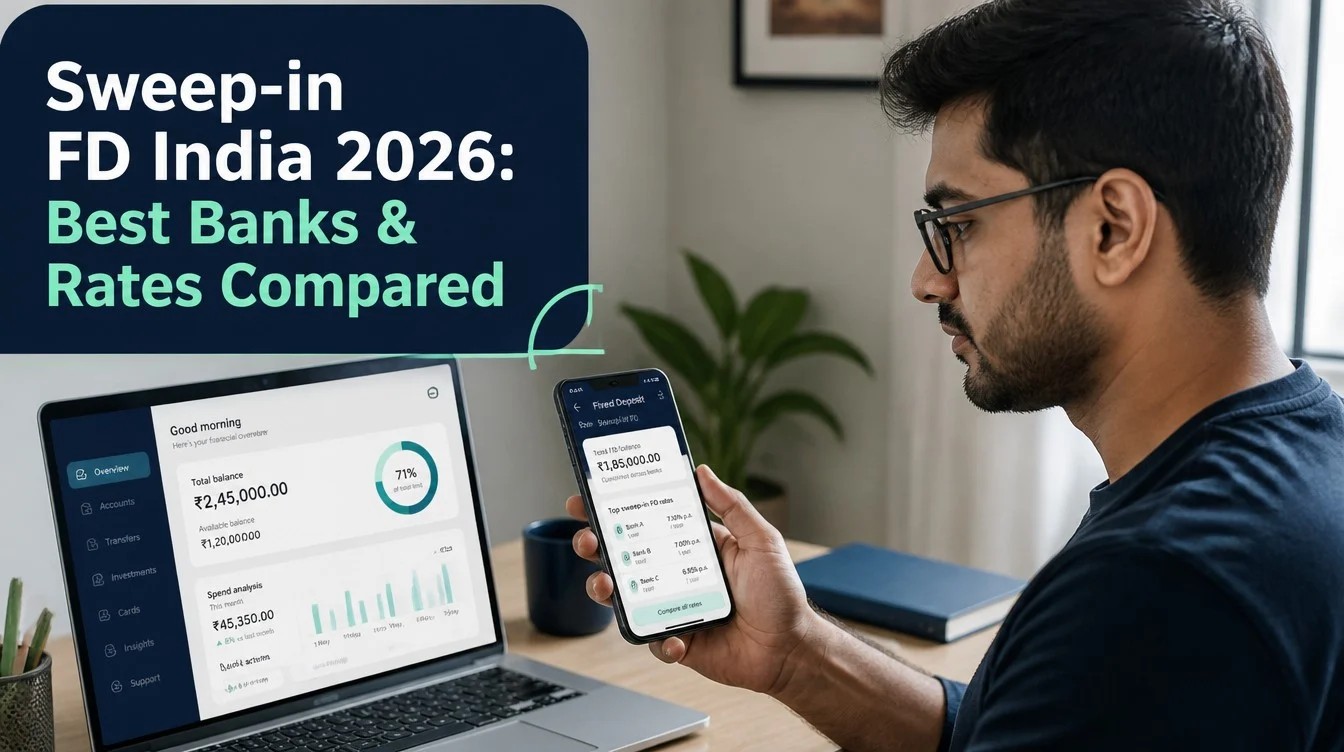
A sweep-in FD links a savings account to one or more fixed deposits in a parent-child relationship. The bank sweeps surplus savings above a defined threshold into the linked FDs in standard multiples (often Rs. 1 to Rs. 5,000, depending on the bank), and breaks the FDs back in reverse order when the savings balance falls below the threshold to meet a payment.
The headline benefit is rate uplift on idle cash. A Rs. 4 lakh salary balance that would otherwise earn 3.00% in a plain savings account can earn close to the prevailing one-year FD rate (typically 6.50% to 7.25% in 2026) on the portion above the threshold. The headline catch is that breaking the FD prematurely usually carries a small interest penalty on the broken portion.
The trigger threshold
The threshold is the savings balance above which the sweep is triggered. Banks let the customer set this in net banking, typically anywhere between Rs. 10,000 and Rs. 1,00,000. A higher threshold means more idle savings sit at the lower savings rate but fewer sweep events; a lower threshold means more rate uplift but more frequent FD breakages on debits.
The sweep-in unit
Surplus balance is swept into the linked FD in standard multiples. HDFC Bank’s auto-sweep uses units as small as Rs. 1 in some variants, ICICI Bank often uses Rs. 5,000 multiples, and SBI’s MOD (multi-option deposit) sweeps in multiples of Rs. 1,000 or Rs. 5,000 depending on the variant. The smaller the multiple, the more granular the rate capture.
The sweep-out logic on debits
When a payment is initiated that exceeds the savings balance, the bank breaks the most recent FD first (last-in-first-out) for just the amount needed. The remainder of the FD often continues to earn the contracted rate, though some banks apply a small penalty on the broken slice. The customer typically sees a single line item on the savings statement and does not have to do anything manually.
How sweep interest is credited
Sweep-in FD interest accrues like a regular FD and is credited at maturity or quarterly, depending on the scheme. The credit lands in the savings account, where it again becomes a candidate for being swept back up.
Sweep in FD India 2026: comparison table of leading products
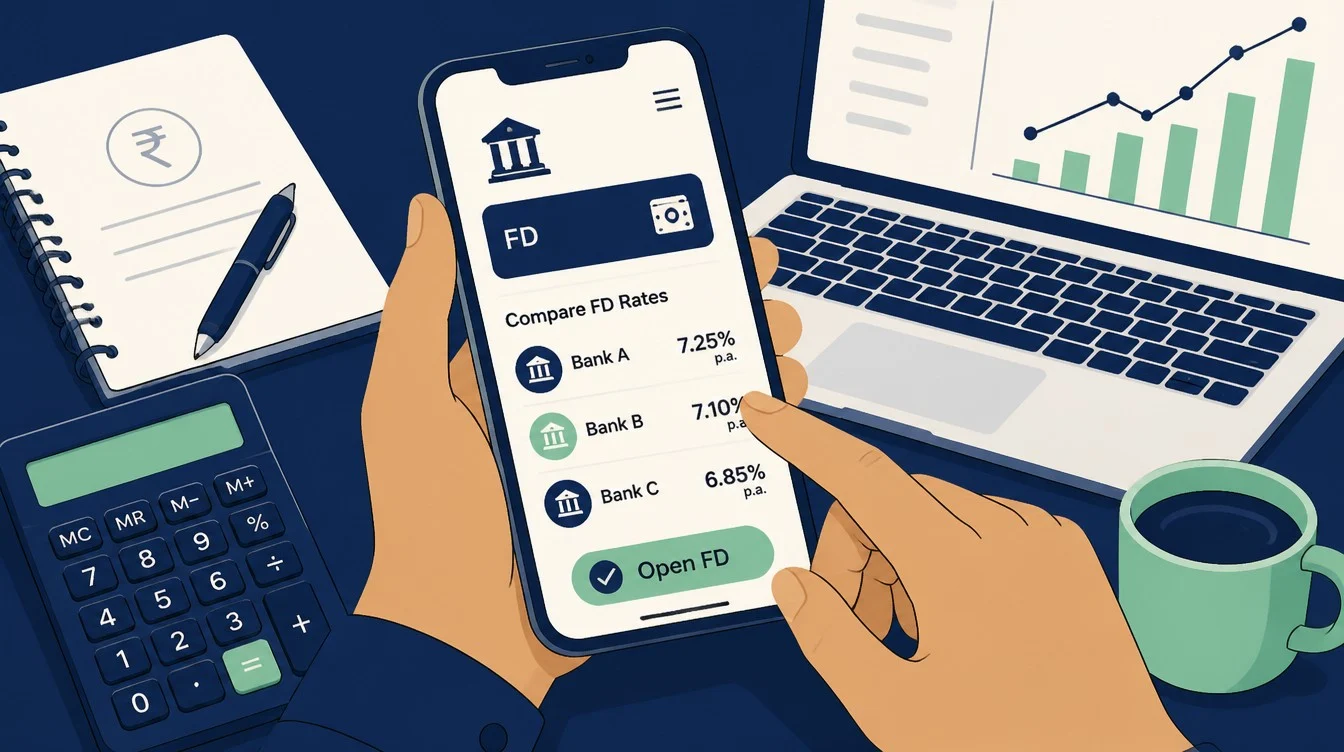
The table below summarises the structure of sweep-in FD products across major Indian banks in 2026. Headline FD rates are illustrative for a one-year tenure for general citizens; senior-citizen rates are usually 50 basis points higher. Exact thresholds and unit sizes can vary by product variant.
| Bank | Product name | Typical threshold | Sweep unit | Indicative 1-year FD rate (2026) |
|---|---|---|---|---|
| State Bank of India | MOD (Multi-Option Deposit) | Rs. 35,000 (min savings) | Rs. 1,000 multiples | ~6.75% p.a. |
| HDFC Bank | Sweep-In FD facility | Customer-set, typically Rs. 25,000 | Rs. 1 unit | ~7.00% p.a. |
| ICICI Bank | Money Multiplier / Sweep-In | Customer-set, typically Rs. 10,000-25,000 | Rs. 5,000 multiples | ~7.00% p.a. |
| Axis Bank | Encash 24 / Sweep-In | Customer-set | Rs. 1,000 or Rs. 5,000 multiples | ~7.10% p.a. |
| Kotak Mahindra Bank | ActivMoney | Rs. 25,000 (typical) | Rs. 5,000 multiples | ~7.20% p.a. |
| IDFC FIRST Bank | Auto-Sweep | Customer-set | Rs. 1 unit | ~7.25% p.a. |
| Yes Bank | Smart Sweep / Sweep-In | Customer-set | Rs. 1,000 multiples | ~7.10% p.a. |
| IndusInd Bank | Sweep-In FD | Customer-set | Rs. 5,000 multiples | ~7.25% p.a. |
| Bank of Baroda | Super Savings Account / Sweep | Rs. 50,000 (typical) | Rs. 5,000 multiples | ~6.90% p.a. |
| PNB | Sweep / Multi-Benefit Deposit | Rs. 35,000 (typical) | Rs. 1,000 multiples | ~6.80% p.a. |
Rates can move with each MPC decision and quarterly rate review. A real customer should always confirm the current rate, threshold, and unit size with the bank before activating the facility.
What the table does not show
Premature withdrawal penalty is usually 0.50% to 1.00% on the broken slice, applied only to the broken amount, not to the remaining FD. Some private banks reduce or waive this penalty when the broken amount is below a certain percentage of the total sweep.
The senior-citizen variant
Most banks offer a senior-citizen sweep-in with a 25 to 50 basis point uplift on the base FD rate. This is a meaningful boost for retired households parking ten to thirty lakhs in a single account.
Joint account considerations
A joint savings account can be linked to a sweep-in facility, but the FD ownership defaults to the primary account holder unless explicitly structured otherwise. Couples planning for joint tax planning should consult the bank on TDS form choices before activating the sweep.
Tax treatment of sweep-in FD interest in FY 2025-26
Sweep interest is treated the same way as any other FD interest under the Income Tax Act. There is no separate concessional category. The total interest earned in a financial year is added to the depositor’s “income from other sources” and taxed at the slab rate applicable to them.
This is the same treatment that applies to a regular FD. The advantage of the sweep is purely on the rate side, not on the tax side. Smart structuring can still reduce the effective tax bite.
TDS thresholds
Banks deduct TDS at 10% when total FD interest from one bank exceeds Rs. 50,000 in a financial year for general citizens, and Rs. 1,00,000 for senior citizens (effective from FY 2025-26). Sweep interest counts toward this threshold. If the depositor’s slab rate is higher than 10%, the balance tax is paid at the time of filing the income-tax return.
Form 15G and Form 15H
Depositors whose total income is below the basic exemption limit can submit Form 15G (general citizens) or Form 15H (senior citizens) to the bank at the start of each financial year to request that no TDS be deducted. The form has to be re-filed every year and applies to the entire FD portfolio at that bank.
Section 80TTA and 80TTB
Section 80TTA allows a deduction of up to Rs. 10,000 per year on savings account interest (not FD interest) under the old regime. Section 80TTB, for senior citizens, allows a deduction of up to Rs. 50,000 on combined savings and FD interest under the old regime. Sweep interest qualifies under 80TTB for seniors but not under 80TTA for general citizens.
New regime versus old regime
Neither 80TTA nor 80TTB is available under the new tax regime. Most salaried filers default into the new regime for FY 2025-26 and pay slab tax on the gross interest. Senior citizens with significant FD interest should run the math; the old regime often still wins because of 80TTB.
Net of tax yield in 2026
For a 30% slab depositor, a 7.00% sweep FD yields about 4.90% post-tax. A 3.00% savings account yields about 2.10% post-tax. The 2.80 percentage point uplift on Rs. 5 lakh is roughly Rs. 14,000 per year of additional post-tax income for no additional effort.
Common mistakes when using sweep-in FDs
Sweep-in FDs are forgiving products, but the small mistakes below can erode the benefit or create unnecessary tax events.
Setting the threshold too high
A threshold set at Rs. 1,00,000 in a salary account leaves an entire month of expenses sitting at the savings rate. Most salaried households can comfortably set the threshold at one month of essential expenses, freeing the rest to sweep.
Linking the FD to a short tenure unnecessarily
Sweep FDs allow the depositor to set the FD tenure (typically 1 to 5 years). Selecting a very short tenure caps the interest rate at the lower end of the FD curve. A one-year sweep, refreshed automatically, typically captures the best blend of rate and flexibility.
Forgetting to submit Form 15G or 15H
Depositors below the taxable threshold who skip the form pay TDS unnecessarily and have to reclaim it via the income-tax return. Submitting the form at the start of the financial year prevents the cash flow disruption.
Confusing sweep with overdraft
Some banks offer an overdraft against FD facility alongside the sweep. The two are different: sweep is rate uplift on surplus, overdraft is borrowing against the FD if a payment would otherwise bounce. Activating both is fine, but mixing them up leads to confusion at the next statement.
Not nominating
Each sweep-in FD created under the facility should carry a nomination. Many customers nominate on the savings account but assume the nomination flows through; for FDs created automatically through the sweep facility, an explicit nomination is usually required.
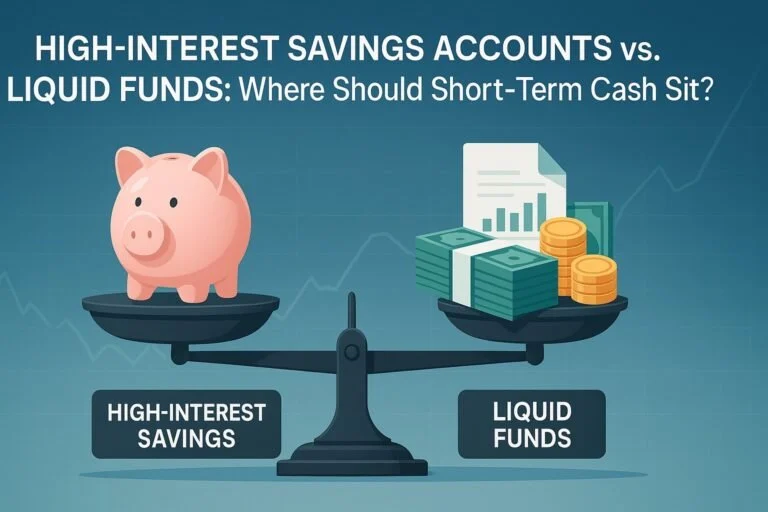
Sweep-in FD versus liquid mutual funds
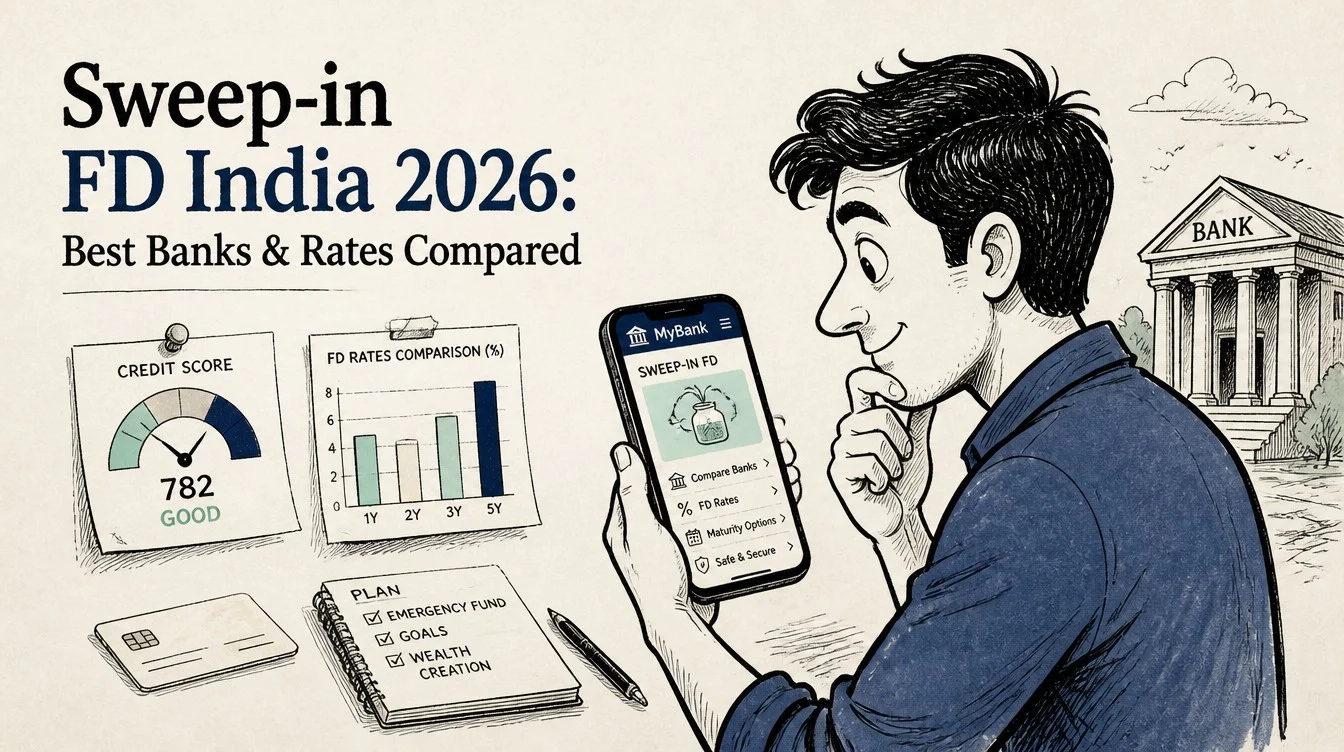
The natural alternative to a sweep-in FD for the same use case is a liquid mutual fund. Both park surplus cash, both promise quick access, and both target rates higher than a savings account. The differences are in tax treatment, liquidity speed, and risk profile.
Rate of return
Liquid mutual funds typically generate annualised returns in the 6.50% to 7.25% range in 2026, broadly comparable to one-year sweep FD rates. Liquid fund returns are market-linked and not contractually guaranteed; FD rates are contractual but may carry a small breakage penalty.
Liquidity
Sweep FDs settle within minutes when a payment debit hits the linked savings account. Liquid mutual funds typically settle in T+1 working day for redemptions above a certain threshold, with an instant redemption facility (up to Rs. 50,000 per scheme per day) on most apps. For day-of liquidity beyond the instant cap, sweep FDs are faster.
Taxation
Liquid mutual fund returns are taxed as short-term capital gains at the investor’s slab rate if redeemed within three years, and as long-term capital gains at slab rate after the 2024-25 changes (the earlier indexation benefit on debt-oriented funds is no longer available for units acquired after April 2023). FD interest is also taxed at slab rate but is paid annually as it accrues.
Risk profile
FDs from scheduled commercial banks enjoy deposit insurance up to Rs. 5,00,000 per depositor per bank, including principal and interest. Liquid mutual funds carry credit and interest-rate risk, low but not zero. Liquid funds invest in short-tenure debt instruments and have historically been low-volatility, but past performance is not indicative of future performance and market-linked instruments carry market risk.
Convenience
A sweep-in FD is fully automated within the bank. A liquid fund requires the depositor to manually move money in and out via the mutual-fund app or net banking. For households that want a “set and forget” experience, the sweep usually wins on convenience.
When to use which
A sweep-in FD is the default for the household’s everyday cash buffer up to Rs. 3-5 lakh. A liquid mutual fund can complement the sweep for the slice of the buffer that does not need same-day liquidity but earns a slightly better risk-adjusted return. Splitting the buffer 60% sweep, 40% liquid fund is a common middle-ground choice.
How to set up a sweep-in FD step by step
The setup is a five-minute exercise on net banking. The list below walks through the typical flow at a major Indian bank in 2026.
- Log into net banking and locate the “Sweep-In FD” or “Auto-Sweep” option (often under deposits or value-added services).
- Select the savings account to be linked.
- Set the threshold (typically one month of essential expenses).
- Select the sweep unit (the multiple in which the sweep happens).
- Set the FD tenure (one-year is a common default).
- Add a nomination, confirming it matches the nomination on the savings account.
- Submit and check after the next payday that the sweep has executed correctly.
What to confirm before activation
- The prevailing FD rate for the chosen tenure for general or senior citizens, as applicable.
- The breakage penalty, if any, on premature withdrawal.
- The minimum sweep amount and minimum residual after sweep-out.
- Whether interest is credited quarterly or at maturity.
- The nomination details, separately for the sweep FD if required.
What changes when the threshold is breached
The sweep typically executes within minutes of the threshold being crossed. The savings account statement shows a debit to a “sweep deposit” code, and the linked FD account shows the corresponding credit. The depositor does not need to do anything manually.
How to deactivate
Sweep facilities can be deactivated at the same screen where they were activated. The existing linked FDs continue to maturity (or can be broken on request), and fresh sweeps stop. Reactivating later is just as easy.
Tracking the sweep over time
Pull a quarterly view of the savings statement and the linked FD statement. Confirm the interest credit is showing up, that the sweep math matches expectations, and that no FD has broken due to a debit you do not recognise.

Use cases where the sweep-in FD shines in 2026
The sweep is most powerful when matched to the right slice of household cash. The use cases below are the most common.
The emergency fund
An emergency fund of six months of expenses sitting fully in a savings account loses meaningful purchasing power each year. A sweep on this corpus captures FD rates while preserving same-day liquidity. For most salaried households, this is the highest-impact deployment.
The big-purchase warm-up corpus
Money being accumulated toward a big purchase six to twelve months out (down payment for a car, registration costs for a property, planned medical procedure) fits the sweep neatly. The cash is reachable on the planned date, but it earns FD-grade rates in the interim.
The salary balance overhang
For households whose salary credit exceeds expenses every month, the residual balance compounds. A sweep automatically harvests this overhang without requiring the household to make a deliberate transfer at the end of each pay cycle.
The retiree’s transactional buffer
Retired customers running their household from interest income or pension can keep three to six months of expenses in the savings account, with a sweep ensuring the bulk of that float still earns the senior-citizen FD rate plus the 80TTB benefit under the old regime.
The small-business proprietor
Proprietors running a small business through a current account can use a sweep variant (where the bank permits it) to capture rate on the working-capital float between vendor payments. A current-account sweep is typically structured slightly differently and may require a relationship-manager conversation to set up.
Common questions in practical use
The questions below come up repeatedly in real customer service queues. The answers below are general guidance and individual bank policies vary.
Does the sweep create a separate FD certificate?
Most banks create a virtual FD under the sweep facility, visible in net banking as a linked deposit with its own deposit reference. Physical certificates are usually not issued for sweep deposits; the digital statement is the record of the deposit.
What happens to the sweep on the savings account closure?
If the linked savings account is closed, the sweep facility ends and the linked FDs are either matured or broken according to the customer’s instruction. Plan the closure with the bank to avoid an unintended premature withdrawal penalty.
Can the sweep break my emergency fund without telling me?
The sweep breaks an FD only when a payment debit would otherwise fail because the savings balance is too low. The break is silent in the sense that the customer does not have to authorise each break, but it is fully visible in the statement.
Is sweep interest treated differently from regular FD interest?
No. The sweep interest is added to “income from other sources” and taxed at slab. TDS rules and 80TTB (for seniors) apply identically to sweep and non-sweep FD interest.
Can I have a sweep on more than one savings account?
Yes. Each savings account can carry its own sweep configuration. Some households use one sweep on the salary account for transactional surplus and a second sweep on a partner’s account for joint-budget surplus.
FAQ
What rate does a sweep-in FD earn in 2026?
Sweep-in FDs earn the bank’s prevailing FD rate for the contracted tenure, typically 6.75% to 7.25% per annum for a one-year tenure for general citizens in 2026, with senior-citizen variants 25 to 50 basis points higher. The exact rate depends on the bank and the tenure selected.
Is there a penalty if my sweep FD is broken to fund a payment?
Most banks apply a small premature withdrawal penalty of 0.50% to 1.00% on the broken slice, applied only to the broken amount, not to the remaining FD. Some private banks reduce or waive this penalty when the broken amount is below a threshold or when the FD has already run for a minimum period.
How is sweep-in FD interest taxed?
Sweep interest is added to “income from other sources” and taxed at the depositor’s slab rate. Banks deduct TDS at 10% when total FD interest from one bank exceeds Rs. 50,000 in a year for general citizens or Rs. 1,00,000 for senior citizens from FY 2025-26.
Is the deposit insurance the same for sweep FDs?
Yes. Sweep FDs are regular bank FDs from a deposit-insurance standpoint and are covered up to Rs. 5,00,000 per depositor per bank by the DICGC, the same as any other FD or savings balance at the bank.
Should I choose a sweep-in FD or a liquid mutual fund?
For everyday cash buffer up to Rs. 3-5 lakh, a sweep-in FD typically wins on convenience, same-day liquidity, and deposit insurance. For incremental buffer beyond that, a liquid mutual fund can complement the sweep for a slice that does not need same-day access. Past performance of mutual funds is not indicative of future returns and market-linked instruments carry market risk.
Related guides on this topic are coming to learnfinedge.com soon.