

The single longest source of friction in Indian health-insurance contracts has historically been the pre-existing disease (PED) waiting period: the multi-year gap between buying a policy and being able to claim for any condition that existed at the time of purchase. IRDAI’s reforms through the Insurance Products Regulations, 2024 and subsequent communications have steadily compressed that gap, with material implications for new buyers, portability candidates, and households managing chronic conditions like diabetes or hypertension. The current pre existing disease waiting period india 2026 framework caps the maximum waiting period at materially lower levels than the historical 48 months, with a tighter look-back window and reduced moratorium too.
This guide walks through what counts as a PED under current IRDAI definitions, the before-and-after comparison of waiting periods, the moratorium and look-back changes, and the buying-strategy implications for households with diagnosed conditions. The framework applies to retail health insurance issued in India under IRDAI regulation.

What Counts as a Pre-Existing Disease Under IRDAI Rules
The definition of PED has been standardised across the Indian health-insurance industry through IRDAI’s standardisation of health-policy terminology, with periodic refinements.
The standardised definition
A pre-existing disease, under IRDAI’s standardised health-insurance definitions, means any condition, ailment, injury, or related disorder that was diagnosed by a registered medical practitioner within a defined look-back period before the policy was first issued, or any condition for which medical advice or treatment was received within that period. The exact look-back period was historically 48 months and was reduced to 36 months effective 1 April 2024 under the Insurance Products Regulations, 2024, with further changes communicated through subsequent IRDAI directions.
Common examples of PEDs
The most frequently flagged PEDs in Indian retail health policies are diabetes (Type 1 and Type 2), hypertension, hyperlipidaemia, hypothyroidism, asthma, chronic kidney disease, ischemic heart disease, hepatitis, and various forms of arthritis. Surgical histories within the look-back window (joint replacements, cardiac procedures, organ transplants) are also captured. Mental-health conditions diagnosed within the look-back window are PEDs under the same framework.
What is not a PED
A condition that arises for the first time after the policy commencement date is not a PED for that policy. A condition diagnosed before the look-back window opens (e.g., a hypertension diagnosis from 5 years ago for a policy where the look-back is 36 months, with no treatment in the last 36 months) may not qualify as a PED, subject to the specific policy wording and the medical history at the proposal stage. Common short-duration acute conditions (flu, infections, minor injuries) are not PEDs.
Why the look-back length matters
A shorter look-back period reduces the number of conditions that count as PEDs at the time of policy issuance. Under the older 48-month look-back, a hypertension diagnosis from four years ago counted as a PED; under the current shorter look-back, a similar diagnosis from over three years ago may not. The compressed window benefits middle-aged buyers with older diagnoses that they have since managed without recent treatment.
The Before-and-After Comparison
The structural changes to PED treatment in Indian health insurance can be summarised in a single before-and-after table.
| Dimension | Pre-2024 framework | Current framework |
|---|---|---|
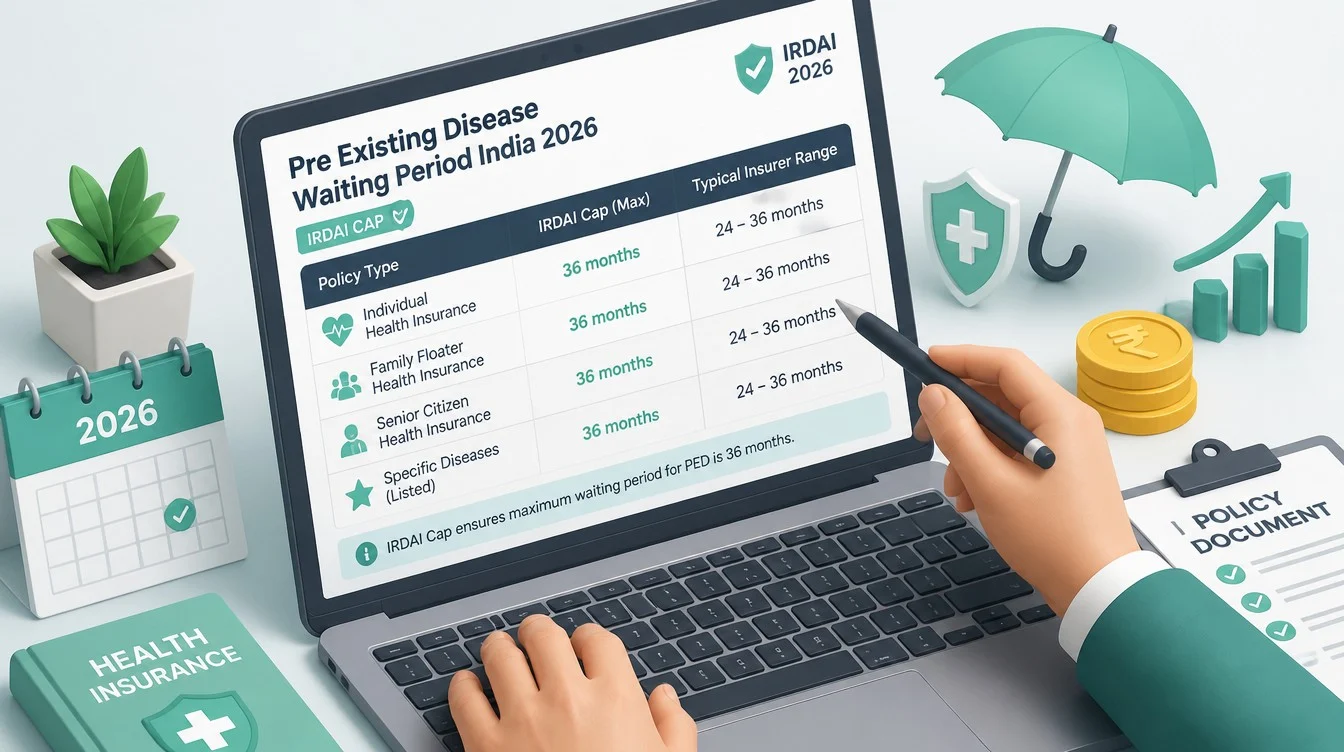
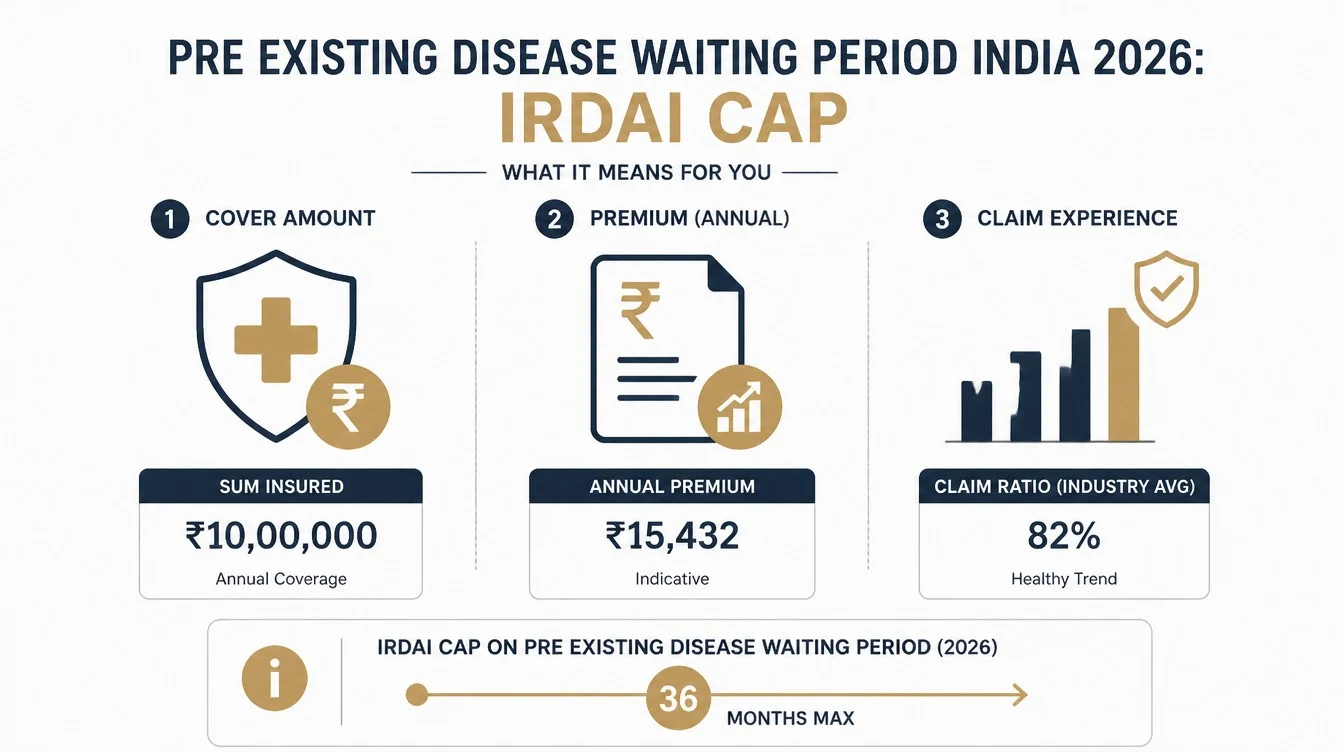
| Maximum PED waiting period | Up to 48 months | Capped at materially lower levels (24 to 36 months depending on insurer and policy) |
| PED look-back window | 48 months before policy inception | Reduced to 36 months under the 2024 regulations |
| Moratorium period | 8 years | Reduced to 5 years for non-disclosure-based claim rejection |
| Severe-disease exclusion at purchase | Could be declined | Insurers cannot refuse policies for severe PEDs like heart disease, cancer, renal failure, HIV/AIDS |
| Age cap on entry | Various age caps | IRDAI has removed the upper age cap for health-insurance purchase |
| Standardised PED definition | In place, periodically refined | Continued standardisation with tighter look-back |
What the compression means for buyers
For a 40-year-old with a diabetes diagnosis from 2022 buying a new policy in 2026, the difference between the old 48-month and the current shorter waiting period is material. Earlier, the buyer would have waited until 2030 to claim for diabetes-related complications; under the new framework, the wait is meaningfully shorter, depending on the specific policy and the insurer’s chosen waiting period within the regulatory cap.
Buyers with chronic but managed conditions
For households where the senior member has hypertension or diabetes diagnosed many years ago but no recent hospitalisation or active treatment, the shorter look-back may allow the condition to fall outside the PED definition entirely for a new policy, depending on the disclosure and underwriting. The medical declaration at proposal stage remains critical.
The moratorium reduction
The moratorium period (after which insurers cannot reject claims on grounds of non-disclosure of PEDs at the time of policy issuance) has been reduced from 8 years to 5 years. After 5 continuous years of policy coverage (with timely renewals), claims for PED-related conditions cannot be repudiated on grounds of non-disclosure, except in cases of established fraud. The shorter moratorium provides earlier certainty for the policyholder.
The Disclosure Decision at Proposal Stage
The single most consequential decision in any Indian health-insurance purchase is the medical-history disclosure at the proposal stage. The new framework does not change this; if anything, the protections only kick in fully when the disclosure is complete and accurate.
Disclose everything in the look-back window
The cleanest practice at proposal stage is to disclose every diagnosis, every treatment, every hospitalisation, and every prescribed medication received within the look-back window, along with any condition diagnosed at any time that has been treated within that window. The disclosure should include lifestyle conditions (hypertension, diabetes, dyslipidaemia, thyroid disorders) that the proposer may consider “minor” but the insurer treats as material.
What over-disclosure looks like
Over-disclosure (mentioning conditions that are not PEDs under the policy definition) can result in higher premium loading or waiting periods than necessary. It does not result in policy denial. The compromise is to disclose everything accurately and rely on the insurer’s underwriting team to apply the policy definition correctly.
The cost of under-disclosure
Under-disclosure or non-disclosure of a material condition can lead to claim repudiation under Section 45 of the Insurance Act, 1938 within the first 3 years of the policy, and to denied PED coverage even within the new shorter waiting period. The expected savings from non-disclosure (a smaller premium loading) are typically much smaller than the cost of a single denied claim. Disclose everything.
The medical underwriting step
Many policies require a medical examination at the proposal stage, particularly for buyers above 45 and for higher sum-insured policies. The medical results can themselves disclose conditions the proposer may not have known about. Cooperating with the medical and providing full history is the path to a clean policy.
Strategic Implications for Different Buyer Profiles
The new framework changes the buying strategy for several common Indian household profiles.
Young, healthy first-time buyer
For a 28-year-old salaried professional with no medical history, the PED rules are largely academic for the next decade. The buying focus should be on long-term factors like sum-insured adequacy, lifetime renewability, room-rent caps, network hospitals, and pre- and post-hospitalisation cover. PED waiting periods become relevant only later, after the first diagnosis.
Middle-aged buyer with diagnosed condition
For a 45-year-old with diagnosed diabetes or hypertension, the shorter waiting period is a direct cost saving. Buying earlier rather than later starts the waiting-period clock sooner. For households with a senior member in this category, the recommendation is to buy or port the policy now and let the waiting period run; postponing the purchase only delays the date of full coverage.
Older buyer with multiple conditions
For a 55-year-old with multiple chronic conditions, the cleanest strategy is often to port an existing policy rather than buy fresh. Continuous coverage on the older policy carries forward the served waiting periods. The portability framework under IRDAI rules allows the buyer to switch insurers without losing the time already served, subject to defined conditions.
The senior-citizen segment
The removal of the age cap on entry combined with the IRDAI prohibition on declining severe-disease policies means that even buyers in their late 60s or 70s with conditions like cancer survivorship, heart disease, or renal disease cannot be refused outright. The premium loading and waiting periods may be substantial, but the policy itself is available.

The Portability Question
The portability framework allows an existing health-insurance policyholder to switch to a different insurer’s policy while carrying forward the waiting periods and continuity benefits already served. The new PED rules interact with portability in two ways.
Waiting periods on portability
Under the standardised portability framework, the new insurer is required to give credit for the waiting period already served under the previous policy for the same conditions and the same sum insured. A buyer who has served 24 months of a 36-month PED waiting period under an older policy carries forward those 24 months on portability to a new policy.
The sum-insured top-up question
If the buyer ports to a higher sum-insured policy, the additional sum insured may attract a fresh waiting period for PEDs proportionate to the increase. The carried-forward waiting period applies only to the original sum-insured amount. The cleanest practice is to maintain the same sum insured at portability and add a separate top-up policy later if higher coverage is needed.
The 30 to 45 day porting window
Portability under IRDAI rules requires the buyer to apply at least 30 to 45 days before the existing policy’s renewal date, depending on the insurer’s specific requirements. The new insurer has a defined timeline to accept or reject the portability request. Missing the porting window can mean the buyer loses the renewal date and has to re-apply as a fresh customer, losing the carried-forward benefits.
When porting makes sense
Porting is most useful when the existing insurer has materially worse claim service, higher premium escalation, more restrictive room-rent caps, or weaker network hospitals than competitors. Porting for a small headline-premium difference rarely pays for itself because of the friction and the underwriting uncertainty. The benefit-side improvement should be clear before the porting decision.
Common Mistakes in Navigating the PED Framework
The same handful of mistakes show up in households buying or managing health insurance with PEDs.
Waiting “until I am older” to buy a policy
Postponing the policy purchase only delays the start of the waiting-period clock. The recommendation for households with diagnosed conditions is to buy now, let the waiting period run, and have coverage active when it is actually needed. Health is rarely better in the future; insurance terms are rarely cheaper either.
Surrendering an old policy to buy a “better” one fresh
Surrendering an existing policy and buying a new one as a fresh customer restarts all waiting periods. The new policy may have a better feature set, but the buyer loses the time already served. The correct route in this scenario is portability, not surrender-and-rebuy. Portability is a documented IRDAI framework available at every renewal cycle.
Not reading the specific PED waiting period in the policy
Different insurers offer different PED waiting periods within the regulatory cap. A policy with a 24-month waiting period is materially better than one with a 36-month waiting period for the same PED, and the premium difference may not justify the longer wait. The waiting period is in the policy document under the exclusions or waiting period section; the buyer should read it at the comparison stage, not after the policy is issued.
Assuming PED coverage starts on policy issuance
A common misconception is that buying a policy means immediate coverage for all conditions. PEDs are excluded until the waiting period is served. Acute non-PED conditions and accidents are typically covered after a short initial waiting period (commonly 30 days for non-accident illnesses, immediate for accidents), but PED-related claims have to wait out the longer waiting period before the policy responds.
Practical Steps for Buyers in 2026
The practical setup for a buyer evaluating new or existing health insurance in 2026 follows a small number of steps.
Step by step
- List every medical condition diagnosed or treated for each family member in the last 5 to 10 years, with approximate dates.
- For each condition, note whether any treatment, medication, or follow-up has occurred within the last 36 months.
- Identify which conditions are likely to qualify as PEDs under the current look-back window.
- Compare policies from at least three insurers on the specific PED waiting period offered for the conditions in question.
- Compare the moratorium period, the disease-wise sub-limits (cataract, joint replacement, organ transplant), and the room-rent capping.
- Disclose every condition fully at the proposal stage; expect a premium loading or specific exclusion as the insurer’s response.
- Once the policy is issued, retain the proposal form, the policy document, and the medical declaration in a single file for future reference.
The annual review
Each renewal is a moment to evaluate whether the current insurer is still the right choice. Compare claim-settlement ratios, customer-service experience, and any new policy features the market has introduced. Switching at renewal through portability preserves the waiting-period benefits already served and is the cleanest improvement path.
When to use a broker or advisor
For households with multiple PEDs or complex medical histories, working with a licensed insurance broker or a SEBI-registered investment advisor with health-insurance expertise often produces better outcomes than navigating the market directly. The broker’s job is to match the household’s profile to the insurer most likely to underwrite favourably; the household’s job is to provide complete and honest disclosure.
FAQ
If I was diagnosed with diabetes four years ago but have managed it with diet alone, is it still a PED?
It depends on the specific policy wording and the look-back window. Under the current 36-month look-back, a condition diagnosed more than 36 months ago with no medical advice or treatment in the last 36 months may not qualify as a PED for a new policy, subject to the specific policy definition and underwriting. The cleanest path is to disclose the diagnosis fully at proposal stage, let the insurer apply the policy definition, and confirm in writing how the condition is being treated under the new policy.
Can I buy health insurance if I have already had a major surgery or am being treated for cancer?
Yes. Under IRDAI’s current rules, insurers cannot outright refuse health-insurance policies for severe pre-existing conditions like heart disease, cancer, renal failure, or HIV/AIDS. The policy may carry a higher premium loading, longer waiting periods for the specific condition, and sub-limits on related treatments, but a policy is available. Households in this situation should expect to evaluate multiple insurers because the underwriting outcome can vary materially.
Does the shorter waiting period apply to my existing policy or only to new policies?
The applicable PED waiting period is whatever was specified in the policy at the time of purchase, unless the policy is ported or a new policy is bought under the current regulations. Existing long-tenured policies typically continue under their original terms. The clearest way to access the shorter waiting period is to renew with a fresh policy that explicitly offers the shorter term, or to port to an insurer offering it, with carry-forward of waiting periods already served.
What happens if I forget to disclose a condition at the proposal stage?
Non-disclosure of a material condition is a serious issue. Within the first 3 years of the policy, insurers can repudiate a claim under Section 45 of the Insurance Act, 1938, if non-disclosure is established. After the moratorium period (now reduced to 5 years), insurers cannot reject claims on non-disclosure grounds except in cases of established fraud. The safer practice is full disclosure at proposal; if a condition was missed, a written intimation to the insurer along with supporting documents can sometimes lead to a policy endorsement that brings the condition under coverage.
Should I buy a family floater or individual policies given the new PED rules?
The choice between family floater and individual policies is driven primarily by family composition, ages, and individual medical histories rather than by the PED rules. The PED framework applies to both structures. Households with one or more senior members or with significant medical histories often benefit from individual policies for those members layered with a family floater for the younger members, because the PED treatment in an individual policy is cleaner than the shared-claim risk in a floater. Compare quotes for both structures before deciding.
Related guides on this topic are coming to learnfinedge.com soon.