
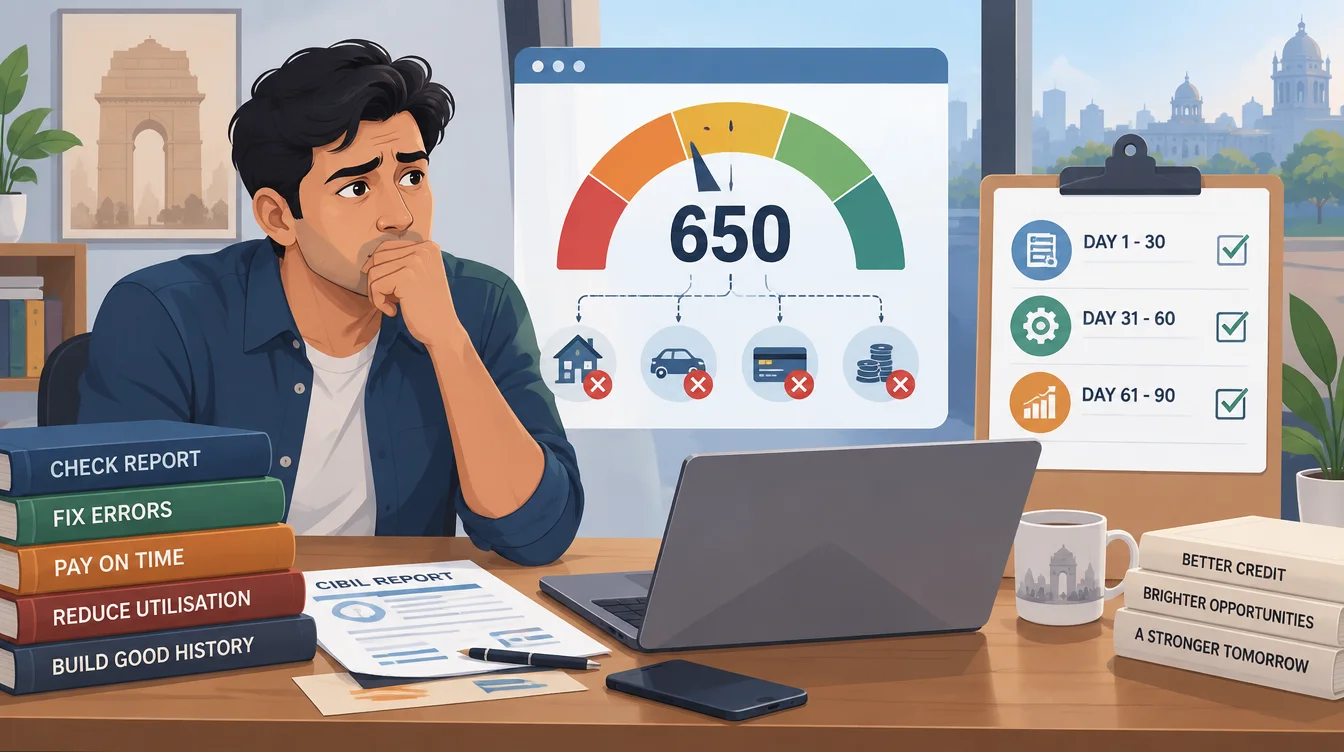
Rohit’s home loan application came back rejected on a Wednesday afternoon. His CIBIL score had landed at 648, just below the bank’s 700 cutoff. This is the most familiar CIBIL score repair India 2026 situation, and the good news is that a structured 60- to 90-day plan can lift a 650 score by 30 to 70 points without drama. He had no idea his score was that low. His payments were never late, as far as he remembered; his credit card balance was “under control”; and he had not missed an EMI in years. What he discovered, after pulling his report, was a closed personal loan still tagged as open, a credit card with an Rs 480 settled-status balance from 2019, and a utilisation rate of 71 percent across two cards. This guide walks through that plan, week by week.

Why a 650 score is the worst kind of score
A score below 600 is a refusal. A score above 750 is a green light. A score in the 640 to 690 band is the cruellest place to sit, because banks will technically accept the application, then quote you a much higher rate, push a smaller loan amount, or insist on a co-applicant. The cost of staying at 660 over a 20-year home loan is anywhere from Rs 6 lakh to Rs 12 lakh in extra interest. That is the real prize a 60-to-90 day score repair is chasing, not a vanity number.
The score has four primary drivers, in order of weight: repayment history, credit utilisation, age and mix of credit, and recent enquiry patterns. The score-repair plan attacks the two highest-weight drivers first and lets the lower-weight ones improve passively.
Week 1: Pull the free CIBIL report and read it like a forensic accountant
How to get the free report
TransUnion CIBIL is required by RBI rules to provide one free credit report per individual per calendar year. Go to the consumer section of the CIBIL portal, register with PAN, mobile, and email, complete the OTP verification and KYC questions, and download the report. Equifax, Experian and CRIF High Mark also offer free annual reports. For a clean repair, pull at least two of the four. Each bureau may show slightly different data because not every lender reports to all four bureaus.
What to look for, in order:
Section one is your personal details. Check spelling of name, date of birth, PAN, phone, email, and address. A wrong PAN tagged to your name is a silent score killer because it can drag another person’s account history into your file.
Section two is account information. Every loan, credit card and overdraft you have ever held is listed. For each line, check the status. Should read “Closed” for accounts you have settled. Check the date last reported. Should be recent for active accounts and within 30 days of closure for closed ones. Check the days-past-due history for the last 36 months. Should be all zeros.
Section three is enquiries. Lists every hard credit pull in the last two years. Five or more enquiries in the last six months is a flag.
Section four is the score itself, with the four factor weights explained. The deeper factor walk-through, including how each component is weighted, is in the credit score factors guide.

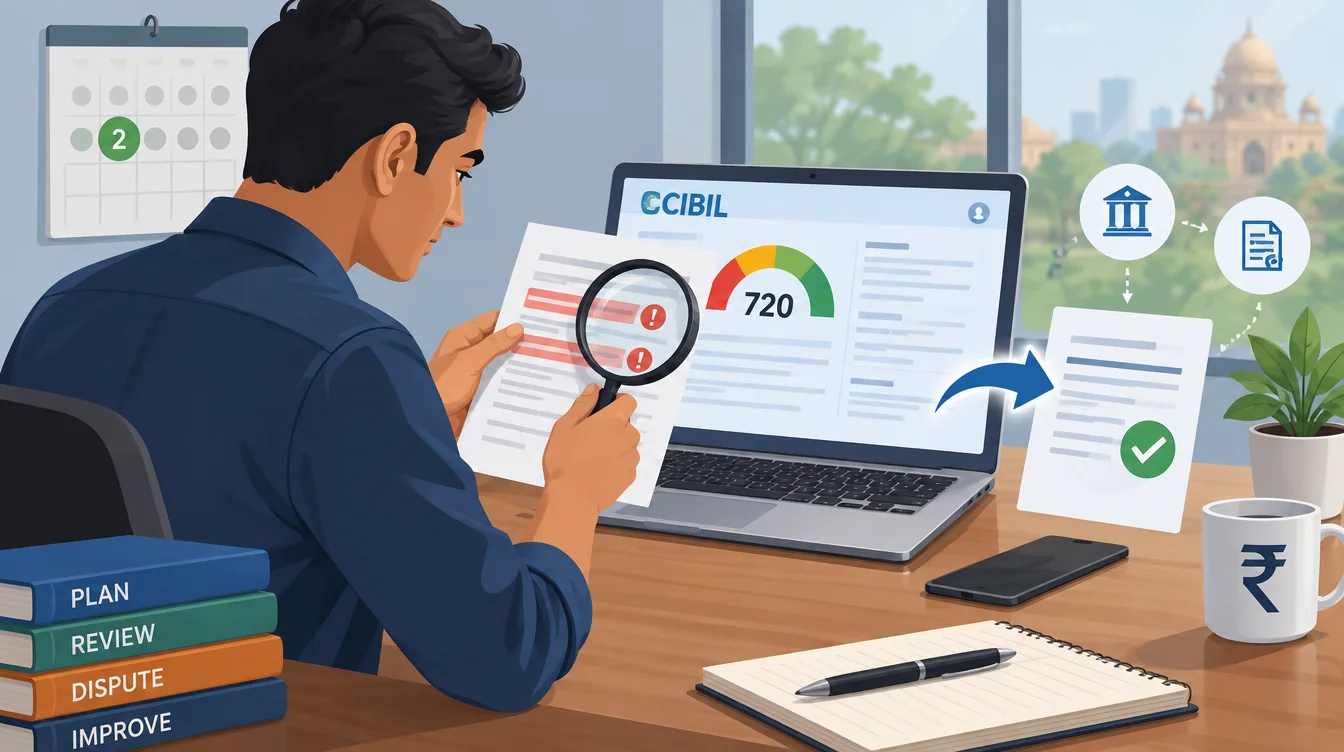
Week 2: Identify and dispute every error
This is the highest-leverage week of the entire plan. Errors on the CIBIL report are surprisingly common. The five errors that recur most often in Indian credit files are:
Closed accounts showing as open
A personal loan or credit card you closed two years ago is still showing as active. Inflates your apparent credit exposure and drags utilisation calculations.
Paid loans showing as overdue
The classic case: you paid the final EMI, the lender’s system updated the closure 45 days later, and the report still shows that one cycle as 30 days past due.
Settled status that should be closed
A Rs 500 or Rs 2,000 balance shown as “settled” stays as a black mark for seven years. Often the borrower was never even told about the residual amount.
Wrong PAN, wrong name, wrong DOB
A merged file with a different individual’s accounts. Rare but devastating when it happens.
Old enquiries that should have aged off
Hard enquiries beyond 24 months should not be visible to lenders. Bureaus sometimes leave them on screen longer than they should.
How to file the dispute
On the CIBIL consumer portal, the Dispute Resolution section lets you raise a dispute on any specific account line. Pick the line, pick the error category, write a short description, and attach supporting documents like the closure letter, the NOC, or the bank statement showing the final payment. Submit. CIBIL forwards the dispute to the originating lender, which has 30 days to respond. If the lender confirms the correction, the bureau updates the file. If the lender contests, you get a response and can escalate.
File disputes across all four bureaus you pulled, even if the same error appears identically; each bureau treats its file independently.
Week 3-4: Drive credit utilisation under 30 percent
Why 30 percent is the magic line
Credit utilisation is the second-heaviest weight after repayment history. It is calculated as your statement-date outstanding balance divided by your total credit card limit. Scoring models start docking points above 30 percent utilisation. Above 50 percent, the penalty steepens. Above 80 percent, the score drop is severe.
The trick is that utilisation is measured on the statement date, not on the payment date. So even if you pay your card in full every month, if your statement is generated on the 18th and you typically spend Rs 80,000 of a Rs 1 lakh limit by then, your file is showing 80 percent utilisation forever. The score model never sees the fact that you cleared it on the 5th.
Three ways to drop utilisation fast
First, pay the card before the statement date, not after. Make a partial payment around the 14th or 15th of every month so the statement-date balance is under 30 percent of the limit. Then pay the residual when the bill arrives.
Second, ask the issuer for a credit limit increase. Some banks now allow self-service limit hikes through the app. A limit hike from Rs 1 lakh to Rs 2 lakh, with the same spend, instantly halves the utilisation ratio. The card issuer typically does a soft pull for this, which does not hurt the score.
Third, spread the spend. If you carry two cards with Rs 80,000 and Rs 50,000 limits, do not park all spending on one. Splitting Rs 40,000 of monthly spend across both keeps per-card utilisation at 50 and 80 percent respectively; consolidating on the larger card alone keeps it at 50 percent and the other at zero, which is actually worse on overall ratio scoring.
The trap of paying only the minimum due, which causes utilisation to compound month over month, is dissected in the credit card minimum payment trap note.
Week 5-8: No new credit applications, plus passive maintenance
Stop applying completely.
Every fresh credit card application, BNPL signup, and personal loan enquiry, even some pre-approved offers, triggers a hard credit pull. Each pull docks 3 to 8 points. Five pulls in a quarter can drop a 660 score to 635. During the 60- to 90-day repair window, the discipline is simple: apply for nothing.
This includes those tempting “upgrade your card” offers, free travel card sign-ups, BNPL on shopping checkouts, and EMI conversions on existing card spends if they are tagged as a fresh loan in the bureau view. The wider playbook for lifting a score with the same kind of structured discipline is laid out in the credit score boost action plan.
Keep oldest cards alive
The average age of your credit accounts contributes to the score. Closing your oldest card to simplify the wallet actually shortens the average and drops the score. If a card has no annual fee and zero current usage, just leave it open. Run a small monthly spend on it, between Rs 200 and Rs 500, and set up auto-pay for the bill. Costs nothing, keeps the tradeline aging.
Add a small secured-credit instrument if you are thin-file
If your file has only one or two tradelines, adding a small secured tradeline now compounds for the rest of the year. A credit card against a fixed deposit or a small consumer durable EMI on an item you were going to buy anyway both add depth. Skip this if your file already has four or more active tradelines; you do not need more.
Weeks 9-12: Track, retest, lock in the gain
By the end of week 8, your disputes should be partially resolved, your utilisation should be sitting under 30 percent for two consecutive statement cycles, and you should have had zero new enquiries for two months. Around week 9, pull the report again. Compare it line by line against the week-1 snapshot.
What a typical 650 score looks like at day 75
If two disputes succeeded, that alone is often 25 to 40 points. If utilisation dropped from 70 percent to 25 percent, that is another 15 to 30 points. If enquiries aged out, that is 5 to 10 points. The aggregate, for a typical 650 starting point, lands somewhere between 685 and 720 by day 75.
Where the score will not move yet
Two things take longer. Settled-status entries take the full seven-year ageing cycle to drop off unless you can negotiate a re-categorisation with the lender. And a recently closed default tradeline keeps appearing for 36 months. The repair plan accepts those as fixed costs and works around them.
Lock-in moves for the next 12 months
Once the score crosses 750, the habits that got it there should become the new normal. Pay before statement date. Never carry a balance. Cap total enquiries to two per six-month window. Pull the free report once a year, every January, and scan for fresh errors. The wider question of when a CIBIL score might drop again and what to watch for is covered in the CIBIL score drop reasons piece.
One honest caveat
A 60-to-90 day plan works for files that are damaged by drift, not by genuine default. If you have a written-off loan from six months ago or a default that was bureau-reported in the current cycle, no repair plan will pull your score above the 670-680 ceiling until those tradelines age out. The plan still helps, just not as dramatically. For files in that bucket, the realistic 12-month target is 700, and the 24-month target is 750. The detailed 90-day playbook for the cleaner cases is in the Improve CIBIL in 90 days guide.
The instinct after a rejection is to apply somewhere else, lower, and faster, hoping someone will say yes. That is the worst possible move. Every rejection adds a hard pull. Every hard pull drops the score further. The cheapest move in the week after a rejection is the boring one: pull the report, fix the errors, and wait.
Frequently asked questions
How long does it actually take to repair a CIBIL score in India?
For a typical file in the 640 to 690 band with utilisation issues and one or two bureau errors, a disciplined 60- to 90-day plan can deliver a lift of 30 to 70 points. For files with a recent default, a written-off loan, or a settled-status tradeline, the realistic horizon is 12 to 24 months, as those entries take time to age off or be re-categorised. The fastest gains come from disputing errors and reducing utilisation to below 30 percent. Slower gains come from accumulating clean repayment history and watching old enquiries roll off the report.
How do I dispute an error on my CIBIL report?
Log in to the CIBIL consumer portal, open the Dispute Resolution section, pick the account line that is wrong, choose the error type, add a short description, and upload supporting documents like the closure letter, the lender’s NOC, or the bank statement that proves the final payment. Submit. CIBIL forwards the dispute to the lender, which has 30 days to respond. If you have errors on Experian, Equifax or CRIF High Mark too, file separate disputes on each bureau because each one maintains its file independently. Keep screenshots of every submission.
What credit utilisation percentage should I target for a higher CIBIL score?
Aim for under 30 percent on each individual card and under 30 percent across all cards combined, measured on the statement date, not the payment date. Scoring models start docking points above 30 per cent, steepen the penalty above 50 percent, and treat anything above 80 percent as a serious risk signal. The simplest way to get there without changing your lifestyle is to make a partial payment around the 14th or 15th of each month, before the statement is generated, so your statement-date balance is low even if your actual monthly spend is much higher.
Will checking my own CIBIL score lower it?
No. Pulling your own report through CIBIL, Experian, Equifax or CRIF High Mark is classified as a soft enquiry and has zero impact on your score. Only hard enquiries, triggered when a lender pulls your report after you apply for a credit card or loan, can shave 3 to 8 points off the score. So pull your own report freely, especially the one free annual report each bureau owes you. The hidden risk is not the self-check; it is the cluster of hard pulls created by applying to multiple lenders in a short window after a rejection.
Can a settled credit card account ever be removed from my CIBIL report?
Difficult, but sometimes possible. A settled status, where you paid less than the full outstanding to close the account, stays on the file for seven years from the settlement date. The only earlier path is to negotiate with the lender to refile the account as closed with full payment after you make up the differential amount. Many banks offer this re-categorisation as a one-time gesture, but you must ask in writing. If they agree and update, the bureau refreshes on its next data cycle. If they refuse, you wait out the seven-year window.