
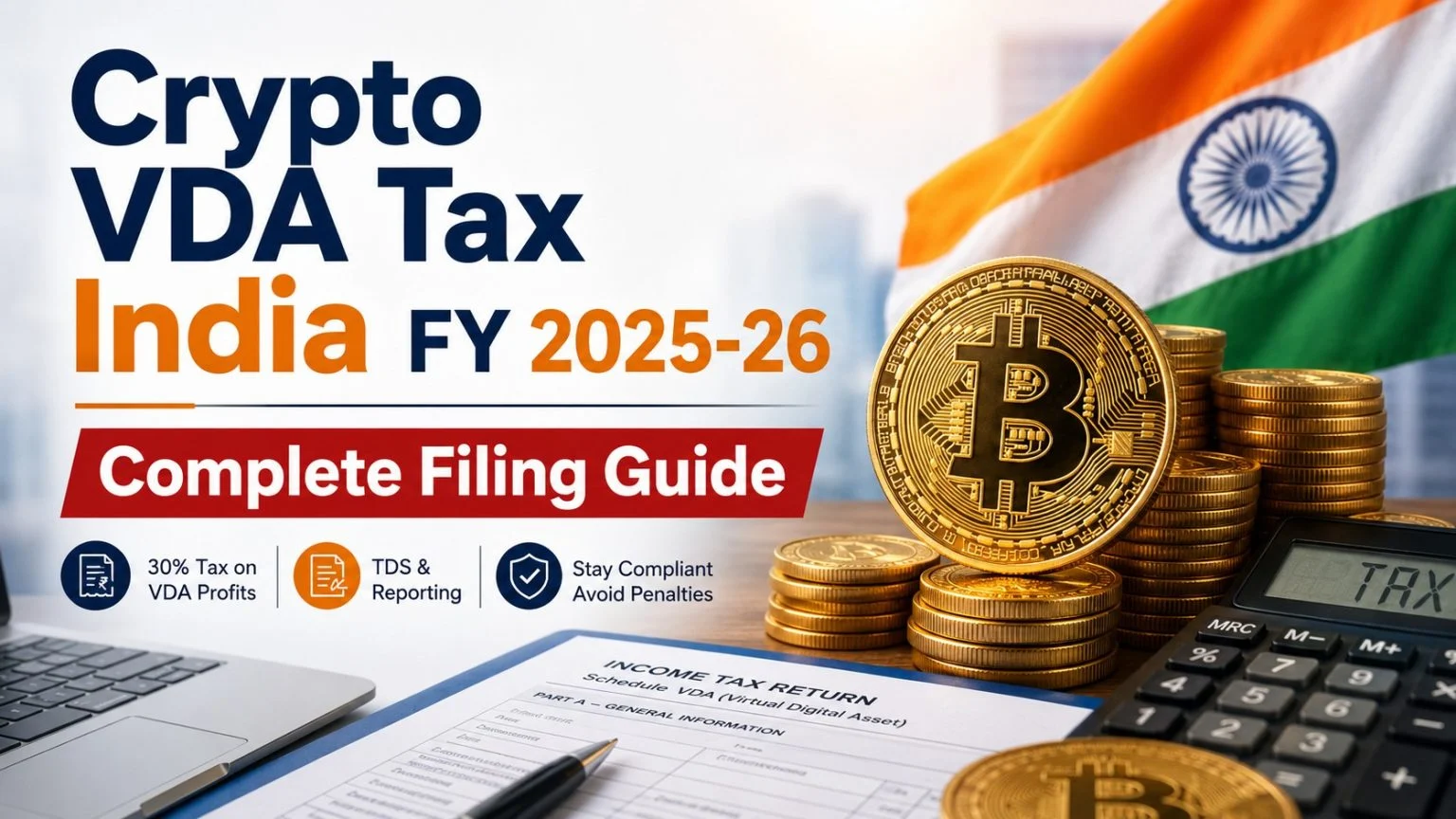
The crypto VDA tax India FY 2025-26 rulebook is harsher than most retail traders realise, and the harshness is the entire point. Section 115BBH brought in a flat 30 percent tax on gains from virtual digital assets in 2022, Section 194S added a 1 percent TDS on every transaction in mid-2022, and neither has been softened in the four budgets since. There is no slab benefit, no loss offset against any other income, no loss carry forward, and no indexation. For the FY 2025-26 return that you will file by 31 July 2026, the rules are exactly the same.
This guide walks through the law as it stands, the TDS mechanics through Indian exchanges, the Schedule VDA reporting in ITR-2 or ITR-3, the foreign exchange and peer-to-peer trap, and the worked example of a trader with Rs 1 lakh profit on Bitcoin and Rs 50,000 loss on Ethereum to show exactly what tax shows up on the final return. It is educational and does not constitute tax advice for any specific situation; check with a CA before filing.

What counts as a VDA in 2026
Section 2(47A) defines a virtual digital asset very broadly: any cryptographic representation of value, any token on a blockchain generated through cryptographic means, and any non-fungible token. Bitcoin, Ether, Solana, Polygon, USDT, USDC and every other cryptocurrency falls inside. NFTs fall inside subject to central government notification. The CBDC (digital rupee) is specifically excluded, as are closed-loop gift cards and subscription tokens. The breadth is deliberate and forecloses the route of arguing a particular token is something other than a VDA.
Three categories of income trigger tax. Gains on sale (sale value minus cost of acquisition). Income from transfer (treated identically to gains, with a narrower deduction list). And receipt of VDA as a gift or in return for services (taxable as other income at slab rate, separate from Section 115BBH). Mining and staking rewards are taxed as other income at slab rate at the point of receipt, valued at the FMV of the coin on the receipt date; the subsequent sale is a separate Section 115BBH transaction with the FMV-on-receipt as cost. Airdrops follow the same rule.

The 30 percent flat rate under Section 115BBH
Gains on transfer of a VDA are taxed at a flat 30 percent under Section 115BBH. No basic exemption, no slab benefit, no Section 87A rebate. If you have Rs 5,000 of VDA gains and no other income, you still pay 30 percent on the Rs 5,000. The only deduction allowed against the gain is the cost of acquisition of the specific VDA being sold. No transaction fees, no exchange charges, no broker commissions, no internet costs. Add 4 percent cess plus surcharge if total income crosses Rs 50 lakh (10 percent) or Rs 1 crore (15 percent, capped). The effective rate on a Rs 10 lakh crypto gain for a high-earner lands in the 32 to 36 percent range.
No loss offset, no carry forward: the hardest rule
A loss on a VDA cannot be offset against gains on any other VDA. So a Rs 50,000 loss on Ether does not reduce a Rs 1 lakh profit on Bitcoin. A VDA loss cannot be offset against capital gains on equity, debt, real estate, salary, business income, or any other head. It cannot be carried forward to subsequent years. Once a VDA loss is realised, it has no tax value anywhere, ever. This is the single rule that makes professional crypto trading economically unattractive compared to equity trading, where intra-head set-off and eight-year carry forward materially soften the bad-year impact. The intuition that crypto can be netted internally is the most common filing error.
1 percent TDS under Section 194S
Section 194S requires the buyer of a VDA to deduct 1 percent TDS on the payment to the seller if aggregate consideration exceeds Rs 10,000 in a financial year for specified persons (individuals, HUFs and small entities), or Rs 50,000 for everyone else. Indian exchanges deduct TDS on every sale transaction above the threshold and issue a Form 16E at year-end. The TDS is on the gross sale value, not on the profit, so selling a coin for Rs 1 lakh triggers Rs 1,000 TDS regardless of whether you bought it for Rs 50,000 or Rs 1.5 lakh. Crypto-to-crypto trades are deemed transfers under 194S and both sides trigger TDS at the exchange level, which is why intraday-style crypto trading bleeds capital even on break-even trades.
Indian exchanges issue Form 16E by June following the financial year-end. Cross-check it against your AIS download and your own trade log; discrepancies must be raised with the exchange before filing. If you trade on a foreign exchange that does not deduct Indian TDS, you owe self-assessment tax on the gain without any TDS credit. Report it in Schedule VDA voluntarily; the IT Department cross-checks foreign exchange data through information-exchange agreements.
Schedule VDA in ITR-2 or ITR-3
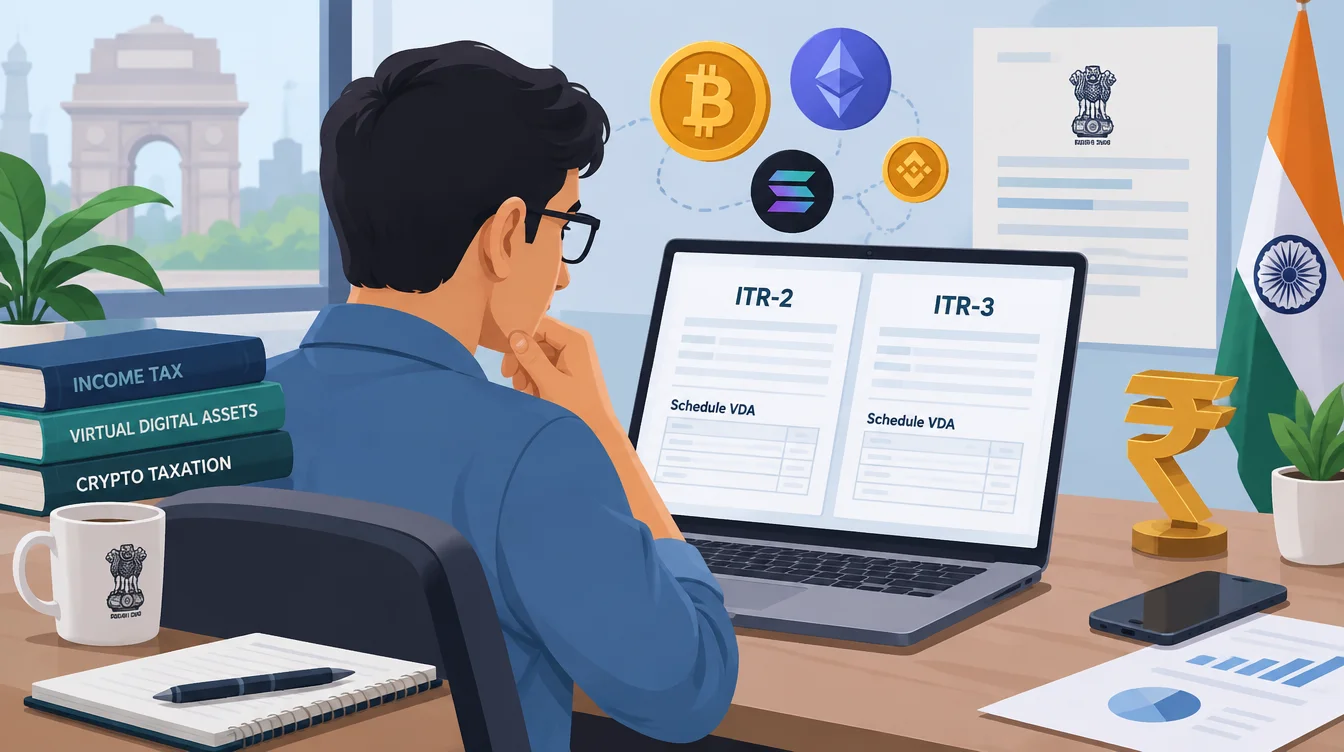
From AY 2023-24, the ITR has a dedicated Schedule VDA capturing, for each VDA transaction during the year, the date of acquisition, the date of transfer, the cost of acquisition, the sale consideration, and the income from transfer. For a salaried filer trading crypto on the side, gains go in Schedule VDA under capital gains taxed at 30 percent. For an active trader whose primary income is from crypto, the gains can be characterised as business income; the tax rate is still 30 percent under Section 115BBH regardless of head.
The form requires transaction-by-transaction reporting, not a summary. CoinDCX, WazirX, ZebPay and CoinSwitch all offer FY-summary CSV downloads that map cleanly to Schedule VDA columns. The walkthrough on filing the full ITR-2 is in our ITR-2 filing guide.
Worked example: Rs 1 lakh BTC profit and Rs 50,000 ETH loss
Assume a salaried IT professional in Hyderabad, age 32, salary Rs 18 lakh, files ITR-2. During FY 2025-26 she executed two VDA trades on CoinDCX. Trade 1: bought 0.02 BTC in April 2025 for Rs 1,20,000, sold November 2025 for Rs 2,20,000. Profit Rs 1 lakh. CoinDCX deducted TDS of Rs 2,200 on the sale. Trade 2: bought 1.5 ETH in May 2025 for Rs 4 lakh, sold February 2026 for Rs 3.5 lakh. Loss Rs 50,000. CoinDCX deducted TDS of Rs 3,500 on the sale.

Tax computation. The BTC gain of Rs 1 lakh is taxed at 30 percent flat. The ETH loss cannot offset (no-offset rule) and simply lapses. Tax on Rs 1 lakh BTC gain Rs 30,000 plus cess Rs 1,200 equals Rs 31,200. TDS already deducted across both trades Rs 5,700. Net additional tax payable at filing Rs 25,500 (plus 234B and 234C interest if advance tax was not paid quarterly). The Rs 3,500 TDS on the loss-making ETH sale is still fully creditable; the loss being non-deductible does not affect the TDS credit.
Counterfactual: equity treatment
Had the same transactions been on listed equity (Reliance and TCS instead of BTC and ETH), both held short term, the Rs 1 lakh profit and Rs 50,000 loss would have offset cleanly, leaving Rs 50,000 net STCG. At the 20 percent post-July-2024 rate the tax would be Rs 10,400 with cess. The VDA route produces Rs 31,200 of tax; the equity route produces Rs 10,400. The Rs 20,800 difference is the cost of the asset class’s tax disability, and for frequent traders this gap compounds dramatically over years.
Foreign exchanges, P2P, and advance tax
Trading on a foreign exchange (Binance international, Coinbase US, Kraken) does not exempt you from Indian tax if you are an Indian resident. The 30 percent rate, the 1 percent TDS, and Schedule VDA reporting all apply to worldwide VDA income for residents. The foreign exchange does not deduct Indian TDS, so you must compute and pay self-assessment tax on the gross gain. The IT Department cross-checks foreign exchange holdings through the Common Reporting Standard. Peer-to-peer transfers (selling BTC to a friend by direct wallet transfer for cash or UPI) are also inside the VDA tax net, with the buyer technically required to deduct TDS though rarely doing so. The seller is then on the hook for the full 30 percent without any TDS credit.
VDA income is subject to advance tax. If your total liability after TDS exceeds Rs 10,000, you owe advance tax in four instalments: 15 percent by 15 June, 45 percent cumulative by 15 September, 75 percent by 15 December, 100 percent by 15 March. Miss them and Section 234B and 234C interest at 1 percent per month accrues. The exchange-deducted TDS counts toward the year-end credit but not toward the quarterly advance tax obligation, which is a common source of interest demands at filing. See our common ITR mistakes guide for the broader filing checklist.

Common VDA filing mistakes in 2026
The first and biggest mistake is netting losses against gains across coins. The system will accept the netted entry but the assessing officer’s notice arrives two years later asking to ungross and pay the difference plus penalty. The second is forgetting foreign exchange transactions; Binance and Coinbase trades by Indian residents are inside the VDA net and the AIS cross-check catches this. The third is missing TDS credit because of an AIS mismatch; download the AIS, TIS and Form 26AS before filing and reconcile against your exchange Form 16E, walked through in our AIS and TIS guide.
The fourth is mining and staking rewards. These are taxable at slab rate at the point of receipt, not at the point of sale. Report them as other income in the year received, at the FMV of the coin on that date, with the FMV becoming the cost basis for the subsequent Section 115BBH sale. The fifth is the classification dispute: if you trade in volume and frequency similar to a business, the assessing officer can re-characterise the income from capital gains to business. The Section 115BBH rate is still 30 percent, so the tax effect is identical, but the head changes. The deeper background is in our crypto tax 115BBH guide.
Where this leaves the Indian crypto investor in 2026
The 30 percent flat rate, the no-offset, the no-carry-forward, and the 1 percent TDS together make crypto one of the most heavily taxed asset classes in India. For a long-only HODL investor with infrequent trades and a long horizon, the crypto VDA tax India FY 2025-26 burden is annoying but manageable. For an active trader, the disability is structural. The no-offset rule means a 60 percent win rate at modest position sizes can generate net taxes that exceed net profits, and the 1 percent TDS adds a 4 to 6 percent annual drag on a churning portfolio. Most professional traders have shifted to swing or position trading since 2022. The honest framing for a salaried Indian in 2026 is to treat crypto as a small, heavily-taxed satellite in a portfolio built mostly around equity, debt and the tax-advantaged options walked through in our tax regime guide.
FAQs
Can I offset my crypto losses against my equity gains in FY 2025-26?
No. Section 115BBH explicitly disallows the set-off of any loss arising from the transfer of a virtual digital asset against income computed under any other provision of the Income Tax Act. So a crypto loss cannot reduce equity short-term or long-term gains, debt fund gains, real estate gains, salary, business income or any other head. The crypto loss has no tax value. This is the single most punitive feature of the Indian crypto tax regime and it applies in full force in FY 2025-26 with no concession introduced in any budget since 2022.
Do I need to pay TDS myself if I trade on a foreign exchange like Binance?
Yes, indirectly. Section 194S places the TDS obligation on the buyer of the VDA, which for a peer-to-peer or foreign exchange trade may technically fall on the counterparty rather than you. In practice, foreign exchanges do not deduct Indian TDS. As the Indian resident seller, you must compute your VDA gain and pay 30 percent self-assessment tax on it through the advance tax route or at filing. The 1 percent TDS credit is not available because no TDS was deducted, so the cash-flow impact is heavier on foreign-exchange trades.
Is staking reward taxable when I receive it or when I sell the coin?
Both. The receipt of a staking reward is taxable as income from other sources at your slab rate in the year of receipt, valued at the fair market value of the coin on the date the reward credits to your wallet. The subsequent sale of the staked coin is a separate transaction under Section 115BBH, with the FMV on receipt as your cost of acquisition, and the gain is taxed at 30 percent flat. So a staked coin can be taxed twice: once at slab rate on receipt, again at 30 percent on the gain over the receipt-date FMV.
What is the threshold for the 1 percent TDS under Section 194S in 2026?
The TDS kicks in when aggregate VDA consideration in a financial year exceeds Rs 10,000 for specified persons (individuals, HUFs and small entities below the tax audit threshold), and Rs 50,000 for everyone else. Indian exchanges apply the Rs 10,000 threshold to virtually all retail traders. So a few small trades adding up to Rs 11,000 across the year will start to attract TDS on each subsequent sale. The TDS is on the gross sale value of each transaction, not on profit.
Which ITR form should I use to report crypto gains in FY 2025-26?
ITR-2 if you are a salaried filer treating crypto as capital gains, and ITR-3 if you are characterising the income as business income (typical for high-frequency traders or those whose primary income is from crypto). Both forms have a dedicated Schedule VDA that requires transaction-by-transaction reporting. ITR-1 (Sahaj) cannot be used if you have any VDA income, even small amounts. Salaried readers who picked ITR-1 last year will need to upgrade to ITR-2 once they have a single crypto trade.