
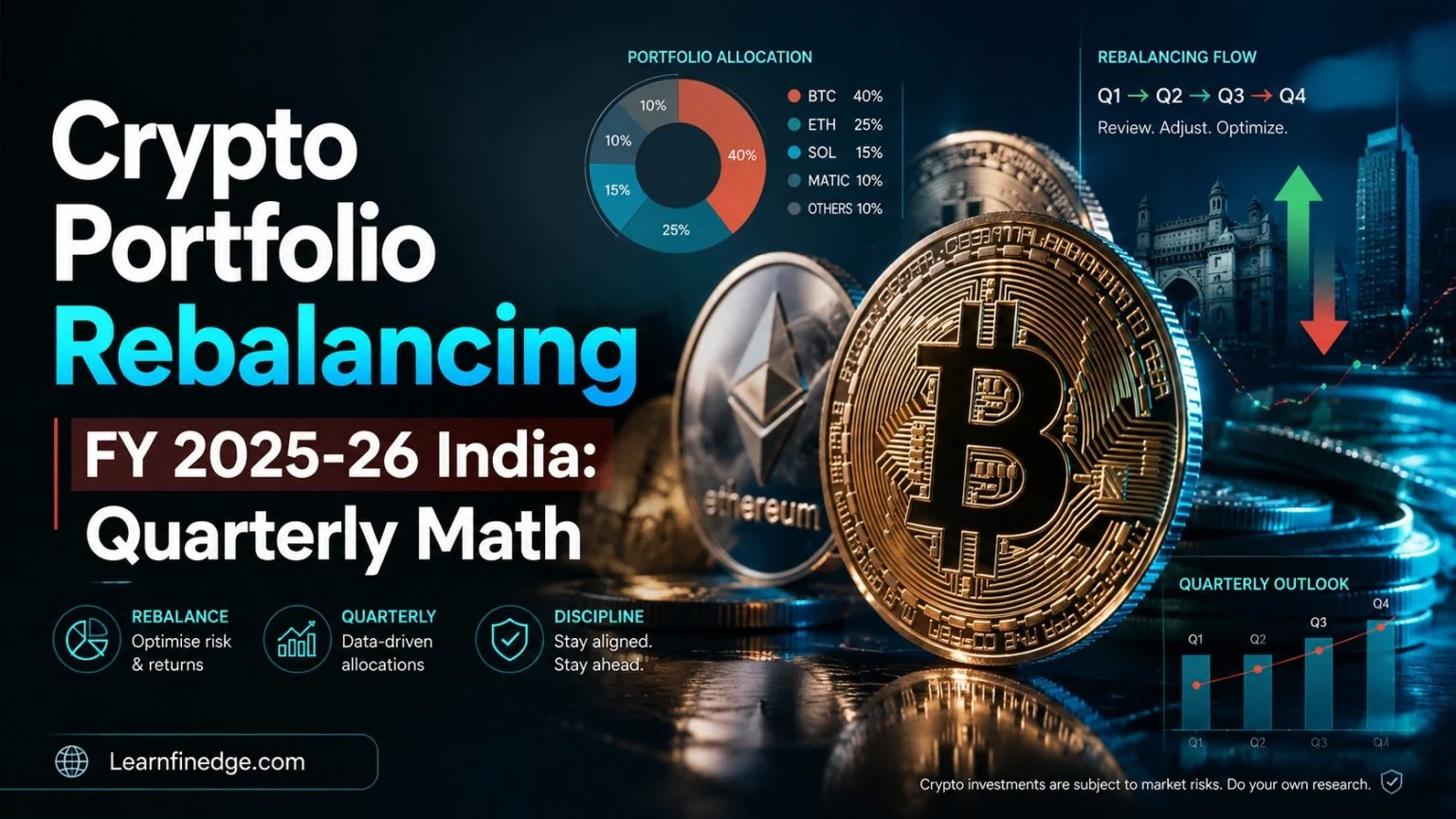
Crypto portfolio rebalancing in India is not the same exercise it is in a mutual-fund or stock portfolio. Every time you sell one virtual digital asset (VDA) to buy another, three things hit at once: a 1 percent TDS under Section 194S, a 30 percent flat tax on any gain under Section 115BBH, and a hard ban on setting that gain off against any other crypto loss. For FY 2025-26, those rules are unchanged from the framework introduced by the Finance Act 2022, and they make naive quarterly rebalancing one of the most expensive things a retail Indian investor can do. This article is educational; it is not investment, tax, or legal advice, and you should confirm specific numbers with a chartered accountant before acting.
The short version: in equities, a 25 per cent rebalance back to target costs you almost nothing if you stay below the long-term capital gains exemption. In crypto, the same rebalance can leak 8 to 12 per cent of the rebalanced amount in tax and TDS friction per round before exchange fees. This guide breaks down the actual math on a sample portfolio, then gives you a quarterly framework that minimises the leakage without abandoning the discipline of rebalancing entirely. We rely on the Income Tax Department’s official text of Sections 194S and 115BBH and the CBDT circulars issued under them.
Why crypto rebalancing in India is structurally expensive
The rebalancing cost in crypto is structurally higher than in any other Indian asset class because the tax code denies you the two relief mechanisms that work in equity and debt: loss set-off and the long-term holding-period concession. Every gain on a VDA transfer is taxed at 30 per cent plus applicable surcharge and cess, regardless of holding period, and the only deduction allowed against that gain is the cost of acquisition. There is no indexation, no exemption threshold, no LTCG slab.
Section 115BBH is explicit on this point: a loss from one VDA cannot be set off against income from another VDA, and it cannot be carried forward. So if you rebalance out of Ethereum at a gain and into Solana, and Solana then falls 40 per cent in the same year, you still owe the full 30 per cent on the Ethereum gain. The Solana loss has no shelter value. This asymmetry is what makes quarterly switching so different here than in a mutual-fund SIP rebalance.
The 1 percent TDS under Section 194S adds a second layer. It applies at the exchange level on the gross transfer value above the threshold (Rs 50,000 per year for specified persons and Rs 10,000 for others per CBDT Circular 13 of 2022). The TDS is creditable against your final tax liability, but it locks up cash until the ITR refund cycle completes, which for FY 2025-26 means waiting until the FY 2026-27 filing season for most retail filers. For more on how the deduction itself works, see the 1 per cent TDS Crypto India explainer.
The math on a sample Rs 5 lakh crypto portfolio
The clearest way to see the leakage is to run a quarterly rebalance through a worked example. Assume a portfolio of Rs 5 lakh on 1 April 2025, allocated 60 per cent BTC, 30 per cent ETH, and 10 per cent stablecoin. By 30 June 2025, BTC has run up 25 per cent, ETH is flat, and stablecoin is flat. The portfolio is now Rs 5.75 lakh, with BTC at 65.2 per cent, ETH at 26.1 per cent, and stablecoin at 8.7 per cent.
A textbook quarterly rebalance back to 60-30-10 means selling roughly Rs 30,000 of BTC and buying roughly Rs 22,500 of ETH and Rs 7,500 of stablecoin. The BTC sale of Rs 30,000 is a transfer for Section 194S, so the exchange deducts 1 per cent TDS (Rs 300). The cost basis of the BTC sold is roughly Rs 24,000, so the gain is roughly Rs 6,000. At 30 per cent flat plus 4 per cent cess, the tax is Rs 1,872. Combined TDS and tax friction on this single Rs 30,000 trade is Rs 2,172, or 7.24 per cent of the trade size.
If you repeat this every quarter through the year, with similar drift, the friction compounds. Four rebalances at 7 per cent friction on roughly 6 per cent of the portfolio each time costs you about 1.7 per cent of portfolio value per year, before exchange fees. Add the typical 0.1 to 0.2 per cent exchange fee each way, and you are looking at 2 per cent annualised drag from rebalancing alone. Over a 10-year horizon, 2 per cent annual drag compounds to roughly 18 per cent of terminal wealth foregone.
Why the standard “rebalance if drift exceeds X percent” rule needs adjustment
The conventional rebalancing rule in mutual-fund and equity portfolios is to rebalance whenever any asset class drifts more than 5 percentage points from target. That rule was developed for tax regimes where long-term gains are either exempt up to a threshold (the Rs 1.25 lakh LTCG window for equity in India) or taxed at concessional rates with loss set-off allowed. The rule does not translate to crypto without modification because every taxable event in crypto is a 30 per cent event with no offset.
A more defensible rule for an Indian crypto investor is to use a wider band (10 to 15 percentage points of drift) and to use a longer review interval (every 6 months rather than every quarter). The wider band cuts the number of rebalancing events by roughly half over a typical year, and the longer interval allows winners to run further before the next forced taxable event. For a related discipline on position sizing, see Crypto Allocation Rule India.
The second adjustment is the direction of the rebalance. In equities, you rebalance both ways: trim winners and top up laggards. In crypto, the asymmetry of the loss-set-off ban means the top-up direction (buying with fresh cash) is materially cheaper than the trim direction (selling winners). Where possible, prefer to bring the portfolio back to target by adding fresh capital to underweight positions rather than by selling overweight ones.
The quarterly switch checklist for FY 2025-26
If you do decide to switch between VDAs within a quarter, work through this checklist before placing the order. Each step is designed to reduce the tax and TDS friction on the trade.
- Confirm whether the switch is necessary or whether a fresh-capital top-up would achieve the same allocation outcome. If you have an upcoming SIP or lump sum, redirect it to the underweight asset before considering a sale.
- Check the cost basis of the lot you plan to sell. FIFO is the default ordering for VDA gains in the absence of specific lot identification in most retail exchanges. If FIFO produces a larger taxable gain than another tracking method your exchange supports, plan for that.
- Estimate the 30 percent tax liability on the gain and the 1 percent TDS on the gross transfer value, then add them as a notional cost to the trade. If the combined number exceeds 5 per cent of the trade size, the switch likely fails the cost-benefit test unless there is a strong fundamental reason.
- Avoid switches in the last week of March if you can defer to early April. This keeps the gain in the next financial year and gives you a full year to plan around it, including any partial rebalancing using fresh capital.
- Maintain a separate working spreadsheet of the year’s VDA transfers with date, type, gross value, cost basis, gain, and TDS deducted. Form 26AS will show the TDS but not the cost basis, and the burden of computing the gain is yours at ITR time.
How to combine TDS credit, ITR reporting, and the cash drag
The 1 percent TDS deducted by your exchange is creditable against your final tax for the year, but the timing mismatch creates a real cash drag. If you rebalance heavily in Q1 and Q2 of FY 2025-26, the TDS sits with the tax department from the date of deduction until your refund is issued, which for most filers will be sometime between July and December 2026. For an active rebalancer, that can mean Rs 10,000 to Rs 30,000 of cash locked up at zero interest for 12 to 18 months.
The crypto gains themselves are reported under Schedule VDA in ITR-2 or ITR-3 depending on whether you have business income elsewhere. Each transfer is reported with date, type, sale consideration, cost of acquisition, and the resulting gain. The 30 per cent tax is computed under Section 115BBH and reported in the same schedule. The TDS deducted is claimed under the Taxes Paid schedule using the entries that appear in Form 26AS or the Annual Information Statement (AIS). For the full reporting workflow, see Crypto Tax Reporting Rules 2026 India.
The Income Tax Department’s pre-fill function in the ITR utility now picks up most VDA TDS entries from AIS automatically, but the gain computation does not get pre-filled. Cross-check every TDS entry that appears in your AIS against your exchange’s transaction history. Mismatches are a common source of notices, and they are easier to fix before filing than after.
A simple FY 2025-26 rebalancing calendar that minimises leakage
For most retail Indian crypto investors with a portfolio under Rs 10 lakh, the following calendar produces a workable compromise between rebalancing discipline and tax leakage. It assumes a four-asset allocation across two large-cap VDAs, one mid-cap VDA, and a stablecoin or INR sleeve.
- 1 April 2025: Set target allocation and document cost basis of every existing lot. Open a working spreadsheet that you will update each time you trade.
- 1 July 2025: Soft review. Rebalance only if any position has drifted more than 15 percentage points from target. Prefer fresh-capital top-ups over sales.
- 1 October 2025: Soft review. Same rule. Track the advance-tax liability on year-to-date gains and pay any shortfall by 15 December.
- 1 January 2026: Hard review. Consider full rebalancing only if the portfolio is materially misaligned with your written risk plan. Avoid trades after 20 March to keep the gain in FY 2025-26 rather than spilling into FY 2026-27.
- 1 April 2026: Year-end reconciliation. Match exchange records against AIS, finalise Schedule VDA inputs, and pay any remaining tax by the relevant ITR due date.
The calendar deliberately leaves space for the portfolio to deviate from the textbook allocation by up to 15 points without forcing a taxable event. The premise is that the cost of the wider drift band is lower than the cost of the additional rebalances it avoids, given the 30 per cent tax wall on every gain.
When to ignore the rebalancing rule entirely
There are two situations where the standard rebalancing logic should be set aside. The first is when a single VDA becomes a serious concentration risk (typically more than 50 percent of the crypto sleeve and more than 5 percent of your overall household portfolio). At that point, the tax cost of trimming becomes secondary to the loss-of-capital risk if the concentrated asset draws down sharply. A staged sell-down over two or three tax years can keep the trim discipline while spreading the 30 per cent tax across multiple ITR filings.
The second situation is when an exchange is delisting or freezing a token or when an exchange itself faces a regulatory or FIU-related restriction. Cost-of-rebalancing math does not apply when the alternative is being unable to transact at all. For the broader risk picture on exchange selection, see Indian Crypto Exchange Comparison 2026.
Outside of those two situations, the safest assumption for FY 2025-26 is that every avoidable VDA transfer is an avoidable tax event. The asset class is more punitive on rebalancing than any other in the Indian tax code, and the rebalancing framework should respect that. The full text of Section 194S is published by the Income Tax Department and remains the controlling reference for any switch decision.
Frequently Asked Questions About Crypto Portfolio Rebalancing in India
Does rebalancing within the same wallet trigger Section 194S TDS?
No. Section 194S applies to a transfer of a VDA, which is defined as a sale or exchange between two parties. Moving the same token between two wallets you control is not a transfer in the legal sense and does not attract the 1 percent TDS. However, the moment you swap one VDA for another, even on a decentralised exchange, that is a transfer, and the TDS provision applies. CBDT Circular 13 of 2022 clarified the responsibility to deduct shifts to the buyer or the exchange depending on the transaction structure.
If I rebalance and book a gain, can I offset it with a stock-market loss?
No. Section 115BBH ring-fences VDA income. The gain from a crypto transfer cannot be set off against losses from equity, mutual funds, debt instruments, or any other source. Conversely, your crypto loss cannot be set off against your salary, business, or capital gains income either. The 30 per cent flat rate applies in isolation, and no carry-forward of crypto losses is allowed. The set-off bar makes loss harvesting, which works in equities, structurally impossible in crypto.
How does the 1 per cent TDS interact with my advance-tax obligations?
The 1 per cent TDS is creditable against your final tax liability, including the advance-tax instalments. If your crypto gains for the year are projected to push you above the basic exemption limit, advance tax is due in four instalments (15 June, 15 September, 15 December, and 15 March). Compute the 30 per cent VDA tax separately and reduce it by the TDS already deducted, then pay the net advance tax in the relevant instalment. Underpayment of advance tax attracts interest under Sections 234B and 234C.
Is it cheaper to convert to stablecoin first, then to the new VDA?
No. Every conversion between VDAs is a separate transfer and a separate Section 194S event. Going BTC to USDT and then USDT to ETH creates two TDS deductions and two potential gain-recognition events instead of one. The single direct swap from BTC to ETH is always cheaper from a tax and TDS perspective. Stablecoin routing only makes sense when you genuinely want to hold the stablecoin for some duration before committing to the next asset.
Does the 30 per cent VDA rate change under the new tax regime?
No. The 30 per cent rate under Section 115BBH is a special rate that applies regardless of whether you opt for the old regime or the new regime under Section 115BAC. Slab rates do not apply to VDA income. The same goes for the 1 percent TDS under Section 194S, which is independent of your overall tax slab choice. Other rebates such as Section 87A also do not reduce the VDA tax liability because Section 115BBH excludes rebates from applying to that specific income category.
What records should I keep for every rebalancing trade?
For every VDA transfer you should keep the date and time of the trade, the gross sale consideration in INR, the cost of acquisition of the lot sold, the gain or loss computed, the TDS amount deducted, and the counterparty or exchange identifier. Most Indian exchanges issue a year-end tax statement, but the burden of reconciling that against your Schedule VDA disclosure remains with you. Keep these records for at least seven years from the end of the relevant assessment year, in line with the standard preservation period under the Income Tax Act.