
Bharat Bond ETF Maturity 2026 is the next big roll-down event for the family of target-maturity passive debt funds Edelweiss MF launched in 2019. The April 2026 series (BHARATBOND-APR26) is winding down toward its scheduled maturity, and unitholders who bought it for the safety of AAA PSU paper and the indexation benefit need to decide what happens next. Rollover into the 2030 series, redeem and shift to an open-ended corporate bond fund, or pull the money out entirely. This guide walks through the maths on each option, the actual tax treatment on maturity in 2026, and a clean worked example on an Rs 5 lakh holding.
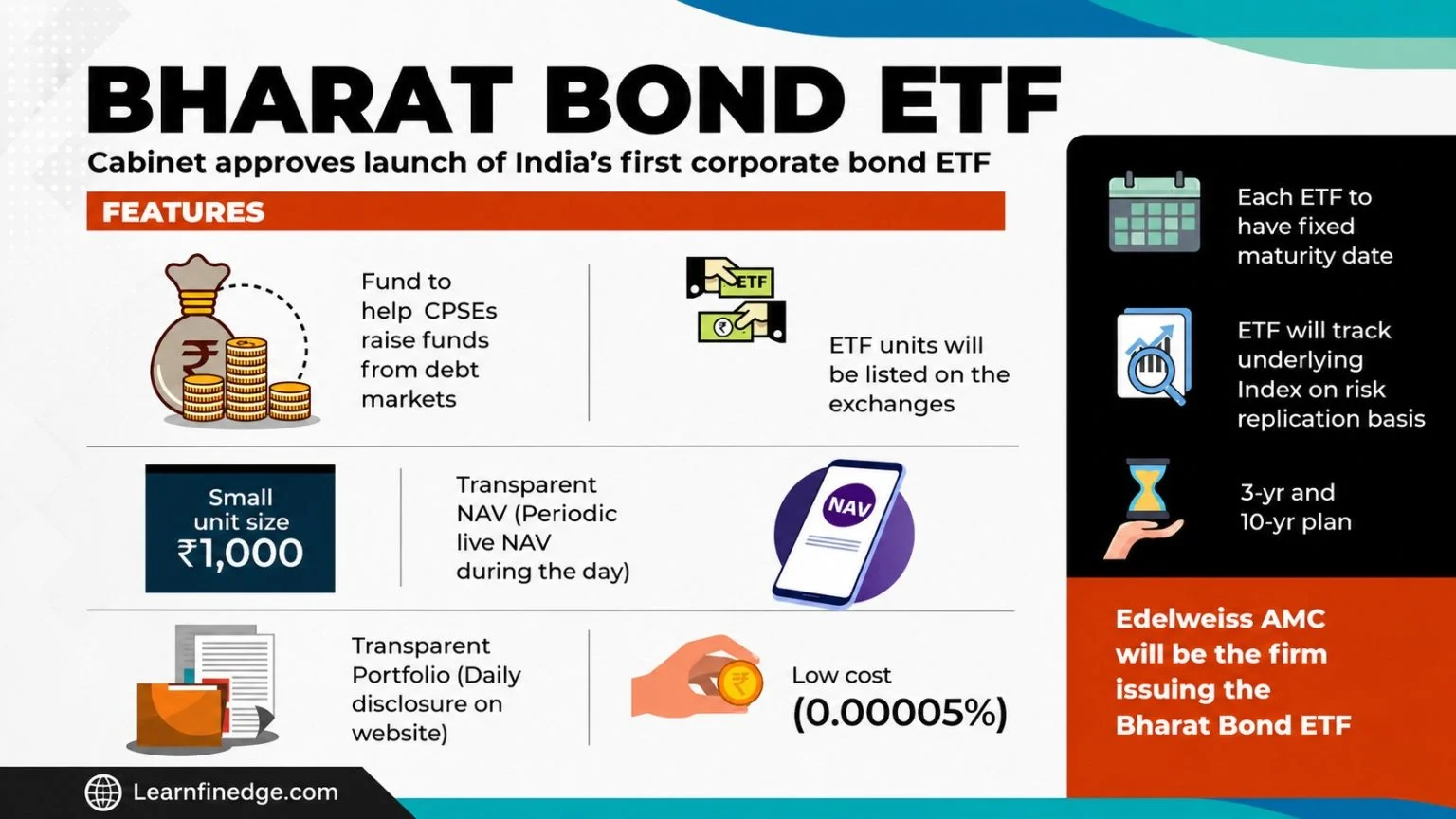
Quick context for readers new to the product. The Bharat Bond ETF is a passive index ETF that holds AAA-rated bonds of central public sector enterprises. Each series has a fixed maturity date. On that date the underlying bonds mature, the ETF pays out the proceeds, and the ETF closes. So unlike an open-ended debt fund, you know going in exactly when and roughly how much you get back.
What actually happens on the April 2026 maturity date
On the maturity date, Edelweiss AMC redeems all the underlying CPSE bonds at face value, collects the principal and final coupon, and pays the net amount to unitholders on a per-unit basis. The ETF unit then ceases to exist on the exchanges. You do not have to do anything to receive the maturity proceeds; they hit your linked bank account or demat-mapped account within the standard T+1 or T+2 settlement window after the maturity date.
The payout is the net asset value of the ETF on the maturity date, which by then converges almost exactly with the index value (the Nifty Bharat Bond Index April 2026). The yield-to-maturity at which you bought the ETF is what you actually realise, give or take a few basis points of fund expenses and tracking error over the holding period.
The 2025 series matured in April 2025 and paid out cleanly. The same mechanic applies to the April 2026 series. There is no maturity rollover by default; you get cash, then you decide.
Tax treatment on Bharat Bond ETF maturity in 2026
Here is where readers need to pay close attention because the rules changed in April 2023 and the April 2026 maturity will be the first major Bharat Bond event under the new rules for many investors.
If you bought your Bharat Bond ETF units on or before March 31, 2023, the old grandfathered rules apply. A holding period over 36 months qualifies as a long-term capital gain (LTCG). LTCG is taxed at 20 per cent with the benefit of indexation. The cost of acquisition gets stepped up using the Cost Inflation Index of the year of purchase and the year of redemption. For someone who bought in December 2019 and redeems in April 2026, that is roughly 6.3 years of indexation, which often wipes out most of the gain on a debt instrument and leaves taxable LTCG close to zero.
If you bought on or after April 1, 2023, the new rules under the Finance Act 2023 kick in. Specified mutual funds (debt funds with less than 35 per cent equity) are taxed entirely at slab rates, regardless of holding period. There is no LTCG concession and no indexation. The maturity gain is added to your income that year and taxed at whatever your slab is.
This single change makes the maturity tax math very different depending on when you bought. Check your purchase contract notes carefully. If you bought in tranches across both sides of March 31, 2023, FIFO applies for cost basis matching.
Worked example: Rs 5 lakh holding bought December 2020
Take an investor who bought Rs 5 lakh worth of BHARATBOND-APR26 in December 2020. The fund’s yield-to-maturity at that point was about 6.1 per cent gross.
Over the holding period of roughly 5.4 years to April 2026, at 6.1 per cent compounded annually, the corpus grows to approximately Rs 6.91 lakh. So the nominal gain is Rs 1.91 lakh.
Now apply the indexation benefit (units acquired pre-April 2023, so old rules apply). CII for FY 2020-21 was 301. CII for FY 2026-27 (assume it gets notified at around 376 based on the historical 4-5 per cent annual increase). Indexed cost = Rs 500,000 multiplied by 376 divided by 301 = approximately Rs 624,584.
Indexed LTCG = Rs 691,000 minus Rs 624,584 = approximately Rs 66,416. Tax at 20 per cent on that is approximately Rs 13,283. A plus 4 per cent cess is approximately Rs 13,814 in total tax.
So on a nominal gain of Rs 1.91 lakh, the actual tax outgo is about Rs 13,814, an effective tax rate of just 7.2 per cent. That is the indexation magic that made pre-2023 debt mutual funds so attractive and is the main reason long-term Bharat Bond unitholders are still smiling.
If the same investor had bought in April 2024 instead (post the rule change), the entire Rs 1.91 lakh would be added to income and taxed at the slab rate. For a 30 per cent slab filer, that is about Rs 59,500 in tax. Big difference.
Option 1: Rollover into Bharat Bond 2030 or 2032
Edelweiss MF has launched newer Bharat Bond series, including the April 2030 (BHARATBOND-APR30) and April 2032 (BHARATBOND-APR32) tranches. After receiving your April 2026 maturity proceeds, you can use the cash to buy units of these newer series at current market YTM.
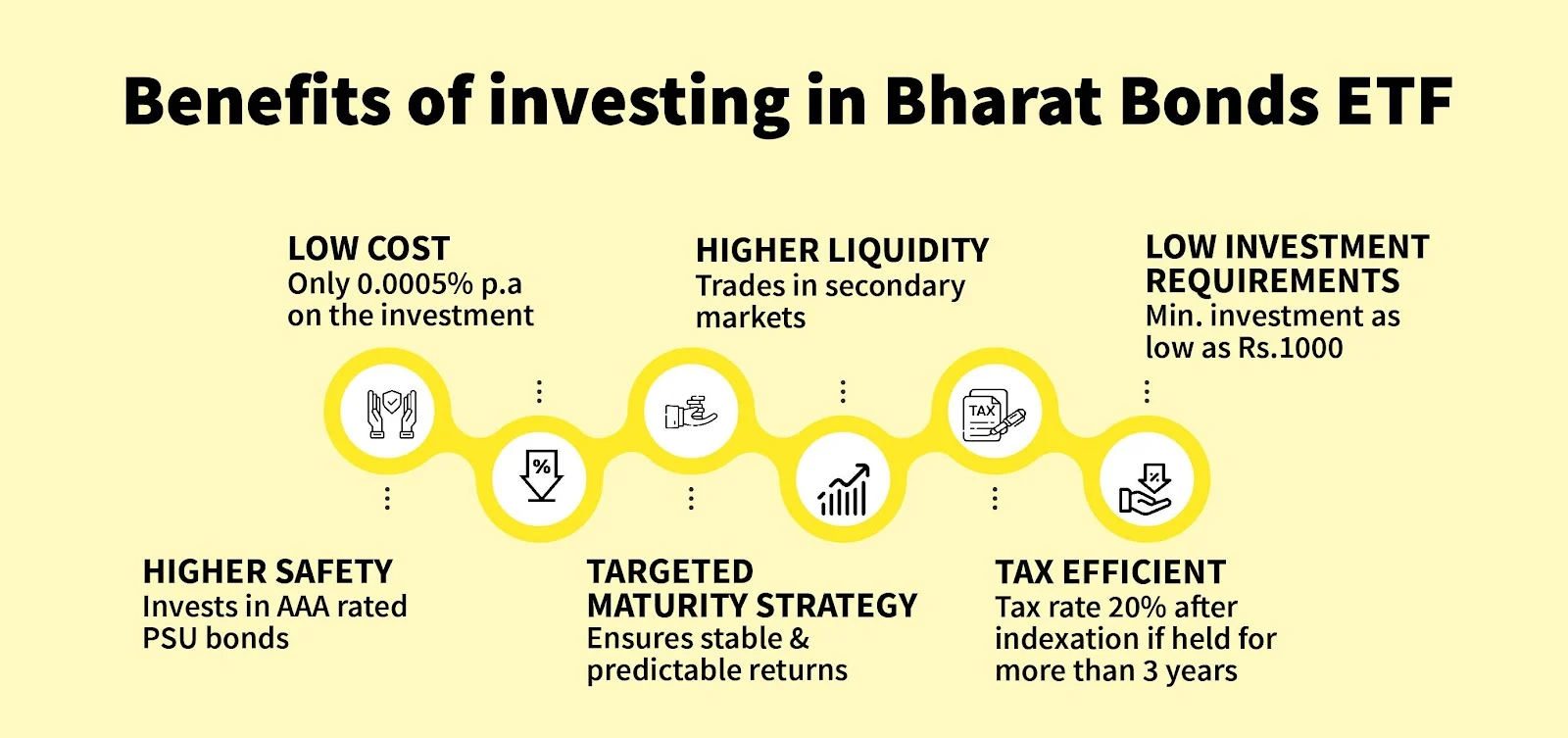
Current YTM on the 2030 series is around 7.4 per cent, and on the 2032 series, around 7.5 per cent (these move with bond yields). For someone with a goal that lines up with 2030 or 2032, this is the cleanest swap: same product family, same underlying credit quality (AAA CPSE bonds), known maturity date, and lower management fee than most active debt funds at a 0.0005 per cent expense ratio.
The catch is the tax clock resets. The fresh purchase is post-April 2023, so the new slab-rate-no-indexation rule applies on the next maturity. Your effective post-tax return on the 2030 or 2032 series will be the slab rate minus the gross 7.4 or 7.5 per cent, which for a 30 per cent slab investor is about 5.2 per cent net. Still respectable for AAA paper, but no longer the after-tax magic of the pre-2023 vintage.
Option 2: Move to an actively managed corporate bond fund
If you want to keep the AAA credit exposure but trade the fixed-maturity discipline for active management, a corporate bond fund (SEBI-defined category; must hold at least 80 per cent in AA+ and above paper) is the obvious switch.
The advantage is the fund manager can extend or shorten duration based on the rate cycle. With repo rate possibly entering a cutting cycle in 2026, a fund manager who is positioned long on duration can capture capital gains as yields fall. The disadvantage is the same: if the manager is wrong on duration, the fund loses NAV during a rate hike.
Tax treatment is identical to a new Bharat Bond purchase: slab rate, no indexation, no LTCG concession. So this option is purely a question of whether you trust an active manager to add value above the passive AAA index. For most retail investors, the passive Bharat Bond family has historically delivered better risk-adjusted return after fees.
Option 3: Redeem and use the cash for goals
If you bought Bharat Bond 2026 for a goal that hits in 2026 (a home down payment, child’s education year, planned consumer purchase, or building your emergency fund), the maturity is exactly what you planned for. Take the cash, deploy it for the goal, and do not reinvest.
This is the option many disciplined goal-based investors should default to. The whole point of a target-maturity ETF is to match a goal date. If the date has arrived, the work is done.
Where Bharat Bond ETF fits in the broader portfolio
For most salaried investors, the debt allocation portion of the portfolio should hold AAA paper with a known maturity, and the Bharat Bond family is the cleanest passive product for that. The standard split most planners suggest is the equity-debt mix per your age and risk profile, with the debt leg further split into a liquidity portion (liquid funds), a stable income portion (Bharat Bond ETF or short-duration debt funds), and a guaranteed portion (PPF, EPF).
For a 35-year-old salaried earner with a 15-year horizon, an allocation pattern in line with our asset allocation India guide might put roughly 30 per cent in debt, of which half goes to Bharat Bond family ETFs and half to PPF or EPF. That keeps the credit risk low (AAA only) and the tax efficiency in line with the new slab-rate regime.
Bharat Bond ETF versus the FOF version
Edelweiss also offers Bharat Bond Fund of Funds (BHARATBOND FOF), which holds the underlying ETF. The FOF is open to non-demat investors via SIP. The expense ratio is slightly higher (about 0.05 per cent including the underlying ETF’s 0.0005 per cent). For investors without a demat account, the FOF is the only access route. For investors with a demat, the direct ETF is cheaper and tracks the index more tightly.
Both follow the same tax treatment. The FOF route also reset to slab rate post April 2023.
What to do in the 90 days before maturity
Three weeks before the April 2026 maturity date, do these checks. Confirm your bank account linked to the demat is active and KYC is current. Pull your purchase contract notes and split the holding by purchase date (pre- and post-April 2023) for tax planning. Decide your post-maturity destination and have the SIP or lump-sum order ready so the cash doesn’t sit idle in the savings account.
On the maturity date itself, no action is needed. Funds will be credited within T+2.
In the next ITR cycle (June-July 2026), report the capital gain in Schedule CG correctly, with the indexed cost for pre-2023 units and the slab-rate gain for post-2023 units calculated separately. Most tax filing utilities like ClearTax and Quicko handle this split natively now, but double-check the cost basis they pull from the AMC statement.
Common mistakes to avoid
Do not let the maturity proceeds sit in a savings account for months earning 3 per cent. Decide your reinvestment plan before the maturity date and execute within a week. The opportunity cost of three months in savings on a Rs 5 lakh corpus is roughly Rs 6,000-8,000 of forgone interest.
Do not assume the new Bharat Bond series will deliver the same after-tax return as your maturing series. The indexation benefit is gone for new purchases, so the after-tax math has structurally weakened on this product family.
Do not roll into a longer-dated Bharat Bond series purely for the slightly higher YTM if your goal date is earlier. A Bharat Bond 2032 unit you sell in 2028 will trade at whatever the prevailing yield is in 2028, which could be higher or lower than your purchase yield, leaving you with possible capital loss if yields rise.
Finally, do not ignore the SIP-into-equity option for the matured proceeds if your overall portfolio is debt-heavy. Many Bharat Bond investors are over-allocated to debt, and the maturity is a chance to rebalance back into a good equity SIP for the long-term growth leg.
FAQs
When exactly will I receive my Bharat Bond ETF April 2026 maturity proceeds?
The scheduled maturity date is in mid-April 2026, on which Edelweiss AMC redeems the underlying CPSE bonds and the ETF gets delisted from the exchanges. The proceeds are credited to your demat-linked bank account within T+2 settlement days after the maturity date. No action is needed from your side: there is no redemption request to file and no form to submit. Check the AMC’s official announcement on the exact maturity date and credit timeline closer to April 2026 because exchange holidays can shift the settlement by a day or two.
Should I roll over into the Bharat Bond 2030 or 2032 series in 2026?
Rollover makes sense only if your financial goal lines up with the new maturity date and you are comfortable with the new tax regime where gains are taxed at slab rate without indexation. The 2030 series suits a 4-year horizon; 2032 suits a 6-year one. For a 30 per cent slab investor, the post-tax YTM on the 2030 series is around 5.2 per cent. If you do not have a matching goal, take the maturity proceeds and deploy them per your asset allocation plan rather than mechanically rolling into the next series.
What is the LTCG tax math on the Bharat Bond 2026 maturity if I bought it in December 2019?
Units purchased on or before March 31, 2023, are taxed under the old debt-fund rules: 20 per cent LTCG with indexation benefit on gains after a holding period of over 36 months. With roughly 6.3 years of indexation between FY 2019-20 and FY 2026-27, the indexed cost of acquisition is much higher than the actual cost. The effective LTCG often drops to a small fraction of the nominal gain. On a Rs 5 lakh investment growing to about Rs 6.91 lakh, the tax outgo is around Rs 13,000-14,000.
What is the difference between Bharat Bond ETF and Bharat Bond FOF?
The Bharat Bond ETF trades on exchanges and needs a demat account. Bharat Bond FOF is an open-ended fund that holds the underlying ETF and can be bought through any mutual fund platform without a demat. The FOF carries a slightly higher expense ratio (around 0.05 per cent vs 0.0005 per cent in the ETF) because of the double layer of fees. For demat holders the ETF is cheaper; for non-demat investors the FOF is the only access route. Both have identical tax treatment.
Can I lose money on a Bharat Bond ETF if I hold till maturity?
Almost certainly not. The underlying paper is AAA-rated CPSE bonds backed by the credit of central public sector enterprises. Default risk on AAA CPSE paper has been zero historically. If you bought the ETF, held it to its scheduled maturity, and the underlying bonds also matured without default, you would receive your principal plus accumulated interest at the original YTM you bought it at. Capital loss can happen only if you sell on the exchange before maturity during a period of rising interest rates, not at maturity.