
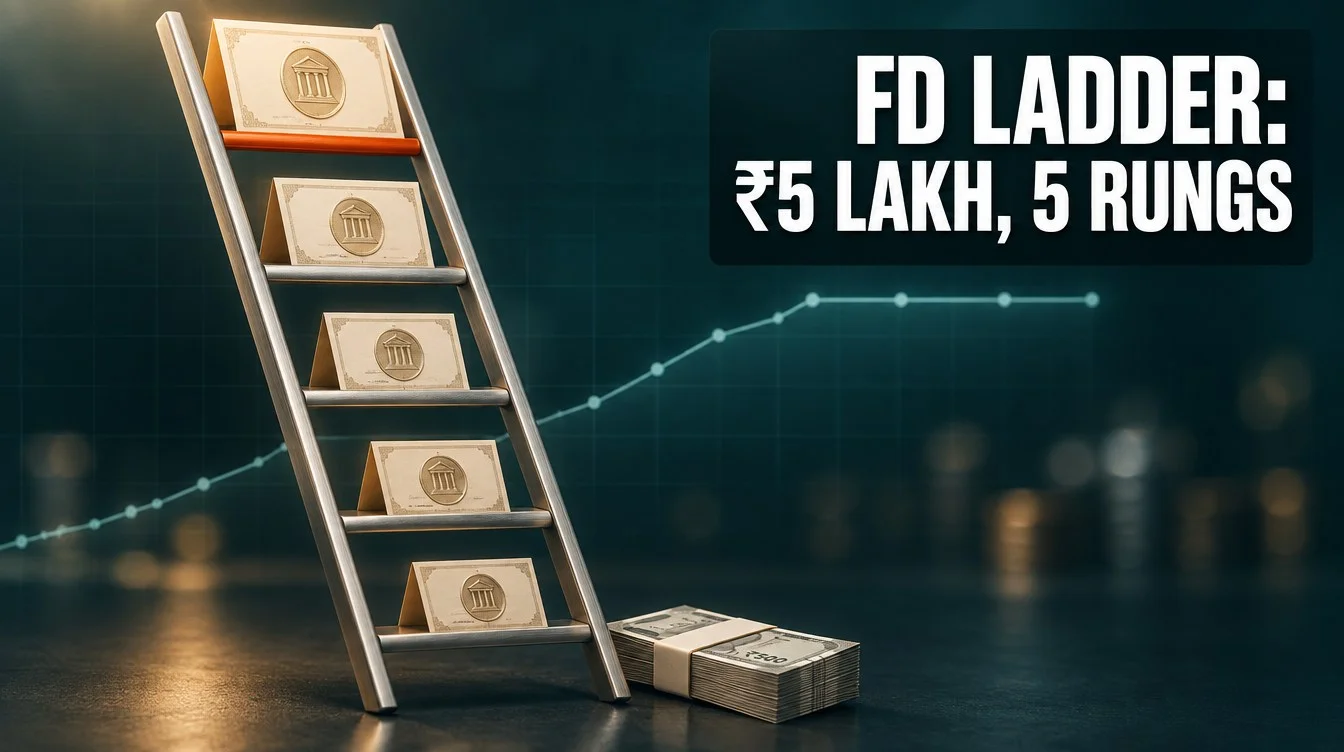
An FD laddering strategy india gives salaried savers a way to balance liquidity and rate risk after the 2026 RBI repo pause. This guide builds a worked 5-rung ladder on Rs. 5,00,000 and shows what happens each year.
Fixed deposits feel simple until you have to decide the one thing that actually matters: how long to lock your money. If you pick a term that is too short, you will keep rolling over at whatever rate the bank offers next. If you pick a term that is too long, you will be stuck if rates climb or you need cash early. A well-built FD laddering strategy in India solves both problems at once by splitting a single deposit into several FDs that mature in different years.
This matters more in 2026 than usual. The RBI has held the repo rate at 5.25 percent, which means the easy days of chasing rate cuts are over and deposit rates have flattened. When the direction of rates is uncertain, spreading your maturities is a defensive move that keeps some money liquid while the rest stays locked at today’s rates. This guide walks through what a ladder is, a full worked example on Rs 500,000 (5 lakh), how the repo pause feeds into FD rates, and how laddering compares with a sweep-in FD or a single lump-sum deposit.

What an FD ladder! Actually Is
An FD ladder is a set of fixed deposits opened at the same time but with staggered tenures, so one deposit matures roughly every year. Think of it as a staircase: instead of one giant step, you climb one small step at a time, and there is always a step within reach.
The analogy that lands for most savers is a set of rain barrels under a gutter. Rather than one large barrel that fills slowly, you place several smaller barrels that each become usable at a different time. When one empties, you refill it or carry the water elsewhere.
The mechanics in plain terms
Say you have money to deposit for five years. Instead of one 5-year FD, you open five FDs that mature in 1, 2, 3, 4, and 5 years. Each year one FD matures. You either take that cash if you need it or reinvest it into a fresh 5-year FD at the going rate.
Over time, every rung becomes a rolling 5-year deposit, with one maturing each year. That is the quiet power of the structure: you get long-tenure rates with near-annual access to a chunk of your money.
Why salaried savers use it
For a salaried reader, the ladder maps onto real life. School fees, an insurance premium, or an annual buffer top-up can be timed to a maturing rung instead of forcing a premature withdrawal that triggers a penalty.
Why the Repo Pause Suits an FD Laddering Strategy in India
The repo rate is the rate at which the RBI lends to banks. When it moves, banks eventually reprice both their loans and their deposits. With the RBI holding at 5.25 percent, banks have little pressure to raise FD rates and little room to cut aggressively either, so deposit rates have settled into a narrow band.
A flat repo rate does not mean every bank FD rate is identical. Small finance banks and NBFCs typically offer more than large public-sector banks to attract funds. But that repo signal sets the broad ceiling on rates.
Why a pause makes laddering attractive
When rates are clearly falling, locking long makes sense. When they are clearly rising, staying short makes sense. A pause is the ambiguous middle, and that is precisely where laddering shines because it hedges both directions. If the RBI’s next move is a cut, your longer rungs already captured today’s higher rate. If the next move is a hike, your maturing rungs let you reinvest at the new, higher rate. To understand how the central bank actually arrives at these decisions, the RBI MPC decoder that explains monetary policy in ten minutes is a useful primer.
Reading the signals yourself
You do not need to forecast rates to ladder well, but it helps to know what the RBI watches. Inflation prints drive most of the decision, and the gap between the two headline measures is covered in this walkthrough of what the CPI and WPI each tell salaried investors. For the specifics of the current pause, the breakdown of the 5.25 percent repo pause and its impact sets the 2026 backdrop.

FD Laddering Strategy India: A Worked 5-Rung Ladder on Rs.500,000
Numbers make this concrete. Suppose you have Rs.500,000 (5 lakh) to deposit, and you want a five-year ladder. The simplest build splits the money into five equal rungs of Rs.100,000 (1 lakh) each, with tenures from one to five years.
The illustrative rates below show the method, not a promise of what any bank will pay. Actual rates vary by bank and change over time, so treat these as an example of how the arithmetic works rather than a quote.
| Rung | Amount | Tenure | Illustrative rate | Matures in |
|---|---|---|---|---|
| Rung 1 | Rs.100,000 | 1 year | 6.5 percent | Year 1 |
| Rung 2 | Rs.100,000 | 2 years | 6.7 percent | Year 2 |
| Rung 3 | Rs.100,000 | 3 years | 6.9 percent | Year 3 |
| Rung 4 | Rs.100,000 | 4 years | 7.0 percent | Year 4 |
| Rung 5 | Rs.100,000 | 5 years | 7.1 percent | Year 5 |
What happens each year
At the end of Year 1, Rung 1 matures. If you do not need the cash, you reinvest that Rs 100,000 into a fresh 5-year FD, so it now matures in Year 6 and the ladder keeps rolling.
By the end of Year 5, every original rung has been spent or rolled into a 5-year deposit. From then on, one FD matures every year, each carrying a full 5-year rate. You have converted a lump sum into a rate-optimised stream with annual liquidity.
Building the ladder step by step
- Decide the total amount and the ladder length. Rs 500,000 over five years is a common starting point.
- Divide into equal rungs, one per year of tenure.
- Open all FDs on the same day with tenures of 1, 2, 3, 4, and 5 years.
- Each year, when a rung matures, reinvest it into a new 5-year FD unless you need the cash.
- Keep TDS in mind: banks deduct tax at source once interest crosses the annual threshold, so submit Form 15G or 15H only if you are genuinely eligible.
Laddering vs Sweep-in FD vs a Single FD
Laddering is not the only way to manage deposit money. Two common alternatives are the sweep-in FD and the plain single FD, and each fits a different need.
What is the difference between an FD ladder and a sweep-in FD?
An FD ladder splits a lump sum into staggered maturities to balance rate lock-in and yearly access, while a sweep-in FD automatically converts idle savings-account balance above a set limit into short FDs and breaks them back when you need the money. A sweep-in is a savings account that quietly earns FD rates on idle balance; a ladder is a deliberate multi-year plan.
| Feature | FD ladder | Sweep-in FD | Single FD |
|---|---|---|---|
| Liquidity | One rung yearly | On demand | Only at maturity |
| Rate captured | Long-tenure | Short-tenure | Single fixed rate |
| Rate-risk hedge | Strong | Weak | None after lock-in |
| Setup effort | Moderate | Low | Low |
| Best for | Rate uncertainty | Idle cash | A fixed-date goal |
When each option wins
- Choose a ladder when you have a lump sum, no single fixed date for the money, and you want to hedge the rate uncertainty of a repo pause.
- Choose a sweep-in FD when your priority is a working buffer that earns better than a savings account but stays fully liquid.
- Choose a single FD when you have one clearly dated goal, such as a payment due in exactly three years, and liquidity in between does not matter.

Common Mistakes That Weaken an FD Laddering Strategy
A ladder is easy to build badly. The most common error is forgetting the reinvestment step, so a matured rung sits in a savings account earning far less than it should.
Chasing the single highest rate
Putting the whole Rs.500,000 into one bank’s top-advertised long tenure defeats the purpose. That is a single FD wearing a ladder’s clothes. The point is spread, not maximising one headline rate.
Ignoring tax on interest
FD interest is fully taxable at your slab rate, which quietly lowers the real return. A rung that looks like it pays 7 percent might net closer to 5 percent after tax for a reader in a higher slab. Post-tax thinking should shape how much you keep in FDs versus other instruments.
Forgetting premature-withdrawal penalties
Breaking an FD early usually costs a penalty of around 0.5 to 1 percent on the applicable rate, though the exact figure depends on the bank. A ladder reduces the odds of needing to break one but does not remove the rule, so size your emergency fund separately rather than relying on breaking rungs.
Where an FD Laddering Strategy Fits in a Wider Money Plan
An FD laddering strategy in India works best as one layer of a broader plan, not the whole thing. FDs give you capital safety and predictable interest, but they rarely beat inflation by much after tax, so they are a stability layer rather than a growth engine.
Balancing safety and growth
Most planners suggest keeping money you cannot afford to lose in guaranteed instruments and reserving market-linked products for long-horizon growth. Mutual funds and equity carry market risk, and past performance is not indicative of future results, so they belong to a different bucket than your FD ladder. Debt-orientated options such as those in this guide to gilt funds and RBI rate risk sit between the two.
Coordinating with other rate-sensitive decisions
The same repo pause that shapes your FD ladder also shapes your borrowing. If you carry a home loan, the flip side of flat deposit rates is covered in this look at how the 5.25 percent repo rate affects home loan EMIs, which is worth reading alongside any laddering decision so your saving and borrowing strategies point the same way.

Frequently Asked Questions
Is FD laddering worth it when the repo rate is on pause?
Yes, a pause is arguably the strongest case for laddering because the next rate move is genuinely uncertain. Longer rungs lock in current rates, while maturing rungs let you reinvest if rates rise later, so you hedge both directions instead of betting on one.
How many rungs should an FD ladder have?
Three to five rungs suit most salaried savers. Fewer rungs give less liquidity, while more than five add paperwork without much extra benefit on a modest sum like Rs 500,000. Match the number of rungs to how many years you want maturity to arrive.
Does an FD ladder avoid tax on interest?
No. FD interest is taxable at your income slab regardless of the structure, and banks deduct TDS once interest crosses the annual threshold. Laddering improves liquidity and rate flexibility, not tax treatment, so plan for the post-tax return rather than the headline rate.
Can I build an FD ladder online?
Yes. Most banks let you open multiple FDs with different tenures through net banking or the mobile app in a few minutes, so you can build the entire ladder on the same day without visiting a branch.
What happens to a rung if I need money before it matures?
You can break an FD early, but it usually attracts a small penalty and a slightly reduced interest rate. Because a ladder always has a rung maturing within about a year, the need to break one early is far less likely than with a single long FD.