

The single hardest financial conversation in most Indian households is not with the bank, the broker, or the tax officer. It is with parents, siblings, in-laws, or cousins sitting across the dinner table. Money in Indian joint and multi-generational households carries emotional weight that pure economics does not capture: who paid for what, who contributed when, what an inheritance means, and how rent or grocery contribution should be split. A working joint family finance india framework is rarely about complicated spreadsheets; it is about a small set of conversations conducted with the right scripts, the right cadence, and the right boundaries.
This guide is built for households where two or more earning adults share a home with parents, in-laws, or extended family. It covers the conflict-prone scenarios (loans within the family, monthly contribution to running costs, gold and jewellery inheritance, property succession), the principles that prevent most disputes, and the two broad financial models (shared and separate) that Indian households tend to follow.

Why Money Conversations Are Harder in Indian Joint Families
Money in Indian families is rarely talked about in the same direct register that Western financial-planning literature assumes. The taboo is partly cultural, partly historical, and partly practical, and ignoring it produces predictable conflict.
The “we are family” objection
The most common opener that ends a money conversation is “but we are family, why talk about money like this”. The objection assumes that putting numbers on family arrangements is somehow disrespectful. In practice, the opposite is true: unspoken expectations generate the resentments that eventually damage the relationship, whereas explicit numbers protect the relationship by removing ambiguity.
The generational gap and unspoken inheritance assumptions
The previous generation in many Indian families managed household finances on a need-to-know basis, with one senior member holding most of the information. The current generation, with dual incomes and individual investing, expects more transparency, and the gap itself is a source of conflict. Joint families also operate on unwritten inheritance expectations: the eldest son may expect to inherit the family home, daughters may expect equal shares per the Hindu Succession Act amendment of 2005, and in-laws may have separate expectations entirely. Silence does not align these views; conversations do.
Why scripts help more than improvisation
For any sensitive money conversation, a prepared opening line and a clear ask reduces the chance of escalation. The same family member who reacts defensively to a vague “we need to talk about money” responds reasonably to a specific “I would like to set up a household contribution amount for the next financial year, can we discuss next Sunday”. The specificity is the de-escalation.
The Three Conflict-Avoidance Principles
Three principles, applied consistently, prevent most family-money disputes before they start.
Principle 1: Make the implicit explicit
The first principle is to convert every implicit arrangement into an explicit one, in writing where possible. If two siblings each pay Rs.15,000 a month toward the household grocery and utility bill, that arrangement should be written down on a shared note, with a review date. Implicit arrangements drift; explicit arrangements survive disagreements.
Principle 2: Separate the cash flow from the relationship
Family money disputes escalate when the cash flow becomes a proxy for the relationship. The conversation “you have not contributed this month” should always be framed as a cash-flow issue with a specific resolution, not as a comment on the contributor’s commitment to the family. The script is “the household account is short by Rs.5,000 this month, can we figure out how to cover it”, not “you are not pulling your weight”.
Principle 3: Build in a review cadence
Every family-money arrangement should have a built-in review date, ideally annual, before the next financial year begins. The review is the moment to update contributions for inflation, for changes in income, or for changes in household composition. The cadence prevents the slow-burn resentment that comes from an arrangement that stopped being fair years ago but was never revisited.
The Monthly Household Contribution Conversation
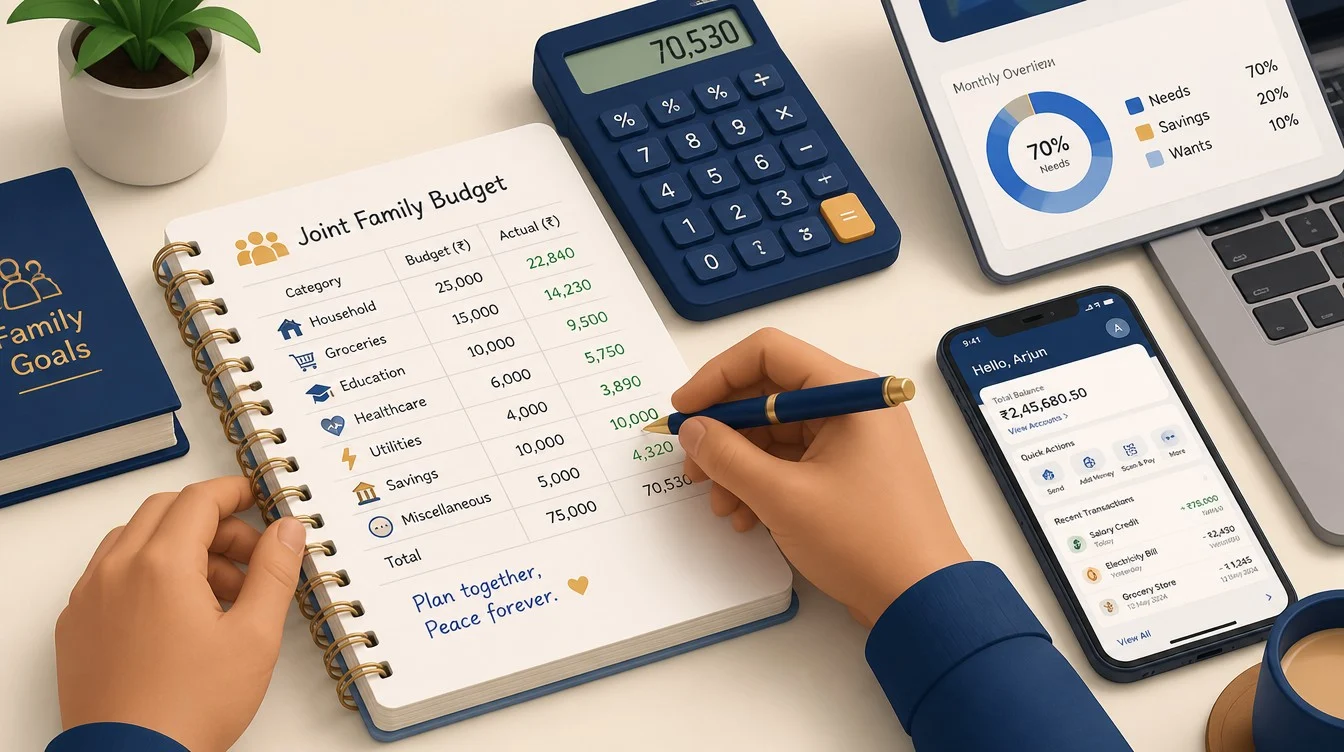
The most frequent family-money conversation in Indian joint households is about who contributes how much to the monthly running costs: rent or EMI, utilities, groceries, household help, and shared discretionary spend.
The shared expense pool model
In the shared-expense-pool model, all earning members contribute a fixed amount or percentage to a common household account, and all shared expenses are paid from that account. The contribution amount is agreed annually, indexed to expected inflation. The model works best when earnings are broadly similar across contributors and trust in the senior coordinator is high.
The proportionate contribution model
In the proportionate model, each earning member contributes a share of the monthly household expense proportional to their take-home income. A household with two earners at Rs.80,000 and Rs.1,20,000 net monthly income would split the shared household expense in a 40 to 60 ratio. The model fits households with significantly different incomes and is widely seen as fairer than equal contribution.
The script that works
The opener that produces a constructive conversation is concrete and forward-looking. “I have looked at our household expenses for the last six months and the average runs at about Rs.X per month. I think we should formalise the contribution into a clean monthly amount; can we discuss what feels fair, and review again in April.” The script names the number, proposes the structure, and includes a review date.
Lending Money Within the Indian Family
Loans between family members are common in Indian households, and they cause more long-term damage to relationships than they preserve, unless the structure is explicit from day one.
The unwritten loan trap
The classic Indian unwritten family loan is a Rs.2,00,000 (2 lakh) transfer from sibling A to sibling B with no written terms, no interest rate, and no repayment date. Five years later, neither party remembers the exact amount, sibling A feels under-acknowledged, sibling B feels pressured, and the relationship carries an unresolved tension. The damage exceeds the loan.
The two-page family loan note
A simple written note that captures the amount, the interest rate (zero is acceptable if explicitly stated), the repayment schedule, and the consequences of non-payment is enough for most family loans. The note is not a legal document in the formal sense; it is a memory aid that prevents the slow drift of expectations. Both parties sign and keep a copy. The act of writing the note is itself a conflict-prevention exercise.
The “gift versus loan” decision
For sums where the lender is willing to accept non-repayment without resentment, the cleaner answer is to call the transfer a gift, not a loan. A Rs.50,000 gift from parent to adult child during a financial squeeze leaves the relationship intact; a Rs.50,000 loan that never gets repaid corrodes the relationship over years. Honesty about whether it is a gift or a loan, at the moment of transfer, is the cleanest practice.
What to do when the loan is not being repaid
If a family loan is in default, the conversation needs to happen, not be deferred. The script is “the agreed repayment was Rs.5,000 a month starting March, and the last payment was in July; can we discuss what is happening and update the schedule”. The framing is operational, not accusatory. A renegotiated schedule, even a slower one, is better than a defaulted loan that sits between two family members in silence.
The Inheritance Conversation
The inheritance conversation is the one that most Indian families avoid the longest and pay the highest price for avoiding. The framework below makes it less hard.
The “open file” approach
Parents in their sixties and beyond benefit from a single document that lists their assets (bank accounts, FDs, mutual funds, property, jewellery, insurance), liabilities, and named nominees. The document does not need to be a will; it needs to be a map. The map is shared with the children once and updated annually. The map removes the post-bereavement scramble that produces most family inheritance disputes.
The will conversation
The next layer is a registered will, drafted by a competent lawyer, that clearly specifies the parents’ wishes. Wills in India under the Indian Succession Act, 1925 (for non-Hindus) and personal laws for Hindus require attestation by two witnesses; registration is recommended for safety though not legally mandatory. The conversation with the children is the parents’ to lead, but adult children can gently propose the topic.
Gold, jewellery, and movable assets
Movable assets like gold jewellery often pass outside the will and produce disproportionate dispute. The cleanest practice is a separate written list, kept with the parents, identifying each significant piece and its intended recipient. The list need not be legally enforceable; it needs to remove ambiguity when implemented.
The equal-share assumption
The Hindu Succession (Amendment) Act, 2005 made daughters equal coparceners in ancestral property. Older family arrangements that assumed sons would inherit and daughters would receive only stridhan need updating. The conversation is best held while parents are healthy enough to make their wishes known. Post-bereavement, the legal default usually prevails, which may not match anyone’s actual intentions if those intentions were never written down.

Shared vs Separate Finance Models for Indian Couples in Joint Families
Married couples in Indian joint families navigate a second layer of financial decisions: how much to merge with the spouse, how much to keep separate, and how the couple-level finances interact with the wider joint family.
The fully shared model
In the fully shared model, both spouses’ incomes flow into a common pool, all expenses are paid from the pool, and major decisions are joint. The model maximises trust and simplicity but requires near-complete alignment on spending priorities. It is most common in single-earner households and in dual-earner households with strong philosophical alignment.
The fully separate model
In the fully separate model, each spouse maintains their own income and expenses, with explicit splits for shared items (rent, groceries, children’s expenses). The model preserves individual autonomy but requires more frequent settlement conversations and is less resilient to income changes. It is more common in dual-earner urban households without children.
The hybrid model
The hybrid model is the most widely used in practice. A common pool funded proportionately by both spouses handles shared expenses; each spouse retains discretion over a personal allocation; major investments and goals are decided jointly. The model captures most of the benefits of both extremes and tolerates income changes without renegotiation. In a household that also includes parents or in-laws, the cleanest design is to treat the couple as a single contributing unit to the joint family, regardless of the internal split.
Comparing the three models at a glance
The trade-offs across the three models are easier to see side by side.
| Model | Best fit | Trade-off |
|---|---|---|
| Fully shared pool | Single-earner or strongly aligned dual-earner | Maximum simplicity, low individual autonomy |
| Fully separate | Dual-earner urban couples, no children, autonomy-led | Frequent settlements, weaker resilience to income shocks |
| Hybrid pool plus personal allocation | Most Indian dual-earner households | Needs one annual review; tolerates raises and dips well |
The Annual Joint-Family Money Meeting
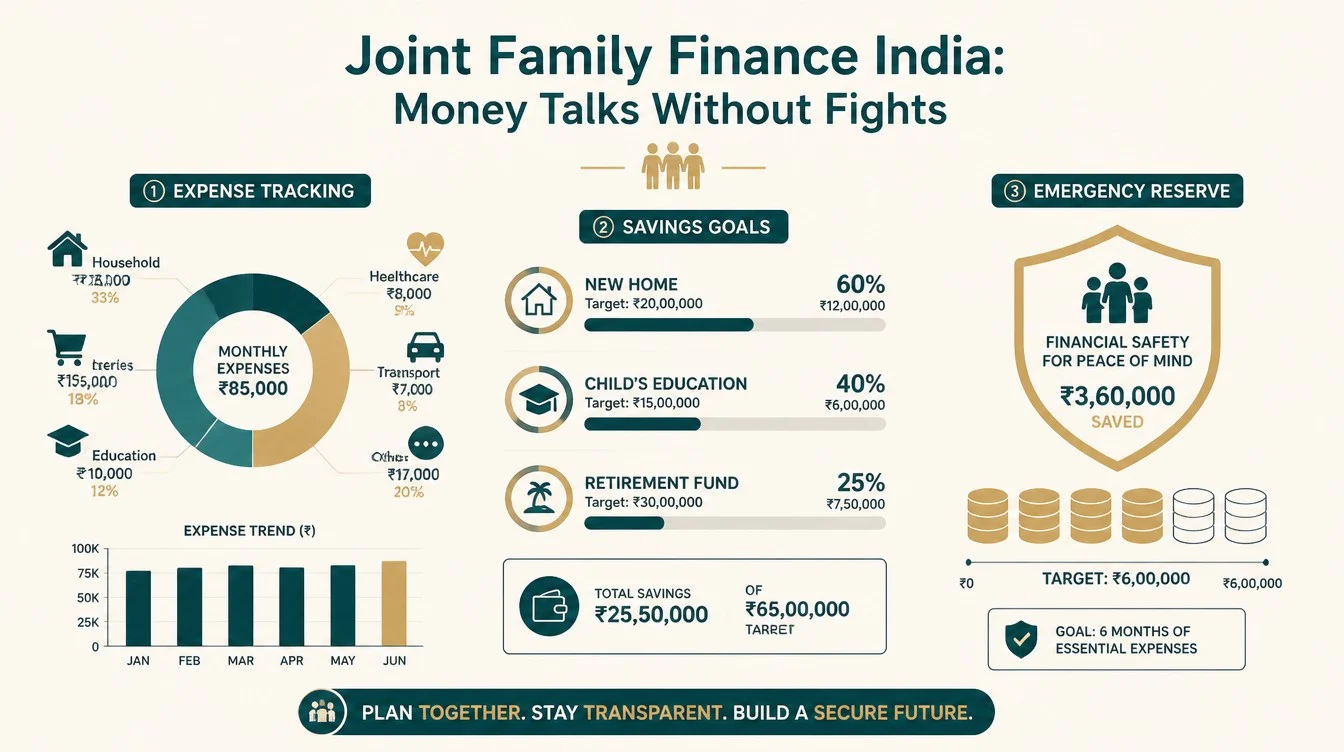
An annual family-money meeting, held intentionally rather than reactively, is the single most useful structural practice for Indian joint households.
What to cover in 60 minutes
- Review the past year’s household contribution and any informal loans or transfers.
- Update the contribution amount for the next year, indexed to inflation and income changes.
- Surface any major upcoming expense (wedding, education, medical, home repair) that needs planning.
- Review the elders’ “open file” map of assets, liabilities, and nominations.
- Agree on the next review date and any specific decisions deferred to a separate conversation.
Who should be in the room
All earning members of the household, plus the senior generation if they are willing and able. Adult unmarried children typically join if they contribute. Children below earning age are usually excluded for privacy, though family-financial-education conversations with teenagers are a separate, valuable practice.
The minutes and the follow-up
A short written summary of decisions, sent in the family WhatsApp group or kept in a shared note, ensures continuity. The summary is not a legal document; it is a memory aid. The follow-up is the verification that what was agreed is actually being implemented one quarter later.
Scripts for the Hardest Conversations
Three conversations come up reliably in Indian joint families and benefit from rehearsed openers.
Asking a sibling to start contributing
The opener is “I want to talk about how we split household expenses now that we are both working. The household runs at about Rs.X a month for shared items; I think a fair split would be Y or Z. Can we agree on a number and review in six months.” The conversation names the amount, proposes a split, and includes a review.
Refusing a family loan without damaging the relationship
The opener is “I want to help, and I would not want a no to feel like a refusal of the relationship. The reason I cannot lend right now is X. Here are two things I can do instead.” The structure separates the loan from the relationship and offers an alternative form of support.
Bringing up the will conversation with elderly parents
The opener is “I know this is not an easy topic, and I am not bringing it up because anything is wrong. I would feel calmer knowing that you have an organised file of your accounts and any wishes, so that nothing is left to figure out at a hard time. Can we sit down with the documents next weekend.” The framing reduces the threat and proposes a concrete next step.
Discussing inherited property among siblings
The opener is “Now that the property is in our names jointly, I want to make sure we are aligned on what we want to do with it. Should we hold it, sell it, rent it, or buy out one share. Whatever we decide, let us put it in writing so we do not have to revisit it under pressure later.” The framing accepts the joint status and proposes a structured decision.
FAQ
How do I bring up money with my parents without it feeling disrespectful?
Lead with care, not with numbers. The opener is “I want to understand your financial picture better so that I can plan around it and so that nothing is left ambiguous at a hard moment. Can we sit down with your accounts and policies next weekend.” Framing the conversation as a planning exercise rather than an inheritance audit usually defuses the discomfort. The first conversation is short; the substance comes over the next two or three sit-downs.
What if my sibling refuses to contribute proportionately to household expenses?
Start by clarifying the actual numbers: monthly shared expense, current contributions, and what a proportionate split would look like. If the conversation still does not produce alignment, propose a smaller test arrangement for three months with a review. If the disagreement persists, the realistic answer is to right-size the relationship: contribute what you are willing to contribute, accept that the imbalance is the cost, and stop expecting it to change.
Should family loans always carry interest?
Not necessarily. Many family loans are interest-free and that is fine, provided the zero rate is explicitly stated in writing rather than left assumed. If the lender wants interest, a rate at or slightly below the prevailing bank fixed-deposit rate is a fair benchmark. Interest above the prevailing personal-loan rate signals that the transaction should probably be at a bank, not within the family.
How do I split a joint inheritance fairly with siblings who contributed differently to caring for the parents?
This is the hardest version of the inheritance conversation. The cleanest practice is to acknowledge the asymmetry explicitly in conversation, propose a numeric adjustment if the family agrees one is warranted (a larger share to the caregiving sibling, or a separate gift), and put the agreement in writing. Pretending the asymmetry does not matter is the most common source of post-bereavement family rupture.
What is the single most useful first step for a joint family that has never discussed money openly?
Schedule a single 30-minute conversation with a narrow agenda: agree on the monthly household contribution from each earning member for the next 12 months. The narrow scope makes the conversation manageable, the agreement provides immediate value, and the experience builds the trust needed for the larger conversations (loans, inheritance, succession) over the following year.
Related guides on this topic are coming to learnfinedge.com soon.