

One of the most common health-insurance decisions for an Indian household with multiple family members is whether to buy a single family floater policy that pools the sum insured across everyone, or to buy individual policies for each member with each one’s own sum insured. The choice has direct financial consequences (premium per family member), structural consequences (claim-sharing dynamics when more than one member hospitalises in the same year), and long-term consequences (renewability, portability, and PED treatment for older members). The right family floater vs individual india choice depends on the family composition, the ages of the members, and the household’s appetite for managing multiple policies versus one consolidated one.
This guide walks through the cost comparison at different family compositions, the claim-sharing risks that family floaters carry but individual policies do not, and the hybrid approach (a family floater layered with a super top-up) that often produces the best risk-adjusted outcome for Indian joint families.

How the Two Structures Work
The fundamental difference between a family floater and individual policies is how the sum insured is shared.
Family floater: one pooled cover
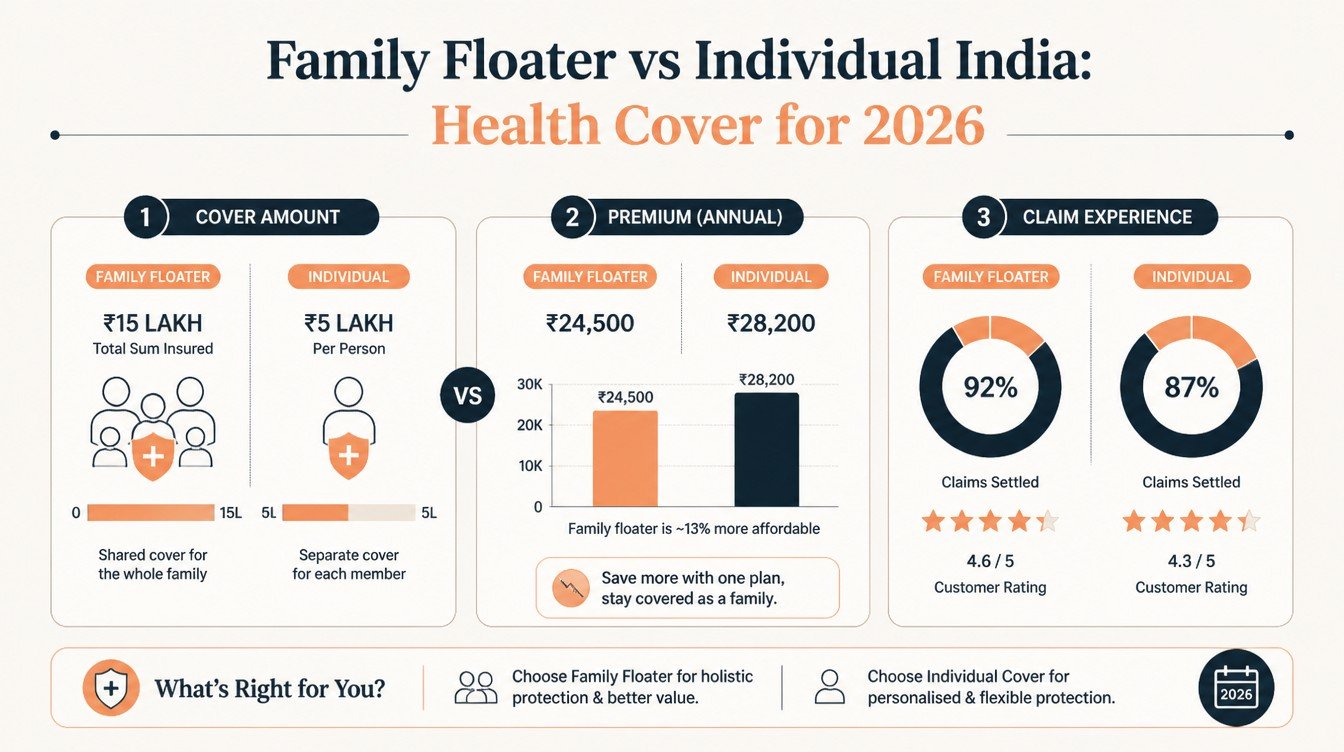
A family floater policy provides a single sum insured (say Rs.10,00,000, or 10 lakh) that any covered family member can claim against during the policy year. If one member hospitalises and claims Rs.6,00,000 (6 lakh), the remaining family members share the balance Rs.4,00,000 for the rest of the year. The sum insured is reinstated on renewal, subject to claim history.
Individual policy: one cover per person
An individual policy provides a sum insured for one named insured person. A family of four buying four individual policies has four separate sum insureds, each available exclusively for that named person. Claims by one member do not deplete the cover available to others.
Coverage scope and standardisation
Both structures cover the same broad categories of hospitalisation, day care, pre- and post-hospitalisation expenses, and AYUSH (subject to specific policy wording), and both fall under the same IRDAI-defined PED look-back and waiting-period framework. The differences are not in what is covered; they are in how the cover is shared.
Common Indian family compositions
The four most common family compositions in Indian floater discussions are listed below, each of which receives a different structural recommendation later in this guide.
- A young couple with no children.
- A couple with one or two young children.
- A young couple with senior parents living with them.
- A multi-generation joint family with three or more adults plus children.
The Cost Comparison at Different Family Compositions
The single most useful exhibit for this decision is the indicative premium comparison at different family compositions. Actual quotes vary by insurer, city tier, sum insured, and individual medical history; the table below illustrates the broad pattern.
The structural cost pattern
| Family composition | Family floater (Rs.10 lakh sum insured) | Equivalent individual policies (Rs.10 lakh each) | Practical comment |
|---|---|---|---|
| Couple, both age 30 | Lowest premium of the three structures shown | About 1.5 to 2x the floater premium | Floater is the structurally most efficient choice |
| Couple age 30 + 2 children | Modest premium increase over the couple-only floater | About 1.8 to 2.5x the floater premium | Floater is still efficient; child add-on is cheap |
| Couple age 40 + parents age 65 | Higher per-family premium due to senior age in the floater | Often comparable when senior parent has individual policy | Hybrid structure usually best; see later section |
| Multi-generation joint family with multiple adults | Premium climbs with the oldest covered member | Individual policies for seniors plus floater for younger adults | Hybrid structure dominates |
The age-of-oldest-member rule
The structural rule that drives most family-floater premium math is that the premium is loaded against the age of the oldest member covered under the floater. A floater that includes a 65-year-old senior parent costs materially more than a floater that includes only the 35-year-old couple and 5-year-old child, even if the sum insured is the same. The age premium for seniors does not get diluted by the younger members on the policy.
The child-add-on benefit
Children under 18 are typically the lowest-risk segment for health insurance pricing in India. Adding a child to a parent’s floater adds only a small premium loading, which is the structural argument for keeping children on the same floater as the parents through their school and college years.
The senior-parent question
The single biggest decision in family-floater pricing is whether to include senior parents in the same policy as the working couple. The premium impact of adding a 65+ parent to the floater can be substantial. Many advisers recommend separating the senior parent into an individual policy or a senior-focused dedicated product, with the working couple and children on a younger-age floater.

The Claim-Sharing Risk in Family Floaters
The single largest structural risk of a family floater is the shared sum insured: a large claim by one member reduces what remains for the others.
The single large hospitalisation scenario
Consider a family floater of Rs.10,00,000 sum insured covering a couple and two children. The husband suffers a serious cardiac event mid-year, with hospital bills of Rs.7,50,000. The remaining family has Rs.2,50,000 of cover for the rest of the year. If the wife or a child also faces a hospitalisation event in the same year, the cover may run out. The same family with individual policies of Rs.5,00,000 each (similar total premium budget, depending on ages) would have four separate Rs.5,00,000 sleeves, none of which is depleted by the husband’s claim.
The Indian context for multi-member events
Multi-member hospitalisation in a single policy year is not the most common outcome, but it is not rare either. Viral outbreaks (dengue, COVID, influenza), shared accidents (vehicle, fire), and family-level surgery clusters (planned cataracts for multiple seniors in a year) can produce simultaneous claims that strain the shared pool.
The mitigation: higher sum insured
The cleanest mitigation within the floater structure is to buy a higher sum insured (Rs.15,00,000 or Rs.20,00,000 instead of Rs.5,00,000 or Rs.10,00,000). The marginal premium for moving from Rs.10,00,000 to Rs.20,00,000 of sum insured on a floater is often less than doubling, because insurers price additional sum insured at lower marginal rates. The higher sum insured provides resilience against multi-member events.
The reinstatement benefit
Some floater policies offer an automatic “reinstatement” or “restore” benefit: if the sum insured is exhausted during the policy year for one claim, it is partially or fully restored for unrelated subsequent claims. The reinstatement benefit varies by insurer and policy and is worth specifically checking when comparing floater products. Restore benefits do not solve the shared-pool risk fully but materially soften it.
When Individual Policies Are the Better Choice
Individual policies for each family member are often the better structure for specific family situations.
Family with members in materially different age brackets
When the family has a spread of ages (couple, children, parents), pooling everyone into a single floater means the family pays the senior age premium on the entire cover. Splitting the seniors into their own individual policies and keeping the younger members on a separate floater often reduces the total premium and reduces the claim-sharing risk simultaneously.
Family with a member having significant PED
A family member with a significant pre-existing condition (diabetes with complications, heart disease, cancer in remission) often produces a higher loading on the family floater because the insurer prices the floater against that member’s risk. An individual policy for that member, separately underwritten, allows the rest of the family to be on a standard floater without the loading.
Family with high income variability across members
Households where different members earn independently and may benefit from health-insurance-as-tax-deduction under Section 80D (in the old regime) can sometimes optimise by having each earning adult hold their own individual policy. The Section 80D deduction is per-policy-holder and per-insured, subject to caps that vary by age. The tax optimisation is small but real for some households.
Family with members in different cities
If members of the same family live and work in different cities (parents in one city, working children in another), individual policies for each member often produce better outcomes than a single floater. Network hospitals, cashless desks, and city-specific service levels become easier to evaluate per-member rather than across a shared cover.

The Hybrid Strategy: Floater Plus Super Top-Up
For many Indian joint families, the most efficient structure is neither a pure floater nor pure individual policies but a hybrid: a moderate-sized family floater for routine claims, plus a separate super top-up policy that provides high-sum-insured cover above a defined deductible.
How super top-up works
A super top-up policy provides cover above a deductible threshold (the “aggregate deductible” calculated across the policy year). If the deductible is Rs.5,00,000 and the family’s aggregate hospitalisation expenses in a policy year exceed Rs.5,00,000, the super top-up kicks in for the excess up to its own sum insured. The premium for a super top-up is materially lower than the equivalent base policy because the insurer only pays out on large-claim years.
The combined structure
A common combined structure for a young family with senior parents is: a Rs.10,00,000 family floater for the working couple and children, individual senior-citizen policies of Rs.5,00,000 each for the parents, and a Rs.50,00,000 (50 lakh) super top-up on the family floater with a Rs.10,00,000 deductible. The structure provides routine claim coverage for everyday hospitalisations and very high-sum-insured cover for catastrophic events, at a total premium that is often comparable to or lower than a pure-floater approach at Rs.20,00,000.
The deductible-sizing question
The super top-up deductible should typically be set at or near the sum insured of the base policy. A Rs.10,00,000 base floater plus a Rs.50,00,000 top-up with Rs.10,00,000 deductible has no coverage gap (the base policy covers up to Rs.10,00,000; the top-up starts at Rs.10,00,000). A larger gap between the base sum insured and the top-up deductible creates an exposure that the household has to fund out of savings.
The “aggregate” vs “per-event” deductible
Super top-up policies in India typically use an aggregate deductible (the deductible applies across all hospitalisations in the policy year combined), not a per-event deductible. This is an important consumer-friendly distinction: an aggregate deductible is much more likely to be crossed in a high-claim year. Always check the deductible type in the policy document.
Decision Framework by Family Composition
The structural recommendations vary by the four common compositions discussed earlier.
Young couple, no children
A single family floater of Rs.10,00,000 to Rs.20,00,000 for both spouses is usually the most efficient structure. The cost per member is low because both are young, and the shared pool produces meaningful diversification of risk. A super top-up of Rs.50,00,000 with a Rs.10,00,000 deductible adds catastrophic-event cover at a modest incremental premium.
Young couple with children
The same family floater plus super top-up works well, with the children added to the floater at low marginal cost. The sum insured may need to be sized larger (Rs.15,00,000 to Rs.25,00,000) to absorb pediatric ICU costs in the rare adverse event. The super top-up remains a high-leverage addition.
Couple with senior parents
The hybrid structure dominates here. Separate individual or senior-focused policies for the parents (Rs.5,00,000 to Rs.10,00,000 each), a Rs.10,00,000 family floater for the couple and any children, and a Rs.50,00,000 super top-up on the floater. The structure quarantines the senior-age premium from the working-couple premium and protects everyone against catastrophic events.
Multi-generation joint family
For households with three or more adults plus children, the cleanest structure is individual policies for each senior (60+), a separate family floater for the younger working adults and their children, and a single household-level super top-up on the floater. The administrative overhead is modest compared to the premium efficiency gained.
Switching Structures and the Portability Question
Many families start with one structure and want to switch to another after a few years. The portability framework allows this without losing the time already served.
Splitting a floater into individuals
An existing family floater can be split into individual policies at renewal through the portability process. Each newly created individual policy gets the carried-forward waiting periods served on the original floater for the named insured. The cleanest path is to engage the existing insurer or a broker who supports portability across insurers, with at least 30 to 45 days of lead time before the renewal date.
Adding a super top-up later
A super top-up does not require porting from the base policy; it is a separate policy purchased independently. Many households add a super top-up after a few years of the base policy, particularly when the base sum insured starts to feel inadequate against rising medical inflation. The super top-up has its own waiting periods, which start from its issuance date, not from the base policy’s issuance.
The medical inflation factor
Medical inflation in India has consistently outpaced headline CPI per IRDAI and Ministry of Health communications. A sum insured that is adequate today is likely to feel inadequate in 5 to 10 years. The structural mitigation is to review the household’s total sum insured every renewal cycle and increase it (through portability with higher sum insured, additional policies, or a higher super top-up) as needed.
The annual review
Each renewal is the moment to evaluate the current structure against the family’s needs. Ageing of parents into senior brackets, marriage of children, separation of households, and changes in medical history all argue for a periodic re-design of the health-insurance structure. Auto-renewing the same policy without review is the path of least resistance and usually not the path of best outcomes.
FAQ
If I already have a family floater, when should I switch to individual policies?
The most common trigger is a meaningful change in family composition or risk profile: a member crossing into a senior age bracket, a new diagnosis of a significant condition, or a member moving to a different city. Switching at renewal through portability preserves the waiting periods already served. For most families, a hybrid (split out the seniors into individual policies, keep the younger members on a floater) is structurally better than a full conversion to individual policies.
Is a super top-up cheaper than increasing my base sum insured?
Usually yes. Increasing the base policy’s sum insured from Rs.10,00,000 to Rs.30,00,000 typically increases the premium by more than buying a Rs.20,00,000 super top-up with a Rs.10,00,000 deductible would. The insurer’s expected payout under a super top-up is much lower because of the deductible, which is reflected in the lower premium. The trade-off is that the super top-up’s deductible has to be crossed for any payout.
Can I have a family floater and separate individual policies for the same person at the same time?
Yes. A person can be covered under multiple health-insurance policies simultaneously. Claims are processed under “contribution clauses” defined in the policies; typically the policyholder can choose which policy to claim from, or the claim is split proportionately between policies. The cumulative cover is the sum across policies. Multiple covers can be useful for redundancy and for splitting risk across insurers.
Does adding parents to the family floater always cost the same as a separate parent policy?
Rarely. The family-floater premium typically prices the entire pool against the age of the oldest member, which means adding a senior parent loads the premium on everyone in the floater. A separate individual or senior-focused policy for the parents prices each member independently and often produces a lower combined household premium. The exact economics vary by insurer, so always get specific quotes for both structures before deciding.
What is the most common mistake families make in this decision?
The most common mistake is keeping a single family floater across all members and ages without re-evaluating it as the family composition changes. A floater that made sense for a young couple becomes inefficient when senior parents are added, then inefficient again when children grow into adults with their own incomes. The renewal-time review against the current family composition is the simplest preventive measure.
Related guides on this topic are coming to learnfinedge.com soon.